The summer of 1982 was the first season my movie habit really took off. It was the first time I had money and mobility enough to go to the theater on a regular basis and I abused it like you wouldn't believe. I was still too young to get into R-rated movies, but that didn't stop me. I was adept at sneaking into these by paying for PG movies and sneaking into the others. It was also really the first year that genre pictures--particularly fantasies--began to dominate the market. What a summer that was! You had Poltergeist, E. T., Star Trek II: The Wrath of Khan, Blade Runner, The Thing, Cat People, The Dark Crystal, The Beastmaster, Friday the 13th Part III in 3-D, Quest for Fire, The Secret of N.I.H.M., and Tron. Some of these remain favorites. The movie I remember looking forward to the most in the spring of 1982 was Conan the Barbarian (directed by John Milius). It was rated R, too, but I didn't have to sneak into it. My dad took my brothers and I to a Saturday evening showing. It was a "dad" kind of movie.
Wednesday, September 28, 2011
Tuesday, September 27, 2011
The October Challenge is Nigh!

The Seventh Annual October Horror Movie Challenge begins next week. This year, I'll be doing something a bit differently. I'm going to run it like a blogathon. So, in addition to making (theoretically) daily posts about my own horror movie viewings, I'll be posting links to other bloggers who have taken up the challenge. If you want to participate, let me know in the comments or email me at archaeopteryx_wtw at yahoo dot com and I'll add you to my spreadsheet and RSS reader.
Some history: The October Challenge started on the IMDB's horror message board. The rules are simple: Watch 31 horror movies over the 31 days of October. At least 16 of these movies must be movies you've never seen before. You are, of course welcome to watch as many horror movies as you like beyond the basics, so don't let me stop you. Within the basic challenge, many participants undertake additional challenges. For instance: last year, I challenged myself to watch 31 movies that I hadn't seen before allowing myself to watch any old favorites. Some other suggestions: 31 Asian horror movies, 31 horror movie sequels, 31 European horror movies, 31 horror movies from a specific decade, etc. These obviously require some planning and certainly added spice. You can watch them all in any configuration you like. All in one go or rationed out over the month. The only thing that matters at the end is the final number, not how you got there.
Finally: last year, I undertook the October Challenge for charity. Last year, my charity was the National MS Society. I pledged fifty cents for every movie I watched and at the end of the challenge cut them a check for $20. This year, I plan to do the same and invite others to pledge against my viewings as well (or to pledge against their own viewings). I also pledged some amount on my friend, Aaron Christensen's challenge. Aaron was my editor for Horror 101 and he is an all-around fantastic guy. His charity last year was an AIDS charity in Chicago. This year, he's supporting AmeriCares disaster relief. He has the same deal. Pledge x-amount per movie--last year he only asked for a dime or a quarter--and settle up in November. He raised over a thousand bucks last year.
Finally, here are some banners you can use (Herbert West is new for 2011):


Posted by
Vulnavia Morbius
at
8:56 AM
7
comments
Labels: blogathons, October Challenge, October Challenge 2011
Monday, September 26, 2011
The Root of All Evil
Before last Thursday evening, I had never seen a movie from the Congo. Oh, I had seen movies that were set there--When We Were Kings is a good example--but never a feature film produced and financed by the Congolese. There's a good reason for this, actually. There hasn't been a feature film from the Congo in a quarter of a century. Viva Riva! (2010, directed by Djo Munga) breaks this silence, while demonstrating the structural barriers to a national Conglolese cinema at the same time. It's also a brutal exploitation thriller. If you're going to found a national cinema, there are worse ways to go about it.
Posted by
Vulnavia Morbius
at
6:00 AM
0
comments
Labels: 2011, film noir, Viva Riva, World Cinema
Saturday, September 24, 2011
Flashion Statements
This is my entry into the Fashion in Film blogathon over at The Hollywood Revue. This is actually something I wrote quite some time ago, reworked a bit for the blogathon. Enjoy.
My long-suffering girlfriend is convinced that I’ve lost my mind. First, there was the Robby the Robot incident, in which I hurried her to the computer to show her a web site (http://www.the-robotman.com/) that sells seven foot-tall FUNCTIONING replicas of Robby and implored her to consider getting me one next Christmas (in truth, I would prefer to have either Gort from The Day the Earth Stood Still or Maria from Metropolis, but this guy doesn’t sell those.
Then there was the Elvis lunacy. I was watching the end of a movie on the Fox Movie Channel (which mysteriously became available to us recently in spite of us making no effort to acquire the channel through our cable company). The movie was Battle for the Planet of the Apes, a palpably awful movie for which I never the less have a great deal of affection. Immediately following the final roll of the credits, this....advertisement...for something called “King-tinued” comes on, featuring a credible Elvis impersonator draped in an American flag singing Eric Clapton’s Tears in Heaven. “Today’s hits, sung Elvis-style!” the announcer blared, and sure enough, some the worst pap of AOR pop music, including BOTH versions of Elton John’s “Candle in the Wind,” “The Wind Beneath My Wings,” the aforementioned “Tears in Heaven,” et al. scrolled up the screen. But WAIT! There’s MORE! You ALSO get “King-Country!” As if the other disc WASN’T enough, you can ALSO hear the King singing the latest country hits (and some not so latest ones, like “The Gambler”). What music collection is complete without The King of Rock and Roll doing HIS take on Lee Greenwood’s “God Bless the USA?” After my brain recovered from this, I was gripped by a divine madness: I WANTED this disc. Bad. It would go into my music collection alongside “The Ethel Merman Disco Album.“
My girlfriend wouldn’t permit it, bless her heart. That mania passed eventually, but sometimes, I still feel it seething just under my conscious thoughts.
Which brings me to the last bit of mania: There is no earthly reason I should derive as much enjoyment out of Mike Hodges’s update of Flash Gordon as I do, but I’ll be damned if I didn’t grin all the way through it the last time I saw it. The film is a travesty: it has a thinly disguised contempt for its source material and the audience for the source material, much as the Batman TV show had contempt for its source--interesting that both flow from the pen of one Lorenzo Semple, eh? It has a producer in Dino De Laurentiis who seems intent on duplicating his early Barbarella with the primary source instead of at second hand. And it has a lead couple in Sam Jones and Melody Anderson who deliver two of the worst performances in big budget film (and that’s saying something). The sneering attitude the film takes to sex and innuendo seems drawn more from Flesh Gordon than the comics or old movie serials
But....man, the production design of this film is really cool: a loving recreation of the day-glo look of the comics combined with William Cameron-Menzies-style grandiosity. The skies of Mongo, a multi-colored profusion of elaborate cloud-tank special effects are like no other science-fiction setting in film. The costumes are agreeably ornate and unbelievably tacky as only disco-era costumes can be. Max Von Sydow has taken a lot of heat for the roles he was taking during this period (many for De Laurentiis), but I can’t imagine a better actor as Ming the Merciless. You can see a barely controlled glee beneath the surface of his performance. Bergman never permitted him anything this broadly outlandish. The Queen soundtrack has kept this movie in the circle of "cult" movies for quite some time now.
I could just leave the justifications at that, but that doesn’t really explain the mania that gripped me during this film. The elements that really seal the deal are of a more personal nature.
When I first saw this film in 1980, the adolescent me developed an unhealthy obsession with Ornela Muti as Princess Aura. This wasn’t an innocent adolescent crush, but a full blown fetish. Her Princess Aura--a better predatory sex kitten pulp sci-fi has never seen--featured prominently in many a nocturnal fantasy. It was never Muti herself, mind you. I’ve seen her in a number of other films and her presence in these never really fired such a glandular reaction. It was Muti as Aura, the nymphomaniac daughter of Ming the Merciless, a character who promises unspeakable pleasures and torments....The only thing in movies, for me anyway, that rivals Princess Aura is Jane Greer in the first scenes of Out of the Past.
The other personal appeal is also probably fetishistic. The drag queen in me has been fixated for a long time on the gown Dale Arden wears for her wedding to Ming in this film. As I said, all of the costumes are ornate and unbelievably tacky, whether it's Princess Aura's skin-tight spandex or General Kala's dominatrix drag by way of Christopher Strong. And so it is for this gown, a creation in beaded black scales that flow like liquid over the curves of Melody Anderson’s body, with threatening winged epaulets and matching headdress. I mean, just LOOK at this thing:

This sucker is the soul of a drag gown. Truth to tell, like Robby the Robot and “King-tinued,” I want one. Bad.
And so I watched Flash Gordon unfold with mounting anticipation, occasionally diverted by the performances (Brian Blessed’s performance as Prince Vultan is particularly ripe), until the segments with Princess Aura would have my unwavering attention and until the film culminates with that glorious gown. Somehow, I doubt that this is a healthy approach to movies...
Posted by
Vulnavia Morbius
at
9:44 AM
4
comments
Labels: blogathons, Flash Gordon
Wednesday, September 21, 2011
Heart of Cinema
This is part of the Guy Maddin blogathon over at Fandor's Keyframe blog. Thanks to Kevin Lee for inviting me to participate.

Back when I was in the video business, we got a steady stream of requests for Guy Maddin movies. I think we eventually got Tales of the Gimli Hospital and The Twilight of the Ice Nymphs before we closed up shop. There was a constant and surprising demand for these movies, given that this was the pre-Internet era and given that we were not doing business in a major city. I have to admit that I didn't "get" either of those movies when I initially saw them. Which is to say, I understood what Maddin was up to, but they seemed like intellectual exercises to me. They didn't grab me by the short hairs and drag me into their delirium. I didn't come around to Maddin until sometime later.
"The Heart of the World," Maddin's 2000 short film for the Toronto Film Festival, turned out to be the Rosetta stone for me regarding Maddin's aesthetic.
"The Heart of the World," like most of Maddin's films, looks back at disused cinematic traditions that the director rescues from the dustbin of history. It's mainly inspired by Russian silent films, with an emphasis on rapid montage. It's what you might get if Eisenstein had got it on with Vertov and been unleashed on the scene dock at UFA. A staccato score that emphasizes its forward motion accompanies the rapid flow of images. The score sends an affectionate elbow into the ribs of contemporary scores for silent movies.
Posted by
Vulnavia Morbius
at
7:42 AM
0
comments
Labels: blogathons, The Heart of the World
Monday, September 19, 2011
Magic and Loss
Lee Chang-dong's new film, Poetry (2010), is the kind of film I would have squirmed my way through had I been forced to watch it when I was younger. It's a slow film, filled with quotidian details that summarize the life of a 66 year old woman in the early stages of Alzheimer's disease. Its main plotline, summarized in its title, follows her changing perceptions once she starts taking a class in writing poetry at her local community center. The movie is a good deal darker than that might suggest, because in learning to see with language--particularly with language that she's losing--she begins to see some very dark things around her. I'll come back to that in a bit, though. First, I need to point out that my younger self was an idiot. She wouldn't have responded to the gentle, but implacable insistence of this movie because she was impatient. She wanted things to happen in a hurry. It would have been her loss. As with the protagonist of Poetry, spending a lifetime with movies eventually does teach one to see, if you're up to it.
Posted by
Vulnavia Morbius
at
10:10 AM
2
comments
Labels: 2011, Korean Cinema, Poetry
Saturday, September 17, 2011
Bad Netflix Tonight!

Tonight is another round of Bad Netflix. Follow me on Twitter, or follow the hashtag #badnetflix. This round is being wrangled by Guts and Grog Reviews. Tonight's crimes against humanity include Asylum's Sherlock Holmes rip-off, a mathom from the late eighties called "Ninja Vengeance," and a recent offering called Dance of the Dead. Join in and follow along, if you like! We'll be starting at 8:30e/7:30c/6:30m/5:30p
Posted by
Vulnavia Morbius
at
2:54 PM
0
comments
Labels: Bad Netflix, blogathons
Wednesday, September 14, 2011
Once Too Often to the Weller
This is my entry into the Juxtaposition Blogathon. The folks over at Pussy Goes Grrr are running this show. It's their first blogathon.
I got it into my head this week to watch RoboCop 3 (1993, directed by Fred Dekker), a film I barely remember seeing when it first came out. To say that it was a troubled production is putting it mildly. Peter Weller, iconic as the title character, refused to reprise the role. Nancy Allen only agreed to do it if her character were killed off. And to top it all off, Orion Pictures went bankrupt at the time of its production, causing it to sit on a shelf for two years. The movie isn't well liked by audiences, either, perhaps because of the casting, but also, perhaps, because it tones down the violence of the previous entries to gain that PG-13 rating that many genre fans hate. The film currently rates a 3.5 out of ten among the users of the IMDB. I feel kind of bad for Fred Dekker, a director I'm fond of. A lot of this was out of his control.
But the film itself? Y'know, it's not bad. It's like reading one of screenwriter Frank Miller's comics from the same period. Certainly, the film reflects Miller's preoccupation with all things Japanese, while indulging in the dystopia of The Dark Knight Returns and Give Me Liberty. It even has a character named Bertha Washington (very close to Give Me Liberty's Martha Washington). And for all the changes that occurred during its production, it feels like a RoboCop movie. The importance of Phil Tippett, Rob Bottin, and Basil Poledouris to the feel of these films shouldn't be understated, and all three of them return for this installment. Hell, Poledouris's score for RoboCop is almost as iconic as his score for Conan. Also, the movie retains the comedy value of the ED-209 robots, which I love.
Posted by
Vulnavia Morbius
at
7:11 AM
4
comments
Labels: blogathons, Leviathan, RoboCop 3
Wednesday, September 07, 2011
Time Out of Mind
I started reading science fiction just as the New Wave of the sixties and seventies was beginning to ebb and just before the cyberpunks showed up to trash the joint. The hot name in the genre at the time was John Varley, who was being hailed as the second coming of Robert Heinlein. It's easy to see why. Varley wrote a so-called future history, in which many of his short stories were interrelated, and he had a similar penchant for alternate sexual configurations (particularly the routine availability of sex changes). He had Heinlein's gift for extrapolating minutiae, too. And then something curious happened to him. Hollywood came a-calling and it broke him.
Varley's short story, "Air Raid," is a clever piece of time travel fiction, in which a future society of time travelers plucks the victims of airplane crashes out of their planes right before they crash in order to repopulate the world. The world of the time travelers is pretty dire, so polluted that every member of the dwindling human race is a mass of cancers and deformities. The snatch teams are the least mutated and they get the best medical care. Unfortunately for time travelers, if you're not careful with your gear, you can cause paradoxes. It's a nimble short story. It was optioned for films almost immediately. According to the author, this is what happened next:
Posted by
Vulnavia Morbius
at
6:43 AM
2
comments
Labels: Millennium (1989), Science Fiction
Tuesday, September 06, 2011
What Rough Beast?
The darkness drops again but now I know
That twenty centuries of stony sleep
Were vexed to nightmare by a rocking cradle,
And what rough beast, its hour come round at last,
Slouches towards Bethlehem to be born?
--William Butler Yeats, The Second Coming (1919)
I think John Carpenter may have been broken on the wheel during his sojourn through studio filmmaking. Certainly, he was never the same filmmaker after the major studios spit him out at the end of the 1980s. Too much of a maverick, I presume. He couldn't help but chafe at the bit. And it's a shame, too, because early Carpenter was one of the most exciting filmmakers of the 1970s. In any event, after about 1986, Carpenter ceased being an interesting filmmaker. But the decline was slow.
I thought about all of this as I watched Prince of Darkness (1987) the director's first indie film following the financial debacle of Big Trouble in Little China. It's a strange film. On the face of it, it's not really very good. It cobbles together a bunch of sci fi horror ideas that are each suggestive in themselves, then resolutely fails to examine them. Instead, the film devolves into another variation on Night of the Living Dead, by way of Carpenter's own Assault on Precinct 13. It's an exercise in confinement and zombies. Most great films that utilize the ideas of confinement use their settings as a microcosm that lays bare the characters trapped within it. Prince of Darkness barely registers as having characters at all. It has types to feed to the meat grinder.
Posted by
Vulnavia Morbius
at
6:15 AM
4
comments
Labels: John Carpenter, Prince of Darkness
Saturday, September 03, 2011
Learning Experiences
Well, my fundraiser ended yesterday. The good news? I raised $105. That's fabulous given the circumstances. The bad news? It's not enough by a long shot. So I'm calling it. No Fantastic Fest for Krell Labs this year. I've learned a few things from the experience, though.
First and foremost: timing is everything. The next time I run a fundraiser, I need to plan it for a time period when I don't have multiple deadlines looming for various freelance jobs. I should also avoid scheduling it for periods when I'm sick, but there's no avoiding that. I haven't been able to promote it the way I would have liked. But there's no guarantee that I would have promoted it anyway because...
Second: fund raising is not for the shy. I'm a lousy self-promoter because, well, I'm pretty shy. I don't want to be intrusive. I don't really want to bother people, and, frankly, that's poison for this kind of enterprise. I needed to be hitting this a couple of times a day every day.
Third: I need to use social media better. At least one of my real world friends told me last night that he had no idea that I was running a fundraiser, even though he'd seen me posting the sketch cards as I finished them on my Facebook account. On the other hand, Facebook doesn't allow me to post 70 point headlines, so be that as it may...
So here's what's going to happen. The folks who donated below the threshold to get a sketch or DVD-R are going to get a refund. I don't feel comfortable taking it if I'm not using it. Everyone else will get their sketch 0r DVD as promised.
The long term fallout of this project is a little bit less grim. First, I've actually managed to sell art over the internet. This is something I've never done before, and it suggests to me that I might be able to make a business of it. I'll probably be opening an Etsy shop in the very near future. More than that, though, people have wanted my art. As someone who has suffered from crippling self-doubt about my art, this is enormously gratifying. Thank you to everyone who asked for a sketch. It means so much.
With all that out of the way, the next installment of Bad Netflix is coming up in a couple of weeks. If you want to join in the fun, it'll take place on September 17. Guts and Grog Reviews has the details. I'll also be participating in the Juxtaposition Blogathon being run by Pussy Goes Grrr, and the Fashion in Film Blogathon being run by Hollywood Revue.
Posted by
Vulnavia Morbius
at
9:57 AM
5
comments
Labels: blogathons, fundraisers
Monday, August 29, 2011
A Night in Byzantium
Given that he made one of the great "heist" movies in Rififi, I wonder what went through director Jules Dassin's mind when he revisited the heist film in Topkapi (1964). In Rififi, the heist comes in the middle of the movie and takes up nearly a third of the running time, but in the end, the heist isn't really what the movie's about. It's a noir film to the core. Topkapi is an entirely different kettle of fish. This is the heist film as "caper," and it's mostly a confection without any noir shadows cast through the film. It's intended as fun, and for the most part, it is. Dassin moves the heist to the end as the film's climax, and it's an altogether more ambitious and complex sequence than the one in Rififi. In its way, it's just as influential.
Posted by
Vulnavia Morbius
at
6:42 AM
6
comments
Labels: classic film, Jules Dassin, Topkapi
Friday, August 26, 2011
Fundraiser Update and Cultural Snapshot
So I've covered my airfare. Rock and roll! I still need to cover the festival pass, with a little over a week to go. I'm totally in love with the things my backers are asking me to draw, and I'm caught up on the sketch cards. The first batch go into the mail tomorrow. Sadly, these two go to different people. They seem like they should be a matched set:


Anyway, there's still time to get a bid in on a sketch or a DVD-R, and here's the button again:
I've been following the various internet kerfuffles over DC Comics and their "relaunch" next month. I have a lot of conflicting opinions on the relaunch, but I'm totally sympatico with the notion that DC has a diversity problem.
Posted by
Vulnavia Morbius
at
7:09 AM
6
comments
Labels: art, comics, fundraisers, Shameless Self-Promotion, Spider-Man, Wonder Woman
Monday, August 22, 2011
Sword in Hand, Brain in Neutral
There's no getting around it. We're living in the dark ages of theatrical exhibition. The last two big films I saw in the multiplexes were Harry Potter and the Deathly Hallows Part II and Captain America. In both cases, the films were projected on the same equipment used for their 3-D showings and in both cases, the film was too dark to enjoy. It was like watching them through a welding glass. In a perfect world, there would be a blog post for each of these films, but I don't think I can give either of them a fair shake based on how I saw them. "But why didn't you just go see them in 3-D?" I can hear someone asking. Because 3-D gives me a headache and I don't like paying the upcharge. So congratulations, Hollywood, you've finally found a way to drive me from the theater. In another era, you would have had my money twice over this past weekend, because I certainly would have gone to see the new Fright Night and the new Conan the Barbarian. Because I couldn't find a reliable 2-D showing of either film, I stayed home. I soothed the hurt by watching the original Conan the Barbarian's idiot sequel, Conan the Destroyer (1984, directed by Richard Fleischer), a film I originally saw at a drive-in in South Dakota on a triple bill with Red Sonja and Iceman and never saw again. It turns out, that that wasn't an optimal way to see this film, either, and, indeed, it turns out that I didn't give it a fair shake all those years ago.
Posted by
Vulnavia Morbius
at
7:00 AM
6
comments
Labels: 3-D, Conan the Destroyer, fundraisers
Sunday, August 21, 2011
Assassination Games
I don't know what I expected when I sat down to watch Takashi Miike's well-regarded 13 Assassins (2010). The second coming of Akira Kurosawa, maybe? That's what the reviews have suggested. Serves me right for reading them. What I got, instead, was a Miike movie, of course. Truth to tell, I'm not even sure how I want to write about it. Please bear with me as I stumble around the movie.
Posted by
Vulnavia Morbius
at
4:11 PM
1 comments
Labels: 13 Assassins, 2011, fundraisers, Japanese Cinema
Saturday, August 20, 2011
Send Krell Laboratories to Fantastic Fest!
A friend of mine has invited me to Fantastic Fest in Austin Texas next month, and I'd love to go and blog the festival. Unfortunately, I'm as much a victim of the current economy as anyone and I don't currently have the money for it. I have a place to stay lined up for the festival, but airfare, food, and (most importantly) tickets are all costs I'm short. So I'm staging a fundraiser. That's where you come in. I'm soliciting donations. In return, I'm planning to blog about the entire festival, so you'll be supporting new content. But if that's not enough of an incentive, there's more. For anyone who supports this fundraiser with a $15 donation, I will send that person a sketch card of anything they want. It can be a movie star, a comic book character, a D&D character, whatever their heart's desire. Sketch cards will be on 3x5 pieces of bristol board, in ink, along the lines of this drawing I did of Claudia Cardinale:
Or this one I did of Vincent Price (though the finished card would, of course, be in ink):
I may have to put a cap on these based on how many I end up having to do. I don't want to make anyone wait a long time to get their sketch.
But wait, there's more! Donate $25, and I'll send you a DVD-R of either Orson Welles's rarely seen film, Chimes at Midnight or Ladislaw Starewicz's equally rare animated feature, The Story of the Fox, your choice. Just be aware that these won't be pristine prints by any means, but they'll at least be watchable. There will be 8 of these available. Donate $50, and I'll send you DVD-Rs of both films. There will be 8 of these available, too.
Smaller donations are, of course, welcome, too, and I'll make a point of thanking each and every person who donates on the blog. I figure I'll close out the fundraiser one way or another two weeks from now, on September 3rd.
How to donate: just press this button. Make sure you send me a note with your donation.
And in the immortal words of Bartles and James: "Thank you for your support."
Posted by
Vulnavia Morbius
at
9:56 AM
0
comments
Labels: Fantastic Fest, fundraisers
Wednesday, August 17, 2011
This is how to get me in the theater...
I don't normally post trailers for upcoming movies, particularly since most trailers are crap these days, but I'm making an exception for this trailer for the upcoming The Woman in Black. This is how you do it:
Here's what I'm taking away from this trailer:
First, this is creepy as hell. It takes every creepy image one associates with desolate Gothic ghost stories and dumps it into a richly textured visual pageant.
Second, the makers of the trailer have come up with a rhyme that gives this a kind of fairytale ambiance. By blotting out the diegetic sound from the footage from the film, this amplifies the creepiness of the images.
Third, this doesn't give away the store. What do I take from this regarding the story? That it's a ghost story. The trailer keeps the movie's secrets.
Fourth, Daniel Radcliffe has turned into an absolutely adorable young man, and boy, howdy, does the period costume amplify this. Yum.
Fifth, I'm going to see this in the theater whenever it comes out. This is the aim of a good trailer, and this one succeeds.
I should mention that this is a Hammer movie, the first since their rebirth to go full-on Gothic. That by itself is cause for rejoicing. I'm there.
Posted by
Vulnavia Morbius
at
11:27 AM
3
comments
Labels: The Woman in Black, trailers
Sunday, August 14, 2011
Divine Comedies
Our erstwhile friend, the Self-Styled Siren, has a tag on her blog called "crabby dissent." That phrase really is perfect for how we feel this morning at stately Krell Labs, so I hope she'll forgive me for swiping it. I also hope she'll forgive me for the crime I'm about to commit, because I know that she's a fan of Preston Sturges and, well, I'm kind of not.
My partner has been giving me grief again about the dearth of comedies in our movie collection. This led to a huge to do about the fact that there aren't ANY comedies in our Netflix queue except those she put there herself (and those are movies I tend not to like). I suppose I should own up to something here: Me and comedies don't get along very well. It's not that I don't like comedies. When a comedy is great--your Some Like it Hots, your Gold Rushes, your Girl Shys--then they're ambrosia. Great comedies are one of the true indicators that cinema loves us. Thing is, when comedies are less than great, or worse, when comedies are flat out bad, I get restless in my chair. To me a mediocre comedy ranks below a bad action film and a bad comedy is just about the worst kind of movie imaginable. I mean, if you have a bad horror movie or a bad sci fi movie or a bad melodrama, there might be some laughs. If you have a bad comedy, though, by definition there are no laughs. Not even accidental ones. Kill me now.
So there's a dearth of comedies in my house.
Posted by
Vulnavia Morbius
at
5:00 PM
4
comments
Labels: classic film, comedy, crabby dissent, Libeled Lady, Preston Sturges, Unfaithfully Yours
Friday, August 12, 2011
The Stupidest Comic Book Panel in the History of the Universe.
This piece ran on another blog back in, wow, 2008. It more properly belongs here.
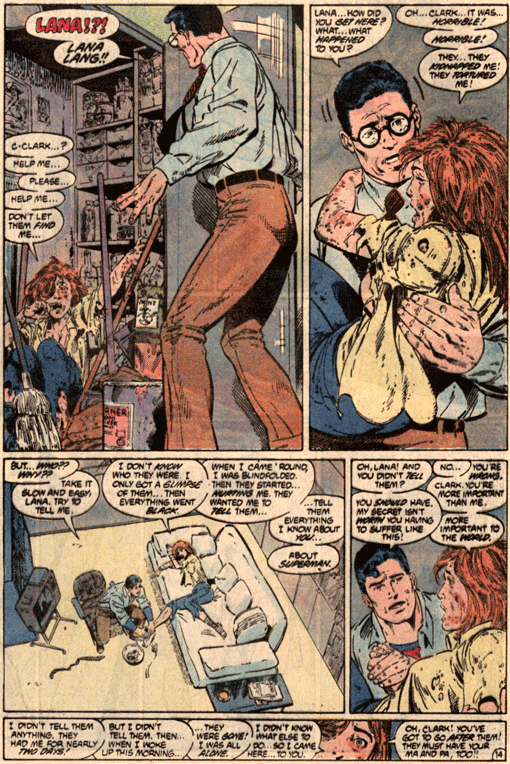
Since my recent jaunt through back issues of the Swamp Thing, the lid of that particular long box of goodness has remained open. This box also has a huge run of Superman comics, mostly (but not exclusively) dating from around the time of the 1987 revamp by John Byrne. I had a wild hair and decided to reread some of those comics this weekend. Some of them aren't bad; Byrne's take on Mr. Mxyzptlk in the eleventh issue is terrific, and there are some nice touches throughout the run. Personally, I liked the book a lot better when Byrne left and Roger Stern started writing it, but Stern has always given great value (he's one of the unsung masters of comics writing). But for all of those pleasures, Byrne still did shit like this page from the second issue:
Never mind the implied violence suffered by Lana Lang at the hands Lex Luthor and his goon squad. There's a debate over misogyny to be had in this issue, but that's not why this page sucks. It's that bottom panel. The long one where you see half of Lana's face and a whole bunch of word balloons? Let's look at this again:
I mean, WTF?
Now, Byrne isn't the only person guilty of stuff like this. There used to be panels like this all over the early issues of Chris Claremont's X-Men, in which Claremont would sometimes completely obscure Dave Cockrum's art. But this is a little bit different, because those X-Men stories were an example of a writer trying to assert his primacy over the artist. THIS on the other hand, is an artist shooting himself in the foot.
It's worth considering that, long before he began making a complete ass of himself on the internet, Byrne was considered to be one of comics' premiere storytellers. Not a great innovator, true, but he knew his way around a comic page. So maybe he couldn't figure out a way to lay this out based on the script he had been handed. Perhaps there were editorial imperatives to consider. Except...well, there are extenuating circumstances here. First, this panel has enough dialogue for an entire page. There's no reason for there NOT to be an additional page. Byrne had the clout at the time to demand (and get) TWO first issues for his revamp, so he surely could have sneaked another page into this sequence with no problems. Second, Byrne wrote this comic himself, in addition to drawing it. At least poor Dave Cockrum was at the mercy of editors and writers. Byrne has no one to blame but himself for this atrocity.
Posted by
Vulnavia Morbius
at
3:37 PM
1 comments
Labels: "Meatloaf again?", comics, John Byrne, stupid storytelling, Superman
Monday, August 08, 2011
Playing the Chump
Movies change over a lifetime. Some change a lot. I revisited Ghidorah: The Three Headed Monster (1964, directed by Ishiro Honda) over the weekend, a film I loved as a kid. The only thing that holds up to adult scrutiny in that movie is the awesome Akira Ifukube score. The rest is a disaster. Watching Mothra, Rodan, and Godzilla have a "conversation" is one of the sillier things I've seen on film recently, while the human story involving repressed memories of a woman maybe descended from Martians is the usual mish mash. I still have some affection for it, but Toho has made better monster-rama team-ups. It's a film I probably won't ever revisit again. That kind of makes me sad. Is the child inside me dead? I hope not, but there are some childish things adults should leave behind, I guess.
Some films change a little, but sometimes that small shift can knock a movie out of the bright circle of fond memory. A case in point is The Sting (1973, directed by George Roy Hill), a film I used to love. It's been, I dunno, a decade since I last saw it. It's a film I originally saw with my mother, and it was a film she loved. It was something we could share, actually, and mom usually had good taste, so it's a memory I treasure. When I sat down with my sweetie to watch it last week, I expected it to be a good experience. I was kind of disappointed. The whole thing fell flat this time out and I'm at a loss as to explain what ineffable quality was missing. It didn't help that my partner didn't like it (this was the first time she had seen it). That was kind of a blow, too. I understand her reaction, because the film didn't work for me this time, either.
The Sting is one of those movies that's trying to put one over on the audience, which is interesting as far as it goes because its structure is like one of those Penn and Teller routines where the magicians dismantle the trick to show you how it works. The audience is privy to the con. The story follows small time con man Johnny Hooker (Robert Redford). Hooker and his partner, Luther (Robert Earl Jones), have run a small grift on a guy who turns out to have been a money courier for big time mobster Doyle Lonnegan (Robert Shaw). Lonnegan brooks no interference with his operation, big or small and he soon dispatches his thugs to knock off Johnny and Luther, though they miss Johnny. Luther, before he dies, puts in a good word for Johnny with long con mastermind Henry Gondorff (Paul Newman), and Johnny convinces Henry to run the long con on Lonnegan as a means of getting his revenge. They set him up with a card game, in which Johnny appears to betray Henry to Lonnegan, then tell him the tale of how he wants to take over Henry's bookmaking establishment with a sure scam that will take it for all its worth. The other two elements of the movie are corrupt cop Snyder (Charles Durning), out for his cut of Johnny's takings, and the FBI, after Henry on a federal warrant. Not everything is as it seems.
The way the movie works is that it tells the audience everything save for one or two small details. Now, if the audience is onto those details, the gig is up and the movie becomes an exercise in makework. It's a house of cards. And this, I propose, is what spoils my fondness for the movie, because once you've seen the whole thing, it holds no surprises. Not cinematic ones anyway. I think the filmmakers know this, because they've built the thing around the charm of Robert Redford (who was probably too old for the role of Johnny Hooker) and Paul Newman, then hedged their bets with a raft of interesting character actors and a sentimental ragtime score. And there are touches that are suggestive of a better film than what one actually gets. I love the idea that Eileen Brennan's character not only runs a house of ill-repute behind a merry-go-round, but that when things get slow for the girls, she fires it up and lets them ride it. That's cool, but it's a fleeting moment. Otherwise, the street scenes all have some weird feeling of being "on set," and visually the whole thing screams "movie." And not in a good way. George Roy Hill is indifferent to any of the possibilities of abstraction offered by the period set and his direction of the film is utilitarian at best.
I suppose this experience could have been worse. I mean, I like The Sting. I still like it, to an extent. But if it was never a favorite before, it will definitely never be a favorite in the future, even if I do choose to watch it again. That's looking pretty dim at this point.
Posted by
Vulnavia Morbius
at
7:32 AM
2
comments
Saturday, August 06, 2011
Regular Joes
I'm not entirely sure why I found myself watching G.I. Joe: The Rise of Cobra (2009, directed by Stephen Sommers) earlier this evening. Pain and drugs, I suppose. A desire for something uncomplicated maybe. I mean, I've shunned much better directors than Sommers for cinematic offenses a LOT less vexing than Van Helsing, after all. For that matter, given the state of the world even here in the (barely) first world, the resources spent on this movie seem kind of, I dunno, obscene. And still, I watched it. All. The. Way. Through.
Posted by
Vulnavia Morbius
at
9:28 PM
5
comments
Labels: G. I. Joe: The Rise of COBRA
Tuesday, August 02, 2011
All for One
There's a moment in Richard Lester's The Four Musketeers (1975) in which Cardinal Richlieu orders his lackey, Rochefort to his knees. In that moment, I realized that Charlton Heston really should have played more villains. Damned, he's good at it. I mean, considering that Rochefort was played by the intimidating Christopher Lee, it's a testament to the star power of Heston that he so dominates the scene (and the film). The Four Musketeers is ruled by its villains. One of its alternate titles is "Milady's Revenge," referring of course to Faye Dunaway's lethal Lady de Winter. The movie is entirely about her machinations. She seeks revenge on D'Artangnan for spurning her attention and foiling her plans. She makes a bargain with Richlieu: she'll prevent the Duke of Buckingham from relieving the Huguenots at the besieged city of La Rochelle if he'll give her carte blanche to dispose of her enemies as she sees fit. Unfortunately for her, one of her past enemies is Athos, who once married Lady de Winter only to discover that she was disgraced. Athos doesn't exactly thirst for revenge, but when the time comes to foil Milady's plans, he takes it.
Posted by
Vulnavia Morbius
at
9:22 AM
4
comments
Labels: The Four Musketeers
Sunday, July 31, 2011
Monster Mash Blogathon: It Came from Outer Space (1953)
I was having a discussion a few weeks ago with a friend of mine about Robert Wise's The Day the Earth Stood Still (1951). For a long time, The Day the Earth Stood Still was the touchstone for "thinking man's" sci-fi, and it's not hard to see why: it's sober, cerebral, and significantly lacking in bug-eyed monsters. Its plea for peace, too, is a refreshing change of pace for Cold War sci fi. But over the last ten years or so, I've kind of fallen out of love with that movie. The political undertones kind of bother me. Klatuu (Michael Rennie) strikes me as a neo-con alien, who is pursuing an intergalactic version of the Bush Doctrine of pre-emptive warfare. He brings "peace" with an ultimatum and a big goddamn stick. If I squint, I see the same kind of xenophobia in this film as I do in other fifties sci fi film, except for the fact that the movie has cast human beings in the role of monster. I'm also uncomfortable with the veiled religious allegory that casts Klatuu as a messianic figure, but that's a whole different kettle of fish.
I find that I much prefer Jack Arnold's It Came from Outer Space (1953) as a paragon of "thinking" 50s sci fi.
Posted by
Vulnavia Morbius
at
5:44 AM
19
comments
Labels: blogathons, classic film, It Came from Outer Space, Sci Fi Sundays, Science Fiction
Friday, July 29, 2011
Netflix Roulette: Night of the Comet (1984)
I'm not ashamed to admit that when I saw the movie the roulette wheel spun up for me this week, I couldn't resist smiling. Thom Eberhardt's ebullient Night of the Comet (1984) is a film I remember fondly. I remember seeing it when it was in theaters in a crackerbox twin theater in a town in podunk, Missouri, back when independent movies were still likely to be interesting genre efforts like The Terminator or The Hidden or crap product from Cannon Films like Tomboy and Avenging Angel. That's all gone now, and movies like Night of the Comet don't show up at the multiplexes anymore. Or if they do, they show up as bloated remakes. Blech.
Night of the Comet is the living end of the "last man on earth" subgenre, what you might get if I Am Legend were filtered through a John Hughes movie. Instead of hardboiled survivor types getting on with the business of, well, surviving, the heroines of this movie are a couple of self-reliant teenage girls whose first instinct upon arriving at the end of the world is to go shopping at the mall. Their main story conflict isn't survival, but who gets to "make it" with the last guy on earth. It's not a film that takes its subgenre seriously, though it never really mocks the subgenre, either. It's a lot more fun than many another more stomach-churning zombie film.
At the very least, it's a time capsule, an effect heightened by the film's long absence from home video during the 1990s and early 2000s. The cultural signifiers of the Reagan era are all in the foreground, from the big hair and shoulder-padded fashions to the hints of illegal wars in Central America to the conspicuous consumption to the empty synth pop of the post-New Wave to an emphasis on video games. Having played second fiddle to the master gamer Lance Guest in The Last Starfighter, Catherine Mary Stewart graduates to the role herself. The whole thing has an ersatz feel to it appropriate to its time. Lending the film some gravitas--if you want to call it that--is Mary Woronov, whose character suggests a different kind of survivor: a survivor of the B-movies of the 1970s. She projects a kind of tired decadence the likes of which is completely alien to our duo of Catherine Mary Stewart and Kelli Maroney. It's a nice contrast.
The film's not without its faults, of course. After a while, the fact that the lights are all still on and that the roads are clear starts to strain the audience's credibility. For that matter, the degeneration of the partially exposed victims of the comet creates some convenient plot turns (as well as an excuse for some zombies). On the whole, though, it makes the best of its modest resources. Its portrait of an abandoned Los Angeles is certainly creepy and indelible, while its hand-crafted make-up effects are as convincing as they have to be.
This is a movie that doesn't think too hard about the nuts and bolts of the Apocalypse. In this film's universe, the machine still works even after people are removed. It would be interesting to see what these characters do once the machine stops, but the film elides this at the end, when our sister heroines argue about crossing against the light. Civilization, the movie says, is in their hands and rather than be cynical about it, it's kind of hopeful. As the last line of the movie suggests: "Bitchin' isn't it."
Posted by
Vulnavia Morbius
at
8:23 PM
2
comments
Labels: Netflix, Night of the Comet
Thursday, July 28, 2011
Random, Drug-fueled Rambling
This week has been a dead loss for me. I've watched a lot of stuff, but most of it comes through in fragments. I've been laid up by a leg injury, and the pain meds tend to fracture my attention. I once watched Solaris while doped up on codeine and vaguely delirious with pneumonia, and I won't make that mistake ever again. "Nothing challenging," was my mission this week. I had to abandon Oliver Assayas's excellent and propulsive Carlos when I realized that the girlfriend character had changed somewhere along the line and I failed to notice it. I'll get back to it when I can actually pay attention to the entire through-line of the narrative. I also watched various television things, from the X-Men Evolution cartoon to the pilot episodes of Twin Peaks (also probably a mistake), Star Trek: The Next Generation, and Star Trek: Enterprise. In my current state, Star Trek: Enterprise trumps the hell out of Next Gen. I was surprised at how good that opening episode was, crappy theme song and all. X-Men Evolution, on the other hand, was just what I needed. The episodes were short, and didn't insult my intelligence. They actually managed to capture the charm and broad themes of the classic X-Men comics without ever going near the Dark Phoenix story. Bully for them. Between this and The Avengers: Earth's Mightiest Heroes, Marvel appears to be catching up to DC's animated output. It was only a matter of time, I suppose.
One thing that did engage my attention was Zombie Girl: The Movie (2009, directed by Justin Johnson, Aaron Marshall, and Erik Mauck), which documents the efforts of a 12 year old girl in Austin, TX, to make a feature-length zombie movie. The girl, Emily Hagins, has the full support of her parents and her mom is her best ally in the project, but over the course of the movie, you begin to see the strain between Emily and her mom. It's a fascinating relationship, though it's one that tends to drag the film down a little in its third act. What carries the movie through is the sheer "Let's Put On a Show!" moxie of Emily and her friends. She has the drive to make the movie and, by golly, she does. It takes her two years, but when she premiers the movie at Austin's Alamo Drafthouse, it's cause for celebration. Hagins, who is 18 now, has made a couple of other films since Pathogen, and I'm kind of curious to see them. This is the movie that Super 8 probably should have been, but that's another matter entirely...
Posted by
Vulnavia Morbius
at
7:05 PM
1 comments
Labels: Zombie Girl: The Movie
Sunday, July 24, 2011
Two-Faced Lovers
I have to admit that I don't really understand all of Luis Buñuel's last film, That Obscure Object of Desire (1977), and that may be the point. It's a deep mystery. I think this is appropriate, actually, because desire and love and obssession--which are things I can say with some assurance by the movie itself that the movie is about--are all the kinds of deeply mysterious noumena we all keep locked up inside of us that can never be explained to others. Perhaps the film's best joke is that its main narrative consists of a man trying to explain it to others. I'd like to say that he's an unreliable narrator, that his essential untrustworthiness is why the movie plays the epistemological games that it plays, but that supposition isn't supported by the film.
Posted by
Vulnavia Morbius
at
9:25 AM
0
comments
Thursday, July 21, 2011
Face to Face
This originally appeared in another form on another now-defunct blog back in 2010.
So, I feel kind of embarrassed that I clicked on the news links for pictures of the first successful full face transplant last week. I'm not entirely sure why I did it. It's more complicated than just the attraction of a freakshow--not that I think the man who received it is a freak, just that some of the people who look at him may be doing so for the same reason people used to go to sideshows. This is part of why I'm embarrassed to admit that I clicked the link. But not all of it.
I'm fascinated by plastic surgeries. I've spent hours looking at the before and after pictures of trans people who have received facial feminization surgeries. I've even had consults myself. FFS is kind of a raw nerve for me. On the one hand, I don't actually think I need it. On the other, I like the idea that it would reduce the chances of random people identifying me as trans. There are times when I'm sure that this is the crazy part of my brain talking, because I know perfectly well that I look fine. If you saw me on the street, you probably wouldn't think twice. Be that as it may, when I look in the mirror every morning, I see the male face I wore for a couple of decades staring back at me. I don't know that bankrupting myself on FFS would even change that perception for me. It's all in my head, but the impulse remains.
All of which got me thinking about Eyes Without a Face, the great 1960 French movie about a mad plastic surgeon who kidnaps and murders women to harvest their faces in a vain attempt to restore his own daughter's ruined face, and how it completely demolishes the beauty myth as an instrument of patriarchy. The movie portrays an attempt to enforce a standard of beauty by force. The recipient of our mad doctor's radical treatments never asked for them. At the end of the movie, she retaliates against her oppressors and wanders into the night.

It goes without saying that Eyes Without a Face is a ghastly movie if you're even a little bit squeamish. It's notorious for its scenes of surgical gore, expertly faked. It looks real and it's filmed with a striking clinical clarity and dispassion. It's less obvious that this is a feminist movie, a fact obscured a bit by the outrageous violence perpetrated against women in it. But it is. It's an indictment of what patriarchy values in women: beauty and obedience. During most of the film, Christiane Genessier, Edith Scob's character, wanders through her father's palatial mansion with a featureless mask. To the world, she's dead. The combination of this plot point and the visual of the mask suggests that a woman without beauty is a woman without identity. There are persistent images of animals in cages--especially birds--that further suggest that Christiane is imprisoned by her father's obsession and that her function is decorative, like a songbird. The actual depiction of Christiane's disfigurement suggests the horror patriarchy feels for the physical bodies of women, though it's greatly exaggerated for effect. Also built into the fabric of the film is the doctor's accomplice, a nurse played by Alida Valli. Her character is a stand-in for the way that patriarchy co-opts women themselves as enforcers of unrealistic beauty standards.
Trans women feel that enforcement more keenly than most, I think. We're sometimes held to an impossible standard relative to cis women in order to even be accepted as women, so I feel for Christiane Genessier, because she's an avatar for anyone who submits to the surgeon's knife in order to have her identity as a woman, or even as a person, validated.
Posted by
Vulnavia Morbius
at
9:07 PM
0
comments
Labels: "Meatloaf again?", Eyes Without a Face, feminism
Monday, July 18, 2011
Baboons and Ninjas
So I did the Twitter bad movie live event last night, and it was fun. I had to bow out of the third movie because my dogs needed walking and I was nodding off during the second film of the trio. The first two, however, are all kinds of bad movie awesome.
The first film of the night was a James Bond rip-off from 1987 called The Order of the Black Eagle, directed by Worth Keeter. Keeter, it should be noted, has made a career out of directing Power Rangers projects, and this movie is a harbinger of that career. As a bad movie, this one doesn't offer the usual bad movie pleasures of excessive blood and boobs, which is vaguely disappointing, but this offers up a variety of batshit that's all uniquely its own.
Posted by
Vulnavia Morbius
at
6:00 AM
2
comments
Labels: blogathons, Mafia vs. Ninja, Netflix, The Order of the Black Ninja
Friday, July 15, 2011
Blogorama Part V
Short notice on this one, but I'm doing the Netflix Instant Bad Movie Marathon on Twitter tomorrow night, hosted by Mr. Gable over at Mr. Gable's Reality. The movies we'll be liveblogging are The Order of the Black Eagle, Mafia vs. Ninja, and Trespassers. This one promises to bring the pain. If you want to follow along, or, god help you, participate, the hashtag will be #badnetflix. I'm @doctor_morbius, but y'all knew that already, right?
Posted by
Vulnavia Morbius
at
6:30 AM
0
comments
Labels: blogathons, Netflix
Thursday, July 14, 2011
Ungendered*: Fassbinder's A Year of 13 Moons. A Dialogue
This was originally published a couple of years ago on another blog. I still haven't gotten around to seeing the film again.
So, I finally got a round to watching Fassbinder's A Year of 13 Moons. It was recommended to me on the IMDB's Classics Board earlier this spring after I was outed as a transsexual. Well, not recommended, per se, but I was asked what I thought of it. Here, many months later, is the conversation I've been having about it. The asterisk in the title of this post? To remind me to give apologies to Julia Serano
My initial, knee-jerk reaction:
I'm still sorting out my reaction to Rainer Werner Fassbinder's In a Year With 13 Moons (1978). It's been a while since I was more conflicted over a movie. On the one hand, the cineaste in me recognizes a keen cinematic intelligence behind the film. But another part of me, the transsexual who is completely fed up with the way transsexuals are depicted by cisgender media, is completely appalled by it. I mean, DEEPLY offended by it. She wants to take the cineaste part of my mind, tie her to a chair and make her watch Jess Franco movies A Clockwork Orange-style as penance for even suggesting that this is a worthwhile movie. Well, you can see my dilemma. I'm sure I'll have a LOT more to say about this when I actually sit down to write an in-depth analysis. I'm going to watch it again, first. But for now, I have this to say. First: while it's striking from both a cinematic and symbolic standpoint, this film's tour of a meat packing plant is probably what most pissed me off. The suggestion is that our heroine--if you can call her that, rather than "our object of pity"--is a piece of meat, not a human being, mutilated by her desires and ultimately disposable. That the film ends the way that it does reinforces this idea. Frankly, this sucks on so many levels that it has an event horizon. Second: I can see this film's influence on European cinema's depictions of transsexualism ever since (which is NOT a good thing). Three: when I was sorting through critical reactions to the film, I stumbled across Ed Gonzalez's review of the film for Slant. I rarely agree with Gonzalez under the best of times, but he's never written a review that actually offended me before: from his occasional tendency to put the words "she" and "her" in quotation marks, to his egregious use of the phrase "she-male" (which is more or less equivalent to the "N" word when you're talking about trans people), to his condescending sympathy with our object of pity, this is the work of someone who has bought in to the kinds false truths Fassbinder arrives at by setting up a false set of conditions under which to examine his characters.
Posted by
Vulnavia Morbius
at
5:00 AM
3
comments
Labels: "Meatloaf again?", Gender Politics, In a Year With 13 Moons, Rainer Werner Fassbinder, Transgender Cinema