Monday, February 23, 2009

Heart of Midnight

Reprinted from my website:

The Midnight Meat Train , 2008. Directed by Ryûhei Kitamura. Bradley Kooper, Vinnie Jones, Leslie Bibb, Roger Bart, Brooke Shields, Tony Curran, Barbara Eve Harris.


Synopsis: Leon is a photographer attempting to step up in the world. He's tired of snapping pictures for the tabloids; he wants to show his work in the gallery of hoity toity art dealer Susan Hoff, who tells him that he's got a good start, but that he needs to go further. There's something missing in his work. It lacks an instinct for the jugular. In search of new material that will cut the mustard, Leon photographs three young men in the act of harrassing a woman in a subway station. The next day, he finds that the woman has disappeared, and that he may have a clue to his disappearance. Investigating further leads him to a butcher who rides the late train every night, where he murders unsuspecting passengers on the way to an unknown, abandoned station. But the butcher is only the tip of the iceberg, Leon discovers. Who does he serve? To his horror, Leon finds out more than he ever wanted to know...

Commentary: The Midnight Meat Train is probably more famous for its troubled release than it is for its actual qualities as a movie. A victim of one of those internal studio power struggles, it found itself ignominiously dumped into dollar theaters for one week, then in a protracted limbo as Lionsgate figured out what to do with it. This is unfortunate, because in contrast with some of Lionsgate's other recent product--the 3-D remake of My Bloody Valentine, for one example, or the annual Saw sequel--The Midnight Meat Train is a striking departure from business as usual. Given a proper release, it may have found an audience. But that's a might-have-been. As it stands now, it will have to find its audience on home video just like countless other horror films, great and small, have done before.

That said, this movie has two primary virtues: a striking visual design, in which harsh, industrial surfaces filmed in a desaturating blue light serve as an abbatoir; and a mean streak a mile wide. Taking its cues from the Clive Barker story of the same name, this movie is interested in placing vivid and nasty images on the screen, images that go well beyond the usual spew and grue of the genre. Director Ryûhei Kitamura, best known for the splenetic zombie action film, Versus, and also for the equally splenetic Godzilla: Final Wars, reels in his more outrageous visual tics for most of the film, saving them for the nastier murder sequences, where his signature style sometimes gets the best of him. This is nowhere more evident than in the murder of Ted Raimi's character, a mix of practical effects and less successful computer images:
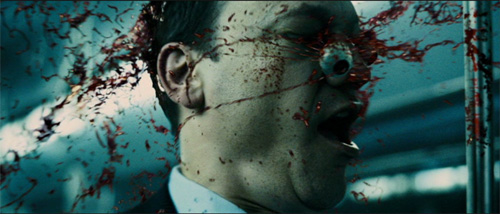
Ted Gets It

Kitamura is at his best when he finds new points of view for his mayhem rather than new kinds of effects. The POV decapitation in the same sequence is rather more successful:
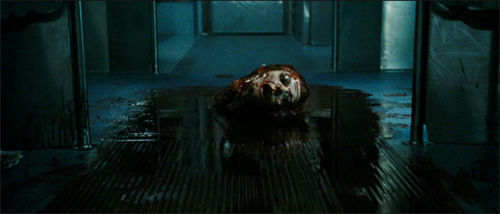
Heads Up

Structurally, the film is problematic. After a strong first act, the film sags as the filmmakers pad the length of the short story. The movie doubles back on itself as the investigation of Mr. Mahogany, the butcher, is undertaken by Leon's girlfriend, Maya (Leslie Bibb), who basically finds out a bunch of things the audience already knows. The film's final act recovers to a degree, in so far as it doesn't veer away from Barker's Nietzchean conclusion that gazing too long into the abyss will make a monster of you. The impact of this is somewhat muted by the necessity of placing a Lovecraftian race of "Old Ones" on screen. The film doesn't adequately imbue them with an aspect of awe and terror equal to the crimes done in their name. Still, the images before this denouement are startling for their novelty. No horror movie I can think of has put similar imagery on screen. In this regard, The Midnight Meat Train actually manages the difficult feat of capturing what made Barker's intial splash with The Books of Blood so memorable.
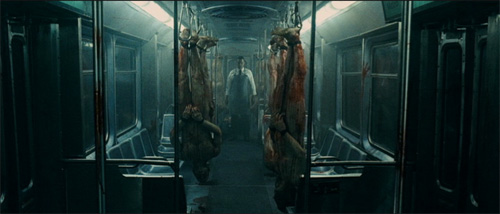
Meat Train


----------------------------

My partner and I are getting close to the end of the first season of Rome. Caesar has assumed power as absolute dictator, Vorenus has been installed as a magistrate, Pullo has fallen hard, and Brutus has alienated himself from Caesar, much to his mother's delight.

The thing I really like about Rome is its complete unwillingness to be shy about anything. The sheer amount of frontal male nudity--comparable to the female nudity--is a thing to see (Mmmm....naked James Purefoy). I love how they prefigure this in the animated graphitti during the credit sequence, which is full of phalluses and fellatio. I also love the brutality of the violence, and episode 11, which is where we stand right now, has a doozie of a violent set piece, as Pullo is sentenced to death in the arena and promptly shows that he's the deadliest son of a bitch in Rome. Arms are lopped off, legs are lopped off, there's decapitation by shield. There are hard-core horror movies that avert their eyes more assiduously. Pullo (Ray Stevenson) remains my favorite character, a status cemented a few episodes back when, tossed on the open sea in a storm, he shouts "If Triton can't keep us drier than this, he can suck my cock!" He's delightfully profane. And this ran on television? God, I love HBO. I can't wait to see their version of A Game of Thrones

Thursday, February 19, 2009

Vampires, Pink Horses, and Counterfeiters

Let the Right One In (2009, directed by Tomas Alfredson) was a bit of a surprise to me. I had seen the praise here and elsewhere, but I really didn't know what to expect. An anti-Twilight, I suppose, but that's not what I got. Well, no, that IS what I got, but not in the way I expected. This is a film that draws from a deep well of loneliness. Visually, it's a bleak and austere movie, composed in the main of long takes and snowy drabness. It's a film where you can feel the chill of winter radiate from the screen. For me, though the surprise is in how it mixes it all up with a striking genderqueer ambiguity. I had no idea it was as queer a movie as it turned out to be, but it strikes exactly the right notes in this regard, too. Best of all, though, it functions as a horror movie on top of all of its other concerns; it plays by the rules of vampire mythology (including a ghastly demonstration of what happens when a vampire enters a home uninvited). The finale at the swimming pool is both ghastly and comic by turns, delivering the goods for the horror audience. And then...the movie demonstrates an admirable grasp of irony, though the irony is there from the outset (the scene with the dog is a good example). The very end of the movie seems hopeful and touching, but I found it utterly horrifying. After all, we saw what became of Eli's previous familiar. Did he start out as Oskar did? I think he might have. Longer review here.

--------------

I wasn't very far into Robert Montgomery's Ride the Pink Horse (1947) before I realized that it was a tour de force in the very basics of the director's craft. At a basic level, the director of a movie is responsible for blocking the actors and supervising their movements, and collaborating with the cinematographer to compose the frame. At the outset of this movie, there is a long unbroken take in which a man arrives on a bus at a border town, gets off, walks into the terminal, puts a significant slip of paper in a locker, and hides the key. This is, perhaps, not as showy of a long-take opening as the one in Touch of Evil, but it certainly demonstrates a mastery of craft that used to be taken for granted in movies. This sort of thing is pretty much lost these days, as films are cut to mimimize the need for blocking or the creation of environments. Which is too bad. Ride the Pink Horse isn't an a-list classic, but it has more craft--more art--in that one sequence than can be found in the entire filmography of, say, Michael Bay. The story itself follows embittered veteran Montgomery as he attempts to blackmail a war profiteer. It's a stock, hard-boiled b-picture, though it adds some interesting flourishes, like the Mexican girl who thinks she's seen our hero dead, and the wonderful Thomas Gomez as a merry-go-round operator (which provides the pink horse of the title). After its opening, it doesn't feel the need for complex camerawork, and doesn't need it, really. It's enough to know that they COULD do it if they wanted to.

I could say much the same thing about the crime films of Richard Fleischer, which are models of narrative economy that often end with a flurry of noir stylistics. Trapped (1949) is such a film. It starts as one of those semi-documentary crime films that were popular at the time, complete with stolid narrator extoling the virtues of the agents of the Department of the Treasury, but that goes silent in short order as we engage the story, in which counterfieter Lloyd Bridges escapes from custody to track down the people who are using his plates to make funny money. It's a pretty standard crime-does-not-pay story, but the ending, in which the T-men track the bad guy to a trolley depot, dissolves into a dazzling abstraction of light and shadow. It's not a masterpiece, by any means, but it's a nifty little film.

Monday, February 09, 2009

Kink


There was even one drunken American who, laughing, grabbed her, but when he realized that he had seized a fistful of flesh and the chain which pierced her, he suddenly sobered up, and O saw his face fill with the same expression of horror and contempt that she had seen on the face of the girl who had given her a depilatory; he turned and fled.

There was another girl, very young, a girl with bare shoulders and a choker of pearls around her neck, wearing one of those white dresses young girls wear to their first ball, two tea-scented roses at her waist and a pair of golden slippers on her feet, and a boy made her sit down next to O, on her right. Then he took her hand and made her caress O's breasts, which quivered to the touch of the cool, light fingers, and touch her belly, and the chain, and the hole through which it passed, the young girl silently, did as she was bid, and when the boy said he planned to do the same thing to her, she did not seem shocked.

But even though they thus made use of 0, and even though they used her in this way as a model, or the subject of a demonstration, not once did anyone ever speak to her directly. Was she then of stone or wax, or rather some creature from another world, and did they think it pointless to speak to her? Or didn't they dare?

--Pauline Reage, The Story of O


One of the main reasons the best and most subversive erotic books and films stand out is because they don't settle for a mundane boy-meets-girl, boy-boffs-girl they-lived-happily-ever-after kind of storyline. Indeed, some of the best pieces of erotic literature are positively terrifying, chronicling love and obsession as parts of the same coin, and sometimes making the explicit connection between sex and death. In this, erotica sometimes bleeds into horror. The most terrifying erotic novel I've ever read is Pauline Reage's The Story of O. Oh, it offers up a rich panoply of polymorphous perversion, served up with such an economy of non-dirty words that it would make the Marquis de Sade weep in impotent envy. O loses herself to passion that becomes obsession. She loves so desperately that she loses her identity, her dignity, her self-will, and ultimately (if the hints at the end of the novel are to be believed), her life. I'm not entirely sure of how to take this, actually, but when I first read the book (mumble, mumble) years ago, I took it as both profoundly frightening and vaguely anti-erotic. It made quite an impression.

All of which is almost completely missed by Just Jaeckin's version of The Story of O (1975). Oh, it has more or less the same plot: O's lover, Rene--played by the deliciously creepy Udo Kier--takes her to the Chateau d'Roissy to be trained in the ways of submission. Here, she is dressed (or not) for the pleasuring of men (and women), is punished, etc. What the movie misses, however, is the alarming implications of O's willingness to partake, and it misses the darker aspects of the story's end. And instead of the book's elegant language, Jaeckin has substituted the cliches of soft-core Euro-porn, particularly the tendency to film through filters that look like someone has smeared vaseline on the lens. Still and all, the people in this movie are beautiful to look at. Corinne Cleary was an ideal physical match for O, sexual but naive, but she's not much of an actress. And it's not really boring, the way, say, some Emmanuelle movies are, either. Though I suppose that might depend on your own kinks.

A movie that totally "gets" what one finds in The Story of O is Luis Bunuel's Belle de Jour (1967), which in style is completely deadpan (as are most Bunuel movies) but which in substance is totally subversive. Like many of Bunuel's films, this is an epistemological toybox that bobs and weaves between "reality" and "fantasy" at will until it detonates both the real and the unreal at the end of the movie. Here, we get the erotic obsession of O reincarnated as a destructive force and liberating force at the same time: Severine, a frigid housewife trapped in a sexless marriage, spends her days catering to the kinks of a high-end house of ill-repute. This ultimately destroys her, but on the way, we see her sexual hypocrisy crumble, and at the end, we are given to wonder if it's her kinks that destroyed her, or her unwillingness to share them with her husband. The most telling scene in the movie is when one customer is refused service by the other women in the house because of the awful thing he carries in a box; Severine takes him on and afterwards is shown to be completely satisfied, released temporarily by giving in to her baser needs.

But the thing I love the most about this movie is the way it deals with the Catherine Deneuve problem. The thing about Catherine Deneuve is that, left to her own devices, she has the potential to wreck a movie. She's so inhumanly lovely that everything else runs the risk of being completely upstaged by her. One solution to the Catherine Deneuve problem is to submit to her completely. This is the solution usually employed by Jacques Demy, whose Umbrellas of Cherbourg and Donkey Skin bow down and worship. Bunuel, on the other hand, defiles her. He spits in the face of her beauty and drags her through the mud--sometimes literally. The scene that gives this strategy its fullest expression finds Miss Deneuve dressed in a blinding white gown and tied to a stake while her husband throws shovels full of mud at her. I think this is the scene that cemented my own love for Catherine Deneuve for all time.


Among more vanilla films:

Action in the North Atlantic (1943, directed by Lloyd Bacon) is a Bogart film that I've managed to miss all these years, and woe is me. This one's a corker, chronicling the wartime experience of the Merchant Marines as they brave the Nazi u-boat wolf packs. This starts with a bang, as Bogart's ship is torpedoed and the entire cargo of gasoline goes up in flames. This is a bang-up action sequence that lasts for the first half hour of the film. The film sags a bit when Bogart, his captain (played by Raymond Massey), and his crew are rescued and sent home. Things pick up again in the last third of the movie, in which all hands are back on duty as part of a convoy to Murmansk. We get a full-fledged naval battle here, followed by a game of cat and mouse with a u-boat and the Luftwaffe, all staged with aplomb by director Bacon and the Warner special effects department. Sure, the boats look like models, but they don't look more "fake" than the computerized boats in Pearl Harbor, really. And even though it was the result of the movie's slant as propaganda, there's a refreshing cosmopolitan attitude in this film, in which America still thinks that every allied country contributed to victory in the great war. Would that our contemporary nativist superpatriots remember that.

The first film version of The Maltese Falcon (1931, directed by Roy Del Ruth) is an interesting film. On the one hand, Bebe Daniels is a much more appealing femme fatale than Mary Astor, there's far more pre-Code sex and innuendo than in the Bogart film, and Sam Spade is the sleazeball one finds in the novel. On the other hand, Ricardo Cortez is a stiff as Spade. He's "acting" smarm, and it just doesn't work. Still and all, it's fun to watch. Otto Matieson gives almost exactly the same performance as Peter Lorre as Joel Cairo, Thelma Todd is a knock-out as Iva Archer (with whom Spade is DEFINITELY having an affair), and we get a fun non-horror turn by Dwight Frye as Wilmer (for which he seems perfectly cast). What this lacks, though, is Bogart. Oh, Bogart. If there were ever any doubt as to whether Bogart had the "it" that makes great movie stars, the contrast between this film and his should put that all to rest. There's a weird kind of alchemy going on in the Huston film that this film never once matches. Oddly enough, this is a case where the Production Code did something good, because THIS version of The Maltese Falcon was totally out of bounds, so they had to make another one. And when that one didn't work so well, they made a third.

Monday, February 02, 2009

Rings and Monsters

I was home sick this week, so I took the opportunity to revisit an old friend: Pixar's Monsters, Inc. (2001, directed by Peter Docter and Lee Unkrich). This remains my favorite of the Pixar films, in part because it makes me laugh the hardest, but also because the door chase at the end is the most jaw-droppingly imaginative setpiece I've ever seen. It's Keaton, Chaplin, and Lloyd all rolled into one. Plus, my emotional investment in it grows every time I see it. Just as I'm coming down from the adrenalin rush of the door chase, the movie sucker-punches me in the gut as Boo and Sully are parted. And when the movie reveals its last shot, and we hear "Kitty!" on the soundtrack, I'm bawling. Oh, plus it's got fun monsters, and a sushi restaurant called "Harryhausen's." How cool is that?

In contrast, I maintain a cool emotional distance from Peter Jackson's Lord of the Rings films. I watched the extended editions of all three of them this week, and for the most part, I viewed them as formal exercises. In retrospect, The Fellowship of the Ring (2001) is probably the most uniformly excellent of them. It really only strikes a false note with the council of Elrond, and even that's not bad. It loads the screen with terrifying menaces--it's very much the most monsterific of the trio--with my favorite of the monsters being the Watcher at the the gates of Moria. The Balrog was realized better than I could have imagined, but turns out to be something of a straw man (in the first film, at least). And the Ringwraiths seem like something that galloped out of The Tombs of the Blind Dead. I think a fair amount of the success of these films stems from having a director steeped in horror movies at the helm. Many of the film's set-pieces are palpably terrifying. Sean Bean arguably gives the most nuanced performance of the series as the doomed Boromir.

While The Two Towers (2002) is probably the most inconsistent of the three, it's probably my favorite. It's got the most Christopher Lee in it, and it throws in Brad Dourif for good measure, both terrific villains, both more comprehensible villains than the Great Eye of Mordor. A great villain makes for great fantasy. Jackson again gets to show off his horror chops as Frodo, Sam, and Gollum navigate the Dead Marshes, and shows a melancholy romanticism in Elrond's vision of Arwen's future, a vision worthy of the German romantics, Friedrich and Runge. This film begins an interesting escalation of scale in one half of the film (the battle of Helm's Deep) and an interesting narrowing of scale in the other half, in spite of the fabulous attack on the rangers of Gondor by the Nazgul.

The narrowing of scale continues in the third film, The Return of the King, even as the rest of the movie becomes so overstuffed that it's fit to burst. This one is all over the map, but when it comes down to it, the story devolves into a three sided psychodrama that, if one so desired, could probably be staged on a bare stage without any scenery. More than the other two films, this is a film that resonates with deep mythic images, from the reforging of The Sword that Was Broken, to Faramir's last ride, to Eowyn's battle with the Witch King and Theoden's heroic death, to Shelob, the cinema's all-time scariest giant spider. All of this, and the multiple maudlin endings, are emblematic of a director whose style is excess. Jackson doesn't know the meaning of restraint. Tell him that less is sometimes more, and he'll scoff at you because, by his lights, MORE is always more. Still, by the time Frodo sails into the West, the viewer is exhausted. This viewer, anyway.

I normally stay until the end of the credits when I see a movie in the theater, so when Taken (2009, directed by Pierre Morel) unreeled it's last few feet before me and the film's rating came up, I was shocked. PG-13? THAT was a PG-13 movie? Really? In retrospect, there's not really any bad language, and what sex there is isn't more revealing than your average episode of CSI, but, jesus, it's a brutal movie. This just goes to show that the MPAA, and Americans in general, are still ridiculously prudish when it comes to sex and language, and ridiculously permissive with violence. Disgusting. The movie itself isn't bad, though I daresay that the movie WOULD be bad if Liam Neeson wasn't playing the lead. He makes a silk purse out of a sow's ear. Like most Luc Besson movies (he wrote this one), the particulars are ridicuolous, but not moreso than your average Seagal or Van Damme movie. Neeson's conviction sells it all, and gives his role an extra cold-blooded malice that would elude a more regular action star. He's the reason to see it. No other. Certainly not director Pierre Morel's handling of the action scenes, which are clumsy even for being filmed in the run and gun, shaky-cam style.

Monday, January 26, 2009

Three Dimensional

For the Vincent Price Challenge:

The Oblong Box (1969, directed by Gordon Hessler) teams Vincent Price with Christopher Lee in a film that was supposed to be directed by Michael Reeves before his untimely death. Pity. Maybe he could have made more of the film's ridiculous plot, involving disfigured noblemen, body snatchers, and voodoo. As it is, it looks a lot like a television film. Not the best work of anyone involved.

The touchstone film to see for the 3-D process has always been Andre de Toth's House of Wax (1953), which, coincidentally, more or less turned Vincent Price into the next generation's Boris Karloff. This was a prestige production and it shows, not only in its production values, but in the lush Technicolor photography. It's more or less a remake of The Mystery of the Wax Museum--also a pioneering Technicolor film in its day--minus the Glenda Farrell reporter and the snappy dialogue. It's probably better for the focus on the main plot, in which disfigured sculptor creates disturbingly realistic wax sculptures from the bodies of his victims. There's a hint of the moral universe of the slasher film here, as good-time girl on the make Carolyn Jones (later Morticia Addams) is a victim while her virginal friend, Phyllis Kirk is the final girl. I've always been amazed that the most impressive display of 3-D was made by a director who only had one eye. Go figure.

The modern 3-D process is marginally more sophisticated, but the effects committed to celluloid are more of the same. Long things (sticks, guns, pointy tools) stick out of the screen at the audience. One hopes that more talented directors than Patrick Lussier will make better use of the process. All told, Lussier's remake of My Bloody Valentine (2009) is competent and agreeably mean-spirited. The 3-D got me into the theater, so in that way, it's a success. I might have seen it anyway, since it has Tom Atkins in it in a Tom Atkins-y role. Plus he gets a memorable and thorougly revolting death scene. I think it's also interesting for taking the convention of having 30 year old actors playing teenagers and advancing the plot until they're the right age for their characters. It also gets points for knowing what the audience for its sub-genre wants: gore and nudity. True, there's only one nude scene in the movie, and it's NOT starring scorching hot Megan Boone, but kudos to Betsy Rue for playing an extended scene completely starkers, full frontal. It's a doozy. Unfortunately, the movie plays its hand too early, and if anyone doesn't catch on to who the killer really is before the 40 minute mark, they just aren't paying attention. Plus, all of the really "good" stuff is frontloaded, and I spent the last 30 minutes of the movie waiting for it all to play out. The 3-D itself seemed more like a distraction than anything--I think they really needed to keep a deep-focus composition through out (they didn't)--and I wonder how the movie plays without it. I'm not going to pay to find out, though.

The Silent Partner (1978, directed by Daryl Duke) is one of those films that used to show up late at night on cable in the early 1980s along with stuff like Guyana: Cult of the Damned or The Evictors. It's always been hard to find on video, though it was in print on at least two separate VHS labels. It finally made it to DVD last year, and there was much rejoicing. This is a razor sharp thriller, in which nebbish bank teller Elliot Gould foxes vicious bank robber Christopher Plummer. Unfortunately, Plummer KNOWS he's been had, and a game of cat and mouse ensues. This film originally stuck in my mind for two scenes. The first, Plummer making dire, reasoned threats at Gould through a mail slot. The second, one of the nastiest decapitation scenes in film. I can only imagine how that last scene must have shocked an audience expecting a more genteel film based on its cast. Credit where credit is due: screenwriter Curtis Hanson gives a masterclass in suspense clockwork (Hanson later made L. A. Confidential) and Plummer and Gould make it tick. I need to apologize to Elliot Gould, too. I've never liked Gould, and I've said bad things about his performance in this film, too. But it was unwarranted. He's nearly perfect. I also didn't realize it back when I first saw it, but this film LOOKS Canadian. It never dawned on me how much this film looks like Cronenberg or any miscellaneous slasher film from the same era. Maybe it's the light. In any event, this comes highly recommended.

Monday, January 19, 2009

Poe, Gangsters, Bogart

For the Vincent Price Challenge:

The Haunted Palace (1963, directed by Roger Corman). Long review here.

The Pit and the Pendulum (1961, directed by Roger Corman). I used to think all of the Roger Corman Poe films were all alike. In terms of their subtexts, almost all of them ARE alike, but visually, they each have a unique identity. This one is very much the drabbest of them, a production heavy on the neutral colors and overall murk. It also has the most shocking ending of the Poe films, eschewing Corman's usual pyrotechnic displays in favor of a final shot worthy of E. C. Comics. Oh, Vincent Price essentially reprises his role as Roderick Usher for most of the film, before rampaging off into a more homicidal turn later. Les Baxter's score is suitably off-kilter, especially when it is first heard over the psychedelic colors of the pre-credit sequence. Not the best of the Poe films, I think, but the most fun of them.

The rest of the week:

It's no use for me to debate where GoodFellas (1990, directed by Martin Scorsese) ranks in the pantheon of Scorsese movies. It's not one of my favorites, but that's no big thing, because it doesn't need MY approval. For better or for worse, it's Scorsese's masterpiece, a film that distills everything Scorsese had learned about film to that point into 146 minutes of the director demonstrating what a motherfucker he is. As pure cinema, it's a joy to watch--no small feat for a film that relies heavily on a voice-over narration. It's so slick that it kind of mitigates it's aim of de-romanticizing the gangster archetype because the violence, when it comes, escalates over time into the operatic. The sequence late in the movie when we are given a tour of Jimmy the Gent's massacre of his collaborators is every bit the set-piece that the baptism sequence in The Godfather is.

Across the Pacific (1942, directed by John Huston) is kind of an anti-auteur movie, a gun-for-hire piecework that shows its director at his most anonymous, which is interesting given that the film re-unites three of the principles from Huston's version of The Maltese Falcon (Bogart, Sydney Greenstreet, and Mary Astor). The story follows disgraced soldier/intelligence operative Bogart as he uncovers a plot to sabotage the Panama Canal on the eve of Pearl Harbor. It's propaganda, no doubt, and it shows how ugly propaganda can be: this is VERY racist, indulging in every negative stereotype of the Japanese one can imagine, while ALSO calling for the round-up of the Nisei because, of course, they can't be trusted, either. Ugly film, one that Huston himself had enough contempt for that he left it unfinished and insoluble for other hands to finish (in this case, the unfortunate Vincent Sherman, speaking of whom...).

All Through the Night (1941, directed by Vincent Sherman) is altogether more palatable, though no less propagandist. Made before America's entry into the war, this already warns of Nazi fifth columnists with villains Conrad Veidt and Peter Lorre. Bogart is still in his gangster persona here, over-layered with a Runyon-esque veneer of all American tough guy. The character cast is deep, including Jackie Gleason, William Demarest, Phil Silvers, and Wallace Ford. Whatever else may be wrong with the film, it's fun to look at the faces on screen, and listen to that hard-boiled dialogue the Warner script department could churn out in their sleep. It's fun watching Bogart begin to turn the gangster persona into something else, a transformation he would complete in The Maltese Falcon.

Rome, Season 1

Episode 3: An Owl in a Thornbush
Episode 4: Stealing from Saturn

Things start to get fun--not that they weren't fun before--as Caesar crosses the Rubicon, Pompey retreats, Atia plots, and Pullo swipes the stolen treasury from Pompey's agents. I'm really digging Ciarán Hinds as Caesar--possibly the best Caesar I've ever seen (with the possible exception of Roddy McDowell in Conquest of the Planet of the Apes), and I'm really starting to like Ray Stevenson as Pullo. Polly Walker continues to steal the series, though. This is a serious porn-gasm for a history geek like me.

Monday, January 12, 2009

Into 2009.

This blog was never actually intended as a "blog" per se. I originally started it as a means of archiving the writing I've done on message boards (particularly at the IMDB). Somewhere along the line, it took on a life of its own. Right now, though, I'm pressed for time, so this week's posting is just a listing of what I've watched since the beginning of the year. I'll come back to all of this--perhaps even in this blog entry--and write something. I've already written about The Tomb of Ligeia and Laura on my stand-alone web site, and I don't really have much to say beyond what I originally wrote. I've included links. The rest? Maybe later in the week.

I'm not counting the movies I watch this year. I think I'll get more enjoyment out of them if I just watch them without worrying about making a quota. Anyway...

For the Vincent Price challenge on the IMDB Horror Boards:

The Tomb of Ligeia (1964, directed by Roger Corman)
Leave Her to Heaven (1945, directed by John M. Stahl)
Laura (1945, directed by Otto Preminger)
Vincent (1982, directed by Tim Burton)
While the City Sleeps (1955, directed by Fritz Lang)

Just for the fun of it:

The Last Life in the Universe (2003, directed by Pen-Ek Ratanaruang)

After Hours (1985, directed by Martin Scorsese)

Forgetting Sarah Marshall (2008, directed by Nicholas Stoller) Yay! Penis shots! Woo hoo!

Casablanca (1943, directed by Michael Curtiz)

Rome, Season One (2005)
Episode 1: "The Stolen Eagle (directed by Michael Apted)
Episode 2: "How Titus Pullo Brought Down the Republic" (directed by Michael Apted)

Agreeably violent, agreeably sexy, and loaded with the kind of palace intrigue that made I, Claudius so much fun to watch. This series rocks so far. Ciarán Hinds, they guy they got to play Caesar, is superb, but Polly Walker is in the process of stealing the show. Not hard to do when one gets that many nude scenes. Nice.

Cheers.

Saturday, January 03, 2009

All Done for 2008. Happy New Year.

Wow. My last batch of films for 2008 certainly had a queer slant to them.


342. Gilda (1946, directed by Charles Vidor). The first hydrogen bomb was named "Gilda. " This movie is why. Rita Hayworth is the bombshell of all bombshells in this movie. The movie poster for this movie paints the dress she wears in "Put the Blame on Mame" as green, but in black and white, it becomes whatever color you like, so long as it's the color of sex. Incredibly, the two men in the story, Glenn Ford and George MacReady, seem to have eyes only for each other. This is just about the queerest movie the golden age of Hollywood ever produced.

343. Excalibur (1981, directed by John Boorman) is full of such obvious symbolism that it sometimes surprises me with how subtle it is. I mean, the interesting twinning effect that goes on at the marriage of Arthur and Guinevere never dawned on me before, as the camera follows Merlin and Morgana rather than the ceremony itself. Or maybe John Boorman realized that Nicol Williamson and Helen Mirren were the two most interesting members of his cast, and decided that this was one of the best opportunities to take advantage. Nigel Terry and Nicholas Clay are pretty stiff as Arthur and Launcelot, though I took more notice of Cheri Lunghi this time round. Still, Boorman occasionally lets his half-assed mysticism get the better of him, even though the movie always looks fabulous.

344. All About My Mother (1999, directed by Pedro Almodovar) is the director's most heartfelt hymn to her, whether they be Madonnas or whores or both (Penelope Cruz play's a pregnant nun--you do the math). This is my favorite of Almodovar's movies, in part because it manages the not-inconsiderable feat of taking a character who starts as a cliche--Antonia San Juan's transsexual prostitute (sheesh, again?)--and gives her her dignity as just another woman. Oh, and Cecilia Roth is my favorite of Pedro's leading ladies.

345. Milk (2008, directed by Gus Van Sant) is a film that packs so much shock of recognition into its moral arc that it's hard not to see it through the lens of contemporary GLBT politics. The events of Harvey Milk's life seem to have replayed themselves writ large in 2008. One could very well mistake this as a VERY IMPORTANT MOVIE, but for the fact that it's too damned much fun as a movie. It would have been easy for Gus Van Sant, the commercial filmmaker, to phone this in. Instead, we get Gus Van Sant the eccentric filmmaker instead. Parts of this are playful. Parts of it are lovely. All of it is acted to the hilt. Sean Penn gets a new lease on relevence with this film. It's his most approachable role in years--if you don't mind watching guys kissing, that is. Pity that element alone will keep some audiences away. Alas. In any event, it strikes me that Milk's revolution is similar to the one kinda sorta going today, in which GLBT youth aren't satisfied with the status quo of either their place in the world or their place in the GLBT establishment and are taking to the streets to take what they want. More power too 'em. The change is coming.

346. A Christmas Story (1983, directed by Bob Clark). Y'know, this perennial chestnut isn't that great for great whacks of its running time, but when it clicks, it really clicks. My favorite episode? Ralphie's relationship with the "ef" word, and its consequences. I sometimes wonder about the deal with the devil Bob Clark made. It came partly due shortly after this movie hit theaters--Clark never made anything even remotely worth a damn afterwards.

347. "The Mysterious Geographic Explorations of Jasper Morello" (2005, directed by Anthony Lucas) (via YouTube: http://www.youtube.com/watch?v=vORsKyopHyM) uses the same animation technique that Lotte Reiniger used in The Adventures of Prince Achmed, but it mixes in nearly a century of other animation techniques, too. It's a steampunk bitches brew of Jules Verne and H. P. Lovecraft that shouldn't work, but does. It's kind of wonderful. But see for yourself:


348. The Magnificent Ambersons (1941, directed by Orson Welles) remains the cinema's most interesting murdered movie. It's been a while since I saw it last and in the interim, I've read Booth Tarkington's novel. Welles knew Tarkington as a boy, and always thought that George Amberson Minifer was based on himself. Of course, he has his revenge, given that Tarkington is today remembered mainly because Welles made this movie. Such are the vaguaries of literary reputations. In any event, it strikes me that the studio may have had a point in appending a "happy" ending. Their ending more closely resembles the book. Mind you, I'd LOVE to see Welles's cut (come on South America! Yield up Welles's print!), but I can live with the current film. It really is lovely. And brisk! It rampages through the story without a pause. It's obviously a movie that's a masterpiece in some form or other--but maybe not at it's current 88 minute form. Or even maybe in that form at that.

349. Quills (2000, directed by Philip Kaufman) is remarkably sympathetic to the Marquis De Sade. He's the voice of freedom in addition to being the raging id of the Enlightenment. This is, make no mistake, a literary horror movie, in which the subject is not de Sade, but books: what it takes to make them, what books work upon the world, and who, ultimately, profits by them. Oh, it's about a lot of other things, too--particularly the notion that one can enjoy erotica without actually wanting to wallow in what it depicts, which brings me to...

350. Crash (1996, directed by David Cronenberg), which is the director's most misunderstood movie. Who in their right minds gets off on car crashes? The smart-ass in me wants to direct anyone who asks that question to a demolition derby, but it's really a moot point. The movie isn't about this particular (fictional) fetish, so much as it's about fetish in general. Car crashes are a stand in for whatever perverse thing turns your crank. It could be high heeled shoes or tightlaced corsets or furry animal suits. It doesn't matter. The characters in this movie are ensnared by their sexual pecadilloes to the point where they cannot function, cannot feel pleasure, without them. The ending of this movie--in which James Spader and Deborah Unger search for the next crash/orgasm--is the best instance I know where a movie shows the sexual impulse and the death impulse side by side with a clear eye. I think this movie is a masterpiece.

Finally, finishing up with The Chronological Donald Duck:

351. "Working for Peanuts" (1953, directed by Jack Hannah)
352. "Canvas Back Duck" (1953, directed by Jack Hannah)
353. "Donald's Diary" (1954, directed by Jack Kinney)
354. "Dragon Around" (1954, directed by Jack Hannah)
355. "Grin and Bear It" (1954, directed by Jack Hannah)
356. "The Flying Squirrel" (1954, directed by Jack Hannah)
357. "Grand Canyonscope" (1954, directed by Charles Nichols)
358. "Spare the Rod" (1954, directed by Jack Hannah)
359. "Bearly Asleep" (1955, directed by Jack Hannah)
360. "Beezy Bear" (1955, directed by Jack Hannah)
361. "Up a Tree" (1955, directed by Jack Hannah)
362. "No Hunting" (1955, directed by Jack Hannah)
363. "Chips Ahoy" (1956, directed by Jack Kinney)
364. "How to Have An Accident in The Home" (1956, directed by Charles Nichols)
364. "How to Have An Accident At Work" (1959, directed by Charles Nichols)
365. "Donald and the Wheel" (1961, directed by Hamilton Luske)
366. "The Litterbug" (1961, directed by Hamilton Luske)

The interesting thing to me about this bunch of ducks isn't the way they interchange Donald and the Park Ranger from cartoon to cartoon, or the fact that these take such a dim view of romance ("Donald's Diary" and "How To Have An Accident in the Home"), nor even the sometimes over-looked fact that Donald appears to have actually married Daisy at some point and had a kid with her, but rather, the way that Disney, like every other American animation studio in the 1950s, moved away from lush, full animation to a flatter, more abstract style. They mostly did it with their backgrounds, and they mostly did it in a very intelectual way. I mean, consider this landscape from "How To Have An Accident in the Home":


It reads as a landscape, but it's no more "realistic" than a painting by Cezanne (with which it shares some characteristics). Or take this shot from "How To Have An Accident at Work":


This still-frame has no acquaintance with mathematical perspective. It's completely abstract. Almost cubist. And yet, it works. Even at this late date, Disney's animators were master-designers.

The last batch of these cartoons have an educational bent to them, before Donald bowed out as a movie star in 1961's "The Litterbug." He would return, eventually, in such later features as Fantasia 2000 and Mickey's Christmas Carol, but they weren't HIS movies. Alas.

Wednesday, December 17, 2008

Closing in On Year's End

Catching up. Only two weeks to go on my little experiment.

John Adams (2008):
324. Join or Die
325. Independence
326. Don't Tread On Me
327. Reunion
328. Unite or Die

Interesting portrait of the crankiest of America's founders. Terrific production values and the kind of grittiness HBO likes to add to its historical mini-series give value to what could be a dry recitation of facts. Hell, this is downright exciting. But for one small thing: Paul Giamatti seems the wrong actor for Adams. Oh, he's probably historically accurate, but Williams Daniels pretty much owns the role for all time in the musical, 1776 (I saw Daniels in a traveling version of the stage show with my mother sometime in the mid-seventies, so there's a double-reinforcement). Unfair to Giamatti? Probably. He's a capable actor and his performance grows on you as the miniseries unfolds. And fortunately, Laura Linney is amazing as Abigail Adams. She's been knocking them out of the park for a while now, and this is the best I've ever seen her. Did anyone else ever have to read the letters between John and Abigail Adams for school? It's one of my favorite love stories. Other performances are equally good, particularly Danny Huston as Samuel Adams and Tom Wilkinson as a surprisingly unscrupulous Ben Franklin.

I'm listing the episodes as individual films because, for the most part, they feel like individuals--especially the long second episode--with individual dramatic arcs. Two more to go.

The Chronological Donald Duck:
329. "Let's Stick Together" (1952, Directed by Jack Hannah)
330. "Donald's Apple Core" (1952, Directed by Jack Hannah)
331. "Trick or Treat" (1952, Directed by Jack Hannah)
332. "Don's Fountain of Youth" (1953, Directed by Jack Hannah)
333. "The New Neighbor" (1953, Directed by Jack Hannah)
334. "Donald in Mathmagic Land" (1959, Directed by Hamilton Luske)

More Ducks. There are some standouts here. "Trick or Treat" features Disney's take on a benevolent cartoon witch (voiced by the great June Foray), while "The New Neighbor" is practically the same film as Norman McLaren's "Neighbors" from the previous year. I remember seeing "Donald in Mathmagic Land" in a math class when I was in grade school. I was delighted to see it again here. It's deliriously abstract, and is a primer for anyone who wants to excel at billiards. They don't make educational films like this one anymore.

335. An Actor's Revenge (1963, directed by Kon Ichikawa) has been retitled for video as "The Revenge of a Kabuki Actor" by Animeigo, the current distributor. Apart from this, I have no quibbles with the edition. It's not as good a print as the old Criterion laserdisc, but Animeigo's anal-retentive subtitling and cultural notes more than make up for it. And it's not a bad print, either way. The movie itself, about the revenge of an onigatta, and the web of thieves that surround the kabuki theater, is strikingly theatrical to the point where the viewer might not notice how playful it is as cinema. For example, having the same actor play two different characters who appear on screen at the same time is a feat beyond the theater. Mind you, the story is fascinating, but the film that surrounds the story is a tour de force in meta-cinematic legerdemain.

336. M (1931, directed by Fritz Lang). By all accounts, Fritz Lang was a complete bastard to work with, a man who epitomized the sadistic director. By contrast, his wife, Thea Von Harbou, was said to be one of the nicest of people. Lang, of course, fled the Nazis shortly after M was made. Von Harbou remained and joined the Nazi Party. You can never tell about people, I guess, which is part of the point of this film, one of the greatest of all films. This presents a world turned upside down, in which the criminals enforce the law and justice, in which a harmless little man murders children. It's a film in which Lang abandons the grandiosity of his previous productions (Metropolis, Siegfried, The Woman on the Moon) in favor of a stark, reportorial style that prefigures film noir. And it features one of Peter Lorre's greatest performances. Lorre completely steals the film, even though he's really only center stage for the last fifteen minutes. Even so, the movie is subtle. The tune Lorre whistles is "The Hall of the Mountain King" from Peer Gynt, which suggests he's spiritually a troll. He can't help himself. His crimes are what trolls do. It's in his nature. He throws this back at his accusers--and by proxy at the audience--who aren't trolls. What's THEIR excuse? They have a choice to be criminals or not.

It's not a surprise that the Nazis didn't much like this film.

As an aside, this was the last film at our local arthouse's Wild Weimar film series. I LOVED seeing these films with an audience. Watching them on video just doesn't do them justice.

The Godfather (1972, directed by Francis Ford Coppola)

337. The Godfather Part II (1974, directed by Francis Ford Coppola)

338. The Godfather Part III (1990, directed by Francis Ford Coppola)

So, this time through the entire Godfather Trilogy, I was struck by both the absolute necessity of the third movie, and by it's relative failure. It's necessary from a structural point of view. If, as Mario Puzo and Francis Ford Coppola clearly intend, the Godfather saga is collectively "The Tragedy of Michael Corleone," then leaving things as they stood at the end of the second film with Michael sitting on a bench completely alienated from his family doesn't work. By this time, Michael is such a cold fish that one might wonder what a shark feels for the fish that it eats. At this point, "The Tragedy of Michael Corleone" is that he once had a conscience and he loses it. His lack of a conscience is his tragic flaw. And while that's interesting, it's not very engaging on a gut level.

The major influence on The Godfather films is Luchino Visconti (want an example? Take a hard look at Rocco and his Brothers or The Leopard and see what I mean). From Visconti, Coppola developed a taste for the operatic. This is most evident in the Baptism montage in the first film, which is orchestrated like grand opera. And opera is an idiom of emotion. The end of The Godfather Part II has a dark chill to it, but it's as stoic as the expression on Al Pacino's face.

So the third film is necessary. Why? Because for the kind of tragedy Coppola and Puzo want, it is necessary for an innocent to die. This is the Shakespearean model--which is a model from the first film onward, too, given that Coppola initially viewed the saga as a variant of King Lear. And in order for the full force of the tragedy to take place, Michael Corleone has to thaw. So, in the third film, we find Michael wracked by guilt for the murder of Fredo, desperately trying to enter the legitimate business world, giving huge amounts of money to the Catholic Church as some kind of atonement. But, of course, his previous life won't let him escape. This is a sympathetic Michael. We see the Michael Corleone who volunteered for the Army here, the one who told Kay that he wasn't like his family. It's not completely without precedent in the series, and if one accepts it, the accidental death of Mary Corleone at the end of the movie IS the fulcrum of the collective "Tragedy of Michael Corelone."

I don't have much of an issue with the casting of Sofia Coppola as Mary Corleone, really. I don't believe that Sonny's bastard son, Vinnie would find her irresistible, but there's a level of suspension of disbelief in all movies. She's not on stage all that much. Where The Godfather Part III goes wrong is in thawing Michael Corleone too much. This is not recognizable as the same character who was so cold-blooded that he ordered the murder of his brother with a single glance. And that's the structural flaw in the third film. The first time I saw this movie, I bought it completely. These days, I have an uneasy relationship with it.

I think about these things too much.


339. Hero (2002, directed by Zhang Yimou) can be seen as a propaganda film. I suspect that Zhang had to slant the film just so to get it made. If one views it as such, one can still groove on the spectacle. Christopher Doyle's cinematography is still so beautiful that it bids fair to make one's eyes water. But I noticed something strange about it this time: All of the variants on the story told by the film's assassin are color coded, indicating that none of them is true, that all of them are stories. But then, so is the framing sequence! I never noticed it before because the code color for this sequence is black rather than the bright colors of the rest of the film, which is a clever way to hide it. What does this mean? Is the film to be trusted in any measure? Or is the film entirely about storytelling rather than about politics? It might be.

340. No Regrets for Our Youth (1946, directed by Akira Kurosawa). Relieved of the restrictions of wartime censorship, this early film by the great director turns its gaze on censorship itself. This is not the fully formed, robust director of the next decade, but he was already pretty good. The opening sequence, in which lead character Setsuko Hara is chased by her suitors reminds me of Bergman for some reason. Later Kurosawa seems to have no interest in women, so it's a surprise to see that he's fairly deft with a female lead. It doesn't hurt that Setsuko Hara is one of the great actresses in Japanese film, but details.

341. Voice (2005, directed by Ik-hwan Choe) is the fourth in the Korean "Haunted Girls School" series. This one eschews the horror show of the third entry (Wishing Stairs) and goes back to the second (Memento Mori) for its themes, though it approaches them from a fresh perspective. The point of view of the movie is that of the ghost. This might seem an awkward conceit, but it works well enough here, and it enables the filmmakers to examine what death really is in their minds. Mostly, it's loneliness. Oh, there's a big reveal of the plot mechanism at the end of the film, and it's not entirely awful, but the film doesn't really need it. The director, Ik-hwan Choe, was an assistant on Whispering Corridors, the first film in the series, so this brings things full circle, in a way.

Monday, December 01, 2008

The Two Faces of The Scarecrow

316. I don't believe I ever saw the full version of Walt Disney's The Scarecrow of Romney Marsh (1964, directed by James Neilson) when I was a kid, but I remember its shorter theatrical version very well. That film was titled Dr. Syn Alias the Scarecrow. In truth, there's not a whole lot of difference between the two versions. Admittedly, the theatrical version is a bit brisker of pace, but at the expense of some characterization. In any event, this is variant of the Zorro myth, set in the England of George III. Patrick McGoohan plays saintly Dr. Syn, the vicar of Dymchurch, who, by night, leads a gang of smugglers as the terrifying Scarecrow to help the locals endure the burden of excess taxation. Of course, the king's men come to town to try to catch him and he outwits them in three separate episodes (or acts). It's rollicking adventure that works because Patrick McGoohan is terrific in the lead. As the Scarecrow, he adopts a terrifying, guttural voice that sounds like a bearing about to go bad. This voice is abetted by a striking character design by the costume department, with its twisted smile. As Dr. Syn, McGoohan is saintly, but with a sly twinkle behind his eyes. And he looks like a man who has and keeps secrets. And, oh, my! He was a looker in his youth (note to self: track down Danger Man). His supporting cast of British stalwarts lends the whole enterprise a gravitas that grounds some of the pulpier aspects of the story. This one was a favorite of mine as a kid. I'm glad to see that it holds up.

317. Hammer's competing version of the Scarecrow story changes a few key details for legal reasons--Disney having sewn up the rights to certain aspects of the story--and is a darker film over-all. Captain Clegg (1962, directed by Peter Graham Scott) was re-titled Night Creatures in the US and finally saw the light of day on Universal's Hammer box a few years ago. It, too, is carried on the strength of its lead performance. Peter Cushing's Dr. Syn (renamed "Dr. Blyss" in this version) has a good deal more menace in him as the vicar, and the movie retains the character's piratical past. The movie is a good deal more violent, too, and shows its hand right from the get-go with a memorable marooning sequence in which a man has his ears slit and tongue cut out before being imprisoned on an island. But the overall arc of the film is the same. Its one of Hammer's more handsome films from the period and the filmmakers have given some of Hammer's stock character actors their heads in this one, notably Michael Ripper as Mr. Mipps, who positively beams at the chance to show an impish sense of humor.

The new Disney Treasures tins include volume four of The Chronological Donald Duck. I love me some Donald Duck (you can blame Carl Barks for this). The current volume features cartoons that were a constant staple of Disney's television empire, so I'm very familiar with all of these:

318. "Dude Duck" (1951, directed by Jack Hannah)
319. "Corn Chips" (1951, directed by Jack Hannah)
320. "Test Pilot" Donald (1951, directed by Jack Hannah)
321. "Lucky Number" (1951, directed by Jack Hannah)
322. "Out of Scale" (1951, directed by Jack Hannah)
323. "Bee on Guard" (1951, directed by Jack Hannah)

In most of these, Donald contends with Chip and Dale, who always seem to cross his path. I always used to think that Chip and Dale were male and female, especially with the way Chip is sometimes drawn as the more effeminate of the two. Lately, I'm convinced that they're gay. But that has nothing to do with what's on screen. It's just my impression. That's all. We also get a Hewey, Dewey, and Louie appearance in a rare depiction of the trio as teenagers. And a bee. Donald has no luck with any of them. The weirdest of these cartoons is "Dude Duck", in which Donald hops off the bus after a gaggle of human women. I've always been able to accept the anthropomorphism in Disney's cartoon so long as it follows Barks's Duckberg model, in which everyone is an anthropomorphized character. Putting human characters in the frame is just weird.

324. There are a lot of things to dislike about the new James Bond movie, Quantum of Solace (2008, directed by Marc Forster). It's cut too fast. It has no sense of geography in the action scenes. It is fairly lacking in the series' signature humor. It lacks a baroque, comic-opera villain. This is all true. But I came out of the film liking it none the less. I really like the theme song by Jack White and Alicia Keys, which has a distinction that the last several theme songs have lacked: it actually sounds like a Bond theme. The credit sequence is much improved over Casino Royale--again, it seems like the credit sequence of a Bond film. And it has a pretty good story. An acquaintance of mine thought that the McGuffin--our villain is cornering the market on water--was pretty lame; but I grew up in Colorado where there's a saying that "Whiskey is for drinking, water is for fighting." So it made perfect sense to me. I LOVE that the filmmakers are re-inventing SPECTRE and SMERSH for the 21st Century (and in a way that seems all too plausible). Oh, and Daniel Craig is inhabiting the role of Bond quite nicely. Oh, my, yes. James Bond will return, the credits tell us. I'm looking forward to it.

Wednesday, November 26, 2008

A Prayer for the Departed...

313. Dario Argento's The Bird with the Crystal Plumage pretty much sets the tempo for the giallo thrillers of the 1970s. I won't go into details beyond a short mention of Fredric Brown's source novel, The Screaming Mimi, but there are a couple of things I really picked up on during this viewing. First, Argento's complete obsession with art objects and art spaces as weapons and places of menace was fully formed from the get go. Second, I can almost see the director laughing to himself as he leaves clues in plain sight that give away the whole thing. Like in this shot:


I just about blew my drink through my nose when I saw that shot. I didn't remember it, but I know the movie pretty well, so it means everything.

The opening suspense sequence in between the glass doors is still a corker.

Anyway...

Reprinted from my web site (and my old blog).

314. and 315. So I saw Marty Scorsese's The Departed (2006) again a couple of weeks ago. It's an okay film, but something about it has been gnawing on me since it was released.

A little background: The Departed is a remake of the Hong Kong cop thriller, Infernal Affairs (2002, directed by Wai-keung Lau and Siu Fai Mak). Both films follow the intersecting paths of two undercover agents. One agent is a cop placed in the confidence of a mob boss. One agent is a mobster planted in the police by that same mob boss. Neither man knows the other, though both are aware of the other's existence. A cat and mouse game follows. Both films have the equivalent of an all-star cast. I prefer the cast of the original, stocked as it is with some of my favorite actors anywhere in the world (Tony Leung and Anthony Wong in particular). I'm less sanguine about the cast of the remake. I've never warmed to Jack Nicholson or Matt Damon, and Leo Di Caprio is laboring in the shadow of Tony Leung's astonishing performance in the original item. But that's neither here nor there. If you haven't seen the original, you'll love the remake. If you have seen it, you'll probably like the remake. Maybe.

If you have an interest in seeing either film, but haven't yet, stop reading now.


Still with me? Okay.

Infernal Affairs is a terrific film. The Departed isn't as good, but it's not bad. It follows the original's story pretty faithfully until the end. The end. That's where I get hung up. At the end of Infernal Affairs, the Andy Lau character betrays his mob boss and goes over to the cops. To do this, it's necessary to wipe his opposite number off the ledger and turn his back on his murder. He gets away with everything (well, not quite, but enough). Andy Lau's saturnine face is inscrutable through all of this, and there is a remarkable ambiguity built into this ending. That's the ending that most of the world saw. There is an alternate ending made for the mainland Chinese market. The censorship standards in the mainland market require that corrupt government officials be brought to justice in their movies--a convenient fantasy, one must admit, given the rampant corruption known to exist in China's ruling Communist party. In that version, Lau's character is arrested at the end of the film and hauled off to jail. This is in opposition to the spiritual thematic concerns of the movie, but try telling that to a censor. Irony is just one of many virtues lost on censors.

Apparently, Americans are subject to the same rigid censorship requirments. The Departed changes the ending even more thoroughly than the ending intended for the mainland Chinese. The remake sets up a situation where someone else in the police department knows the identity of Leo Di Caprio's character, and once Leo's character is dead and Matt Damon's character is seemingly scott free, he shows up and puts a bullet in the brain of Damon's character. Evil, then, has been punished. To underline this ending, the camera pans up to the balcony where a rat scuttles across the railing, as if to say: "Get it?" This would be disappointing in any film, but for it to occur in a Scorsese movie is a travesty. There is the suggestion in this turn of plot that not only do the big multinational companies that keep Americans--and by proxy most of the rest of the world--sucking like infants at the teat of bourgeois media hold their audience in even lower regard than the Communist Chinese. And they do it in even more brutal fashion. Let me give you two other examples:

A decade ago, someone got the bright idea of remaking Alfred Hitchcock's Dial M For Murder. This film, retitled A Perfect Murder, actually manages to improve on the original item in several important ways and largely sidesteps the shadow of Hitchcock until the ending. In the original, Ray Milland is trapped by his own web of lies and when he realizes that he's screwed, the expression on his face is priceless. He's hauled away in disgrace to await trial by a jury of his peers. It's very satisfying, actually. The remake eschews this kind of "complexity" in favor of a gunfight at the end, during which Michael Douglas is killed off and not made to suffer due process or any further humiliation for trying to murder his wife. Justice, in the contemporary, parlance, has been served, but it's a hollow kind of vigilante justice. It's NOT satisfying. Or at least, not to me. It's far too tidy. For a real-life analogue, I offer you the case of Ken Lay and Enron. Not only did Lay's untimely death deprive the victims of Enron's collapse the redress of justice, it prompted Lay's conviction to be set aside.

The living end of this was the end of Troy, a retelling of the Trojan War. The movie paints Agamemnon, played by Brian Cox, as the film's rat-bastard villain. But I'll get to that in a moment. The ostensible source for Troy is The Illiad. If you ever read the poem in high school, you would likely have been annoyed at the changes made to the text, but for the most part, it gets things right. You get the wrath of Achilles ("Sing to me, o' Muse of the wrath of Achilles, the man-killer") and you get the ultimate tragic scene from the end of the poem where Hector's father, Priam, comes to Achilles tent to beg for the body of his mutilated son, Hector). If the filmmakers had had the genius of Homer, they would have ended it there, where Homer himself ended it. Then the film would have been a tragic epic worthy of milennia of stories about the Trojan War. But American audiences demand more. They demand "resolution" to even the most meaningless of plot threads. So we get the Trojan Horse. We get Achilles's death from an arrow in his heel. And we get Agamemnon's death...wait...Agamemnon didn't die at Troy. He sailed home with the prophetess, Cassandra, only to be murdered by his wife, Clytemnestra and her lover. Not in this version, though. Here he gets killed for the audience's sense of "justice," in which villains are slain at the end of the last reel. Villains can never be seen to prosper. Oh no.

Puh-leeze.

Are American audiences such uncomprehending sheep? Is the only satisfying end for a villain his death, whether from a gunshot, a fall from a high place, or a sword through his chest? How far has drama fallen? And what does this do to our cultural mores? American studio movies are largely junk anymore and it troubles me, not just because I love the artform, but also because I hate the underlying ethical assumptions behind them. But mostly, I hate the idea that audiences are in the grip of a media that has no more regard for their individual judgement than that held by the Communist Chinese. That disturbs me, actually.

Edit: Oddly enough, I'm not the only one to notice these things. Critic/Film Scholar David Bordwell notices some of the same things. So I'm not crazy after all...

Monday, November 17, 2008

Femme Fatales

306. After the election, I felt a certain obligation to watch Frank Capra's Mr. Smith Goes to Washington (1939), which used to be one of my favorite movies when I was a teenager. It hasn't aged well for me as an adult. I still like it a lot, though some of that is residual affection from my youth, but I see the glaring flaws in it today, thrown into stark contrast by an adult life engaged with the political process (I've been an activist for the last eight years, in one capacity or another). In that light, the sheer naivete of Jefferson Smith and his national boy's camp seems ridiculous on the face of it. Oh, the film slants the dam project that Claude Rains's corrupt senator wants to ram through by telling us at the outset that it's a boondoggle for the benefit of the political machine pulling his strings, but, hell, a hydro-electric dam sounds to me to be a lot more useful than a boy's camp, even if it does enrich the bosses. I mean, we're talking about a country that was still only barely electrified at this point in time. Of course, I'm well aware of the fact that the details are beside the point, that the boys camp and the dam and all are McGuffins of the highest order, and that the point of the film is the injection of integrity into the political process, but the sentimentality tends to undo this for me anymore. Sentiment, as anyone who makes serious art can tell you, is pure poison.

307. I'm much more in love with Capra's It Happened One Night (1933), which not only put Capra on the map of "great" directors, it also put Columbia Pictures on the map after years of a marginal existence on poverty row. Studio boss Harry Cohn was fabled as the cheapest man in Hollywood, after all, but he gave Capra his head, and Capra made stars of the first magnitude out of his actors: Clark Gable and Claudette Colbert. Colbert set the standard for spoiled heiresses that persists in one degree or another to this very day, and Gable suddenly ruled the 1930s as the King of Hollywood. Although there isn't anything as salacious in this movie as one finds in other pre-code movies, there's a sexual friskiness in this movie that vanishes from the screwball comedies that use it as a template. This is especially manifest in the "walls of Jericho" scene. This adds seasoning to a film that could wind up too sweet. As it is, it's just right.

308. Chinese director Jin Xie died last month, so in his honor, I watched Stage Sisters (1965). A story of two actresses caught up in the revolution, this is one of the most cunning bits of misdirection in the history of movies. On the surface, it seems to be a stock piece of upright communist propaganda--and Jin Xie knew that it had better damned well pass that particular test if he didn't want to end up in a re-education camp--but what the movie REALLY is is a bittersweet lesbian love story. I mean, it's hard to miss it these days, after years of decoding queer subtexts in films, but I presume that the Red Chinese censors of the day were as literal-minded as censors always are and they couldn't see what's right in front of their faces. Some of the dialogue near the end, with its whiff of sloganeering, is hard to take, but on the whole it's a beautiful film to watch.

309. As childhood nightmare fuel goes, it would be hard to beat the late Paul Berry's deranged short film, "The Sandman" (1991). Very much in the Tim Burton mold (Berry made models for Burton's The Nightmare Before Christmas), this is a horror story through and through, one that delves deep into childhood fears, and which features a gruesome denouement. Then it caps it with a haunting final image after the credits. Highly recommended. You can see it here:

310. My partner wanted to watch a comedy this weekend, so we got Get Smart (2008, directed by Peter Segal), which I gave a pass when it was in theaters. I liked Anne Hathaway as Agent 99. Steve Carrell doesn't erase memories of Don Adams, unfortunately. The dastardly plot is pretty transparent from the get-go. I was happy to see Patrick Warburton show up at the end, but I'm always happy to see him in a movie. It's mostly harmless and intermittently amusing. I'm glad I rented, though, because I doubt I'll ever watch it again. 311. There are two sequences in Abel Ferrara's Ms. 45 (1981) that show the director's hand. While there are tons of elements in the movie that suggest that it's a pure exploitation film (the old "head in the freezer trick," anyone?), Ferrara's ambitions towards art manifest themselves. The first: Thana, our mute heroine, out on her first real rampage, is surrounded by gang bangers who circle her like sharks. Ferrara shoots this from above, and the movies is temporarily transformed into the equivalent of a Busby Berkely musical. This sequence is pure choreography, violence in the abstract. The second: Thana picks up a prospective victim in a bar and they make their way to the waterfront, where her victim recounts how he found himself cuckolded by his wife. Thana's gun misfires and he takes it away. Then points it at his own head and pulls the trigger. This sequence seems like a predecessor to Ferrara's later "Madmen in New Yawk" films like Bad Lieutenant and delves more deeply into an existential abyss than any Death Wish knock-off has any right. Also, it's interesting how Ferrara resists the urge to turn Thana into a gun-toting fetish figure. Oh, sure, she winds up decked out as such, but Ferrara intercuts these depictions with the fate of Thana's first "victim," which acts as a kind of subversion. We can't entirely embrace Thana as an angel of vengeance, because Ferrara shows us how profoundly damaged she really is. This movie is still waters. There are hidden depths. 312. Our local art house has been showing films from Weimar Germany this fall, and this weekend, they got to a doozie. G. W. Pabst's Pandora's Box (1929) is a portrait of the decadence one thinks of when one thinks of Weimar Germany, but it goes deeper than that. The arc of this film is a downward spiral into degradation, ending with the knife of Jack the Ripper (or, at least, his nearest cousin). At the center of it all is Louise Brooks as Lulu, who is part femme fatale, part naive innocent, and who is the walking, talking incarnation of the Golden Apple of Discord. She destroys everyone she touches. When I first saw Pandora's Box (mumble, mumble) years ago, I was awed by Brooks, and deeply impressed by the queer subtexts presented by the Alice Roberts character, one of the screen's first overtly lesbian characters, two elements I fixated on at the expense of every other element of the film. This is understandable, I guess, given that the image of Louise Brooks has left an indelible mark on everyone who's seen the film. Beyond these two elements, though, is a bitches brew of subtexts. It's easy to enter the film from a feminist point of view. Brooks is a free spirit, whose freedom is an affront. The film must destroy her, and it does. But a contrary viewpoint is that the film is an indictment of forces that destroy her, and the film must destroy them. And it does. It's possible to see the film as deeply cynical about the motivations of human beings: every relationship in the film is defined by a transaction. Relationships are commodities in this film. And when, at the end, Lulu forgoes a transaction and extends the hand of kindness, there's a knife waiting for her.


And in spite of all of that, there is still the image of Lulu, with her short bob and her impossibly lustrous bangs. However brutal the film becomes, it comes dazzlingly alive whenever Louise Brooks smiles at the camera. Frankly, the film would not work without her. With her, it's a stunner.

Wednesday, November 05, 2008

The October Horror Challenge: The Bitter Taste of Failure.

The stragglers from the October Challenge:

October 26:

300. Wicked Little Things (2006, directed by J. S. Cardone), in which a woman and her daughter are haunted by the children killed in a mining accident. Zombies. Cliches. This was supposed to have been directed by Tobe Hooper, which makes this a bitter pill, because I can totally see him going to town with this material. It's not awful as it is, but I'll be damned if I can remember much about it a week later.

The Thing (1982, directed by John Carpenter), for the second time in the last two months. My SO wanted to watch this for a date night. Who am I to argue? The family that watches horror movies together, slays together, I say.

October 27:

301. Arang (2006, directed by Sang-hoon Ahn), in which are conflated the Asian ghost story (complete with ghost girls with long black hair and bloody eyes), and the serial killer procedural. This is a mash-up. It's slick, but it's nothing you haven't seen before, only collected in one economy package.


302. Bloody Reunion (2006, directed by Dae-wung Lim) is like a Korean version of a giallo. It seems more like a giallo than a slasher movie, but that's splitting hairs, I guess. What this IS is violent. It's relatively elegant about it, too. Unfortunately, it pulls the rug out from under itself in the last act. It's a head-scratcher.

October 28:

303. The Mummy (1959, directed by Terence Fisher), which I think I've seen in fragments in the past. I've never watched it start to finish before, though. It's an energetic reworking of Universal's second wave of mummy movies, with Prince Kharis rather than the sinister Imhotep. Christopher Lee is largely wasted in the title role--he seems altogether too athletic for the part, actually--but Peter Cushing is always good.

304. I'm in the same boat with The Gorgon (1963, directed by Terence Fisher): I've seen fragments. I may even have seen the entire thing before, but never all at once. The Boys at Bray get the most out of Lee and Cushing here by having them both on the same side, rather than as opponents. The monster, however, is disappointing. Alas.

October 29:

305. Cinderella (2006, directed by Man-dae Bong) is a plastic surgery horror movie, rather than a dark fairy tale, and it really wants to be a drama rather than a horror movie. I don't usually mind dramas hiding behind the genre signifiers, but this is a movie where the two impulses work at cross purposes. The first part of the movie isn't bad, but it degenerates rapidly after the half-way point.

Final tally: 22 films, 19 new to me.

So this is a partial success. I beat my previous best new films by two movies. But I failed to get to 31. Suck.

Monday, October 27, 2008

The October Horror Movie Challenge, continued.

From the challenge:

October 20:

293. The Abandoned (2006, directed by Nacho Cerdà), in which a woman returns to the home of her parents in Russia where she meets her long lost twin brother and, it appears, their undead doppelgangers. This is pretty good. It gets the sense of dread right, and it flourishes it with genuinely frightening ghosts and a touch of Lovecraftian "wrong" geometry, then caps it off with a strikingly bleak ending. A bit more visceral than ghost stories tend to be, too, with a pig scene worthy of Clive Barker. Recommended.

October 21-23:

Nothing

October 24:

294. The Island of Doctor Moreau (1977, directed by Don Taylor). If I ever knew it, I had forgotten that this version of Wells's anti-vivisectionist rant was produced by Sam Arkoff and AIP. That explains a lot of the film's shortcomings, though it doesn't explain the A-list in 1977 cast. I mean, Arkoff and Burt Lancaster are not names one commonly hears in the same breath. I remember when this came out, my horror-loving friends and I were all over the make-up effects for the "Manimals". The effects haven't aged well. At all. Nor has the film, which has an anonymous 70s-era TV Movie feel thanks to lackluster direction. Still, Lancaster makes a surprisingly effective Moreau, though one misses the impishness of Charles Laughton in the role. And the chant of the Sayer of the Law is still iconic. "Are we not men?"

295. Inside (2007, directed by Alexandre Bustillo and Julien Maury) is a pure, single-minded shocker. Upon my first viewing, I'm not entirely sure if it has anything to say beyond its shocks--it may or may not offer up a helping of existential dread--but it's hard to tell because the movie is so pummellingly brutal an experience. It wants to reduce its audience to a fetal ball in the corner screaming, "Make it stop!" It's very successful. Part of this is because, unlike some other films intended to shock for the sake of shock, this one is no stranger to creeping menace and mounting tension, either. While I don't want to compare this movie to The Texas Chain Saw Massacre, it reminds me of that film in so far as I think it is only defensible as a filmmaking tour de force unto itself. This one hurts.

October 25:
296. The Mist (2007, directed by Frank Darabont) is another variant of Night of the Living Dead/Rio Bravo. This time, a collection of characters is trapped in a supermarket while a mist containing hideous monsters from another dimension rolls in. This is a lot better than I expected it to be, given that I've never been much of a fan of the Stephen King story on which it is based. This is a movie for monster-lovers, because this sucker has some jim-dandy creatures. It has interesting actors, too, though most of them are encouraged to over-act outrageously. One exception to this is Toby Jones, who makes the most of a nerdy supermarket clerk with hidden depths. He makes up for Marcia Gay Hardin's trip to religious looney-ville. The film has an agreeably bleak ending, sure to piss off half the audience, but them's the breaks sometimes.

297. Malefique (2002, directed by Eric Valette) plays more than a bit like a play. You have a limited setting (mostly inside a prison cell) with, basically, four characters. There's an element of a gallic theater of the absurd, too. How else to explain the mix of characters: a very butch transsexual, the cannibal little buddy, the wise wife-killing librarian, the corporate criminal. The plot contrivance--a spellbook hidden in their cell by a hundred-year old serial killer--gives this feeling, too. Like most recent French horror, this has an instinct for the thoroughly nasty visceral image. It has a dumb Twilight Zone-y ending, though. Meh.


298. Mortuary (2005, directed by Tobe Hooper). Oh, Tobe! How could you? And just when I was ready to let you back into the canon...Sigh.


Non Horror:

299. After being brutalized by Inside, I put on The Princess Bride (1987, directed by Rob Reiner), which has long been on of my few pieces of cinematic comfort food. It's all in the screenplay with this one, because the direction is kind of dull. Still, I love Wallace Shawn in this movie, and Christopher Guest. Hard to make out most of Andre the Giant and Mandy Patinkin's dialogue, even after all these years.

I'm going down in flames this year. Pesky vacation. Ah, well. Maybe next year.

Monday, October 20, 2008

The October Horror Movie Challenge, 2008 edition.

Like Jason returning in a Friday the 13th sequel, The October Horror Movie Challenge is upon us once again. The object, as usual, is to watch 31 horror movies before midnight chimes on Halloween, with at least 17 movies being movies you've never seen before.

I got off to a flying start after the end of my vacation. I've got some catching-up to do. First-time viewings in blue:

October 6:

282. Black Sabbath (1962, directed by Mario Bava). In which Bava invents Italian horror cinema out of whole cloth. It's like a Basil Gogos painting come to life. Longer review here.

October 7:

283. Snake Woman's Curse (1968, directed by Nobuo Nakagawa). Weird, theatrical Japanese horror movie, with a strong Marxist backbone. Evil land-owner torments peasant family. Peasant family visits a nasty curse upon them once they're all dead. It's creepy in parts. Never really scary, though. Mostly an oddity.

October 12:

284. The Uninvited Guest (2004, directed by Guillem Morales). A brilliant set-up, in which an architect begins to think the man who came in to use his phone and then disappeared is living somewhere in his house. Lots of doubling goes on in this--there's a doppelganger effect--but the ending of the film descends into an incoherent ambiguity. Still, the first hour is razor sharp.

October 15:

285. Sweeney Todd: The Demon Barber of Fleet Street (1936, directed by George King). In which Tod Slaughter devours the scenery as the title character. It's amazing how much Sondheim took from this version of the story. It creaks, though. A lot.

October 16:

286. Feast (2005, directed by John Gulager). This is a minor miracle. Anyone who watched this unfold on Project Greenlight saw a completely dysfunctional production. That anything watchable emerged is surprising. That something genuinely entertaining emerged is astounding. Mind you, this isn't great. It has some fun subverting expectations (and winking at the audience while it does), but it's nothing profound. Another variant of the Night of the Living Dead scenario, which is so popular because it's so cheap to produce. But even so, it has an appealing instinct for the jugular.

October 17:

287. MOH: Homecoming (2005, directed by Joe Dante). A disappointment. I mean, I love that Dante decided that "complete freedom" means freedom to make a political statement, and I love the fact that this is a modern updating of Abel Gance's J'accuse. But the satire isn't sharp enough and it doesn't go far enough over the line to draw any real blood. The real thing is still more horrifying.

288. MOH: Pick Me Up (2005, directed by Larry Cohen). The weird alchemy in this series continues, in which the guys I don't much respect are the ones knocking it out of the park while the heavy hitters are striking out. This time, Larry Cohen makes me choke on every bad thing I've ever said about his movies, because this is sharp, merciless, and scary. Having his cinematic alter-ego, Michael Moriarty, as one of his dueling serial killers is a nice bonus, and even Fairuza Balk's familiar face doesn't save her in the end. Nice.

289. The Dark (2005, directed by John Fawcett). If one turns off the sound and ignores the story, this is a beautiful production. Gorgeous locations on the Isle of Man, terrific actors, superior cinematography. I mean, Sean Bean (yum) and Maria Bello (also yum) alone should make this work, right? Well, not quite. The story itself is pretty bad, and the script sounds like crap even when it comes out of the mouths of these actors. In spite of its Welsh back story, this still seems like it's ripped off from Asia.

October 18:

Nothing. I suck

October 19:

290. Mother Joan of the Angels (1961, directed by Jerzy Kawalerowicz). Not quite a nunsploitation film, and artier than most similar films short of Ken Russell's The Devils (it tells more or less the same story), this still feels vaguely like a Hammer film. I mean the stark visuals are a million miles away from Hammer, but the set-up would be at home in any of their vampire movies. The picture quality on the DVD leaves a LOT to be desired.

291. Do You Like Hitchcock (2005, directed by Dario Argento). Workmanlike made-for-TV giallo and no more. It throws around Hitchcock references with abandon, but it doesn't understand any of them. Dario, I hardly knew ye.

292. Non Horror: The Last Laugh (Der Letzte Mann, 1924, directed by F. W. Murnau) with live music by Rats and People Motion Picture Orchestra, who were fabulous. The movie itself is silent film at its most inventive and sophisticated, even though there's a stark break in the mood near the end. Does it betray it's intent? Maybe. I dunno. Emil Jannings overacts regardless. Not my favorite Murnau, but one can see the seeds of later Murnau (Sunrise, for instance) in this film. It's hard to believe that this is the same filmmaker who made Nosferatu just two years earlier. Its a quantum leap in cinematic sophistication.

Current tally: 10 films, 8 new to me.

God, I'm sucking this year.

Wednesday, October 08, 2008

Belatedly...

I was on vacation for a week, and I'm only now getting caught up. Here's what I watched before embarking on the annual October Horror Challenge:

268. Underworld Beauty (1958, directed by Seijun Suzuki) Suzuki at his most generic, but an entertaining genre piece none the less, involving a recently released yakuza who has the diamonds from the heist for which he went to prison. Mix in guilt over the loss of his partner's leg (and later life), his partner's straying younger sister, and the treacherous boss who covets the diamonds, and you have a pretty good blend of elements. Suzuki was pretty good with black and white, in spite of his later color experiments.

269. Transsiberian (2008, directed by Brad Anderson)
270. Tell No One (2006, directed by Guillaume Canet)

The difference between a good thriller and a bad thriller: one goes through the motion of a plot without any real meaning to its characters; one uses plot to dig into the moral and psychological states of its characters. Transsiberian is riveting. Tell No One is exhausting. Transsiberian unfolds without leading the audience by the nose. Tell No One requires a 25 minute exegesis to unravel its story. Tell No One is French, but it seems like a generic Hollywood thriller (it was written by Harlan Coben). The plot hook is pretty good: a man whose wife was murdered seven years ago gets an email indicating that she may, in fact, still be alive, but from there it piles on the twists and turns until it resembles the Gordian knot. It's so busy with plot that it has no time to examine the moral or psychological dimensions of it's lead character. To its credit, it does shed some light on his professional life, in which he seems particularly affable (he's a pediatrician). But the movie never really engages. Transsiberian, on the other hand, is a big ole truckload of menace, emotional and moral conflict, and dark secrets. It's an interesting conflation of Hitchcockian thriller (it occasionally references and resembles The Lady Vanishes), while turning many of the conventions of film noir on their heads. The story follows a missionary couple from China to Moscow on the eponymous train trip. They meet another couple with suspicious circumstances. Characters vanish and reappear, and all the while, there is the feeling of being a stranger in a strange land. Emily Mortimer is superb in the lead, who is led astray by homme fatale Eduardo Noriega. Her character bears a crushing weight of guilt through the movie, and Mortimer makes us feel every ounce of it. Ben Kingsley adds another ethnic character to his portfolio as the cop on the case, who has secrets all his own. It's a superior film.

And a whole bunch of Superman cartoons from the 1940s:

271. Superman: Volcano (1942, directed by Dave Fleischer)
272. Superman: Japoteurs (1942, directed by Seymour Kneitel)
273. Superman: Destruction, Inc.(1942, directed by Izzy Sparber)
274. Superman: Terror on the Midway (1942, directed by Dave Fleischer)
275. Superman: Showdown (1942, directed by Izzy Sparber)
276. Superman: Jungle Drums (1943, directed by Dan Gordon)
277. Superman: Secret Agent (1943, directed by Seymour Kneitel)
278. Superman: Eleventh Hour (1942, directed by Dan Gordon)

I don't have much to say about these except to say that there's a noticeable jump in the quality of the shorts directed by Dave Fleischer. The huge gorilla in "Terror on the Midway" makes one of the best monster entrances in film. Perhaps the most interesting film of this bunch is "Eleventh Hour," in which Clark Kent is in wartime Japan and Superman acts as a saboteur. Most of these shorts act as wartime propaganda, but that doesn't diminish their appeal.

279. Back from Eternity (John Farrow, 1956).

Sort of an ur-version of The Flight of the Phoenix, set in a jungle rather than in a desert. Robert Ryan is good as the pilot. Anita Eckberg provides the eye candy. Rod Steiger chews the scenery. Gene Evans goes crazy. It's not a particularly great film, but it's entertaining. John Farrow was adept at these kinds of entertainments.

280. Once Upon a Honeymoon (Leo McCarey, 1942)

This starts as a screwball comedy. I mean, it's directed by Leo McCarey and stars Cary Grant and Ginger Rogers, so it's screwball all the way, right? But after a screwball comedy set-up, it veers into very dark territory as Grant and Rogers embark on a tour of Europe as Rogers's husband (the always nefarious Walter Slezak) undermines government after government for the Nazis. In truth, it's a mix of elements that doesn't work very well. It's not funny enough to stand as a comedy (like, say, To Be or Not To Be) and the comedy undermines the serious overtones. Still, Grant was at the height of his abilities in this movie, and he shades effortlessly from charming and goofy to dark and serious. It's a tour de force looking for a better movie.

281. Boomerang (Elia Kazan, 1947)

Excellent courtroom drama in which a prosecutor goes against the grain and attempts to prove the man in the dock innocent of shooting a priest in the back of the head. This is one of those docudrama/film noir hybrids that Fox loved so much in the late forties, but there's a guiding political principle under the film, too, provided by director Elia Kazan. Dana Andrews is good in the lead. The supporting cast is a gallery of interesting faces, including Arthur Kennedy, Lee J. Cobb, Ed Begley, and Jane Wyatt. It's nice to see this title make it to the shelves after Fox bungled its original DVD release.

And then on to the October Horror Movie Challenge.