Showing posts with label British film. Show all posts

Wednesday, August 06, 2025

Looking Back at Peeping Tom at Horror 101

I was invited to the panel at Horror 101 with Dr. AC again to talk about one of my very favorite horror movies, Michael Powell's Peeping Tom. I haven't ever written about Peeping Tom, but now I kinda want to. My friend, Lee Price, is on the panel, too, and he has written a marvelous piece about the film at Wonders in the Dark.


Christianne Benedict on Patreon
This blog is supported on Patreon by wonderful subscribers. If you like what I do, please consider pledging your own support. It means the world to me.

Friday, June 20, 2025

Revisiting Dead Of Night at Horror 101

I was invited back to Dr. AC's Horror 101 podcast to talk about Dead of Night (1945). It's a film I wrote about for his book, Horror 101, many years ago. I've added that review, slightly revised, below.

Saturday, October 05, 2019

Double Your Pleasure

Mary and Madeleine Collinson in Twins of Evil (1971)

By 1971, Hammer Films were grasping at straws, trying desperately to stay relevant in a changing marketplace. There was a sea change coming in the wake of Rosemary's Baby and Night of the Living Dead. Their competitors for the British horror market were producing the likes of The Wicker Man, Witchfinder General, Raw Meat, Don't Look Now, and Frenzy while Hammer tried to milk the last ounce of blood from their Dracula and Frankenstein franchises. Hammer's usual Gothics seemed quaint in comparison, no matter how much bright red blood they spilled or how many nubile young women they undressed. There's a cautionary tale in this if the makers of the current crop of blockbusters want to take it. In any event, Hammer's biggest success of the era was an adaptation of Joseph Sheridan Le Fanu's "Carmilla", filmed in 1970 as The Vampire Lovers. That film added a dash of transgression to the Hammer formula, given the overt lesbianism that drives its plot. They tried it again with that film's sequel, Lust for a Vampire (1971), with diminishing returns. With the third film in the Karnstein sequence, 1971's Twins of Evil (directed by John Hough), it was back to business as usual. The lesbianism was mostly gone except for one minor nod in that direction, as was everything else that made The Vampire Lovers work. In spite of that, it's not without interest.


Saturday, October 06, 2018

What Big Teeth You Have

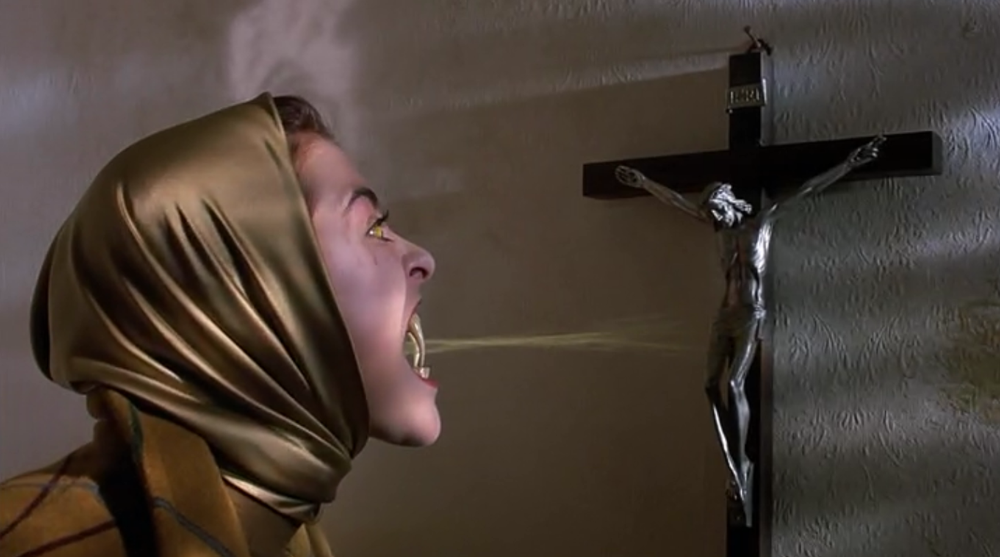
The Company of Wolves

Although it came during the cycle of werewolf movies of the early 1980s, Neil Jordan's The Company of Wolves (1984) doesn't have much in common with The Howling or An American Werewolf in London and their imitators. Apart from a taste for gory transformation effects, The Company of Wolves comes from the tradition of arty European horror movies from a decade or so earlier, indeed going back to the likes of Cocteau's Beauty and the Beast or Jaromil Jires's Valerie and Her Week of Wonders. Like these films, The Company of Wolves reinterprets the Gothic through a modernist lens, influenced as much by surrealism and by the various European New Wave movements as by the then-contemporary norms of the horror movie. Its director claims that it's not a horror movie at all, but there is a whiff of self-interested deflection in that pronouncement. And besides, Jordan has made several other horror movies of a similar bent, so it's not like a horror movie is out of character for him. But in some ways, he has a point. There is certainly an otherness to The Company of Wolves that sets it apart from its contemporaries.

Tuesday, February 03, 2015

Imitation of Life

Benedict Cumberbatch in The Imitation Game

The Imitation Game (2014, directed by Morten Tyldum) aims to right an historical wrong. It postulates that the mathematician, Alan Turing, was responsible for winning World War II, or at the very least, was responsible for shortening the war by several years and saving 14 million lives and preserving the remaining cities of a shattered Europe in the process. Further, it is outraged at the thanks Turing got for his trouble. This is all couched in a biopic that is formally adventurous only when it serves its thesis, though that may well be often enough. In any event, it has good actors, which is always a plus when faced with those terrible words, "Based on a true story..."

Wednesday, November 05, 2014

Field of (Broken) Dreams


I don't know what to make of director Ben Wheatley. He obviously knows how to make a good film. Whatever my complaints with Kill List or Sightseers, they're testament to a major genre talent, but one who makes inconsistent, frustrating films. A Field in England (2013) doesn't change my mind on him. If anything, it's his most impenetrable film; a bad head trip.

Tuesday, October 28, 2014

The Worm Turns

Amanda Donohoe in The Lair of the White Worm

Ken Russell's dalliances with the horror genre were always perverse. Whether the artsy take on nunsploitation in The Devils or the evolutionary visions of Altered States or the Romantic freakout of Gothic, Russell always approached the genre obliquely, using its imagery but eschewing its narrative tropes. A rare exception to this is The Lair of the White Worm (1988), which has a conventional horror movie plot--taken from Bram Stoker's worst novel--upon which Russell hangs his usual altered states of consciousness and psychosexual derangement. It's as looney a horror movie as the 1980s ever produced--which is saying something--though it's perhaps less strange than some of Russell's other films. It's a matter of degrees informed by the history of the director rather than by the genre's standards themselves. Russell, whatever his faults, was one of a kind.

Wednesday, July 16, 2014

A Death in the Family

Paddy Considine in Honour

I'm at something of a disadvantage when it comes to writing about the British crime film, Honour (2014, directed by Shan Khan), because I don't want to step into the landmine of racial politics it engenders. It would be easy--poisonously easy--to deplore the cultural norms that give rise to honor killings in the Muslim world in a way that crosses into outright racism. The last thing I want to do is turn myself into Richard Dawkins, railing about the awfulness of Islam. The world isn't that simple and Islam is not monolithic. The film itself is intensely aware of its racial politics, but charges ahead with its story anyway.

Thursday, December 12, 2013

Dirty Laundry

Judi Dench and Steve Coogan in Philomena

I saw a headline on one of the entertainment sites a few days ago that posed the question of whether or not Stephen Frears's new film, Philomena (2013) was anti-Catholic. Given the subject matter of the film--the sorry history of the Magdalene laundries is central to its narrative--I'd say it's not anti-Catholic enough. This film goes out of its way to be understanding, but I can't imagine the headspace that permits its heroine to forgive. I'm much more inclined to less Christian reaction, myself, especially given that this is a "true story," as the saying goes.

Wednesday, October 30, 2013

Not Constantinople

Gemma Arterton in Byzantium

For a filmmaker who isn't normally thought of as a genre director, Neil Jordan sure does make a lot of horror movies. Byzantium (2013) is his second vampire film, and acts as a kind of distaff companion piece to Interview With the Vampire. Jordan is attracted to the Gothic roots of the horror film, which are on full display in Byzantium, a film that nests flashbacks inside flashbacks, and spirals around its narrative to come at its core elements obliquely. Those core elements are the two great themes of the Gothic: sex and death.

Wednesday, October 09, 2013

A Round on the House

Russell Covey, Richard Coyle, and Ruth Bradley in Grabbers

The premise of Grabbers (2012, directed by John Wright) is what you would get if Ealing Studios back in the early 1950s had been into monster movies. A meteor containing monsters that eat humans crashes off the coast of Erin Island north of Ireland. Humans who are drunk are toxic to the monsters, so bottoms up! It's like Whiskey Galore crossed with It Came from Beneath The Sea. It's ridiculous, of course, as all mash-ups are. Once you get past that, you begin to see its charm.

Monday, August 26, 2013

Pub Crawl

Simon Pegg, Nick Frost, Paddy Considine, Martin Freeman, The World's End

I had a pretty good time at The World’s End (2013), the third film in Edgar Wright and Simon Pegg’s loosely connected “Cornetto” trilogy. My long-suffering partner laughed her ass off at the film, and this soothes my conscience, given that I’ve dragged her to movies that have traumatized her in the past and given that she sat through Edgar Wright’s last film, Scott Pilgrim vs. The World, in a resentful, stony silence. (Her remarks afterward: “Well, that was stupid.”). I can’t ignore this part of the filmgoing experience because having a companion who is having a visibly bad time can poison the well and having the opposite can likewise sweeten the pot. The movie itself isn’t bad, but it has its problems and even though the experience of watching it was good, that doesn’t necessarily I’m ignoring those problems. At another time, at another showing, I might have had an equally bad time. This is why you should take all film writing with a grain of salt—especially mine—because it all exists in the liminal spaces of value judgments and emotional responses. It’s all unreliable. For myself, I don’t even trust myself over time. But I digress.