Wednesday, December 15, 2010

Devil May Care


Ji-Woon Kim's new film, I Saw the Devil (2010) has already developed a rep for its elegant brutality. There's no question that it's a hard film to watch. Without the director's sense of style, it might well be unwatchable. I don't know what it is in the Korean national character that puts them so in touch with revenge, but the Korean cinema of vengeance is one of the most striking categories of film that I can think of. This is very much in the mode of Park Chan-wook's vengeance trilogy, though it is, perhaps, a shade more lightweight when it comes to the philosophy of vengeance. Kim's films are never deep. They are all style.


The story here follows Joo-yeon, a secret service agent played by the ever-elegant Byung-hun Lee, who, upon the murder of his fiance, tracks down the killer and exacts his revenge. The killer in question is Kyung-chul, played with a grungy, sick kind of menace by the amazing Min-sik Choi. Choi furthers the mental association with the Vengeance trilogy. His character here is more in line with the one he plays in Sympathy for Lady Vengeance than with his lead in Oldboy, but you get the picture. For his part, Kyung-chul is completely unrepentant. He has his needs, and he makes no apologies for satiating them. This is surprise number one. Given the nature of the film's plot, there must have been a strong temptation to render Kyung-chul in sympathetic terms. Perhaps not in terms of forgiveness, but at least in terms of pity. The filmmakers don't do this. Kyung-chul is NOT Peter Lorre's character in M. He's a full bore monster. Surprise number two is what Joo-yeon does once he finds Kyung-chul. He punishes him, sure. But then he lets him go. The film even comments on this in the actual text of the movie when Joo-yeon's sister asks him what the point of "catch and release" is. Joo-yeon doesn't answer, but the audience already sees the way the movie is going to go. Joo-yeon gazes too long into the abyss and the abyss gazes also into him.


As I say: Intellectually, this movie is kind of a lightweight. Its overall thesis is that vengeance is dehumanizing, but it never goes any further than that. Hell, revenge stories going back to the Jacobean era at least--hell, back to Homer, for that matter--have postulated the exact same thing. When the movie states its thesis outright about halfway through its longish running time, there's not much else to do but watch the whole clockwork assembly demolish itself. There is certainly pleasure to be had from watching it do so. Kim is nothing if not generous with his set-pieces, and, boy howdy, does he know how to film them. There is ONE scene, however, that suggests another direction for the film: Kyung-chul commandeers a taxi, kills the driver and his passenger, then finds a body in the trunk. This is an awesome "WTF?" moment that suggests an entire world gone mad. Does everyone have dark secrets? In the worldview of this movie, they most certainly do. For the record, the taxi scene is astonishing. It's one of those scenes where you look at it and wonder how the hell they did it, although this wonderment is all but overwhelmed by the violence of it. Much the same thing could be said of the movie as a whole. The last forty minutes are an endurance test. You can't really take your eyes off of it, but you can't really bear watching it, either. In some ways it's the equivalent of the Ludovico technique.


For their part, the leads give committed, well conceived performances. Min-sik Choi, as I say, lays on the menace. He's the kind of character who makes you want to take a shower after spending any amount of time in his presence. There's a scene where Kyung-chul attempts to rape a nurse that Choi plays with all the dead-eyed soullessness one ever wants to see. It's a kind of deadpan, and one can imagine it as the personality of Henry Lee Lucas or Richard Speck. This character approaches his needs like some kind of chore; murder and rape seem like an unpleasant biological function for him. Not like masturbating, perhaps--the film shows a different killer who masturbates to thoughts of his crimes--but more like removing a tick, or defecating. It's something he has to do to function and the actor makes you believe in him. If the film has an enduring value, it's in this performance. I can't imagine a better depiction of a serial killer. Byung-hun Lee, on the other hand, has a more difficult character. His character is a movie character. You can't really imagine him in real life. In this regard, the filmmakers rely on the screen personae of the actor's other roles. Joo-yeon's elegant lethality is a close cousin to Lee's performance in A Bittersweet Life. Lee certainly inhabits the role, but he's kind of hamstrung by the murky motivations provided for the character and by the "movieness" of it. He holds the screen--being ridiculously good-looking helps him in that regard--but if he spent more time sharing the screen with Choi, he might find himself swamped. It's Choi's movie, really, but both performances are worth the price of admission, regardless of what one ultimately thinks of the film's set-pieces.


So, yeah. I'm kind of ambivalent about this movie. I think I like it better than The Good, the Bad, and the Weird, if only because it forgoes the dizzying kinetic style of that movie. But that may be external circumstances asserting themselves, too. I don't think Kim is really growing as a filmmaker. One misses the delicate hand behind his earlier movies, rather than the bludgeons he's using these days. He's obviously still capable of delicacy. You see it in flashes in this movie, but only for short periods. The rest of the time, it's back to blunt force trauma. Blunt force trauma can be bracing once in a while, but not as a regular diet. I Saw the Devil is definitely worth a look if you have a stomach for it, though.

Monday, December 13, 2010

Angry Hornets


There's a point in one of the courtroom scenes in The Girl Who Kicked the Hornet's Nest (2009, directed by Daniel Alfredson) where a ghost of a smile crosses Lisabeth Salander's face. It's at that point that she's won the game, the set, the match. Her courtroom opponents know it, too, and you can see the defeat dawn on them. It's a pretty satisfying close to the character's story arc.

As I was driving home from the theater, it occurred to me that this film is eerily similar to the Wikileaks saga currently playing out in the news. Blomkvist is certainly the same kind of egoist that Julian Assange appears to be, and his "bring the truth to light at all costs" attitude is the same. That which is evil shuns the light of day, and all that. I think I can guess where the late Stieg Larsson would have come down on the issue. This all recalls the destruction of Elliot Spitzer, as well. Who says these things are farfetched?


For all of that, this movie is kind of an anti-climax. It almost can't help but be an anti-climax, since its main narrative function within the trilogy is as a kind of summing up. It ties up the loose plot threads left dangling from the previous installments. It's also the entry in to the series where the characters are more or less set. We don't learn much more about either Lisabeth Salander or Mikael Blomkvist than we already knew from the previous films. This is unfortunate, I guess, given that the characters are the main reason to watch. Oh, we get a good deal more of both Blomkvist's editor/lover, Annika, and a LOT more of his sister, Erika. We also get another sympathetic male character in the doctor who treats Lisabeth for the wounds suffered at the end of the last movie, but it's not these characters who are of primary interest. Salander, who is the center of the movie, is kind of a cipher here. She has fewer lines than any lead character I can remember (fewer than Mel Gibson in The Road Warrior, fewer than Clint Eastwood in any given Man With No Name film). For that matter, as in the last film, Salander and Blomkvist don't share the screen together until the very end of the movie. In all, it's kind of awkward, actually, though given the final reconciliation between Salander and Blomkvist, maybe that's the point. Lisabeth is unused to receiving help, let alone help from a man, so one can sense the effort it takes her to express gratitude. Blomkvist, for his part, owes her his life, so he'll go to the ends of the Earth. Thankfully, this film chooses to forgo the first film's ridiculous sexual relationship between the two. Salander remains a defiantly queer, defiantly unconventional heroine to the last.


The story here resumes at the point where the previous movie ended. Lisabeth is recovering from her various wounds from the previous film (including a bullet in the head) while charges are brought against her for the attempted murder of her father, the monstrous Zalachenko. Meanwhile, her half-half brother, Neidermann, has eluded the law and lurks in the background, waiting for a chance to kill her, while Zalachenko's shadowy government handlers are conspiring to make sure that Salander is never believed when it comes to who is really behind everything. They expand that conspiracy to include Blomkvist when they realize that he has more information than they're comfortable with, the credibility to be believed, and the means to disseminate it through his Millennium magazine. To this end, they attempt to rig her trial. Meanwhile, Blomkvist is contacted by another element of the government who are investigating the secret cabal who ran Zalachenko. It all comes to a head in the courtroom, where Salander's former psychiatric abuser, the monstrous Dr. Teleborian, makes his case that she needs to be remanded back to his sanitarium for the criminally insane.

I think the mistake that these movies make, after the first one, is that they personalize the thriller. The first one featured an impersonal mystery, and it was by far the most satisfying of the three. As an example: this is what you would get if Holmes's brother Mycroft was the secret controller of Professor Moriarty. It's a paranoid's fantasy, and it hurts the movies.


Noomi Rapace remains the reason to see the movie. She does more with less in this movie than any actress I can think of, and that ghost of a smile I described is just the tip of the iceberg. When she fences with the prosecutor, you can sense both a formidable intellect and a barely veiled contempt for her accusers. Michael Nyqvist is fine as Blomkvist, but I can see any number of actors in his role (Daniel Craig, scheduled for the Americanized version, seems as good a fit as anyone). Rapace, on the other hand, makes the role her own. When she's on screen, you can't take your eyes off of her. I pity any actress who attempts the part in the future. Rapace sets an almost impossibly high standard.


Sunday, December 12, 2010

Deathly Chill


The penultimate Harry Potter movie, Harry Potter and the Deathly Hallows Part 1 (2010, directed by David Yates), is without exception the most melancholy film in the series. Given the way the narrative is has been split, and given that the center of the source novel--to which, this film is slavishly faithful--is the dark heart of the Harry Potter series as a whole, this is to be expected. What IS surprising, though, is just how much like a horror movie this plays. Oh, the Potter movies have dabbled in horror before (particularly near the end of the fourth movie), but this one combines both the events that drive the plot with image and archetype in a way that is new to the series. I'm thinking of two scenes in particular:

Harry and Hermione visit the site of the Potter family's fatal encounter with Lord Voldermort, only to meet Bathilda Bagshot, a magical historian with deep knowledge of the life of Dumbledore. This is, of course, of great interest to Harry, given that Dumbledore left him no concrete instructions and only vague hints as to what would be required of him. So he follows her back to her home. The movie adds a subtle--very subtle--insect buzz when we are introduced to Bagshot, and the movie makes good on the promise. When she deteriorates and returns to the form of Voldermort's snake, as Hermione discovers the source of the fly buzzes, the movie has crossed firmly into horror.

But it doesn't stop there.

Late in the movie, our young heroes are caught by a group of "snatchers," who take them to the mansion of Lucius Malfoy, where Voldermort's second in command, Bellatrix Lestrange imprisons Ron and Harry and proceeds to torture Hermione for information. While we're not shown what happens in explicit detail, the way this is filmed recalls certain "torture porn" horror movies. It's surprisingly effective and surprisingly intense given the traditional audience for the Potter movies. But then, that audience has grown up with Harry, so perhaps it's not as much of a trauma.


In any event, the filmmakers have given this particular adaptation five hours to unfold, and in doing so, have released screenwriter Steven Kloves from trying to pick and choose from elements of the book in order to distill its plot. This film pretty much includes everything. It kind of has to include everything, because huge chunks of the preceding movies really do need some kind of explication. Fortunately, Rowling and her interpreters have provided that explication. Also, by decompressing the narrative, one really gets a sense of time passing for the first time since the third movie. The later Potter movies have felt like they rush from plot point to plot point without time for anything else, so it's a welcome change, even if director David Yates doesn't let his characters even crack a smile. Yates certainly does his level best to evoke gloom with this movie, which does dismal the way only the British do dismal. It's a particularly joyless movie, actually.

It's probably my second favorite of the movies, for all of that.

As I say, this a melancholy film, and it strikes that tone from the outset, as it details childhood's end for all three of our young heroes. Harry watches as the Dursleys pack up and leave his childhood home--unhappy as it may have been, it was a stable safe haven for him. He looks longingly at the closet under the stairs where he lived as a boy. Ron gazes out at the horizon as his mother and sister prepare for his brother's wedding. He knows that his safe haven will be coming to an end, too. And Hermione reluctantly wipes all trace of herself from the lives of her muggle parents. This sequence does not portend a joyous carnival of wonders, nor does the film deliver such a thing. David Yates is a depressingly literal director, but in the case of this particular story, letting the story carry the weight of the world may actually be a wise move.


The main flaw in the movie, apart from the incomplete nature of the story, is that it contains a lot of non-action. It takes this fault from the book. It makes the best of it, and it does give our trio of young actors the chance to show just how good they've become by absenting them from the legion of British worthies in the cast, but it brings things to a screeching halt. Also, one misses Michael Gambon, and Alan Rickman, who both get what amounts to cameo roles, while things aren't much better for Robbie Coltrane, Brendan Gleeson, and David Thewlis. When things do pick up at the end, the movie is commandeered by Helena Bonham-Carter's off the hook performance as Bellatrix Lestrange. Jason Isaacs is in this part of the movie, too, but he gives a very different account of Lucius Malfoy than the one from previous movies. The arc of his character (and of the Malfoys in general) is not one for a barnstormer, and Isaacs dials it back appropriately. Unfortunately, this leaves a void that Bonham-Carter is more than happy to fill.


In spite of this, it's up to Daniel Radcliffe, Emma Watson, and Rupert Grint to hold the screen for almost all of the movie, and they do an admirable job. They've all become really fine actors. Never mind the series' various directors, the biggest influence on this movie is the team that cast Harry Potter and the Philosopher's Stone all those years ago. I mean, it's one thing to populate a movie with amazing actors who are known to be amazing actors. It's quite another to see amazing actors in a trio of raw ten year-old kids (they performed a similar feat with Tom Felton and Bonnie Wright, as well). Daniel Radcliffe in particular has an amazing future ahead of him after Potter. He really has become a fine actor and a totally adorable man. In some ways, this movie is his coming-out party. It bodes well for the second half. It doesn't hurt that J. K. Rowling managed to close the series with the best of the books. Good breeding will show eventually.


David Yates does take one interesting chance with this movie. Nestled into the second half of the movie is the story of the Deathly Hallows, three objects that, when combined, provide the one who has them with ultimate power over life and death. The story of the Deathly Hallows is contained within a storybook that Dumbledore leaves to Hermione, and when the time comes to relate the story, the movie reverts to animation. The animated portion of the movie is a striking example of CGI disguised as bunraku puppet theater and cut-out animation a la Lotte Reiniger. Like the rest of the movie, it's a melancholy fairy tale, but it's such an unexpected shift in idiom that it's a delightful surprise. This is the seventh movie in the series, and that it is still capable of surprising the audience is a testament to how rich a creation the Harry Potter movies have turned out to be. I took Roger Ebert to task for declaring the first of these movies to be an instant classic. At the time it seemed like a ridiculous and completely unreflected opinion. But he was right and I was wrong. These movies are built to last.


Friday, December 10, 2010

The Films of Robert Aldrich: World for Ransom


Aldrich's career got off to a rocky start. His second feature, World for Ransom (1954), lists Aldrich as a producer, but omits his directorial credit. I get the feeling that this was deliberate. It's not a very good movie. It IS an interesting movie, though, mainly as a kind of ur-Kiss Me Deadly, but also as a bridge from Aldrich's television work.

This was filmed on the sets of the television series "China Smith," for which Aldrich directed two episodes, and features most of the cast members from that show, including Dan Duryea in the lead. Duryea plays an American vagabond kicking around Singapore who falls into the role of gumshoe on the trail of a kidnapped nuclear expert (the movie describes him as "a combination soldier of fortune and beachcomber"). The set-bound parts of the film even LOOK like fifties television. To its credit, this film isn't a re-packaging of episodes for movie theaters (as was occasionally done at the time), but an actual new story nominally unrelated to the show.


In its broad outlines, this is Aldrich's first dalliance with the nuclear age, which is the obvious link to Kiss Me Deadly. Less obvious is the general contempt Aldrich seems to feel for his private eye lead character, who is presented as a bit of a sleazeball and as a shiftless barfly. Duryea inhabits the role effortlessly, and perhaps with a bit of method acting derived from a bottle. His face by this time was kind of a wreck for a leading man. The movie is also populated by a terrific roster of character actors, including Reginald Denny, Keye Luke, Gene Lockhart, and Nigel Bruce (in his last role). Strother Martin shows up in an unbilled bit part. The femme fatale is played by Marion Carr, and her character is a bundle of confused motivations: married to Duryea's best friend, but in love with him. In all, it's an interesting cast, and Aldrich, never one to restrain his actors, lets them chew the scenery. In spite of this, the film never really comes alive. I suspect the speed with which it was made--a mere 10 days--contributes to the awkward line readings throughout the movie. There's also a good deal of miscasting. Certainly, Gene Lockhart is too cuddly an actor to play a criminal mastermind. I get the casting against type, but the actor doesn't rise to the challenge.

The film's last act turns into an action film, and in this regard, it loses more than a little of its credibility. After staggering through the first half of the movie, Duryea turns into a killing machine? Hard to believe. Oddly enough, the second half of the film seems like a template for a James Bond movie. It works better than the early parts of the movie, in any case, but Aldrich is pretty sloppy with his camera placements during the actions scenes (see also, Apache, Vera Cruz), and probably filmed it so fast that coverage shooting was only a pleasant dream. This is very much a journeyman work, in spite of the signature flourishes that occasionally mark the film (it takes an explicit poke at colonialism at one point). It's not unwatchable, but, in all, it's pretty minor.


Thursday, December 09, 2010

La Música de la Revolución


“The Third World is not a reality but an ideology.” --Hannah Arendt

It's hard to look at The Violin (2005, directed by Francisco Vargas) and not see politics, but like the Italian neo-realists before them, its makers couch its political philosophy in the faces of the downtrodden and in a common humanity. It's a tough balancing act: too much politics and it becomes a polemic. Too much humanity and it loses its tooth as a rage against the machine. The Violin isn't entirely successful in navigating that razor's edge, but it navigates it well enough.

The story here follows a family of musicians in a time of guerrilla war. The country is never named, but we are taken to understand that the film is set during Mexico's peasant uprising of the 1970s in the state of Guerrero. The central character is Don Plutarco Hidalgo, a man who cannot work his land due to the ongoing conflict. He and his family--a son and a grandson--make music to get by. Don Plutarco is a violinist, in spite of missing his right hand. He straps a bow to the stump and goes to town. His son is up to shadier things, helping out the guerrillas against the repressive government forces while searching for his wife. Don Plutarco, for his part, is a passive combatant, and during the course of the movie, he's our guide through the complaints of the oppressed people. He trades a year of his crops to a wealthy landowner in exchange for a mule. The landowner hands him a blank sheet to sign; he'll fill in the details later. He then visits with the commander of the local government forces, who has a yen for music. He insists on keeping Don Plutarco's violin. If Don Plutarco wants to play, he has to return and play for the commander. Indeed, the commander wants to learn to play himself. During their conversations, the commander tells Don Plutarco that, if it were up to him, the soldiers would be gone already. He seems a reasonable man. The end of the movie, however, demonstrates Hannah Arendt's awful banality of evil: it's usually reasonable men who commit at atrocities. Don Plutarco's last line is bitter and haunting: "The music is over."


This is all filmed in a stately black and white that recalls the depression-era photographs of Walker Evans and Margaret Bourk-White. Director Francisco Vargas, directing his first movie, lingers on the face of Ángel Tavira, the first-time actor who plays Don Plutarco. It's the kind of seamed peasant face that seems to have a kind of eternal grace to it. It's the kind of face that seems carved specifically for black and white photography. The film has deliberate echoes of other leftist art, too, particularly John Steinbeck. There's a scene in which Don Plutarco explains the origin of war to his grandson in an elegant, mythic argument for socialism while the camera slowly moves over the smoldering coals of their fire that recall's Tom Joad's "I'll be there" soliloquy in John Ford's The Grapes of Wrath. It's a beautiful scene.


The film missteps at its outset. The opening scene features a faceless guerrilla being tortured by the soldiers, followed by a snippet of one of the female guerillas being raped. These scenes prejudice the viewer from the outset and makes one rather more suspicious of Comandante Cayetano (Silverio Palacios) than is good for the movie. It's important that the viewer see Cayetano's basic humanity for the film's final effect to strike home, and by opening the film the way he does, Vargas almost bungles the whole thing. Fortunately, the bulk of the film recovers from this enough to put some distance between the end and the beginning, but this is a flaw too, given that the point of the film is to elide the bad things that are going to happen to our protagonists once the game is over, and by placing the opening in the viewer's memory, it is intended to send a chill through the viewer as the movie plays the audience out to the exit. So as a narrative structure, this has deep, possibly irreconcilable problems. Still, the rest of the film is of such beauty that it mostly overcomes the awkwardness of its design.


Blogorama Part III

I've been enjoying the blogathons, so I'll be contributing something to the Tod Slaughter Christmas. Thanks to Joe over at From Beyond Depraved for inviting me. This should be fun.


Some Housekeeping Matters

My blog traffic has been way up this month, thanks in part to the Naschy blogathon and to residual traffic from the October Challenge. Welcome to all the new visitors and followers. I'm happy to have you.

Unfortunately, the spike in traffic has been accompanied by a bunch of spam comments, so for the time being, I'm moderating my comments. I hate doing this, but I'm getting annoyed by the spammers. And so it goes.

I've been blogging here (more or less) for the last five years, but it's only been in the last few months that I've hit my stride. This has been a great year for me, and hopefully, next year will be even better.

Tuesday, December 07, 2010

A Beast, that Wants Discourse of Reason


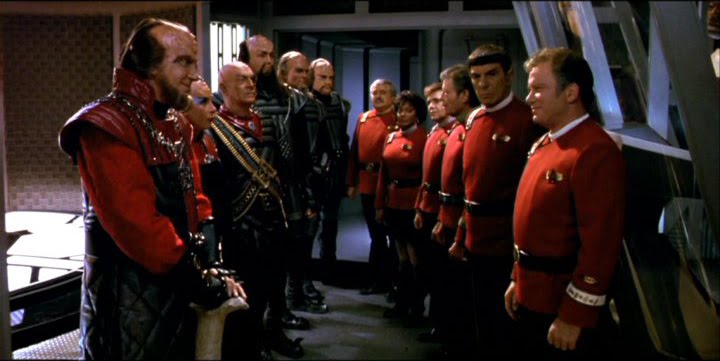
It's usually taken as a given that Star Trek films from II to IV form a kind of a trilogy, but upon revisiting Star Trek VI: The Undiscovered Country (1991, directed by Nicholas Meyer), it becomes clear that that's not technically true. It is rather, a quartet. The Undiscovered Country acts as a capstone to the story begun by director Nicholas Meyer in The Wrath of Khan in a way that Star Trek IV does not. It resolves, among other things, Kirk's lifelong enmity with the Klingons, Spock's struggle with his human half, and the Federation's culture of perpetual war (long an odd element of a future envisioned as humankind on the advance). Like many Star Trek projects, this film is an allegory. Unlike some of Star Trek's other allegories, this one refrains from preaching by virtue including too many other interesting elements to distract the audience. It's a political thriller, and a submarine movie, and a prison movie, and a whodunit all rolled into one. This all serves the film as a clever disguise. It's also the most cinematically interesting Star Trek movie since the first one. Or, hell, maybe including the first one.

The story here finds the moon where the Klingon's manufacture most of their energy exploding at the outset of the movie, creating a humanitarian crisis for the Federation. Spock, at his father's request, has opened a dialogue with the head of the Klingon high command, Chancellor Gorkon, with an opportunity to declare an end to seventy years of hostility between the Federation and the Empire. Unfortunately, there are those on both sides of the Neutral Zone who would prefer a continuing state of war, and many in the Federation who feel that the Klingons can never be trusted. Kirk, still mourning the murder of his son in the third movie, is among the doubters. When Spock volunteers Kirk and the Enterprise as ambassadors to the peace talks, Kirk demures. "Only Nixon can go to China," Spock quips. "They are dying." Kirk replies: "Let them die."


The rest of the movie concerns an assassination plot aimed at Gorkon, and then at the head of the Federation at the peace talks. The Enterprise is framed for the murder of Gorkon, for which Kirk takes the fall as Spock and the crew race to uncover the true assassins. Kirk, for his part, is transported to a Klingon prison planet after a kangaroo show trial. He escapes, the conspirators are uncovered, and the plot is foiled in the end. I think I can safely give away the end of this movie. Does anyone really think that our heroes will fail in the end? No.


What's really interesting about this movie is the way it turns Kirk into Ethan Edwards. Kirk is certainly a John Wayne-ish part anyway, but this turn of events is a specific echo of Wayne's racist hero in The Searchers. Like Edwards, Kirk is a hero in spite of his racism. Part of his heroism in the movie is in overcoming that racism and doing the right thing. Kirk's inner turmoil here is actually well-handled even if the other racial allegories are ham-fisted. "Guess who's coming to dinner," quips Chekov, in one of the film's more obvious references. But before the whole thing becomes choked with its own self-importance, the game, as they say, is afoot and the film turns Sherlockian for a while. Then into a political thrills. And then the naval battle. One even forgets the racial allegory for a while, even as the political allegory (about the end of the Cold War) comes fully to the fore. In any event, it's a film that doesn't stop long enough to be pinned down.

This is the first film in the series that really thinks through its shot compositions in anything more than a strictly utilitarian manner. The blocking of scenes is important in this movie. This shot, for instance, shows the distance the film's plot puts between Kirk and Spock:


While the sequence where this shot occurs spins around Spock and Valeris in a slow, dizzy approximation of the way Spock rapes Valeris's brain to get the information he needs. It's one of the darkest scenes in Star Trek:


Star Trek VI also succeeds where the previous three films failed. It provides the audience with memorable villains. Christopher Plummer is a barnstormer as the Klingon general, Chiang. Nicholas Meyer lets the actor chew the scenery with relish after acquiescing to his request to forgo the hair piece that most Klingon's wear. Of all the Klingons who have crossed the big screen in the various Star Trek movies, Plummer is the one that stands out as an arch villain. It doesn't hurt that he's a Bardolator, spouting Shakespeare all through the movie. This is a honey glazed ham of a performance. Kim Catrall, on the other hand, is much more subtle as Valeris, the traitorous Vulcan. Catrall asked that the name "Eris" be worked into her name somehow, as both a signal of her true calling, and as a clue hidden in plain sight. Poe would have been proud. Meyer is canny about placing Valeris in interesting positions throughout the movie as a kind of gamesmanship with the plot, especially given that the early audiences would not ordinarily suspect that one of the villains was a Vulcan officer on the bridge of the Enterprise. It's a marvelous bit of misdirection. The audience is busy watching Plummer as Catrall worms her way under the skin.


Star Trek VI accomplishes at least one other thing. It allows the original cast the dignity of going out in style, in a legitimately good movie, rather than as laughingstocks in Shatner's vanity Trek. The cast deserved better than that ignominious fate, and this movie voids that indignity. This film feels very much like a valediction. When, at the end of the movie, Shatner/Kirk give the order to head for "The second star to the right, and straight on 'til morning," it's the send-off the original crew deserves.


Monday, December 06, 2010

Morituri Te Salutant


There's a depressing familiarity found in Neil Marshall's latest movie, Centurion (2010). Marshall made a splash several years ago with his harrowing horror movie, The Descent, but it seems as if that movie is an aberration. His other three movies have been of a piece. It's not that he's reworking the same material looking for new interpretations in the manner of a proper auteur. Rather, he's reheating his left-overs. Really, this movie, like Doomsday before it, is a reworking of Dog Soldiers. Marshall isn't growing as a filmmaker. Quite the opposite. All of this pains me to say, because I like Marshall's movies, even the widely derided Doomsday. Any case, Marshall needs a new shtick.

This is another grunts on patrol movie. This time a Roman legion that has been ambushed by Picts has to brave hostile territory to make it home. As in Doomsday, they are hunted by a feral enemy that employs a goth punk warrior huntress against them.

Separated at birth?


As in Doomsday, they make it through their ordeal (at a wall, no less), only to be betrayed by their higher-ups. There's not much more to this. Indeed, some of the characters are so similar to one another that I sometimes lost track of who was who. The one character who does stand out--Dominic West's blue collar General Virilus (who is unusually well-named)--doesn't make it half-way through the movie. One wishes that Marshall had swapped West for Michael Fassbinder, but Fassbinder does okay with what he has, I guess. For the most part, even setting this story during the time of the Emperor Hadrian (he of the famous Wall) rather than during a zombie epidemic doesn't disguise the movie's lack of new ideas.

In addition to recycling his old material, Marshall shows a certain amount of bad taste in his influences. This shot, for instance...


...reminds me a LOT of this painting by Jean Louis Ernest Meissonier:


Meissonier was a darling of popular opinion in his day by virtue of a certain amount of technical virtuosity, but he was a colossally bad artist. Seriously, Marshall needs to widen his palate beyond the kinds of wargaming art favored by fanboys. But even there, he hasn't actually learned anything. He has augmented his already bad penchant for flash cut run and gun action sequences with a preponderance of epic vistas in which human figures become indistinct to the point of anonymity. (Though, in his defense, the action sequences in this movie are more visually comprehensible than the ones in Doomsday, perhaps owing to the lack of motorized vehicles.) Most of the shots in this movie--the ones that don't zero in on some specific violence done to the human body, that is--look like this one:


And that's one of the more intimate shots. Others are aerial shots and still others are landscapes drawn in a computer. I'm exaggerating for effect here, but not by much.

The movie introduces a love interest late in the movie, but one gets the idea that her inclusion is mainly a kind of deus ex machina designed to give our heroes a respite before the big brawl at the end and to act as a source of exposition. The fact that the bad guys think it's a curse to kill her is suspiciously convenient. She's emblematic of a screenwriter trying to extricate himself from the corner into which he's painted himself. For that matter, the reliance on a narrator indicates a similar level of desperation.

I suppose one could justify the movie on the basis of kinetic filmmaking, and if one is only in it to watch the mayhem, I suppose you could get some kicks out of it. This doesn't scrimp on the gore, and it's very inventive with its catalogue of maimings, dismemberments, and decapitations. It leaves out the sex, though, which, if we're arguing that this works as a kind of history porn exploitation movie, is a serious failing (besides, I for one would LOVE to see a naked Michael Fassbender; just sayin'). For the most part, this is yet another of the director's rehashings of Deliverance, gussied up in period drag to give it an air of respectability rather than the whiff of the drive-in. Doomsday had no such pretensions and was a lot more fun as a result. This movie, on the other hand, is not very good or even very much fun, and that's just a crying shame.


Saturday, December 04, 2010

Saturday Spectacle


I grew up as a Marvel Comics fan rather than a DC Comics fan. Oh, I came to DC eventually, and I never really had a block against them. Some of my favorite comics from my childhood were from DC (phrases like "The Composite Superman" and "Adams and O'Neill" warm the hackles of my geeky little heart). But Marvel had a formula that got people hooked. They had a through narrative from comic to comic that had the same addictive property one finds in soap operas. That's something that has been missing from most of Marvel's projects in other media, so imagine my surprise when I discovered that their 2008 cartoon series, The Spectacular Spider-Man, reproduces exactly that hook. For that matter, I was surprised at this late date to find a Saturday cartoon series that's worth a damn at all, let alone one that bears favorable comparison the The Batman Animated Series and its descendants, which is the gold standard for cartoon superheroics. And it does it without aping that series, too.


By and large, The Spectacular Spider-Man comes the closest to reproducing the glory days of Silver Age Marvel of anything I've ever seen. This show is infused with a loving respect for the work of Stan Lee and Steve Ditko and Lee and John Romita Sr., even when it's presenting the Black Suit story and Venom. And it does this while beginning in media res. It skips the origin story. Spidey is already Spidey at the outset, and about to meet his first super villains (it saves the origin story for a particular purpose near the end of the first season). It even gets the chronology mostly right, while throwing in some bones for long time fans. It's an elegant balancing act.


Obviously, there are elements borrowed from the Raimi movies, though that's not a bad thing. It picks those elements very carefully. The depiction of the staff of The Daily Bugle, particularly J. Jonah Jameson, seems plucked directly from the movies, and since to my mind, J. K. Simmons's portrayal of JJJ is the highlight of the films, this is all to the good. Unlike the Raimi movies, though, it fully fleshes out the cast of characters to include Spidey's friends and girlfriends (other than Mary Jane Watson and Gwen Stacy). Hence, we get interesting depictions of Flash Thompson (Peter Parker's high school bête noire), Liz Allan, Rand Robertson, and Glory Grant, in addition to Gwen (who appropriately has the lead girlfriend role) and Harry Osborne. Some of the personal story of Peter Parker is drawn directly from the comics, including the way the series orchestrates the arrival of Mary Jane Watson, which is lifted almost note for note from the comics).


Still, the series isn't slavishly devoted to the comics. It contains some surprises. Its depiction of The Green Goblin, for one instance, is designed to subvert viewer expectations, while it recreates the character of Eddie Brock/Venom from whole cloth. The series' explanation of the alien symbiont is considerably more elegant than the Raimi explanation. Venom is a villain I've never particularly liked, but the show actually manages a tolerable version. It's a nice surprise. Also a nice touch is the presence of The Enforcers and The Sinister Six. In the former case, the show takes its cues from the comic that bears the actual title, "The Spectacular Spider-Man," which is unexpected--there are obviously Spidey scholars among the film's writing staff. In the latter case, you get the ultimate Spidey villain showdown presented in a way that had me grooving on the show the way I used to groove on the comics.


If I have a complaint with the series, it's found in the animation. Oh, the animation during the actions scenes is excellent. It has the kinetic appeal of some of the better anime, from which it obviously draws inspiration. The character designs, on the other hand, are occasionally ugly--J. Jonah Jameson is particularly grotesque--and in the case of the MILF-ish Aunt May, completely wrong headed. Aunt May has an egregious case of what animator John K. describes as "animation hair," which comes off as particularly ridiculous here. Much the same can be said of Gwen Stacy's design. I'll be damned if I can figure out the anatomy of Peter Parker's nose. In all, the villains come off best, but even some of the villains--I'm thinking specifically of The Lizard--seem slightly off, too. Fortunately, none of this is a deal-breaker, though it's disappointing.


Seriously, guys. WTF?


What The Spectacular Spider-Man really does, though, is remind me of why I loved Spider-Man in the first place, a feeling I haven't gotten from the Raimi movies, any previous cartoon version, or, indeed the comics in a very long time (don't get me started on the state of the comics these days). Not only that, but it does so in a way that is bright and fun, but not pandering. The show is made for kids, obviously, but it won't insult an adult sensibility. It's the "bright and fun" part that I find really appealing. I'm getting too old to be a cynic about these things.


As a side note, Sony is releasing this series in a particularly heinous manner. Look for whole seasons, if you're buying, because the other DVD presentations are a complete rip-off. Buyer beware.


Friday, December 03, 2010

Cognitive Whiplash


At about the 16 minute mark of The Hunchback of the Morgue (1973, directed by Jose Aguirre and written again by Paul Naschy's screenwriting alter ego, Jacinto Molina), there's a scene transition of such passing strangeness that it hurt my head. Setting the scene: Gotho the Hunchback is tending to his dying friend, the tubercular Ilse, in the garden at the hospital where he works. He's deeply in love with her, and he's promised to give her flowers every day during the last extremity of her illness. And then, seemingly out of nowhere, the scene shifts to the local women's prison where one of the inmates is enthusiastically flogging her cellmate, who seems to be totally into it. This is a film of non-sequiturs.


After Ilse dies, Gotho comes across two medical students bickering over her gold cross. This so infuriates him that he dismembers them both with an ax. A little later, we meet Gotho's kindly mentor, who turns out to be a mad scientist. I guess the logic here is that where there's a hunchback, mad science cannot be far away, and Dr. Orla (Alberto Dalbés) does not disappoint as a mad labs proprietor.


This is a film that is basically in three acts. In the first act, we get the love story of Gotho and Ilse. In the second, we get Gotho's rage and grief as he flees from the law. In the third, we get a Frankensteinian denouement that shades into the purview of Lovecraftiana. Dr. Orlo, it seems, is building a shoggoth. The movie follows all of this down the rabbit hole with nary a hesitation. Hell, it revels in its own absurdity. Of all the Naschy films I've watched for the blogathon, this is the most singularly deranged. It's also the only one where the filmmakers seem to have exercised some structural planning for the overall design of the film (though it breaks down from scene to scene).


The tonal shifts from scene to scene are jarring. The movie is good at evoking pathos, which it ladles on with a heavy hand. All the better to contrast the various horrors that interrupt the passion of Gotho. This movie is creative with its gore. It's not content to merely chop up corpses and living people with an ax. That's for the bourgeois slasher film audience. No, this film has acid baths and all-devouring creatures. It doesn't spare the ax, either. This has more "what the fuck?" moments than any film I can recall. Perhaps the biggest "what the fuck?" moment doesn't even involve any gore: when Rosanna Yanni's character comes on to Gotho, we're provided with one of the weirdest vanity scenes ever in a career of vanity projects. Though this scene vies with the scene where the filmmakers have set a bunch of live rats on fire for sheer weirdness.


And still, he gets the ladies.

As an aside: The scene with the rats kind of sours me on the movie, actually, for the same reason that the animal cruelty in some Eye-talian films bothers me. Plus, I've had rats for pets; they are curious, intelligent, and affectionate pets and, for me, watching them harmed is a bit like watching a dog or a cat harmed.


Some thoughts on some of the film's other elements:

  • The score for this movie is pretty good. I haven't been impressed with the scores on Naschy's other movies, but this one reminds me a little bit of Maurice Jarre's score for Eyes Without a Face. The carnivalesque liet motif that runs through it is a nice contrast with the film's horrors.

  • The locations/sets for the subterranean scenes provide the movie with a LOT of texture, as do the hospital settings. The location shooting is unusually fine.

  • Naschy throws himself into the part as Gotho, but it seems to me that he's too good-looking for the role. The fright wig he wears doesn't help things. Gotho could have used a more grotesque make-up design. Though, on second thought, maybe more make-up would have hindered Naschy's performances. While I like Naschy and I think he's a perfectly fine actor, I somehow doubt that he could match Charles Laughton or Anthony Hopkins as hunchbacks go. He's just not in that league.

  • The print I watched seemed to have inconsistent elements, with the town scenes showing significantly more damage than the interiors.

  • The film takes a chance when it shows Gotho mutilating the body of one of his tormentors early in the film. This tends to undermine the audience's sympathy for Gotho.


In any event, this seems like a good summary of what a Paul Naschy film usually is. There are moments of poetry and long stretches of schlock. There's a total commitment to even the most absurd ideas. And there's a sense that the filmmakers are kids at heart, making the kinds of monster showdowns they wanted to see at the matinee. That gets to be infectious after a while.

And so, the Paul Naschy blogathon comes to an end. Many, many thanks to The Vicar of VHS over at Mad, Mad, Mad, Mad Movies for inviting me to participate. This has been a blast.


Thursday, December 02, 2010

First Principles


I mentioned a couple of posts back that the first Paul Naschy film I ever saw was Frankenstein's Bloody Terror (1968, directed by Enrique Eguiluz), a film that is more properly named "The Mark of the Wolfman" (as a literal translation of its Spanish title would read). Frankenstein doesn't figure into it at all. Mind you, this IS a monsterific rally film, but "Frankenstein" exists only in the title and in a tacked on prologue from distributor Sam Sherman, who owed his exhibitors a Frankenstein movie. It's a total rip-off, true, but it's a pretty shameless one. I have a certain amount of affection for it. For that matter, I have a considerable amount of affection for the movie itself. I was hesitant to revisit it after all this time, but it holds up remarkably well. Better than remarkably well, actually, because the last time I saw it was on a crap VHS tape recorded in SLP to save tape by the cheapskate fly-by-night outfit that was putting it out at the time. That version was chopped and cropped and was otherwise mutilated. The version I watched for this review was gorgeous. I can well believe that this film looked FAN-tastic on its original 70mm release.

Of course, the film was a first for Naschy, too, in more ways than one. It was his first werewolf picture, and his first portrayal of his signature character, the doomed lycanthrope, Waldemar Daninsky. It was his first film as a screenwriter. The film itself was written with Lon Chaney, Jr. in mind. Chaney was almost certainly WAY too old for the part and declined, leaving it for Naschy. This is serendipitous for the audience, too, because even if Chaney had agreed, there's no way he could have matched the unbridled physicality of Naschy's performance. Naschy, if you'll pardon the expression, was off the leash in this movie.


The story here finds a pair of wandering gypsies taking refuge in the old Wolfstein castle, where, searching the crypts for loot, they find a skeleton with a silver crucifix through its heart. Not being fools, they swipe it. Unfortunately for them, it releases the last Wolfstein from death and he arises as a werewolf to terrorize the countryside. In the hunt for the werewolf, nice guy Waldemar saves his friend, Rudolph's, life, but in the process gets bitten by the werewolf, acquiring the curse of lycanthropy in the bargain. His friends, Rudolph and the comely Countess Janice, enlist the aid of a distant psychiatrist and his partner, who both turn out to be vampires. The movie climaxes with Waldemar, in full-on fang and fur frenzy, taking out the vampires to save his friends. The movie's a lot more complicated than this synopsis would suggest, and I'm sure that the print I watched was still missing some footage, but this film seems a lot less random than some of Naschy's other films. I wonder how much of this can be attributed to Naschy as opposed to director Enrique Eguiluz.


One thing is for sure, though: This is an attractive movie. It's a movie that makes me wonder how much better Horror Rises from the Tomb or Vengeance of the Zombies might have been with more adventurous directors at the helm. The look of this movie is striking, and even lacking the nudity and gore of the later films in the Daninsky cycle, this still generates a marvelous ambiance of menace. The filmmakers make good use of the locations, which are richly decorated by the prop department, and they cover for any deficiencies with a striking use of colored lighting. The whole thing plays as if Terence Fisher and Mario Bava had had their genes spliced and their mutant progeny had turned its attention on the Universal-style monster rally. Some scenes in this film look to be taken straight from paintings by Basil Gogos.

Even given the movie's reliance on werewolf action--a given in any Naschy werewolf picture--there's an otherness to this movie that eludes most of Naschy's other films and turns the "blender" quality of its construction into a kind of dream logic. Two examples. The first is this shot:


...in which there's an actual reliance on symbolism as Wandessa Mikhelov (Aurora de Alba) ensnares young Rudolph (Manuel Manzaneque). I sat up when this shot came on screen, because it wasn't something I was looking for. Naschy's films have a tendency toward utilitarianism, so this is an unexpected and delightful boon. The second example is more complicated: At the end of the film, Dr. Janos Mikhelov (Julián Ugarte), our vampire, abducts our heroine with a wave of his cape. The cut between the cape covering her and where they end up is worthy of the surrealists, and the chase through the ruined castle that follows looks more than a little bit like a refugee sequence from a Guy Maddin movie. It's a beautiful scene.


A recurring feature in Naschy movies--utterly gorgeous women--finds
an early flowering in La marca del Hombre-lobo

You can make an argument that La marca del Hombre-lobo is the beginning of Spanish horror filmmaking. In recent years, Spain has become one of the epicenters for the new millennium's horror renaissance, but it was building on a vigorous tradition. I think this period in Spanish horror reminds me a little of the Hong Kong New Wave in that respect, because immature idioms are sometimes explosions of creativity. There's a direct line of evolution--a quick evolution at that--between this movie and something like Narciso Ibáñez Serrador's Who Can Kill a Child? or even Victor Erice's The Spirit of the Beehive (with its dreamy evocation of Frankenstein's monster), and for that, we can all be thankful.