Monday, October 10, 2022

Sunglasses at Night

I told a friend that Dario Argento's new film, Dark Glasses (2022) strikes me as what you might get if you fed his old film, Cat O' Nine Tails, into an AI filmmaking engine. It would be equally soulless, but maybe that's being unkind. Dark Glasses isn't the same kind of car wreck Argento was making when last we met. Whatever the new film's deficiencies, it is an absolute baller in comparison to his Dracula. Faint praise, I know. For a brief period at the start, I thought the Argento of the early 1970s was behind the camera. The opening sequence is creepier and more suggestive of a world out of joint than the entirety of the director's output this century. But it was not to be...

Friday, October 07, 2022

Childhood Trauma

Invaders from Mars (1986)

In retrospect, Tobe Hooper probably should have walked away from Cannon Films and Menahem Golan and Yoram Globus after the debacle of Lifeforce. Hooper still had cache after directing Poltergeist for Steven Spielberg, and the lingering reputation from the The Texas Chain Saw Massacre, but his three pictures for Cannon were career killers. Cannon had a reputation for producing schlock while over-promising on the quality of their films and one has to wonder if that had something to do with the reception for the remake for Invaders from Mars (1986). There was a staggering amount of talent associated with this film, including Hooper, cinematographer Daniel Pearl, screenwriter Dan O'Bannon, special effects masters John Dykstra and Stan Winston, and a cast of familiar faces, even if there were no big, big stars. And the film itself? It's better than I remembered it being. Mind you, I didn't really understand this film when I first saw it when it was in movie theaters. I hadn't seen the original film as a kid, so I didn't feel its wavelength as a children's movie. Nor did I recognize how thoroughly it reconstructed the original film for the 1980s. I did have the feeling that it was a poisoned fruit from a poisoned tree, which is perhaps not really true.

Tuesday, October 04, 2022

Sins of the Fathers

"Henry, your sovereign, Is prisoner to the foe; his state usurp'd, His realm a slaughter-house, his subjects slain, His statutes cancell'd, and his treasure spent; And yonder is the wolf that makes this spoil" -- William Shakespeare, Henry VI part III

The Cursed (2021, directed by Sean Ellis) is a full-bore Gothic that seems more critical of wealth and power than is usual for the genre. I mean, speaking truth to power is baked into the form even going back to its earliest days, but rarely are Gothic works so explicit and up front with the sins that motivate their plots. Unlike more traditional Gothics, it doesn't conceal its sins behind a veil of plot. It is an inheritor of films like The Fog and The Nightingale in which the villains and their sins are laid bare. It turns the xenophobia of so much of the genre on its head, and shows us the true face of evil: rich white men protecting their stolen wealth from the peoples they stole it from. As such, this is a fantasy, because the villains in this movie get their just deserts. Maybe I'm just being cynical.

Sunday, October 02, 2022

Double Double Toil and Trouble

Hocus Pocus 2

October is upon us again and that means horror movies and the October Horror Movie Challenge. The first film I watched was Underwater, which I wrote about when it was in theaters. This was the second.


I was a grown adult when the original Hocus Pocus came out in 1993 and I never had children of my own, so that film was never part of my childhood. I saw it on television one year and charitably decided that it wasn't for me. I wasn't really planning to watch the sequel, newly released to streaming, but it's had pretty good notices--something the original item never got--some of them from people I admire. So in the wee hours of the morning on the first day of October, I clicked play. Hocus Pocus 2 (2022, directed by Anne Fletcher) is considerably better than the first film, at least, as far as I can remember. It's been a while. As kid-friendly spooky shows go, I could get behind this one if I had little ones of my own. Even as a bitter middle-aged woman, I can see its charms. I'm inclined to Halloween candy more than is probably good for me.

Monday, September 05, 2022

Wedding Jitters

The Invitation (2022)

The main villain in The Invitation (2022, directed by Jessica M. Thompson) looks like someone crossed Sean Connery and Udo Kier in a genetics lab, which for a film like this one is like flashing a big red light to warn the heroine (and the audience) to run away as fast as she can. She does not run away, alas, and gets herself ensnared in a Gothic mansion full of creepy aristocrats and even creepier family history. I sometimes wonder if the Gothic as a mode of filmmaking hasn't worn out its usefulness in the age of microchips and LED lights, and this film doesn't make a case for the opposite point of view. But I also wonder if it's just the filmmakers who make use of it. There's plenty of evidence on screen that the latter case is where the rot resides.

Friday, August 26, 2022

The Grant Mystique: Penny Serenade (1941)

Penny Serenade (1941)

On the Wikipedia page for Penny Serenade (1941, directed by George Stevens), there's a short section detailing a recent "AI colorization" of the film. Curious, I took a look. It looks about the same as colorization has looked for a couple of decades, now, which is to say it doesn't look very good at all except for in fleeting moments. It's in the wrong aspect ratio, too. This particular film is a prime victim for this sort of noodling because when the copyright came up for renewal 28 years after its release, Columbia Pictures neglected to renew it. Thus, it fell into the public domain. As a result, its presentation on home video usually has been awful, with countless editions available from fly by night video companies. Public domain is invaluable and necessary, but it is often a haven for philistines and grifters. Most PD versions of Penny Serenade are short five minutes of movie in addition to the usual defects. It's a shabby fate for a film that contains Cary Grant's first Oscar-nominated performance and a performance from co-star Irene Dunne that the actress herself felt was her very best. For what it's worth, the edition from Olive Films is excellent, sourced from primary materials and restoring the entire film. My screen caps for this post come from the Olive disc.

The story one finds in Penny Serenade follows the marriage of Julie Gardiner (Dunne) and Roger Adams (Grant), from their first meeting through tragedy after tragedy in which Julie loses her unborn child in an earthquake in Tokyo and becomes unable to bear another child. They adopt an infant daughter after a close inspection by the state, only to have her die of a fever. Roger loses the newspaper he owns, and the law refuses to allow them to adopt another child due to Roger's insolvency. Pleading with the courts. The shock is too much to bear. We meet them at the very end, as they are prepared to go their separate ways. The flashbacks that tell their story are keyed to music--they first meet in a music store where Julie works--and the film's vignettes are accompanied by well-known songs of the day (hence the title of the film).

Monday, July 18, 2022

The Films of Robert Aldrich: The Dirty Dozen (1937)

The Dirty Dozen (1967)

When I originally started to write about Robert Aldrich in the early days of this blog, I formulated a list of some of Aldrich's main themes and recurring story elements. Aldrich was a true auteur in so far as his private universe is distinctive and consistent across the entire body of his work. Aldrich had contempt for authority, a deep hatred of Hollywood myth-making, and a preference for protagonists who are individualists caught in a suffocating system. I also had the idea--maybe the main idea when I look at his films--that he made Gothics, and not just the pair of psychobiddy films he made in the early 1960s. One of the key films in my thinking is The Dirty Dozen (1967). On the surface it doesn't seem much like a Gothic film. It's a classic "men on a mission" film--at this point half a century later it's probably THE classic "men on a mission" film--which seems far removed from brooding castles and ghosts and madwomen in attics. But let's look at some of the elements of the Gothic: sublimated sexual derangement, confinement as a microcosm where personalities and psychological forces collide, a sense of encroaching doom, characters haunted by past crimes, a big house that is a character unto itself. Many Gothics--maybe even most of them--are psychoanalytic in nature. If we look closely at the elements of The Dirty Dozen, most of these hallmarks are actually there, including the psychoanalytic nature. This is the frame into which Aldrich slips his own private obsessions. The Dirty Dozen is one of the key works on his resume. Even if it hadn't been a gargantuan hit, it would be an important film. It was a gargantuan hit, though. It was the highest grossing film of 1967. Its success enabled Aldrich to form his own production company in order to keep working on more personal projects, at least until he found another gargantuan hit. It took him a while to find that next hit, and he went through The Dirty Dozen's capital--both social and commercial--in due course. But that, as they say, is another story.

Monday, June 27, 2022

The Future is Now

Crimes of the Future (2022)

There's a sense of the world moving on in David Cronenberg's new film, Crimes of the Future (2022). A lot of Cronenberg's films seem like they depict a world on the brink of collapse, but this one seems like it takes place afterwards, rather than on the brink. The director has watched the world tumble over the falls in the decade since his last movie, precipitated by many of the very things that make up the unease and horror in his earlier films: a pandemic, right wing conspiracies, unfettered capitalism, a brain-washing media landscape. The various apocalypses postulated in the director's earlier films are a fait accompli at the present historical moment. In Crimes of the Future the director says, "yeah, all that happened and this is the result: a world in which no one can feel anything anymore. "

Friday, May 27, 2022

A Hymn for the Red Planet

I bought a copy of The War of the Worlds (1953, directed by Byron Haskins) during a recent Criterion Collection sale. When my long-suffering partner saw it in my stack of loot, she said: "You'll be watching that one on your own." The ticking of the Martian war machines gives her nightmares. When I popped it into the player at home, that ominous ticking was the soundtrack for the menu screens. She threw up her hands and walked out of the room after ostentatiously slamming the door to drown out that sound. It's a fair reaction, particularly if you first encountered the film at a young age. It still resonates. Once you've heard it, you never forget it.

Sunday, May 15, 2022

Free Falling

A Free Soul (1931)

There is an unspoken assumption among some connoisseurs of American pre-Code cinema that the shocking freedom these films enjoyed was somehow linked to a progressive attitude toward social mores. The willingness of filmmakers and studios to take on such "forbidden" subjects as drug addiction, abortion, sexually liberated women, racial issues, and what have you might suggest that the filmmakers and the studios were in the forefront of social and moral progress. This is a mistaken assumption. While it is true that the Hays Code absolutely was a mechanism for conservative social engineering, that doesn't mean that every film that flouted it was on board with an opposing viewpoint. Sometimes, filmmakers used their freedom to demonize that very freedom. No one could have accused a filmmaker like, say Cecil B. DeMille of being socially liberal, and it was one of his films that more or less brought about the end of the pre-Code era. Films like Female, Baby Face, Call Her Savage, or Torch Singer were all retrograde critiques of the sexual liberation of women hiding behind their sexual frankness and racy imagery, with many of their "liberated" heroines repenting and eventually settling for their more "natural" roles as wives or mothers. While this narrative was often played ironically with its fingers crossed behind its back, sometimes it was in deadly earnest. One such deadly earnest version is found in A Free Soul from MGM in 1931, directed by Clarence Brown. It's a film whose only brush with irony is its title. No one in the film is free and that's the way the filmmakers like it.

Saturday, March 19, 2022

True/False 2022: Wayward Daughters and Hot Volcanoes

Sirens (2021)

All of the films I saw on my second day at True/False were directed by women and were by and large about women and relationships. I didn't plan this. Hell, I rarely plan anything when I'm at the festival because nothing ever lines up the way I expect. In recent years, I've picked my films based on what venues have the most comfortable seats. I'm getting old and my back and my ass appreciate this. I would recommend this approach at any film festival, not just True/False. You have to trust the festival programmers for this, and they mostly know what they're doing. Mostly.

In any event, seeing a slate of movies by women was pure coincidence, and not an unhappy one.

Friday, March 11, 2022

True/False 2022: People Watching and Shoot 'Em Ups

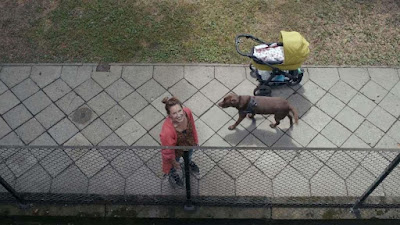
The Balcony Movie (2021)

I took last year off from my city's annual True/False film festival. It was the first time I'd missed the festival in the seventeen years it's been in existence, but I have trust issues and co-morbidities that make me disinclined to stick my neck out into a global pandemic. You know how it goes, sometimes. I'm fully vaccinated this year and the festival is being militant about safety protocols, so I'm back this at it. The experience of being in crowds has changed. Crowds are now fraught and anxiety-inducing. Once I was in the auditorium, I was thankful that I could shrink the scope of my world to just me and what was on the screen.

Saturday, February 19, 2022

Carrying on the Family Business

Ghostbusters: Afterlife (2021)

Ghostbusters: Afterlife (2021, directed by Jason Reitman) is two thirds of a good movie. That two thirds of a film are better than any comparable running time in any other Ghostbusters film, including the original item. This should not be a surprise. Jason Reitman is a better director than his father ever was, and is a better director than Paul Feig. He's better at blocking his scenes, better at writing dialogue, and better at working with actors, particularly young actors. Since the lead characters in the film (rather than in the credits) are kids, this gets value from its director that the other films never demanded. Better still, the first two acts of Ghostbusters: Afterlife don't play like any previous film in the series, either. Part of this comes from moving the film out of New York and out into the sticks. Part of it comes from a cast of characters who are drastically different character types than what you find in the other films. It's only when the film decides that a paying audience demands what the original item provided that the film gets itself into trouble. Big trouble.

Thursday, February 03, 2022

The Grant Mystique: The Last Outpost (1935)

The Last Outpost (1935)

I used to think that Cary Grant could do anything. Comedy? Drama? Action? There's a classic film in almost every category to make an argument. In more recent years, I've been discovering the limits of the Grant persona. Grant was not particularly suited to historical pieces like The Howards of Virginia or The Pride and the Passion (though he's not bad in the latter). Some registers of comedy don't work with the polished perfection of "Cary Grant," either. I've often thought that Grant was wasted in sitcoms in the 1950s. But the thing that Grant really couldn't pull off was facial hair. This is the problem with The Last Outpost (1935, directed by Charles Barton and Louis J. Gasner), which finds Grant sporting a 1930s-style pencil thin mustache and that mustache completely dims Grant's star power. I mean, he's barely recognizable, which is a shock given how small a change it is to his face. It's like Superman putting on a pair of glasses to become Clark Kent. It makes him ordinary.

Friday, October 29, 2021

In It For the Kills

Halloween Kills (2021)

I guess you could call it an epiphany. While I was watching Halloween Kills (2021, directed by David Gordon Green), I realized that the artfulness of a slasher movie doesn't matter to its audience. You could say I've been blind to what slasher movies actually are, and maybe I have been. I admit that I've never understood the appeal, except on the rare occasions when the filmmaking is sharp and the sensibility behind the camera has actual ambitions beyond the red meat of the sub-genre. It's purely an accident that the foundational film in the category is a genuine work of art, one that's informed as much by autumnal melancholy and cinematic legerdemain as it is by teenage sadism. It barely spills even a drop of blood. Maybe that's why its inheritors refuse to learn anything from it. Not enough Christians for the lions.


So now we have this film. It was inevitable that a sequel to the 2018 Halloween would be made once that movie raked in summer blockbuster money, and it was perhaps inevitable that the same talent would be attached. It's more of the same; it's more of more of the night HE came home, if you will. In truth, I like this film a little better than its predecessor. I thought that film completely immolated itself with one colossally dumb plot twist. This film has no comparable moment. I enjoyed some of the metacinematic touches in this one, too, which reach just beyond aping moments in John Carpenter's original, while connecting it to the broader roots of the horror genre. Mind you, there are a lot of things connecting this film to Carpenter's original and to the original film's first couple of sequels. This is as much an homage as it is a (not so new) new narrative. If cinema going forward is going to be a recursive echo chamber selling you the same experiences again and again, then this film is a state of the art example. If you want something new, like a story about a latter day druid killing a generation of kids with sinister masks, then you will be left wanting.


I admit that I am swayed a bit by the circumstances under which I saw the film--as the first half of a double feature at a drive-in theater as god intended. That counts for a bit. But the overall film? Well, maybe not so much.


Saturday, October 16, 2021

Going Ape

I must have been in a bad mood when I saw Kong: Skull Island (2017, directed by Jordan Vogt-Roberts) when it was in theaters because I didn't like it very much at the time. I remember grousing about the distinct lack of dinosaurs in the film, and that's a rule I apply to any King Kong movie. There must be dinosaurs. It's one of the reasons I dislike the 1976 De Laurentis Kong so intensely. No dinosaurs. None. All we got was a giant snake and I think Carlo Rambaldi may have re-used that snake for Conan the Barbarian. Don't quote me on that. For what it's worth, the lack of dinosaurs is by no means the only reason I dislike that film. In any event, Kong: Skull Island at least has the courtesy to replace the dinosaurs with monsters, so that's some consolation. I probably let my prejudices blind me to the very real virtues the film surely does possess. Of the Monsterverse films, this is the one with the best cast of human actors, and it does the most with them. It also has an antic sense of metacinema that crops up in unexpected places. None of this should be dismissed just because I don't get my fill of ape on dino mayhem. It's not a bad film by any stretch. As corporate franchise product, it could be a lot worse.


Sunday, October 03, 2021

It's Not a Tumor!

Malignant (2021)

I wasn't expecting much of Malignant (2021, directed by James Wan). The film has received withering reviews from other quarters and my own experience with James Wan's other horror movies has been indifferent to actively hostile. So imagine my surprise when I found myself cackling like a maniac when the film turned its cards face up and let its freak flag fly. I wasn't expecting a movie that so gleefully followed its muse over the cliff, but by golly, when that moment arrived I was ride or die for the duration. Mind you, I don't want to suggest that Malignant is a "good" movie. It's not, really. James Wan is still who he is and the movie is still burdened with the family über alles moralizing Wan picked up in the Insidious and Conjuring and Fast and Furious movies, but the raw materials? Oh, mercy!


Saturday, October 02, 2021

Creature Stole My Twinkie

The Monster Squad


Fifty-two horror and mystery movies made before 1948 were licensed for television in 1957, including the Universal horror movies like Frankenstein, Dracula, and The Invisible Man. The famous "Shock Theater" package (Twenty more followed the next year). On television, they became a huge hit all over again and were part of the spark of the Gothic horror movie revival of the late 1950s. One of the side effects of this package was the creation of a subculture of horror fans, particularly among young people. The so-called "Monster Kids" were a phenomenon throughout the decade that followed, providing a reliable audience for the Hammer films and Corman Poe films and Italian horror movies that filled the drive-in movie circuit in the next decade. The phenomenon spilled over into broader pop culture, too, resulting in horror-themed television shows (The Addams Family and The Munsters and Dark Shadows), horror imagery in car culture (also in The Munsters), cereal festooned with cartoon versions of the classic Universal monsters, glow-in the dark model kits, and dedicated horror culture magazines like Famous Monsters of Filmland and Castle of Frankenstein (and belatedly, Fangoria). Eventually, the monster kids began to be an element in horror media, in a kind of feedback loop. Stephen King was a monster kid and one of the protagonists in his novel, 'Salem's Lot, is a monster kid. Eventually, they started to show up in movies. You had entire generations of kids who knew the "rules" of horror movies, and you couldn't just ignore them if you made a monster movie. You see this in films like The Lost Boys and The Goonies, arguably The Blob, and (tangentially) Fright Night. The living end of this phenomenon is Wes Craven's Scream, which explicitly lays out the "rules" of slasher films in the text of the film, but that's a late mutation of the monster kids. The traditional monster kid phenomenon was largely spent by the late 1980s. Universal has been trying to revive interest in its traditional monster movies for the last couple of decades with indifferent results, but it seems that the world has moved on from that kind of horror movie. Even the monster kid movies in the 1980s seem like nostalgia pieces when they weren't actively trying to integrate with more contemporary horror movie imagery. Fred Dekker's The Monster Squad (1987) seems like a nostalgia piece. It certainly feels that way to this particular Gen X viewer.


Saturday, June 05, 2021

A Dragon and His Wrath

Jason Statham in Wrath of Man (2021)

Thou hadst been better have been born a dog
Than answer my waked wrath! 

--Williams Shakespeare, Othello, Act III, Scene III


Guy Ritchie's The Gentlemen was one of the last films I saw before the Covid pandemic closed the theaters. That film was pretty good, and on brand for Ritchie who has always been a deft hand at the achronological semi-comic crime thriller. The theaters are open again, finally, and I've been vaccinated against the virus, so I finally returned to in-person movies at a goddamn theater on Memorial Day, 2021, after the longest absence from moviegoing in my entire long life. As it so happens, the film I chose to see is another Guy Ritchie film: the doom-haunted Wrath of Man (2021), and it suggests that Ritchie could dispense with shit like live-action Disney remakes and King Arthur rehashes and spend the rest of his career playing variations on crime cinema. On the evidence, he would never exhaust the possibilities of the form. Wrath of Man is as different a film from The Gentlemen as you can imagine for being essentially the same damned thing. Like The Gentlemen, it pulls its central events apart and rewinds through multiple perspectives to view them from an cubistic perspective: every side all at once. Both of them are crime films. But where The Gentlemen is nimble and fairly light, with jokes aplenty, watching Wrath of Man is like watching a tornado approaching your house and you're in its path without a storm shelter. The gloom is only the precursor to the calamity. It's a stone-faced revenge tragedy that doesn't bother with niceties like humor or sympathetic characters. Its protagonist isn't a hero so much as he's an elemental force. He most reminds me of Clint Eastwood's revenant gunslinger in High Plains Drifter. But even that film cracked a smile once in a while.

Saturday, April 17, 2021

Couple's Therapy

Barbara Crampton and Larry Fessenden in Jakob's Wife

I sometimes wonder what would have happened if Brian De Palma had cast Barbara Crampton as the lead in Body Double, rather than as Craig Wasson's faithless girlfriend. It was Crampton's first film role, and her one scene in the film only asked her to take her clothes off for the part. Crampton, for her part, has proven to be a more capable actress than either of that film's ostensible leading ladies. Deborah Shelton had her lines dubbed by another actress in the movie (perhaps as one of the film's metacinematic in-jokes), while Melanie Griffith was launched into the big time with indifferent results. One wonders what Crampton might have made of that kind of career launch. For her part, Crampton attained cult immortality in Chopping Mall, and in a trio of films for Stuart Gordon. I'll take her performance in From Beyond over any performance ever given by Melanie Griffith, thank you very much. She worked for years in soap operas after that and then vanished from the screen for a decade or so in order to raise a family. She could have slipped quietly into obscurity had Adam Wingard not cast her as one of the victims in You're Next. What followed was an unlikely career resurrection that has seen Crampton expand her cult immortality in a series of daring horror movies. The capstone for this resurrection is Jakob's Wife (2021, directed by Travis Stevens), which Crampton produced herself and which co-stars fellow horror luminary, Larry Fessenden.

Monday, February 01, 2021

Hammer Time

Mortal (2020)

In the mostly silent opening of André Øvredal's latest film, Mortal (2020), there is a huge sense of landscape. Even once the film moves out of its initial wilderness about ten minutes in, the landscape is ever-present. Filmed on location near a couple of Norway's more scenic fjords, it acts as a tourist promo to a point that I said to my long-suffering partner--who was folding laundry in the other room at the time--"What do you think about moving to Norway?" "What's in Norway?" she asked. "Fjords! This movie is gorgeous!" She waited two beats before answering: "So you're pining for the fjords?" She has excellent timing.

Saturday, October 31, 2020

End of the World Blues

Starfish (2018)


The thing about doomsday is that it's always the end of somebody's world. "Eschatology" is a big word for a commonplace experience that comes for everyone eventually. As I write this in the dwindling months of 2020, huddled away in my house like I'm taking refuge from a zombie apocalypse during a plague year that is this generation's great calamity, I've been feeling that old millennial unease settle into my bones. The world really does feel like it's winding down, like the people I know are the last generations of humankind before pestilence and climate change wipe the world clean with fire and hurricanes and Covid-19, to say nothing of the other man-made ills that afflict the planet and the body politic. As always, the horror movies of the present moment reflect and interpret this reality, presenting apocalypses both small and personal and cosmic, with a range of flavors in between.


One such film is Starfish (2018, directed by A. T. White). It plays like an indie drama gone slumming in genre-ville, but it circles around the end of the world throughout its running time, embracing the end in terms that are personal, cosmic, and meta-cinematic by turns. It provides red meat and monsters for the horror crowd, but it's wrapped its narrative in layers of grief, regret, and redemption. It's an ambitious film for a production of such modest means, so it can be forgiven if it loses its way in the end.


Tuesday, October 27, 2020

Cuts Like a Knife

Knife + Heart (2018)

Knife + Heart (2018, directed by Yann Gonzalez) begins with one of the horror genre's better visual jokes. The slasher film and the giallo mystery before it are notorious for their use of knives as the weapon of choice for their mad killers, presumably for their phallic symbolism. Knife + Heart takes this out of the subtext and makes it literal by hiding a stiletto in a dildo. It's right up front, too, at the start of the movie. It would be pretty funny if the murder involved wasn't so nasty. Knife + Heart is a movie that connects the fetishy nature of the giallo mystery with their black-gloved killers and posh bougie chic fashions with the equally fetishy world of gay porn, all while taking the "bury your gays" trope to such a height that it collapses on itself in the end. It works surprisingly well, mostly because satirizing and deconstructing the slasher/giallo movie isn't all that it has on its mind.


Sunday, October 25, 2020

Doing the Islands

Sweetheart (2019)

Sweetheart (2019, directed by J. D. Dillard) is a model contemporary low budget genre film. It's efficient, it provides all the genre thrills a horror movie requires, and it even makes a stab at psychological depth, all inside a compact eighty two minute running time. Its first act is laconic. There's barely any dialogue. Its storytelling is conveyed entirely through the actions of its heroine, who must carry the weight of the narrative for the duration of the film. Depending on the actor, this kind of gamble can fail spectacularly. The filmmakers have chosen wisely in Kiersey Clemons who is more than up to the challenge, but anyone who has seen her in other films knows that already.


Thursday, October 22, 2020

An Unwanted Heirloom

Relic (2020)

There's an old interview with director David Cronenberg that has stayed with me in which the interviewer asked Cronenberg what scared him. Cronenberg said, "When I go to pick up my kids at school and they're not there waiting for me." That something so mundane would scare a man whose business was scaring people is telling. Most of the things people fear are in the everyday of their lives, not big sweeping things like zombie apocalypses or robot uprisings or mutagenic television signals. Most really good horror movies connect with something that real people actually fear from day to day. Sometimes, they do it in abstract ways. Sometimes they do it pointedly and on the nose. The challenge is in finding something that enough people fear to pull it off and in making that fear real for an audience. A surprising number of horror movies fail at this, either from a failure to face that fear head on or by burying it too deeply under the tropes of genre. This isn't a problem for Relic (2020, directed by Natalie Erika James). It puts its finger on a set of existential terrors that real people face every day that are close to universal, then follows them to their logical conclusion. It's an unsettling movie.


Sunday, October 18, 2020

I Could a Tale Unfold...

The Mortuary Collection (2020)

I could a tale unfold whose lightest word
Would harrow up thy soul, freeze thy young blood,
Make thy two eyes, like stars, start from their spheres,
Thy knotted and combined locks to part
And each particular hair to stand on end,
Like quills upon the fretful porpentine:


--William Shakespeare, Hamlet, Act I, Scene V.


I wish I could have seen The Mortuary Collection (2019, directed by Ryan Spindell) in a movie theater with a big crowd of teenagers. Alas, the Covid-19 pandemic put the kibosh on that even if the realities of contemporary distribution wouldn't have accomplished the same thing. I am green with envy for the Fantastic Fest audience that saw the film in September of 2019, but that seems like another world from this distance. In any event, The Mortuary Collection is an audience film if ever there was one, and I feel like the world is all the poorer for having to view it on Shudder in the solitude of our living rooms, however nice our home systems might be. It's a fun film, with set pieces designed to goose an audience but good.

Saturday, October 17, 2020

Departmental Politics

Weird Woman (1944)

In 1943, Universal Pictures teamed up with the then-popular Inner Sanctum radio show to brand a series of modest low-budget thrillers. There were six of these films in all, all of them starring Lon Chaney, Jr. Chaney was Universal's bell-cow horror star in the 1940s--or, at least, he's who Universal wanted to be their bell-cow star after showing Lugosi and Karloff the door. Chaney had made his horror debut in The Wolf Man in 1941, and in short order had played the Monster in The Ghost of Frankenstein and Dracula in Son of Dracula and Prince Kharis, the Mummy, in The Mummy's Tomb, in addition to his more lycanthropic duties in Frankenstein Meets the Wolf Man, et al. Prior to his career in horror movies, he had been a bit player in Westerns, and had played perhaps the role of his career as Lenny in Of Mice and Men. Chaney was not a natural fit for horror movies, and after the horror boom had ebbed in the late 1940s, capped off by Abbott and Costello, Chaney went back to Westerns both on the big screen and the small. Even so, horror would follow him for the rest of his career. That's what comes of being the son of Lon Chaney.

The Inner Sanctum mysteries are clearly influenced by the Val Lewton films at RKO. Cat People and I Walked With a Zombie had been a gigantic hits on minuscule budgets, and Universal must have reasoned that they could do that, too. They were the home of horror movies, after all. It was their bread and butter. In Weird Woman (1944, directed by Reginald de Borg), the second of the Inner Sanctum mysteries and today's topic, even borrowed one of Lewton's stock player in Elizabeth Russell, who memorably played the woman who approached Irina in the cafe and asked "Moya sestra?" in Cat People. Weird Woman takes its source material from Fritz Leiber's novel, Conjure Wife, a story that is tailor made for the epistemological ambiguity and mounting terror in which Lewton and his directors specialized. Without Lewton's guiding hand, the results are less than satisfactory.

Monday, October 05, 2020

Burning Down The House

House of Usher (1960)

According to his autobiography and many many interviews over the years, Roger Corman made the first of the Poe films, House of Usher (1960), out of a sense of exhaustion. He had been making three and five day wonders like Little Shop of Horrors, The Creature from the Haunted Sea, and Bucket of Blood for a couple of years at that point and he was tired of the go go go nature of that kind of filmmaking. He wanted to slow down. More, he wanted to make something that was aesthetically a cut above the films he was making. Samuel Z. Arkoff and James Nicholson, Corman's nominal bosses at AIP were amenable. The kinds of films Corman had been making were starting to play out to diminishing box office and they were keen on the next big thing for the drive-in theaters that were their primary market. To hear Corman tell it, they weren't keen on Poe, but Corman was persuasive. They gave him a shooting budget of $200,000--a fortune compared to their usual budgets, but modest compared to the industry--and let him have his head. That's the official story, anyway. I think what actually happened was somewhat different. I think Corman, Arkoff, and Nicholson looked covetously at the box office returns of Hammer's Curse of Frankenstein and Horror of Dracula and decided that the Gothic horror movie on the Hammer model was the next wave and acted accordingly. They weren't alone in this, either. Filmmakers in Europe and America were already eyeing a Gothic revival and Gothics came to dominate the horror marketplace during the first half of the 1960s. Don't think Corman wasn't aware of this. He was quick to poach Barbara Steele for his second Poe movie. Whatever the actual origins of the Poe movies, Corman started work on House of Usher in late 1959. It took him fifteen days to shoot it in January of the next year for a summer release. It was a huge hit.

Friday, October 02, 2020

The Saw is Family

The Texas Chainsaw Massacre 2

The Texas Chainsaw Massacre 2 (1986, directed by Tobe Hooper) was always likely to be a fiasco over and above the inevitable comparisons to the unrepeatable original film. It was a troubled, unstable production, one whose budget ebbed and flowed depending on the box office of whatever films the feckless Cannon Films had in theaters at the time. Tobe Hooper was a reluctant director who originally intended only to produce the film before landing in the director's chair when no suitable director could be found for the money producers Menahem Golan and Yoram Globus were willing to pay. Golan and Globus wanted a very different film from what Hooper wanted to make, too, and were horrified when he delivered not the intense bloodbath they expected, but rather a pitch black comedy. Even so, Hooper leaned into the original film's unearned reputation for extreme violence, resulting in a film that had to either accept an X-rating from the MPAA or go out unrated. Cutting the film wasn't even in the discussion. The film's problems with censors were a worldwide mountain to climb. Cannon was stuck with marketing a film it did not like or understand, but even so the teaser trailer was killer ("After ten years of silence, the buzz is back!") and the one-sheet was hilarious. Critics, like the producers, expected something else and excoriated the film for it.

And yet...somehow, the film managed to make a profit in its original theatrical run and slowly developed a cult following on home video. Rob Zombie has been trying to reverse engineer the film for years with indifferent results. For myself? The first time I saw it I knew it had more on its mind than its sick jokes and elaborate gore gags--though the sick jokes and elaborate gore gags were occasionally inspired. To quote another cult film from the 80s: it had a philosophy

Thursday, October 01, 2020

Tools of the Trade

Toolbox Murders (2004)


I've been thinking about the career of the late Tobe Hooper this month, in part prodded by Catherine Stebbins's yearly top ten project which had many nice things to say about Hooper's Spontaneous Combustion for her 1990 edition. The last of Hooper's films that I wrote about, apart from his Masters of Horror episodes, was his remake of Toolbox Murders at my old web site in 2005. Here's that review--somewhat revised--to kick off Halloween season. I haven't changed my mind on any of this upon re-watch, so there you go. I'll be visiting with more of Hooper's films as the season goes on.


Toolbox Murders. 2004. Directed by Tobe Hooper. Angela Bettis, Brent Roam, Brent Travis, Rance Howard, Juliet Landau,

Synopsis: Nell and Steven Barrows have taken advantage of a "remodelling" special to move into the Lusman Building, a crumbling Hollywood apartment building with a dark history. Pretty soon, they discover that not all is well at the Lusman. Some of their neighbors have been disappearing. Nell hates the place and would do anything to break her lease. She's quick to note that something is very wrong in the building, and gets a reputation as a kook when she calls the cops on a scene she misinterprets as bloody murder. But bloody murder IS happening around her, and as she investigates the building's sinister past, she gets drawn through the looking glass into a world of horror she could scarcely imagine...