Tuesday, March 24, 2015

True/False 2015: Remote Control

Drone (2014)

Documentaries about the "War on Terror" seem like a permanent fixture in the contemporary film landscape. So long as horrible things are being done either against the democracies of the West, or, more probably, by the democracies of the West themselves, these kinds of films will be with us. They tend to paint a dismal picture of the world, one that more and more resembles George Orwell's prediction of the future as "a boot stamping on the human face forever." This year's crop includes Drone (2014, directed by Tonje Hessen Shei), a film that attempts to provide a multiplicity of viewpoints on the Obama administration's campaign of remote control warfare. That very multiplicity tends to blunt its impact.

True/False 2015: Poison Pens

William F. Buckley and Gore Vidal in Best of Enemies

I'm late to the party this year when it comes to writing about the 2015 edition of the True/False Film Festival. The delay was unavoidable. Life gets in the way sometimes. I need to get all of this down before I forget it all. Fortunately, I took lots of notes this year.


Best of Enemies (2015, directed by Morgan Neville and Robert Gordon) resurrects the 1968 debates between arch conservative William F. Buckley and arch liberal Gore Vidal on the occasion of that year's national political conventions. "Debate," is probably the wrong word for what these were. Duels, is more like it. Some kind of bloodsport. A harbinger for what media discourse on politics would later become. Buckley and Vidal were mortal ideological enemies and they jabbed at each other with spears tipped with venom, with invective scrawled with acid.

Monday, March 02, 2015

The Devil, You Say?

Daniel Radcliffe in Horns

Alexandre Aja is a director who is never likely to live up to his promise. I'm not a fan of his signature film, Haute Tension, but I could see the talent involved with its making. Before it immolates itself with an unearned twist ending, it's a razor sharp horror movie, one that knows the value of suspense while keeping an instinct for the jugular. Nothing he's made since then has been as assured, though I do have a soft spot for the cheap pulp thrills of his remake of Piranha. I don't know why I expected more from his latest film, Horns (2013), but I did. It has a good cast and a droll source novel. In principle, the elements are all there. Somehow, Aja fumbles it all.

Sunday, March 01, 2015

Ministers of Grace

Bosch -- Christ Carrying the Cross

My first impression of Calvary (2014, directed by John Michael McDonagh) was that it was deadpan religious noir. It's a film that attempts to reconcile the mission of the Catholic church with the wickedness done by that church's ministers. It falls into the category of noir because it's a crime film of sorts, one particularly concerned with a fall from grace. Its concern with states of grace is more (little "c") catholic than is normally the purview of noir, but its fall from grace is an equally dark descent. The punch, when it comes, lands with a brutalizing force even to a mocking unbeliever like me.


My second impression was that it was the cinematic equivalent of Hieronymus Bosch's "Christ Carrying the Cross," which has a central figure carrying the weight of the world through a crowd of leering grotesques. Bosch's painting has always had multiple interpretations, depending on the worldview of the critic. Is it deeply spiritual? Is it an irreligious mockery? I tend to think it's the former. Calvary provides a similar dichotomy, but it's more clearly an expression of spirituality. It's an argument for the necessity of the church in an increasingly secular and sinful world, and an indictment of the Catholic Church's utter failure in the face of its own mission.

Monday, February 16, 2015

Jumpin' Jupiter

Mila Kunis and Channing Tatum in Jupiter Ascending

While I was watching the Wachowskis' new film, Jupiter Ascending (2015), I realized that Lilly and Lana Wachowski are acutely aware of their own career arc. Given that they've helmed a series of big budget fiascoes (commercially, anyway), this might be the last time they get to play with a megabudget production. As a result, they've crammed all of the ideas they have for big budget spectacles into this one delirious package. As you can imagine, this results in a dense film with overlapping moods and elements that are at odds with each other. It's a mess, sure. That much was suggested by its delayed release, moving from prime summer real estate into the wasteland of February, where orphaned productions go to die. I would be lying if I said that didn't like it though, because as fun times at the movies go, this was more fun than I was expecting. A lot more fun.

Tuesday, February 03, 2015

Imitation of Life

Benedict Cumberbatch in The Imitation Game

The Imitation Game (2014, directed by Morten Tyldum) aims to right an historical wrong. It postulates that the mathematician, Alan Turing, was responsible for winning World War II, or at the very least, was responsible for shortening the war by several years and saving 14 million lives and preserving the remaining cities of a shattered Europe in the process. Further, it is outraged at the thanks Turing got for his trouble. This is all couched in a biopic that is formally adventurous only when it serves its thesis, though that may well be often enough. In any event, it has good actors, which is always a plus when faced with those terrible words, "Based on a true story..."

Wednesday, January 21, 2015

Gray Men, Gray World

Philip Seymour Hoffman in A Most Wanted Man

When I was sixteen, my parents gave me an omnibus edition of John le Carré's Karla novels (Tinker Tailor Soldier Spy, The Honourable Schoolboy, and Smiley's People). I still have it and I have a handful of le Carré's other novels, but I never fell in love with le Carré. His stories are cold and distant, filled with gray men doing gray things in gray offices under gray, overcast skies. Or, at least, I imagine the skies as overcast. Le Carré's books are anti-thrillers. They are often Kafka-esque traps for their characters. Most of the films based on le Carré are similarly dreary, though stocked with magnificent actors playing drab. When the Cold War ended, it was replaced by the equally dangerous War on Terror. The actors on the world stage have changed. The game generally has not, which is how le Carré has remained so relevant. So it is in A Most Wanted Man (2014, directed by Anton Corbijn), in which Philip Seymour Hoffman plays the head of a small anti-terror unit in German intelligence. He's a defeated man, which makes the fact that this is the last role Hoffman played before his untimely death bittersweet.

Saturday, January 17, 2015

Rhythm Method

Miles Teller and J. K. Simmons in Whiplash

Back when I was just out of college, I had a conversation with some friends over a game of spades about what you would have to score on the rhythm ACT to play with various bands. We suggested that you needed about a 12 to play most rock and roll. You needed about a 33 to play with P-Funk. You needed about a 4 to play with the Sex Pistols. You needed to ace the thing to play with James Brown. That conversation, now twenty-something years in the past, flashed through my mind with crystal clarity while watching Whiplash (2014, directed by Damien Chazelle), a film that's all about precise rhythms. It's also a film about the sociopathy that often goes with creativity, particularly as it intersects with the kind of perfectionism geniuses often pursue. It's one of the most electrifying films I've seen in a goodly long while, a coming of age film played as a psycho-thriller. It's a head-cutting film in the musical meaning of that phrase.

Tuesday, January 13, 2015

Rethinking the American Canon

Maya Deren in "Meshes of the Afternoon"

Sometime last year, I finally started tagging posts in which I write about films by women. There is well-documented bias in the film industry marginalizing women filmmakers and my thinking is that part of the way to counteract this is to actively seek out and write about films by women. My friend, Willow, over at the excellent Curtsies and Hand Grenades is doing exactly this right now and while I'm not going to go to the same lengths, I AM going to be consciously watching more films by women this year and beyond. (Dudes: don't worry. Your dominance of the film industry means that I'll write about plenty of the dude films you like, too. Hell, I probably can't avoid them).

Sunday, January 04, 2015

Revenge of the Nerds

Big Hero 6

Big Hero 6 (2014, directed by Don Hall and Chris Williams) is suggestive of why Disney bought Marvel a few years ago. They see potential blockbusters in odd corners of the Marvel catalog. This one is completely unlikely. The original is borderline obscure. Indeed, the source material isn't very good, coming as it does at the tail end of Marvel's 90s-era dark age in which everything was a steroid inflated version of extreeeeem grimdark. I doubt that there was ever anyone clamoring for a movie version of Big Hero 6. The movie bears only a cursory resemblance to the comics, which is all to the good. This is a case where the movie version is so much better than the original that by all rights it should completely eclipse it.

Thursday, January 01, 2015

Hindsight is 20/20

Kelly Rilley and Brendan Gleeson in Calvary and Marion Cotillard in The Immigrant

It's customary for people who write about film to do retrospectives this time of the year. I'll make up a top whatever list eventually, but I'm still waiting on a few films to make their way to me. Meanwhile, the list I'm keeping of potential candidates for that list continues to grow. A lot of people were disappointed in 2014 (particularly movie studios, who are seeing their revenues crater in the United States in the wake of some expensive flops). I'm not one of them. To my mind, 2014 was an exceptional year. These are the films I enjoyed this year:

Wednesday, December 31, 2014

December Potpourri

Hilary Swank in The Homesman

I'm behind on my reviews again. Here's a round-up of what I've seen recently:

Friday, December 26, 2014

There and Back Again

Martin Freeman in The Hobbit: The Battle of the Five Armies

There's a scene near the very end of The Hobbit: The Battle of the Five Armies (2014, directed by Peter Jackson) that highlights the sheer folly of splitting J.R.R. Tolkien's novel into three gargantuan movies. The major events are over and Bilbo Baggins has returned to The Shire only to find that his greedy relations have taken possession of his house at Bag End. He catches them in the midst of auctioning off his household belongings. After chasing them off, he surveys the damage and finds his handkerchief. This is a call-back to the first movie, when, at the outset of his journey with the dwarfs, Bilbo tries to halt things so he can go back for his missing handkerchief. The only reason I caught this is because a friend of mine invited me to one of the marathon showings of all three movies. Otherwise, I would have missed the symmetry of this scene because An Unexpected Journey would have been two years in the past. As it was, the object of the callback was still nine hours in the past, nearly forgotten. Tolkien's quaint adventure story has become such a massive white elephant (white Mumak? Maybe) in these movies that niceties like handkerchiefs often get overwhelmed.

Thursday, December 18, 2014

Superhero Blues

Michael Keaton in Birdman

Birdman (or the Unexpected Virtue of Ignorance) (2014, directed by Alejandro González Iñárritu), like many of the director's films, sometimes lets the technique of its making overshadow its subject matter. Iñárritu has been a Mannerist from his first film onward, so this is no surprise. What is surprising is the technique Iñárritu has chosen. His other films have shattered narratives; they are Cubist mosaics in which multiple story chronologies define fragments of the whole. Birdman, by contrast, is downright classical in its adherence to the unities of dramatic time and space. There's a practical reason for this. Most of the film is constructed to look like one long uninterrupted take. And that's only the start of its cleverness.

Wednesday, December 03, 2014

If That Mockingjay Won't Sing...

Jennifer Lawrence in The Hunger Games: Mockingjay part 1

The third film in the Hunger Games series suffers dramatically from being only half a movie. I mean that literally. The Hunger Games: Mockingjay Part 1 (2014, directed by Francis Lawrence) is all rising action without payoff, a function of the producers' decision to split the adaptation of the series' last book into two movies. This tactic may have enriched the makers of the Harry Potter movies and it will assuredly enrich the makers of these films, but it hobbles the penultimate film in the series. After a terrific second film, it's a hard comedown.

Saturday, November 29, 2014

Beyond the Event Horizon

Anne Hathaway and Matthew McConaughey in Interstellar

I was having a conversation with some movie friends of mine last week when I opined that I don't think Christopher Nolan knows what a movie director actually does. That's a pretty provocative statement about a filmmaker who is arguably the most commercially successful director of the last decade and one who has a considerable and fanatically devoted cult from whom I am sure to catch some grief. But hear me out.


The things that Nolan does well are things that producers have traditionally done well: wrangling talent, managing technical departments, casting, overseeing editors and composers, and so on. But when it comes to actually blocking actors and sets and camera movements in the film frame and telling them where to move and how to deliver their lines? When it comes to the basic act of directing a film in front of rolling cameras? Man, that cat is barely functional. He's fortunate that his metier is in big action spectaculars where a lot of these deficiencies can be papered over by the need to construct storyboards and animatics for the action sequences and special effects. Left to his own devices, his idea of drama is placing an actor in a medium two-shot without a companion and dumping exposition as a fucking soliloquy. When left to construct action sequences, his default is the run and gun style that doesn't require a sense of filmic space. He's not good at this stuff.


More, Nolan views films as puzzles. This goes all the way back to Memento, but it reached its zenith with The Prestige, which is a puzzle that cheats, and with Inception. These are puzzles to be solved for their own sakes, and, y'know, that's fair. It's a defensible aesthetic. I like puzzles. It's perhaps inevitable that Nolan would make ambitious hard sci fi, because that stuff is all about puzzles. Science is the pursuit of puzzles and their solutions. There's an atavistic pleasure that all humans feel when they figure something out. The harder the problem, the sweeter its solution feels. Providing that thrill is an experience that movies rarely provide, except in tricky mystery thrillers.


When I say that Nolan is a better producer than director, that's a challenge to the prevailing notion that directors are the authors of films. It's true that film is a director's medium, but that doesn't mean directors are always auteurs. David O. Selznick comes to mind. So does Val Lewton. So this shouldn't be taken as a slight, necessarily. But his neglect of the art of directing for the other crafts of filmmaking does make for deeply flawed films.


I'm not entirely sure what to do with Nolan's newest film, Interstellar (2014). It showcases all of Nolan's failings as a filmmaker while emphasizing all of his strengths. It's ambitious, I'll give it that much. There's a lot to like, actually. It has good actors and phenomenal production design and more rigor when it comes to actual science than is usual for science fiction movies (faint praise, given the magical nature of movie physics). When it wants to make grand statements, though? That's when it tumbles down into that black hole at the center of the narrative. Its metaphysics often struck me as silly.

Saturday, November 22, 2014

Race Relations

Tessa Thompson and Tyler James Williams in Dear White People

Dear White People (2014, directed by Justin Simien) is a portrait of entitlement and privilege as satire and farce. That it's set at an Ivy League school where privilege and entitlement are incubated is right and proper, because this isn't a film where the obvious oppression of economic iniquity fits in. That's a fish in a barrel, one that would lend itself more to a polemic than to a wry satire. Instead, this aims at less obvious, though no less pernicious targets, including a deconstruction of the sometimes rigid expectations of black identity.

Saturday, November 15, 2014

Not Your Disney Princess

The Tale of Princess Kaguya

It's a shame that the supernova of Hayao Miyazaki has sometimes blinded the world to the fact that there's another genius working at Studio Ghibli. That man is Isao Takahata, who once upon a time created The Grave of the Fireflies, one of the greatest of all animated films. His other work has been hard to get in North America, which is a criminal oversight. The appearance of The Tale of Princess Kaguya (2013) on these shores is therefore cause for celebration. It's one of the most beautiful and atypical films from Studio Ghibli, reflecting its director's restless experimentation with animation. It doesn't look like the studio's house style at all. Sometimes, it's deliriously abstract.

Wednesday, November 05, 2014

Field of (Broken) Dreams


I don't know what to make of director Ben Wheatley. He obviously knows how to make a good film. Whatever my complaints with Kill List or Sightseers, they're testament to a major genre talent, but one who makes inconsistent, frustrating films. A Field in England (2013) doesn't change my mind on him. If anything, it's his most impenetrable film; a bad head trip.

Friday, October 31, 2014

Speak of the Devil

Here Comes the Devil

Before it flies off the rails at the end, Here Comes the Devil (2013, directed by Adrián García Bogliano) builds a formidable ambiance of dread. It's mostly a slow burner, in which the intellectual implications of its set-up are more horrible than any monsters, though in the end, it supplies monsters. Maybe. It's an ambiguous, sometimes perplexing movie.

Thursday, October 30, 2014

Seventh Sojourn

Friday the 13th Part 7: The New Blood

I mostly skipped the Friday the 13th sequels after number three (it was in 3-D and I was still a teenage gore hound at the time). I eventually caught up with Jason X (mostly for David Cronenberg) and Freddy vs. Jason (mostly for Ronny Yu), but the rest? Feh. I do admit to a morbid fascination with the idea behind the Friday the 13th Part VII: The New Blood (1988, directed by John Carl Buechler), but I never acted on it to watch the movie before now. The premise is a 1980s variant on the monster rallies of the 1940s. Instead of "Frankenstein vs. The Wolf-man," though, this film posits "Jason vs. Carrie." Team-ups like this are usually the sign of a decadent franchise, and boy, howdy is that the case here. For all that, it remains steadfastly chained to the formula of the previous films in the series.

Wednesday, October 29, 2014

Girls Just Wanna Have Fun

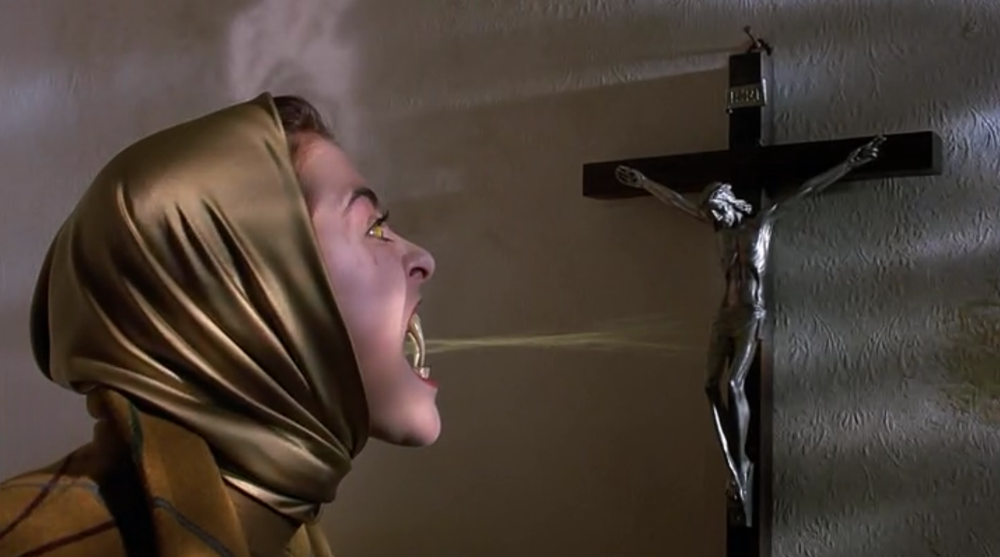
Alucarda

I often don't know how to react to nunsploitation movies. Apart from the feminist and queer-activist objections that I might raise about the exploitation elements in nunsploitation, I'm perhaps more deeply conflicted by the religious implications. Depending on who's behind the camera, these films either indulge in anti-religious straw-manning or they function as religious propaganda. Sometimes, they'll do both within the same damned movie. Alucarda (1977, directed by Juan López Moctezuma), a key nunsploitation film from Mexico, makes no pretense of a coherent theological critique or even a coherent story, though I think it mostly functions on the religious propaganda side of the equation.

Tuesday, October 28, 2014

The Worm Turns

Amanda Donohoe in The Lair of the White Worm

Ken Russell's dalliances with the horror genre were always perverse. Whether the artsy take on nunsploitation in The Devils or the evolutionary visions of Altered States or the Romantic freakout of Gothic, Russell always approached the genre obliquely, using its imagery but eschewing its narrative tropes. A rare exception to this is The Lair of the White Worm (1988), which has a conventional horror movie plot--taken from Bram Stoker's worst novel--upon which Russell hangs his usual altered states of consciousness and psychosexual derangement. It's as looney a horror movie as the 1980s ever produced--which is saying something--though it's perhaps less strange than some of Russell's other films. It's a matter of degrees informed by the history of the director rather than by the genre's standards themselves. Russell, whatever his faults, was one of a kind.

Sunday, October 26, 2014

Female Bonding

Lake Bell, Kate Bosworth, and Katie Aselton in Black Rock

Black Rock (2012, directed by Katie Aselton) is a feminist variant of a familiar genre trope, in which a group of friends head out into the wild and discover they are not alone, that the something else out there means them all harm. It's a survival horror movie at its base. Like any genre construct worth its salt, this one will support all kinds of themes and agendas. This film concerns itself with things you wouldn't ordinarily associate with the survival horror film in its most basic form: the friendships of women, sexual consent, sexual harassment. I almost wrote "rape survival," but, of course, that's a complete subset of the survival horror film. In its bones, this is an indie drama that veers off course into the territory of the nightmare and gets itself lost in the woods.

Saturday, October 25, 2014

Night Bus to Astaroth

Cheryl Smith in Lemora: A Child's Tale of the Supernatural

Lemora: A Child's Tale of the Supernatural (1973, directed by Richard Blackburn) is one of those odd little films orphaned by the business of movies only to take on a weird kind of half-life as time goes on while other kinds of films in similar straits fade entirely from memory. The horror genre is in part built on a foundation of such movies. The hororr movie acts as a collective unconscious for the medium, so it doesn't really forget anything. I don't want to suggest that Lemora is a foundational film in the genre, or even that it's any kind of unsung masterpiece. It's not. It is a singular experience unto itself, though, one that defies easy categorization.

Thursday, October 23, 2014

Thank You For Your Service

Dan Stevens in The Guest

I went into The Guest (2013, directed by Adam Wingard) more or less blind. I had no clue what it was about or if it had good reviews or anything. For someone as immersed in movie culture as I am, this is highly unusual. Oh, I know Wingard and screenwriter Simon Barrett's other films. Barrett is a native of my hometown and he usually brings his films to our local arthouse, so I had an inkling of what to expect, but I was mostly wrong. This film is more polished than any of their other productions (including You're Next, which got distribution from a major studio). There's obviously more money involved. More than that, though, there's a more disciplined approach to the filmmaking itself. Gone are the mumblecore performances and wandering hand-held camera. I wouldn't call this slick--it's much too rooted in pulp traditions for that--but it is certainly goes down easier.

Sunday, October 19, 2014

Blood of the Dragon

Luke Evans in Dracula Untold

A friend of mine described Dracula Untold (2014, directed by Gary Shore) as "300 with vampires." I can see what she means. Any retelling of the story of Vlad III, Prince of Wallachia, however tinged by dark fantasy, is liable to stumble over 21st century global politics. In his time, Vlad was a hero to the people of Wallachia and Romania and Eastern Europe for standing as a bulwark between Christendom and the depredations of the Muslim Ottoman Turks. The allegorical potential in a contemporary world divided in conflict along the lines of Christian and Muslim is too rich. This analogy breaks down, though, when one considers the (anti) hero of the piece. Even in his own time, Vlad Dracula was famed for his bottomless cruelty. I almost wish the filmmakers had included some of the gorier stories about Vlad (in one--my favorite, actually--a trio of monks refused to doff their skullcaps to the Prince, so he nailed them to their heads). Not for nothing is Vlad III forever nicknamed "Vlad the Impaler," something with which this film is very much in tune. Vlad Dracula was a monster even before Bram Stoker modeled his famous vampire upon him. So what do you get if you cast a monster as the bulwark of Christianity against the Infidel Turks? Something different than an allegory for contemporary politics, or, at the very least, a very different kind of allegory than the right-wing jingoism of 300.


The legend of Vlad the Impaler and of Bram Stoker's Count Dracula are so intertwined anymore that it hardly seems worth it to untangle them. The imagery implicit in such an entanglement is much too rich to abandon to mere factuality. One doesn't need the huggermugger of the horror genre to be horrified at the forests of impaled enemies Vlad left in his wake to intimidate his enemies. A contemporary reading of the way Vlad conducted his war against the Turks would convict him of crimes against humanity. Medieval warfare was brutal in ways that we can't even conceive anymore. Adding the vampire legend to Vlad almost seems beside the point, but add it to the story of Vlad the Impaler this film does, and the additional Romantic tragedy that has somehow accreted to both myths.

Saturday, October 18, 2014

The After Party

Emily Bergl in The Rage: Carrie 2

At the time of its release, I remember people describing The Rage: Carrie 2 (1999, directed by Katt Shea) as a sequel no one wanted. I mean, seriously, this comes, what? 23 years later? I didn't see it when it was in theaters. It certainly wasn't a sequel that I wanted. In some ways, I'm glad I waited until now to watch it. There are things in this film that I would not have appreciated in 1999, blinded as I was at the time by whatever vestige of male privilege I once had. A decade without that privilege tends to lift the blinders. The Rage's prescience is startling. Like Kimberly Pierce's remake a decade later, this is a film that benefits from a female gaze.

Thursday, October 16, 2014

Highschool Sweethearts

Amber Heard in All the Boys Love Mandy Lane


All The Boys Love Mandy Lane (2006, directed by Jonathan Levine) had a complicated release. Made and released in other parts of the world mid-last decade, it didn't make it to American screens until 2013 (not that this matters much to determined fans with all-region DVD players or a willingness to torrent, but still...). The film itself is manifestly American in its setting and its idiom, being a throwback to the slasher films of the 1980s, so this is doubly vexing. I doubt this did much bank elsewhere.


Note: this movie is a trickster, so if you don't like spoilers, consider yourself warned. 

Sunday, October 12, 2014

Sweets to the Sweet

Virginia Madsen and Tony Todd in Candyman

Candyman (1992, directed by Bernard Rose) is the best film adaptation of Clive Barker. It's a film that fulfills the promise those blurbs on the original Books of Blood trumpeted ("I have seen the future of horror..."). It's one of the most profoundly frightening films of the 1990s, a decade short on really effective fright films. Oh, it plunges off a cliff in the end, as most films based on Barker do, but before then? Oh, it's the primo stuff.