Thursday, August 12, 2010

The Woman in Full


It took a long time for filmmakers to recognize the droll comedy in Elmore Leonard's novels. They were always in love with his plots, but lacking the comedy, most movies based on Leonard are but pale shadows. For Leonard himself, the plots are an excuse to study his characters. Once asked about his top five crime novels, Leonard listed George V. Higgins's The Friends of Eddie Coyle five times. That book is ALL character study. In any event, sometime in the mid-1990s, someone discovered the comedy, but it wasn't until Quentin Tarantino's 1997 adaptation of Rum Punch, retitled Jackie Brown, that anyone discovered the character study. Perversely, this breakthrough came from Tarantino's decompression of the book's plot, which he films from multiple angles (both chronologically and from points of view). The plot is still there, but the plot is secondary to watching the characters interact and it grows from these interactions. This is the kind of movie that takes time out to watch its characters have dinner or shop for clothes (this last in the midst of its most difficult plot points). A lot of movies tell us what its characters do for a living. This one tells us how much they make and even how much money they have saved in their 401k plan. It's rich with details, a fact that surely contributes to complaints about its length, though not from me. I wouldn't want this to be any shorter. Hell, I could spend another hour with these characters without noticing the time.

Of Tarantino's Inglourious Basterds, I wrote: "and Shoshanna, as played by Melanie Laurent, is basically Marlene Dietrich to Tarantino's Von Sternberg." In retrospect, that honor properly belongs to Pam Grier as the title character in Jackie Brown. Tarantino is in love with all of his actresses, to be sure, but I think he held a special fondness for Grier, the action star and baddest mother fucker of his fondest imaginings. When he read Elmore Leonard's book, in which the character is a blond white woman, he imagined it for Grier. She responded in kind with the best performance of her career. She's Foxy Brown and Coffey fading into middle age, still holding her looks, but having to rely increasingly on her brains. Fortunately, she's also smarter than anyone around her. She's smarter than Ordell Robie, played with amiable menace by Samuel L. Jackson, for whom she smuggles money from Mexico. She's smarter than Ray Nicolette (Michael Keaton), the ATF agent on Robie's trail who views Jackie as an instrument to trap him. She's probably smarter than Max Cherry (Robert Forster), her bail bondsman, but she never has to match wits with him given that he's smitten with her from the moment she walks out of jail and into his life. This is something pretty rare, actually. It's a movie about a 44 year old black woman and a 56 year white old man who have a relationship and plan a caper. I mean, has there ever been another character like Jackie Brown holding the center of a movie? Honestly, I can't think of one. Tarantino's willingness to stop long enough to really look at his actors enhances their performances. It doesn't hurt that all of them have interesting faces, none more so than Robert Forster, who, like Grier, also does career-best work here.


As cinema, this is Tarantino's most assured movie. He's not trying too much. He no longer needs to make a splash--he did that with his prior two films--so he doesn't have to overreach himself. One wishes that he had learned something from this experience, because in his subsequent films, he loads his palette almost to the point of bursting. In Jackie Brown, he's content to observe. A director noted for scenes of graphic violence, he keeps all of the violence in this film out of the frame or at such a distance as to cushion the blow. More than that, though, he's willing to let his lead characters fall in love. This is the only one of Tarantino's films in which the characters realistically relate to each other in the ways that adult men and women relate to each other, and he does it independently of the plot, too. Oh, the plot uses this, sure, but it doesn't depend on it. It also slows down to let its characters think things out. Action, in this movie, is no substitute for thought. The actions that occur without thinking--the scene where Robert DeNiro's character shoots motormouthed Bridget Fonda after she nags him a couple of words too far, for instance--precipitate disaster.


This is also the least "meta" of Tarantino's movies. Oh, the meta level is still there--it makes me smile every time I see Sid Haig play a judge sending Pam Grier to jail, for instance--but the director elides most of it, as if it doesn't matter to the movie. Most of it is in soundtrack cues. Oh, and my, heavens, does this have a killer soundtrack, from the opening shot scored with Bobby Womack's "Across 110th Street" to the diegetic appearance of The Delphonics to a catalogue of heavy soul from soul's golden era. Some of the soundtrack cues come from Pam Grier's other movies. None of this really advertises itself the way that, say, the red light and soundtrack cue from Ironside mark the Kill Bills.

In any event, it's disappointing to me that Tarantino hasn't gone back to this mode of filmmaking. He's gone back to being a provocateur, which is fine, I guess, but on the evidence of Jackie Brown, that impulse squanders an immense reservoir of talent. For Jackie Brown's part, it remains the director's best film, even if it's the one that fans of his more outre films tend to ignore.

Tuesday, August 10, 2010

Shameless Self-Promotion #4

I have a new post up over at the Wild Claw Theater Blog, in which I wish Fright Night a happy 25th birthday. It begins like this:

Fright Night turned 25 last week. I didn't see anyone mark the anniversary, so I thought I'd raise my own glass. You don't look a day over 20.

Well, that's a lie, actually. Fright Night hasn't aged particularly well. The combination of eighties fashions, Spielbergian idiom (horror comes to suburbia), comedy relief, and gooey special effects is very much of its time. More than that, it's a kind of nostalgia piece in itself, one that pines for the late-night horror show and the classical horror movie (in reaction, I suspect, to the shasher films that were dominating the genre at the time of its release). All of that is receding in time.


Read the rest over there. They're good folks and they deserve the traffic.

Monday, August 09, 2010

Olé


Once upon a time, Pedro Almodovar was an enfant terrible. His early films were exercises in provocation and stylistic excess. Sometimes, they were pretty hard to put up with. A case in point is Matador, from 1986, which starts with a man masturbating to the violence in Mario Bava's Blood and Black Lace, then proceeds to tell a story of psychos in love. Diego has a problem: forcibly retired from the bullring after being gored by a bull, he still hungers for the kill. He satisfies this urge by murdering women after he's had sex with them. One of his students, Angel, has been driven mad by both crippling vertigo and his overly religious mother. After attempting to rape Eva, Diego's girlfriend, he claims responsibility fo the murders. Maria, the lawyer who takes Angel's case, has similar appetites as Diego, only her taste is for murdering matadors after having sex with them. Soon, Diego and Maria are circling each other in a deadly mutual attraction.

Early in his career, Almodovar took a LOT of heat for his cavalier approach to rape imagery, and this film is one of the ones that fuels that criticism. Angel's attempted rape in this movie is kinda sorta played for laughs. The character further faints at the sight of blood and is ridiculed by his victim for premature ejaculation. Still, this is all of a piece with this movie, in which every character has some kind of destructive sexual peccadillo. I think it's more destructive to the movie that it occasionally seems to pull elements out of its ass. For example: Late in the movie, Angel is shown to be psychic, which is how he knows the details of Diego's crimes. When this started to play out, all I could think was: "Wrote yourselves into a corner, did you?"

Still and all, Almodovar always mounts attractive films, whether through the design elements or through his choice of actors. You get both here, although the design of the film is very much of its time. Very 1980s. This movie is very much in love Antonio Banderas, who seems impossibly young (he was 26 at the time), but it's Asumpta Serna who walks away with the movie as the predatory Maria. The nominal lead, Nacho Martinez, kind of gets overwhelmed by this, but Almodovar has never had a lot of interest in middle-aged straight guys, so this might be inevitable.

Almodovar is also totally in love with movies, and like many of his other movies, this one is appointed with cinematic points of reference. I mentioned Bava already. There's also the scene where Diego first pursues Maria: they end up in a movie theater that's showing the end of Duel in the Sun, an equally deranged portrait of sexual obsession that foreshadows the end of this movie.

Sunday, August 08, 2010

A Fractured Fairy Tale

This originally appeared on the trans feminist blog, The Second Awakening.

While it doesn't indulge in the same kind of thematic miserablism of other movies about transgender sex workers, Olaf de Fleur Johannesson's The Amazing Truth About Queen Raquela (2008) still can't avoid the fact that at least part of its narrative--arguably the dominant part--is constructed from a cisgender man's preconceptions of who transgender people are. The conceit of the movie is that it's half documentary and half fiction, mixed together in such a way as to obscure the lines between the real and the fake. The director himself calls this shambolic portmanteau structure a "visiomentary." You can probably see the flaws in this approach without even seeing the movie, but I'll elaborate anyway.

The movie begins with its central character, a trans sex worker in Cebu City, The Philippines, speaking directly to the camera and swearing to tell the truth and the whole truth. This is Raquela Rios, essentially playing herself. The filmmakers spend a good deal of time following Rios through her life, which includes interactions with her family, attempts to find employment outside of the sex trade, clubbing with her friends, and generally walking around the city. This is where the film is heavy on the documentary and while it's letting Raquela speak for herself, the movie is on pretty firm ground. Raquela is bright, funny, optimistic, and gregarious. Were she in different circumstances, she would undoubtedly be a success at whatever she did. The same might be said for her friends, Aubrey and Olivia, who also make their livings as "ladyboy" sex workers. Unfortunately, the filmmakers can't leave well enough alone. They also start the film with a title card that says, "Raquela is transsexual. A chick with a dick," and once the movie acquires a narrative, the attitude behind that pronouncement seeps into the whole enterprise.

Slowly but surely, it becomes the task of cis white men to explain the lot of the ladyboy, and with that shift in focus, the movie begins to patronize its subject. The mouthpiece for all of this is Mike, an internet pornographer who makes his living with ladyboy porn from places like The Philippines and Brazil. In a memorable pronouncement on how trans women live their lives, he compares them to cicadas, dormant for the early parts of their lives only to bloom for a short and intense period in which their longing to be something they can never be leads them into risky behaviors. There's a troubling essentialism to the pronouncements the film puts in this guy's mouth, and the filmmakers wisely make it clear that he's a douchebag, but he also carries himself like an authority figure (there's that white male privilege asserting itself) and the movie doesn't quite shake that off.

In the movie's defense, some of the individual scenes here bring Raquela to life as a living, breathing human being just like the rest of them. The audience is invited to share her heartbreak at being denied entrance into nursing school and to share her mounting apprehension as she waits for the results of an AIDS test. Her defense of the kinds of risky sex she uses to validate her gender identity surely comes from the actress rather than the filmmakers. Her candor in sharing these moments gives her performance in the fictional portions of the film a degree of verisimilitude. When she concludes that Mike the Pornographer is kind of an asshole after he regales her with ugly Americanisms all through Paris, it rings true even though Mike himself is a part and she's talking about someone who doesn't really exist.

The sex trade hangs over all of this, though. It's the elephant in the room, and the movie plays to it rather than offering a critique. As a counterpart to Raquela's failure to get into nursing school, for one example, is a scene shortly afterward that dresses her in a latex nurse outfit for the benefit of her webcam chat business. This seems almost cruel in context, and there's definitely a fetishistic gaze involved in the director's choice to make the film in the first place that makes me wonder if he's not a chaser himself. Meanwhile, there's no real acknowledgement of the human cost of the sex trade and its attendant relationship with human trafficking. The movie itself bills itself as a kind of Cinderella tale, in which Raquela is given the chance to live her dream of visiting Paris, but the film blithely creates this plot without realizing that the scenario it constructs is disturbingly similar to the modus operandi of slavers: provide the money to travel, indenture the victim to the money. The movie omits the indenture. One of the film's more unbelievable elements is the notion that Mike the Pornographer takes Raquela to Paris out of the goodness of his heart, especially once the movie establishes that he's kind of a prick. This casts a sinister pall over the director's assertion that the film is about globalization and the commodification of human beings, because he seems to be oblivious to what he's portraying.

Marginally less troubling is the persistent enforcement of a gender binary worldview and the fixed social roles it portends. The movie already indicates that it thinks that Raquela will never inhabit her desired gender (never mind that the movie categorically depicts her doing exactly that). There's a shot--surely staged--of Raquela and her two friends standing at urinals with their skirts hiked up; this is obviously a shot that enforces the film's essentialist ideas of gender identity. The world of this film is also a world without social mobility, where in spite of Raquela's jaunt to Europe, she still winds up back home with no prospects, walking arm and arm down the street with her girlfriends. While there's an inherently humane element to this shot, friends being friends and all, it indicates that Raquela has been running in place. She's never going to move out of her current social role, the movie suggests, and the shadow of dangerous sex, crushing poverty, and (perceived) self-delusion looms large in the end.

As a postscript, I would be remiss if I didn't mention the packaging for this film. Here's the DVD cover:

THAT'S not a prejudicial image. Not at all. Sheesh.

The Amazing Truth About Queen Raquela is available on DVD from E1 Entertainment for purchase or rent from the usual suspects. Also, I need to give a shout out to Gina over at Skip the Makeup, who pointed me at the movie in the first place.

Friday, August 06, 2010

Opening Shots #1: Contact

This is the opening shot of Robert Zemeckis's 1997 movie, Contact. I have a LOT of issues with this movie, but the opening shot is one of the best I've ever seen. It's initially cold and dispassionate and incomparably vast, but it ends up with a striking note of humanity. I wish the rest of the movie were up to it. Alas.

Wednesday, August 04, 2010

Shameless Self-promotion #3

Aaron Christensen was my editor for Horror 101. In addition to being a super nice (and super handsome, grrowl) guy, he is also involved with Chicago's Wild Claw Theater. He asked a handful of 101 contributors, including yours truly, if we would contribute to the Wild Claw blog about all things horror. He asked so nicely that I couldn't refuse. My initial offering is online now. It begins:

"The seminal item in question for today's symposium is Stephen King's Danse Macabre, originally published in 1981. Technically, I'm a little bit early with this, but as it so happens there's a new edition this year for which King has added a new essay called "What's Scary," so this turns out to be topical. People have been calling for King to write a follow-up to Danse Macabre for years, given the explosion of the genre since its publication. I doubt that this new essay is going to quiet those demands."

Read the rest there.


Currently on my iTunes shuffle: "I'm Waiting for The Man" by The Velvet Underground

Monday, August 02, 2010

Wicked City


The Phenix City Story (1955, directed by Phil Karlson) makes a strong first impression. I originally saw it on some fly by night cable channel in the 1980s and I've never forgotten it. It's one of the most hard boiled crime films of the 1950s, a period not short on hard boiled crime films. It's also a true exploitation film, one rushed to theaters on the strength of a topical story where the principle actors were still going through the legal system. It's also brutal as hell.

The movie follows the inhabitants of the titular city, which is across the river from Columbus, Georgia. On the evidence of the film, Phenix City seems like it was Columbus's secret sharer, the id where all of its darkest impulse are lived out. It's a cesspit of rigged gambling dens, quick loan joints, dope peddlers, and whores. The city's vice is run by a network of good ol' boy crime lords, and enforced by good ol' boy thugs. Into this mix is thrown lawyer Albert Patterson and his family. His son, John, has returned from Germany in search of a nice place to raise his children. John is a crusader and a war hero, and he slowly but surely draws his father into opposition to the "syndicate" that runs the town. Patterson embarks to run for Attorney General to clean up the town, but it all ends badly.


The structure of the movie is awkward at first, prefaced by interview material with the real people of Phenix City. Everyone is awkward in documentary footage, so this section of the film is not promising. Once the actual movie starts, things improve. It still has a documentary structure along the lines of the other pseudo-documentary crime films of the period, but as the film progresses, the shadows grow longer and the compositions get more stylized until we're smack in the middle of the film noir dark city. The cast is an excellent assortment of familiar faces. John McIntyre is probably the most recognizable actor, promoted from the character ranks into the forefront of the movie. Richard Kiley is ostensibly the lead. The smiling Edward Andrews, a familiar face from a generation of TV guest appearances and commercial roles and cast against type here, makes for a dandy villain. All well and good. There are other similar films littering the noir period. Director Phil Karlson even made a couple of them.


What really distinguishes this film is its willingness to take the next awful step. It's not squeamish about throwing the good and virtuous characters it has into the meat grinder. It has its villains abduct a black child in order to throw her corpse on the lawn of our heroes as a warning. It has young lovers who never get together and wind up dead. It has a jaundiced view of human nature. It gets away with it all under cover of its documentary pedigree, in the best tradition of exploitation filmmaking. Karlson would go to this well again twenty years later with the very similar Walking Tall. It works there, too.


One sour note, though: this has a certain veneer of Hollywood liberal guilt. It presents a relatively noble black character, shows our heroes being friendly and upright in their friendship with him, and lies through its teeth about it. It's a whitewash, of course. The "real" story is suggested on the IMDB's trivia page for the movie:

In the film, John Patterson (Richard Kiley) is depicted as supportive of African-American Zeke Ward (James Edwards) and his family. In real life, following his term as Alabama attorney general (1954-1958), he ran for governor in 1958, ran an openly racist campaign and won. One of his opponents, George Wallace, had run as a racial moderate and told his friends after the election, "John Patterson out-niggered me, and I'm never gonna be out-niggered again." Four years later, in 1962, Wallace won the governorship of Alabama as an open racist.

Hollywood can't tarnish its heroes with racism. Nope. John Patterson can't be Ethan Edwards. Pity.


Saturday, July 31, 2010

How Sharper than a Serpent's Tooth.


During Akira Kurosawa's long eclipse during the 1970s, a period during which he made one film as an exile and made one suicide attempt, the director occupied himself with refining the designs and storyboards for two films he didn't know if he would ever make. At the time, he had only made two films in color, and one can imagine him beginning to burst at the possibilities of color that he might never get to realize on screen. The two films* that eventually resulted from this long obsession play as if the director had taken a gun, put it in his mouth, and splattered both his disillusionment and his pent up ambitions onto the screen in eyeball-searing color.

My local art house has been running a Kurosawa retrospective this summer, consisting of six films. Of these six, I own five of them and have seen all of them on the big screen at one point or another. The sixth is Ran, Kurosawa's 1985 version of King Lear, which I have only ever seen on television and don't own. I skipped the others, but went to Ran.

There is a valedictory quality to Ran. There are so many disparate theatrical elements plucked from his long career and from his national cinema that it seems as if Kurosawa, in this one film, was trying to live up to the criticism that his career was like watching the history of Japanese cinema running in reverse. The theatricality of it is at odds with his early films, but of a piece with them, too. The theatricality of it was always there in films like Seven Samurai, but it was hidden, perhaps because they were in black and white. A great many of the shots in Ran seem decorated rather than composed, as if the director had spent years and years working and re-working them. The volume of Kurosawa's art from this period shows that this is indeed what happened. The director enlisted his friend, Ishiro Honda, to realize many of these pieces on screen, thus, perversely linking this particular apocalypse with the various catastrophes inflicted on Japan in Honda's kaiju films.

There are odd notes, from the androgynous Fool (the actor who plays him was in fact a noted female impersonator), to the grandly theatrical make-up worn by Tatsuya Nakadai, to a Tôru Takemitsu's score that sounds like nothing Japanese at all and most resembles Jerry Goldsmith's Planet of the Apes score. This is a weirdly feminine movie, too. The aforementioned Fool is part of it, but the movie hinges on the two female characters, Lady Sue (Yoshiko Miyazaki) in the role of the murdered innocent and Lady Kaede (Mieko Harada) as a descendant of Lady Macbeth. Lady Sue has hardly any screen time, but the pivotal role of the murdered innocent is implacable in a Shakespearean tragedy. Lady Kaede, on the other hand, steals the entire movie from all comers, even the wildly overacting Nakadai. I categorize this all as odd because Kurosawa was never a filmmaker with much interest in women, and yet they dominate his valediction. All told, this assemblage of oddities has a mounting effect, like a top that begins with small wobbles spinning into wildly eccentric gyrations. It would be a mistake to think that this effect is an accident, because, after all, the title of the film translates literally as "Chaos."

Ran is a great movie, no doubt about it, but I'd forgotten just how much of a downer it is. Not all of that can be laid at the feet of William Shakespeare, either. Oh, the broad outlines of Lear are still there, though it changes Lear's daughters into sons and kinda sorta changes Richmond into Lady Kaeda, one of the cinema's most jaw-dropping monsters. Lear is already something of a total negation of life, in which even the villains are inconsequential in a godless void. Its dominant words are no, not, nothing, and (memorably) never never never never. And in spite of all this, Kurosawa goes it all one better. The last shot of the movie has a blind man teetering on the precipice of a ruined castle, having accidentally dropped an image of the Amida Buddha he had been given to keep him company. Rarely has a filmmaker ever matched himself so keenly to the material. Ran is Kurosawa howling in the wilderness.


*The other is Kagemusha (1980)


Friday, July 30, 2010

Floral Arrangements


I've been on kind of an Almodovar kick lately. I came late to the party with Almodovar, so I'm having to view some of his older films through the filter or his recent work. It's an interesting kind of parallax. I don't know that my old opinion of Almodovar was necessarily wrong, just that I wasn't seeing or wasn't "getting" what he was up to. In this regard, his 1995 movie, The Flower of My Secret is a kind of Rosetta Stone. It stands as a kind of nexus between his older films and his current, mature style. The director was always evolving towards a kind of Sirkian melodrama, even in his more outrageous earlier films, and here you can see him groping for the effects he would attain in over the next decade and a half. Hell, it sometimes seems like he had those films already written in his mind from the evidence of this film.

The movie itself concerns Leo, a romance writer who has become disillusioned with her work. She wants to write more realistic, more literary work, but her contract with her publisher prevents it. Compounding this problem is her disintegrating marriage with her absent husband, with whom she has raging fights after it becomes clear that he no longer wants her. On a whim, she takes her writing to the publisher of a newspaper and lands a gig reviewing her own latest novel, which she excoriates as "typing," a la Truman Capote's famous put-down of Jack Kerouac. Her editor at the newspaper, on the other hand, loves her romance novels (even though he doesn't know that she's the writer) and begins to fall for her.

The details of this movie are telling. Her best friend stages training performances for doctors to rehearse their bedside manners (this recurs in All About My Mother). The one performance we see concerns the mother of a boy who is in a persistent vegetative state (All About My Mother again for the grieving mother, and Talk To Her on the disposition of a boy in a coma). The dance sequence at the end also anticipates Talk to Her. And most telling of all is the plot of Leo's "literary" novel, in which a girl murders her father who is molesting her and her mother covers the crime by hiding the body at a friend's vacant restaurant (this is more or less the plot of Volver). During the course of the movie, these echoes of the future make it clear that Pedro has placed himself in the movie as multiple characters. Leo is certainly an avatar, as is Angel (her editor), and Antonio, who steals the idea of Leo's novel and sells it for movies. All of this is also evidence of a director who never throws anything away; a true auteur.

Unfortunately, this isn't one of Almodovar's better movies. Don't get me wrong: It's totally watchable. Compulsive, even. You want to know what happens next at any given point of its running time. The trouble with it is that none of the echoes of the future cohere into a satisfying narrative and when this finds its way to an ending, my first impulse was to ask, "That's it?" Almodovar falls victim to his own success, I think. The emotional content and the heights of melodrama presented earlier in the movie seem to cry out for some kind of epic catharsis of some kind. Instead, the movie kind of fizzles out, as if it wasted all of its fireworks and had nothing left for a finale.

Tuesday, July 27, 2010

The Films of Robert Aldrich: The Choirboys


Skipping ahead to the end of Aldrich's career this time, to The Choirboys from 1977 (which also saw the release of Twilight's Last Gleaming). Aldrich only made two more movies after this one. There's no getting around the fact that The Choirboys is a pretty unpleasant movie. Based on Joseph Wambaugh's novel, this lets Aldrich's anti-authoritarianism loose without any restraint. Wambaugh famously disowned the movie, and speaks ill of it to this very day. I get the feeling that Aldrich approached the book the same way he approached Spillane's Kiss Me Deadly, which he is known to have hated. I think he saw in it a hagiography for authoritarianism, which is totally against his nature. The resulting movie tears down the veils that hid the fault lines in American culture in the post-Vietnam/post-Watergate era. To some extent, those fault lines are still there. This is a racist, sexist, xenophobic, homophobic morass, in which all of these impulses are given complete license. This is the cop movie crossed with Salo. It's all id.


The story here follows a precinct full of rowdy LA cops. The members of this precinct hold "choir practice" after hours, in which they drink, womanize, and play vicious pranks on each other. There's not much plot at first, just a rambling series of episodes. It's a picaresque. It acquires a plot in the second half, in which Vietnam vet Don Stroud freaks out and kills a gay teen in the park. His fellow cops then feel obliged to cover the crime. This is only the most extreme of the private failings on display here, but it's all of a piece with the cop who's into kink, the cop who thinks he's Dracula, the lieutenant who dabbles in hookers, the drunks, the lechers, et cetera. Aldrich doesn't paint a pleasant picture of cops. The main trouble with the movie is that he doesn't provide a means of entry into this world. There is no characteristic anti-hero railing against authority here, no individual railing against the system. I get the feeling that Charles Durning's retiring cop is intended as the sympathetic protagonist, but he's not on screen enough to work in this capacity. Like many of Aldrich's anti-heroes, Durning is compromised by his own moral outrage, then unconvincingly redeemed in the end. It doesn't really work. At only one point does the misanthropic mask slip, when Burt Young's grungy sergeant books a scared gay teen. This one moment informs the nastiness of the film's last act, given that the gay teen is Stroud's victim. This is played against a troubling taste for gay baiting elsewhere in the movie, with a stereotyped flaming gay, complete with pink poodle.


From my own theoretical point of view, this has a lot in common with the Gothic elements of The Dirty Dozen. It's an all male film--all of the female characters are bit parts--and one gets the feeling that the crucible of masculinity has driven these characters insane. This is certainly suggested in the homophobia manifested on screen. It's an even more extreme version than The Dirty Dozen, though, because it spreads the psychosexual manias among multiple characters rather than confining it to one sex maniac. It should be noted that there are some interesting actresses in the background of this movie, including Blair Brown and exploitation goddess Cheryl 'Rainbeaux' Smith.

In any event, it would be a horrifying movie to watch if it weren't so willfully goofy. On the one hand, the antics of the cops in the first half of the movie are juvenile and unfunny. On the other, the actions of the cops in the back half of the movie are reprehensible. It's an irreconcilable tension that the movie simply cannot resolve. It's also one of Aldrich's grottiest movies (he made a lot of grotty movies during the 1970s), one that still manages to look a bit like it was made for television, though the content of the movie would never play in prime time (this was a staple in the early days of HBO). It would be easy to count this film as evidence of the director in decline. Certainly, his days of masterpieces were over by this time, but this is still not without interest. It's just not very good.


Post script: The Choirboys has been out of print for years and has never been on DVD, so far as I know. It is, however, available for streaming on Netflix. This may be the wave of the future for deep catalogue movies where the rights-holders don't see a financial upside of pressing a disc.


Sunday, July 25, 2010

Shock and Awe


The first time I encountered Shock (1946, directed by Alfred L. Werker), it was in a plagiarized form in E. C. Comics as "Mute Witness to Murder." Al Feldstein and Bill Gaines weren't above swiping their material wholesale when they were under the gun. They were pretty shameless about it. They only got caught once, I think, when Ray Bradbury called them out for it and started taking a piece of the pie. Anyway, "Mute Witness to Murder" showed up on HBO's Tales from the Crypt, too, starring Patricia Clarkson in the lead, and it's pretty good. It has an instinct for the jugular that's missing in the original. Shock was done on the cheap and features a depressing literalism. It's one of the founding films in the psychiatric ward noir (most recently on screens as Shutter Island), in which a woman witnesses a man murder his wife, goes catatonic, and discovers that the murderer is the psychiatrist charged with treating her catatonia.

For the most part, the movie's not worth going out of your way to see, save for one small detail: it stars Vincent Price. Price was in the ascent at the time, after toiling in supporting parts for other Fox films. With this film, and Dragonwyck from the same year, Price graduated to leading roles of a particularly sinister bent. This is one of the first urbane villains in his portfolio. He's not a horror star yet, but you could see the seeds of it. He pretty much steals Shock from everyone, in spite of playing a character who is fundamentally weak (a spiritual brother to his gigolo in Laura perhaps), and it's fun to watch him work.

Also of interest is a dream sequence toward the beginning of the film, one of those surreal phantasmagorias that were really the only genuine experimentation Hollywood indulged in during the classic period. Come to think of it, they're also a hallmark of the psychiatric noir, too (see also: Spellbound, Shock Corridor). This one, as I say, is depressingly literal-minded, and functions more as exposition than poetry.

Still and all, it's a fun movie that doesn't over-stay its welcome.


Talk to Her (2002) might be Pedro Almodovar's most perverse film (and that's saying something). Mind you, it's a startling portrait of love and loss, but it also asks the question: if you were shrunk to the size of a couple of inches tall, would you climb into your lover's vagina only to be lost and smothered? This shows up in another of Pedro's films within a film, this time imagined as a striking silent movie recounted by one of the film's twin protagonists to his comatose patient/love object. I had to stop the movie for a short time because I was laughing so hard, which is a nice tonic to what is otherwise a fairly tragic movie.


The film follows two men in love with women who are comatose: Marco's girlfriend is a Lydia, a bullfighter who has a disastrous encounter in the ring. Benigno is a nurse caring for Alicia, a ballerina with whom he has been long obsessed. The two men strike up a friendship. Both men begin the movie watching a ballet in which a man moves chairs out of the way of a blind dancer, and both wind up in much the same position, caring for helpless women. Unfortunately, both men are headed for grief. Marco's girlfriend, he learns, was trying to break up with him at the time of her accident, favoring her ex-lover with the promise of marriage. Benigno, unfortunately, follows his obsession with Alicia over the cliff, raping her and getting caught because she becomes pregnant. He comes to a bad end.

The movie moves through successive layers of grief. It's kind of a shock to arrive at the end of the movie to discover that it has entirely healed that grief. There's a tantalizing hint of uplift that sends the viewer away happy. It's an amazing balancing act, made doubly difficult by the moral quagmires the movie sets up. Benigno is unquestionably a rapist, but does he see that in his mind? Can he help himself? The scenes where Benigno cares for Alicia have an elegant beauty and an uncomfortable jolt at the same time. And can the audience get behind Marco's loyalty to his friend? This could be a disaster in other hands, but Almodovar doesn't drop a single stitch.

And is there a filmmaker making as much use of widescreen as Almodovar? I can't even imagine a pan and scan version of this film. It's weird: I used to think that Almodovar was an empty stylist. In the last dozen years, though, I finally see the humanity behind the over-the-top colors, I finally feel the emotions evinced by the outlandish situations. His movies get more and more beautiful by and by.

Saturday, July 24, 2010

What's In a Name?


I think it was William K. Everson who put The Living Dead at Manchester Morgue (1974, directed by Jorge Grau) on my radar when he wrote a glowing blurb for it in The Classics of the Horror Film. Everson thought it was a better movie than Night of the Living Dead, and it's hard for me to overlook that kind of endorsement. It took a LONG time for me to track the film down. I didn't have a good copy until Anchor Bay put it out on DVD under the title Let Sleeping Corpses Lie, and when I finally did, I was surprised to discover that it was a film that I'd already seen. The movie has had an encyclopedia of alternate titles. I originally saw it on a fly-by-night VHS edition under the abbreviated title, "The Living Dead," in the early-90s and didn't even realize it. The titling of the movie is a huge part of its relative obscurity. It's hard to build a brand on that kind of confusion.

In any event, I had a mind to revisit the film this week.

What's immediately apparent to me about The Living Dead at Manchester Morgue is how uneasy a combination of elements it is. With the benefit of hindsight, it's easy for me to see what Everson liked in the movie. He was a reactionary when it came to horror movies, and this movie reassembles the radical break with tradition one finds in Night of the Living Dead into a more traditional Gothic form, so of course he's going to prefer it. Unfortunately, this retrogradation of the new radical horror movie (well, new in 1968, anyway) tends to dull the impact. It dates the movie badly. Which isn't to say it's bad, mind you, just that one needs to make allowances. The overall effect of the movie is what you might get if one of the baby Hammer studios--Amicus, for instance, or more probably Tigon--tried to reverse engineer Night of the Living Dead.


The story here follows George, an antique dealer, on a trip to the Peak District, where his motorbike meets with an accident when a woman backs over it with her car. He imposes on the woman, Edna, to take him on to his destination, but before they can arrive, they're waylaid by the events of the movie. First, they encounter a Ministry of Agriculture machine that's using low-level ultrasonic radiation to kill insects, then they encounter the living dead. The machine, it seems, stimulates primitive nervous systems, so it drives newborn children at the local hospital insane and it raises the recently departed and drives them into a homicidal rampage. Unfortunately for our heroes, the law thinks they're responsible for the ghastly murders in the area. The Inspector on the case doesn't like George's looks; he thinks his hippie hair and his "faggoty" clothes are emblematic of the moral rot in the world. Unfortunately for our heroes, bodies start piling up.


Unfortunately, this never makes it to Manchester, unless that's supposed to be Manchester in the prologue. This is strictly rural, which gives the film part of its character. This was filmed in Derbyshire and the landscapes in this are spectacular. In fact, all of the locations in this are picturesque, which lends the film its old-school Gothic ambiance. By placing its Romero-esque zombies in this context, the film takes on a quality of medieval horror, more akin to The Tombs of the Blind Dead than Night of the Living Dead. The zombie sequences are pure Romero, though.


Our first glimpse of the living dead is deliberately styled after the opening of Night of the Living Dead, in which the drowned zombie wanders into the frame like Romero's cemetery zombie to attack our heroine. It's still an effective sequence at second hand. The later zombie feast when the policeman buys it in the cemetery cements the association. In general, the zombie sequences in this movie are very effective; they turn the screws tight and are pretty violent. Grau doesn't pander to gore hounds, per se, but he certainly doesn't disappoint them, either. The fates of our heroes at the end of the movie are also deliberate echoes. It's too bad that the filmmakers didn't stop there, because there's an illogical coda to the movie that turns it into an E.C. Comic and diffuses the impact.


Grau is one of the few first-wave European inheritors of Night of the Living Dead to recognize that film's social critique, and he builds a similar critique into his film. The shots of the city in the prologue are designed to emphasize the pollution and alienation of our civilization (an effect amplified by the contrast with the scenery in the rest of the film). When a streaker disrobes and runs into the street, it's not even remarkable. The story itself is stridently environmentalist, with our hero standing in for Ibsen's archetypal enemy of the people. The Inspector, of course, is the oppressive hand of the old order, intent on crushing dissent and stifling the young. Grau uses a heavy hand when it comes to his symbols. This stridency fixes the movie forever in its time. Still, Grau began his career in Franco's Spain, which I'm sure colors his viewpoint when it comes to authoritarianism. He's probably entitled. This also puts me in mind of the depiction of the Yorkshire police in the Red Riding trilogy. While I was watching The Inspector in this movie, all I could see in my mind was the characters in Red Riding toasting themselves and "The North! Where we do what we want!" So maybe it's not as strident as it could be.

That all said, The Living Dead at Manchester Morgue is a pretty good movie that deserves better than the obscurity to which it's been consigned.


Monday, July 19, 2010

Grand Gestures


For a movie constructed from so many things that I love, I Am Love (2009, directed by Luca Guadagnino) sure left me feeling disappointed at the end. I mean, it's chock full of architecture and food and cinephilia and Tilda Swinton, and yet I still found myself thinking, "Is that it?" as the credits rolled. The entire gist of the movie, save for one key plot point, is there in the trailer: plot, visuals, music, everything. What you see in the trailer is a conflation of Visconti and Sirk, with a hint of Hitchcock and pumped full of steroids. The movie itself calls to mind Ambrose Bierce's definition of a novel as "a short story, padded."

The story is familiar enough to anyone who has seen Sirk's All that Heaven Allows (substitute a lower class chef for Rock Hudson's handyman), though this movie gives it a different ending. The visual metaphors the movie employs--empty rooms of the affluent are dominant, though the seasons are important, too--are pure Sirk in a slightly different key. That's where Visconti comes in, because this is also a movie about a wealthy family coming to grips with changing times. The same visual metaphors apply, with the furnishings of affluence providing a glimpse of a past that's slipping away. The comparison with The Leopard is well nigh inescapable.

At the center of all of this is Swinton in fine form, playing the Russian bride of a Milanese textile merchant. In marrying into his family, she abandons her identity. Her husband even provides her with a new name. Swinton's character, it should be noted, shares a name with Flaubert's Madame Bovary: Emma. She seems to have no connection to her husband, but she loves her children. One of her children is questioning the direction of the family business in a globalized world. The other is in the process of coming out as a lesbian. Her son's friend is a chef who catches her eye, first with food, then with his looks. Tragedy ensues.


The movie is on its firmest ground when it focuses on Swinton, watching her behavior. It's the small scenes that play the best: when she finds a letter from her daughter in which she discusses falling for another woman, when she has the dialogue of an American businessman translated for her (a very meta moment, given that the actress is one of the most articulate of British actresses), when she's lost in the taste of food. That she's a Russian in Italy makes her a stranger in a strange land, and it amplifies her isolation and ennui. One wishes that there was more of this sort of thing. A lot more. For the most part, the plot is an excuse for the form and they don't really support one another. Or, rather, the form dominates.


This is a film of seasons. The opening movement is set in the winter, and in the midst of cold, modernist architecture. The second movement is set in the spring and the ornate architecture of the baroque period. The third movement is set in the summer, in the low, picturesque villages of the countryside. Fall is rainy, and the architecture is sepulchral. Through it all is an emphasis on food. The moods of the picture are conveyed by food, as is a key plot point at the end of the movie that precipitates the movie's tragedy. As a visual object, I Am Love is excellent, but perhaps a bit too arch with it its symbols. Still, the film does come to vivid life, especially in the erotic sections where Swinton proves to be a very unself-conscious actress. Her love scenes are surprisingly uninhibited. I don't know that I can imagine another actress of her stature in these scenes, but she inhabits them effortlessly. The movie overplays this, though, by using the natural world (particularly insects on flowers) the way it uses architecture, mostly as a bludgeon.


I mean, I'm all for the grand gesture. I'm all for taking a swing at the fence. I'm not going to fault the film for its ambitions. Hell, I wish more movies took these kinds of chances. I wish I liked this film more. But I don't.

Saturday, July 17, 2010

Marriage Counselling


What a perverse set of mixed messages one finds in The Blood Spattered Bride (1972, directed by Vicente Aranda), one of the more interesting adaptations of J. Sheridan Le Fanu's "Carmilla." On the one hand, it presents a set of arguments that feminists everywhere will recognize as our heroine, Susan, marries a lout and lives to regret it. On the other hand, it totally plays to patriarchal male fears about women who take control of their own sexuality. It wants it both ways. It's very clever about it, though it may not be clever enough.


The story follows two newlyweds on their honeymoon. Right after the wedding, they head to a kind of modernist hotel for their wedding night, where Susan, the bride, has a disturbing rape fantasy that wigs her out. She insists they leave, so they continue on to the groom's ancestral home. Susan's rape fantasies turn out to be a premonition of her married life, because her new husband is a total horndog who insists on sex at the drop of the hat, sometimes forcefully. Susan's future looks to be one of sexual abuse. Meanwhile, she begins to dream about a sinister woman with a dagger, who she comes to believe is her husband's ancestor, Mircalla Karnstein, who killed her husband on her wedding night for demanding "unspeakable acts." These dreams coincide with the appearance of a dagger, upon which she fixates as the weapon Mircalla used for the crime. Her behavior becomes erratic and her husband calls in a doctor who dopes her up and pronounces her "anxious" about her new marriage. Nothing more. Meanwhile, her husband finds a naked woman on the beach who has no memory of how she got there. The woman says her name is Carmilla, and she and Susan soon form a connection. Soon they're taking midnight strolls together, much to the consternation of Susan's husband and doctor. The doctor follows them one night and witnesses the pair indulging in unspeakable acts. Soon, the two are being hunted by the men, after they kill the doctor. Susan's husband eventually finds them curled up together in Mircalla's crypt and takes his revenge.

This movie has a bifurcated narrative. In the first part, Susan is the protagonist, in the second, it's her husband. This has a built-in flaw, because the first half of the movie prejudices the audience's view of the husband (he's never named, by the way). After the movie shows him basically forcing his wife to fellate him, after showing him pursue her through the grounds of the mansion with copulation on his mind, after showing him to be a thorough going cad, the switch in viewpoint is bound to fail. The first half of the movie is a list of grievances in support of a feminist point of view on marriage, and it's a LOT stronger than the second half's point of view. The second half of the movie adopts the point of view of a man threatened by his wife's sexual awakening and by her realization that she really doesn't want him. It constructs a revenge fantasy around masculinity under attack, and the countervailing list of grievances in this half of the movie--that women who throw off their men are man-hating, castrating lesbians comes off as shrill and absurd. Plus, the way the movie is structured suggests that the husband gets everything that's coming to him. Interestingly, he survives the film, while our lesbian vampires do a number on relatively innocent men.

The movie isn't subtle about its symbolism. This is probably the salient image from the first half of the movie:


While this is the image that sticks with you from the second half:


Juxtaposed with each other, these two images are the poles of the ideological spectrum, the first one radical, the second one reactionary. The first image of the caged bride is a familiar kind of image from more realistic films. It's the sort of image that the filmmakers of the French New Wave favored. The second is over the top, catering to irrational fantasies of male inadequacy. It's one thing to be cuckolded, it's quite another to be cuckolded by another woman. This kind of over-the-top exaggerated male anxiety is made explicit in the dialogue when Carmilla exhorts Susan to "Kill (your husband)! Kill him! Destroy his manhood!" and when the doctor suggests that Susan is under the influence of a "Dominating lesbian, a dangerous pervert." We later see Susan blow the testicles of a man off with a shotgun. It pretty much goes all in with its homophobia, misogyny, and castration anxiety.

The second half of the film is so broadly ridiculous that I wonder if there's not a double game at work here. I wonder if the second half of the film isn't actually a critique of patriarchy rather than an endorsement. This line of argument is supported by the grievances presented in the first half of the movie. I suppose one could argue that the extremity of the film's final five minutes, in which all of the women in the movie are wiped out, that we're watching the all-destroying patriarchy responding in character when threatened. I'd feel a lot more comfortable with that idea if it hadn't gone to such pains to justify it in a way that men find primal. It's not just that the women are threatening the patriarchy here, they're also going after the gonads. And that, to some men, is likely unforgivable.


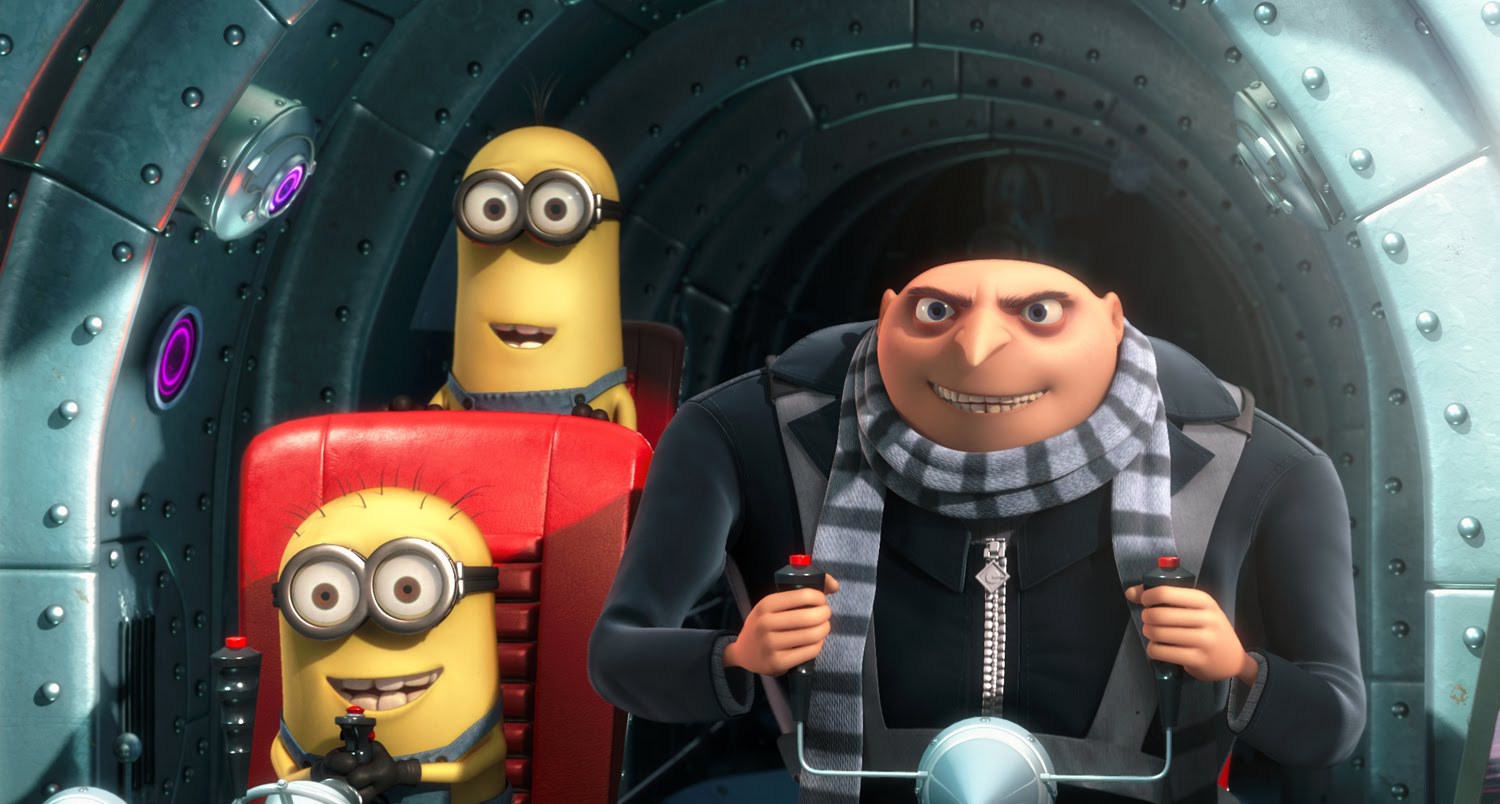
My initial reaction to Despicable Me (2010, directed by Pierre Coffin and Chris Renaud): Must we have treacle with our brimstone? Hmmm? Meh.


I can't say I'm impressed. If you're going to make a movie about an arch-villain, I think it behooves you to make him villainous. And don't turn him into a wuss by providing him with three adorable children. This is another of those movies where Hollywood demonstrates its daddy issues, methinks, and another in a long line of cartoon families with no mother and no procreative reasons for the dad to have the kids. Cartoons are weird about this sometimes.

Still, it's mostly harmless. Our "hero", Gru, seems like he walked out of a Charles Addams cartoon--he bears a close resemblance to Addams's Uncle Fester, and his pill-shaped minions provide the movie with its best laughs. Plus, it takes pot shots at Bill Gates, so it's not all bad. It's just kind of bland, though.

Also, I think I'm done with 3-D. This pains me, because it means I'm probably going to miss Toy Story 3 in the theater (there are no 2-D showings nearby), but I'd prefer to enjoy the movie without a vague sense of nausea. That's sure to color my opinion.

Anyway, all I can say about Despicable Me is that my nephews liked it. Take that as any kind of recommendation you like.

Shameless Self-Promotion #2

While it doesn't indulge in the same kind of thematic miserablism of other movies about transgender sex workers, Olaf de Fleur Johannesson's The Amazing Truth About Queen Raquela (2008) still can't avoid the fact that at least part of its narrative--arguably the dominant part--is constructed from a cisgender man's preconceptions of who transgender people are. The conceit of the movie is that it's half documentary and half fiction, mixed together in such a way as to obscure the lines between the real and the fake. The director himself calls this shambolic portmanteau structure a "visiomentary." You can probably see the flaws in this approach without even seeing the movie, but I'll elaborate anyway.


So begins my latest post over on The Second Awakening. Check it out.

Monday, July 12, 2010

The Blind Leading the Blind

I have to admit that I'm a complete sucker for Zatoichi, the blind swordsman, but I always find it odd when someone else besides Katsu Shintaro reprises the role. I mean, Katsu played the role in 26 movies and a television series. He pretty much laid claim to the role for all time. It just seemed wrong to see the character kinda sorta updated for the West in Blind Fury, with Rutger Hauer in the role, and more traditionally with Takeshi Kitano in the 2003 revival. It's awkward. This problem is sidestepped in Ichi (2008, directed by Fumihiko Sori), in which the blind swordsman himself is absent, replaced by his daughter. She has the same lethal sword stroke and the same blindness, but because she's NOT Zatoichi, the cognitive dissonance is largely absent. That's not to say the movie doesn't have problems of its own.

The basic plot should be familiar to anyone who has ever seen a Zatoichi movie. Ichi (Haruka Ayase) wanders the countryside as an itinerant musician rather than as a masseuse. There is the obligatory gambling scene in which Ichi can hear whether the dice are odds or evens. There is the band of yakuza thugs terrorizing the town. There is the hidden sword and the hidden skill with the sword. All of this isn't so much a formula as it is a ritual. With this being a distaff version of the character, some changes have been made. The biggest change is that Ichi herself isn't the deadliest swordsperson in the movie. In fact, she gets her ass handed to her by the leader of the Yakuza. Takao Ôsawa plays the hero/romantic interest of the piece. He's better than Ichi, too, though he's kinda sorta castrated by a trauma in his past. He can't draw his sword until the very end of the film. The confrontation between him and the bandit leader turns into one of those heroic bloodshed moments that so enamoured Chang Cheh and John Woo.


For the most part, this is completely sexist, and it's surprising to find this iteration in Japanese genre film, which sometimes fetishizes its death-dealing heroines. Still, Haruka Ayase seems a good deal softer than Meiko Kaji ever did, I guess. Be all that as it may, it's disappointing that this becomes about the men and their problems rather than Ichi herself.

Ichi's story is interesting enough in itself to carry the movie, but it serves here mainly as a counterpoint to the way the movie downgrades the archetype. She sets out on her own to find her father after being sexually assaulted and killing her attacker. The movie makes a good deal of hay out of her "disgrace," though I don't know that it endorses the notion. There is a good deal of violence against the women in this movie, but the movie refrains from really turning Ichi into an archetype of female revenge even as she chops up the rapists and exploiters throughout the movie. I'm a bit troubled by the regressive way it places women in the background, even its ostensible heroine. I mean, if you're going to do this, what's the point of creating this particular character in the first place.

I'm also kind of bothered by the way this movie turns into a romance and with how it perpetuates the myth of the regeneration of manhood through violence. Maybe I'm just being picky. Maybe I'm letting feminism get in the way of enjoying the action.

As befits an updating of Zatoichi, this film is almost classical in its approach to filming action. It eschews the fast cut shaky-cam style of contemporary action films in favor of a more Kurosawan approach. It rarely gets closer to the action than a medium two-shot, but it does indulge in slow-motion. There's blood, but there aren't the geysers of blood from the balmier days of the chambara. The blood here is digital, but it's not overly intrusive.

This approach is appealing, but it has a drawback. Lacking the eye for mise en scene and editing of a Kurosawa (or even a Fukasaku or a Misumi), this approach has a kind of flattening effect. The movie never really wows the viewer with either the action or the style. In this regard it's almost exactly like a mid-period Zatoichi movie, but that shouldn't be counted as a compliment. Much as I love those movies, I'm under no illusions about their aesthetic merits, just as I'm under no illusions about this film, either. Still, it's an attractive movie and an entertaining chop-em up. I wish I could like it better than I do.

Saturday, July 10, 2010

There Are No Strings On Me

All things considered, Jonathan Mostow makes movies that really should be better. This is true of his very sinister Breakdown, of his ill-advised Terminator 3, and of his 2009 sci-fi thriller Surrogates. Mostow is competent, and he puts together appealing genre exercises that are just good enough to whet the audience's appetite for a much better movie. Surrogates suggests so many interesting avenues of exploration that one longs for it to have been made by a Kubrick or even a Spielberg. Instead, the interesting ideas all provide plot points.

The story posits a future in which robotic bodies are driven from afar by users as a means of presenting younger versions of themselves, of being indestructible in the face of dangerous occupations and passtimes, and even of exploring polymorphous sexual identities. In the course of the film, someone manages to attack one of the surrogates in a way that kills the user. Enter FBI agents Greer and Peters, who follow the crumbs to both VSI, the company that builds the surrogates, to that company's exiled founder, Dr. Canter, and to the Dreds, a cult that abhors surrogates. In the course of the movie, Greer's surrogate is destroyed and he has to take to the street as his flesh and blood self, navigating the mystery without the benefit of indestructibility. This causes some friction with his wife, who he hasn't seen in the flesh in some time. Peters, for her part, meets with a different misfortune, and her surrogate becomes an agent of chaos in the back end of the movie.

Given that short summary of the plot, any reasonably imaginative person could extrapolate any number scenarios from the comic to the apocalyptic to the transgressively kinky. Hell, the filmmakers are obviously aware of all of the possibilities inherent in their premise because they occasionally touch on just about all of them. But the film doesn't take it any deeper than points on the line of a police procedural. From my own perspective, the scene where they discover the first victim taken out by the murderer is a huge prick tease: the surrogate is a bombshell of a woman, but the user is a middle-aged white guy. This scene is over in about thirty seconds, and passes almost without comment. It says something to me about a movie so overloaded with untapped ideas when it clocks in at under an hour and a half, as this one does. It means that the filmmakers couldn't even be bothered. Pity.

In any case, as I say, the whole thing is competent. Mostow stages the action sequences in a perfunctory manner, and he doesn't intrude on the plot with anything approaching style, but in an era of over-edited run and gun filmmaking, you could make an argument for the classical austerity in this approach. And the movie does occasionally have an arresting image or two. Most notable--and the most creepy--is the way the movie's special effects make both Bruce Willis and Radha Mitchell into perfect versions of themselves. The surrogate version of Willis appears to be about 38, while Mitchell's appears to be about 29. Surprisingly, I find Willis at his actual age to be considerably more attractive, but that's just me.

The film has to perform an interesting inversion of this on Rosamund Pike as Willis's wife. She probably doesn't look far off from her barbie-doll surrogate, but they have to age her considerably for her flesh and blood counterpart. One of the film's more arresting images is the broken doll stare of Pike's face after her surrogate has been disconnected.

So what we have here is a genre programmer that should be a mind-blower. Damn you, Mostow. Would it hurt to even try once in a while?