306. After the election, I felt a certain obligation to watch Frank Capra's Mr. Smith Goes to Washington (1939), which used to be one of my favorite movies when I was a teenager. It hasn't aged well for me as an adult. I still like it a lot, though some of that is residual affection from my youth, but I see the glaring flaws in it today, thrown into stark contrast by an adult life engaged with the political process (I've been an activist for the last eight years, in one capacity or another). In that light, the sheer naivete of Jefferson Smith and his national boy's camp seems ridiculous on the face of it. Oh, the film slants the dam project that Claude Rains's corrupt senator wants to ram through by telling us at the outset that it's a boondoggle for the benefit of the political machine pulling his strings, but, hell, a hydro-electric dam sounds to me to be a lot more useful than a boy's camp, even if it does enrich the bosses. I mean, we're talking about a country that was still only barely electrified at this point in time. Of course, I'm well aware of the fact that the details are beside the point, that the boys camp and the dam and all are McGuffins of the highest order, and that the point of the film is the injection of integrity into the political process, but the sentimentality tends to undo this for me anymore. Sentiment, as anyone who makes serious art can tell you, is pure poison.
307. I'm much more in love with Capra's It Happened One Night (1933), which not only put Capra on the map of "great" directors, it also put Columbia Pictures on the map after years of a marginal existence on poverty row. Studio boss Harry Cohn was fabled as the cheapest man in Hollywood, after all, but he gave Capra his head, and Capra made stars of the first magnitude out of his actors: Clark Gable and Claudette Colbert. Colbert set the standard for spoiled heiresses that persists in one degree or another to this very day, and Gable suddenly ruled the 1930s as the King of Hollywood. Although there isn't anything as salacious in this movie as one finds in other pre-code movies, there's a sexual friskiness in this movie that vanishes from the screwball comedies that use it as a template. This is especially manifest in the "walls of Jericho" scene. This adds seasoning to a film that could wind up too sweet. As it is, it's just right.
308. Chinese director Jin Xie died last month, so in his honor, I watched Stage Sisters (1965). A story of two actresses caught up in the revolution, this is one of the most cunning bits of misdirection in the history of movies. On the surface, it seems to be a stock piece of upright communist propaganda--and Jin Xie knew that it had better damned well pass that particular test if he didn't want to end up in a re-education camp--but what the movie REALLY is is a bittersweet lesbian love story. I mean, it's hard to miss it these days, after years of decoding queer subtexts in films, but I presume that the Red Chinese censors of the day were as literal-minded as censors always are and they couldn't see what's right in front of their faces. Some of the dialogue near the end, with its whiff of sloganeering, is hard to take, but on the whole it's a beautiful film to watch.
309. As childhood nightmare fuel goes, it would be hard to beat the late Paul Berry's deranged short film, "The Sandman" (1991). Very much in the Tim Burton mold (Berry made models for Burton's The Nightmare Before Christmas), this is a horror story through and through, one that delves deep into childhood fears, and which features a gruesome denouement. Then it caps it with a haunting final image after the credits. Highly recommended. You can see it here:
310. My partner wanted to watch a comedy this weekend, so we got Get Smart (2008, directed by Peter Segal), which I gave a pass when it was in theaters. I liked Anne Hathaway as Agent 99. Steve Carrell doesn't erase memories of Don Adams, unfortunately. The dastardly plot is pretty transparent from the get-go. I was happy to see Patrick Warburton show up at the end, but I'm always happy to see him in a movie. It's mostly harmless and intermittently amusing. I'm glad I rented, though, because I doubt I'll ever watch it again.
311. There are two sequences in Abel Ferrara's Ms. 45 (1981) that show the director's hand. While there are tons of elements in the movie that suggest that it's a pure exploitation film (the old "head in the freezer trick," anyone?), Ferrara's ambitions towards art manifest themselves. The first: Thana, our mute heroine, out on her first real rampage, is surrounded by gang bangers who circle her like sharks. Ferrara shoots this from above, and the movies is temporarily transformed into the equivalent of a Busby Berkely musical. This sequence is pure choreography, violence in the abstract. The second: Thana picks up a prospective victim in a bar and they make their way to the waterfront, where her victim recounts how he found himself cuckolded by his wife. Thana's gun misfires and he takes it away. Then points it at his own head and pulls the trigger. This sequence seems like a predecessor to Ferrara's later "Madmen in New Yawk" films like Bad Lieutenant and delves more deeply into an existential abyss than any Death Wish knock-off has any right. Also, it's interesting how Ferrara resists the urge to turn Thana into a gun-toting fetish figure. Oh, sure, she winds up decked out as such, but Ferrara intercuts these depictions with the fate of Thana's first "victim," which acts as a kind of subversion. We can't entirely embrace Thana as an angel of vengeance, because Ferrara shows us how profoundly damaged she really is. This movie is still waters. There are hidden depths.

And in spite of all of that, there is still the image of Lulu, with her short bob and her impossibly lustrous bangs. However brutal the film becomes, it comes dazzlingly alive whenever Louise Brooks smiles at the camera. Frankly, the film would not work without her. With her, it's a stunner.
Monday, November 17, 2008
Femme Fatales

Wednesday, November 05, 2008
The October Horror Challenge: The Bitter Taste of Failure.
The stragglers from the October Challenge:
October 26:
300. Wicked Little Things (2006, directed by J. S. Cardone), in which a woman and her daughter are haunted by the children killed in a mining accident. Zombies. Cliches. This was supposed to have been directed by Tobe Hooper, which makes this a bitter pill, because I can totally see him going to town with this material. It's not awful as it is, but I'll be damned if I can remember much about it a week later.
The Thing (1982, directed by John Carpenter), for the second time in the last two months. My SO wanted to watch this for a date night. Who am I to argue? The family that watches horror movies together, slays together, I say.
October 27:
301. Arang (2006, directed by Sang-hoon Ahn), in which are conflated the Asian ghost story (complete with ghost girls with long black hair and bloody eyes), and the serial killer procedural. This is a mash-up. It's slick, but it's nothing you haven't seen before, only collected in one economy package.
302. Bloody Reunion (2006, directed by Dae-wung Lim) is like a Korean version of a giallo. It seems more like a giallo than a slasher movie, but that's splitting hairs, I guess. What this IS is violent. It's relatively elegant about it, too. Unfortunately, it pulls the rug out from under itself in the last act. It's a head-scratcher.
October 28:
303. The Mummy (1959, directed by Terence Fisher), which I think I've seen in fragments in the past. I've never watched it start to finish before, though. It's an energetic reworking of Universal's second wave of mummy movies, with Prince Kharis rather than the sinister Imhotep. Christopher Lee is largely wasted in the title role--he seems altogether too athletic for the part, actually--but Peter Cushing is always good.
304. I'm in the same boat with The Gorgon (1963, directed by Terence Fisher): I've seen fragments. I may even have seen the entire thing before, but never all at once. The Boys at Bray get the most out of Lee and Cushing here by having them both on the same side, rather than as opponents. The monster, however, is disappointing. Alas.
October 29:
305. Cinderella (2006, directed by Man-dae Bong) is a plastic surgery horror movie, rather than a dark fairy tale, and it really wants to be a drama rather than a horror movie. I don't usually mind dramas hiding behind the genre signifiers, but this is a movie where the two impulses work at cross purposes. The first part of the movie isn't bad, but it degenerates rapidly after the half-way point.
Final tally: 22 films, 19 new to me.
So this is a partial success. I beat my previous best new films by two movies. But I failed to get to 31. Suck.
Monday, October 27, 2008
The October Horror Movie Challenge, continued.
From the challenge:
October 20:
293. The Abandoned (2006, directed by Nacho Cerdà), in which a woman returns to the home of her parents in Russia where she meets her long lost twin brother and, it appears, their undead doppelgangers. This is pretty good. It gets the sense of dread right, and it flourishes it with genuinely frightening ghosts and a touch of Lovecraftian "wrong" geometry, then caps it off with a strikingly bleak ending. A bit more visceral than ghost stories tend to be, too, with a pig scene worthy of Clive Barker. Recommended.
October 21-23:
Nothing
October 24:
294. The Island of Doctor Moreau (1977, directed by Don Taylor). If I ever knew it, I had forgotten that this version of Wells's anti-vivisectionist rant was produced by Sam Arkoff and AIP. That explains a lot of the film's shortcomings, though it doesn't explain the A-list in 1977 cast. I mean, Arkoff and Burt Lancaster are not names one commonly hears in the same breath. I remember when this came out, my horror-loving friends and I were all over the make-up effects for the "Manimals". The effects haven't aged well. At all. Nor has the film, which has an anonymous 70s-era TV Movie feel thanks to lackluster direction. Still, Lancaster makes a surprisingly effective Moreau, though one misses the impishness of Charles Laughton in the role. And the chant of the Sayer of the Law is still iconic. "Are we not men?"
295. Inside (2007, directed by Alexandre Bustillo and Julien Maury) is a pure, single-minded shocker. Upon my first viewing, I'm not entirely sure if it has anything to say beyond its shocks--it may or may not offer up a helping of existential dread--but it's hard to tell because the movie is so pummellingly brutal an experience. It wants to reduce its audience to a fetal ball in the corner screaming, "Make it stop!" It's very successful. Part of this is because, unlike some other films intended to shock for the sake of shock, this one is no stranger to creeping menace and mounting tension, either. While I don't want to compare this movie to The Texas Chain Saw Massacre, it reminds me of that film in so far as I think it is only defensible as a filmmaking tour de force unto itself. This one hurts.
October 25:
296. The Mist (2007, directed by Frank Darabont) is another variant of Night of the Living Dead/Rio Bravo. This time, a collection of characters is trapped in a supermarket while a mist containing hideous monsters from another dimension rolls in. This is a lot better than I expected it to be, given that I've never been much of a fan of the Stephen King story on which it is based. This is a movie for monster-lovers, because this sucker has some jim-dandy creatures. It has interesting actors, too, though most of them are encouraged to over-act outrageously. One exception to this is Toby Jones, who makes the most of a nerdy supermarket clerk with hidden depths. He makes up for Marcia Gay Hardin's trip to religious looney-ville. The film has an agreeably bleak ending, sure to piss off half the audience, but them's the breaks sometimes.
297. Malefique (2002, directed by Eric Valette) plays more than a bit like a play. You have a limited setting (mostly inside a prison cell) with, basically, four characters. There's an element of a gallic theater of the absurd, too. How else to explain the mix of characters: a very butch transsexual, the cannibal little buddy, the wise wife-killing librarian, the corporate criminal. The plot contrivance--a spellbook hidden in their cell by a hundred-year old serial killer--gives this feeling, too. Like most recent French horror, this has an instinct for the thoroughly nasty visceral image. It has a dumb Twilight Zone-y ending, though. Meh.
298. Mortuary (2005, directed by Tobe Hooper). Oh, Tobe! How could you? And just when I was ready to let you back into the canon...Sigh.
Non Horror:
299. After being brutalized by Inside, I put on The Princess Bride (1987, directed by Rob Reiner), which has long been on of my few pieces of cinematic comfort food. It's all in the screenplay with this one, because the direction is kind of dull. Still, I love Wallace Shawn in this movie, and Christopher Guest. Hard to make out most of Andre the Giant and Mandy Patinkin's dialogue, even after all these years.
I'm going down in flames this year. Pesky vacation. Ah, well. Maybe next year.
Monday, October 20, 2008
The October Horror Movie Challenge, 2008 edition.
Like Jason returning in a Friday the 13th sequel, The October Horror Movie Challenge is upon us once again. The object, as usual, is to watch 31 horror movies before midnight chimes on Halloween, with at least 17 movies being movies you've never seen before.
I got off to a flying start after the end of my vacation. I've got some catching-up to do. First-time viewings in blue:
October 6:
282. Black Sabbath (1962, directed by Mario Bava). In which Bava invents Italian horror cinema out of whole cloth. It's like a Basil Gogos painting come to life. Longer review here.
October 7:
283. Snake Woman's Curse (1968, directed by Nobuo Nakagawa). Weird, theatrical Japanese horror movie, with a strong Marxist backbone. Evil land-owner torments peasant family. Peasant family visits a nasty curse upon them once they're all dead. It's creepy in parts. Never really scary, though. Mostly an oddity.
October 12:
284. The Uninvited Guest (2004, directed by Guillem Morales). A brilliant set-up, in which an architect begins to think the man who came in to use his phone and then disappeared is living somewhere in his house. Lots of doubling goes on in this--there's a doppelganger effect--but the ending of the film descends into an incoherent ambiguity. Still, the first hour is razor sharp.
October 15:
285. Sweeney Todd: The Demon Barber of Fleet Street (1936, directed by George King). In which Tod Slaughter devours the scenery as the title character. It's amazing how much Sondheim took from this version of the story. It creaks, though. A lot.
October 16:
286. Feast (2005, directed by John Gulager). This is a minor miracle. Anyone who watched this unfold on Project Greenlight saw a completely dysfunctional production. That anything watchable emerged is surprising. That something genuinely entertaining emerged is astounding. Mind you, this isn't great. It has some fun subverting expectations (and winking at the audience while it does), but it's nothing profound. Another variant of the Night of the Living Dead scenario, which is so popular because it's so cheap to produce. But even so, it has an appealing instinct for the jugular.
October 17:
287. MOH: Homecoming (2005, directed by Joe Dante). A disappointment. I mean, I love that Dante decided that "complete freedom" means freedom to make a political statement, and I love the fact that this is a modern updating of Abel Gance's J'accuse. But the satire isn't sharp enough and it doesn't go far enough over the line to draw any real blood. The real thing is still more horrifying.
288. MOH: Pick Me Up (2005, directed by Larry Cohen). The weird alchemy in this series continues, in which the guys I don't much respect are the ones knocking it out of the park while the heavy hitters are striking out. This time, Larry Cohen makes me choke on every bad thing I've ever said about his movies, because this is sharp, merciless, and scary. Having his cinematic alter-ego, Michael Moriarty, as one of his dueling serial killers is a nice bonus, and even Fairuza Balk's familiar face doesn't save her in the end. Nice.
289. The Dark (2005, directed by John Fawcett). If one turns off the sound and ignores the story, this is a beautiful production. Gorgeous locations on the Isle of Man, terrific actors, superior cinematography. I mean, Sean Bean (yum) and Maria Bello (also yum) alone should make this work, right? Well, not quite. The story itself is pretty bad, and the script sounds like crap even when it comes out of the mouths of these actors. In spite of its Welsh back story, this still seems like it's ripped off from Asia.
October 18:
Nothing. I suck
October 19:
290. Mother Joan of the Angels (1961, directed by Jerzy Kawalerowicz). Not quite a nunsploitation film, and artier than most similar films short of Ken Russell's The Devils (it tells more or less the same story), this still feels vaguely like a Hammer film. I mean the stark visuals are a million miles away from Hammer, but the set-up would be at home in any of their vampire movies. The picture quality on the DVD leaves a LOT to be desired.
291. Do You Like Hitchcock (2005, directed by Dario Argento). Workmanlike made-for-TV giallo and no more. It throws around Hitchcock references with abandon, but it doesn't understand any of them. Dario, I hardly knew ye.
292. Non Horror: The Last Laugh (Der Letzte Mann, 1924, directed by F. W. Murnau) with live music by Rats and People Motion Picture Orchestra, who were fabulous. The movie itself is silent film at its most inventive and sophisticated, even though there's a stark break in the mood near the end. Does it betray it's intent? Maybe. I dunno. Emil Jannings overacts regardless. Not my favorite Murnau, but one can see the seeds of later Murnau (Sunrise, for instance) in this film. It's hard to believe that this is the same filmmaker who made Nosferatu just two years earlier. Its a quantum leap in cinematic sophistication.
Current tally: 10 films, 8 new to me.
God, I'm sucking this year.
Wednesday, October 08, 2008
Belatedly...
I was on vacation for a week, and I'm only now getting caught up. Here's what I watched before embarking on the annual October Horror Challenge:
268. Underworld Beauty (1958, directed by Seijun Suzuki) Suzuki at his most generic, but an entertaining genre piece none the less, involving a recently released yakuza who has the diamonds from the heist for which he went to prison. Mix in guilt over the loss of his partner's leg (and later life), his partner's straying younger sister, and the treacherous boss who covets the diamonds, and you have a pretty good blend of elements. Suzuki was pretty good with black and white, in spite of his later color experiments.
269. Transsiberian (2008, directed by Brad Anderson)
270. Tell No One (2006, directed by Guillaume Canet)
The difference between a good thriller and a bad thriller: one goes through the motion of a plot without any real meaning to its characters; one uses plot to dig into the moral and psychological states of its characters. Transsiberian is riveting. Tell No One is exhausting. Transsiberian unfolds without leading the audience by the nose. Tell No One requires a 25 minute exegesis to unravel its story. Tell No One is French, but it seems like a generic Hollywood thriller (it was written by Harlan Coben). The plot hook is pretty good: a man whose wife was murdered seven years ago gets an email indicating that she may, in fact, still be alive, but from there it piles on the twists and turns until it resembles the Gordian knot. It's so busy with plot that it has no time to examine the moral or psychological dimensions of it's lead character. To its credit, it does shed some light on his professional life, in which he seems particularly affable (he's a pediatrician). But the movie never really engages. Transsiberian, on the other hand, is a big ole truckload of menace, emotional and moral conflict, and dark secrets. It's an interesting conflation of Hitchcockian thriller (it occasionally references and resembles The Lady Vanishes), while turning many of the conventions of film noir on their heads. The story follows a missionary couple from China to Moscow on the eponymous train trip. They meet another couple with suspicious circumstances. Characters vanish and reappear, and all the while, there is the feeling of being a stranger in a strange land. Emily Mortimer is superb in the lead, who is led astray by homme fatale Eduardo Noriega. Her character bears a crushing weight of guilt through the movie, and Mortimer makes us feel every ounce of it. Ben Kingsley adds another ethnic character to his portfolio as the cop on the case, who has secrets all his own. It's a superior film.
And a whole bunch of Superman cartoons from the 1940s:
271. Superman: Volcano (1942, directed by Dave Fleischer)
272. Superman: Japoteurs (1942, directed by Seymour Kneitel)
273. Superman: Destruction, Inc.(1942, directed by Izzy Sparber)
274. Superman: Terror on the Midway (1942, directed by Dave Fleischer)
275. Superman: Showdown (1942, directed by Izzy Sparber)
276. Superman: Jungle Drums (1943, directed by Dan Gordon)
277. Superman: Secret Agent (1943, directed by Seymour Kneitel)
278. Superman: Eleventh Hour (1942, directed by Dan Gordon)
I don't have much to say about these except to say that there's a noticeable jump in the quality of the shorts directed by Dave Fleischer. The huge gorilla in "Terror on the Midway" makes one of the best monster entrances in film. Perhaps the most interesting film of this bunch is "Eleventh Hour," in which Clark Kent is in wartime Japan and Superman acts as a saboteur. Most of these shorts act as wartime propaganda, but that doesn't diminish their appeal.
279. Back from Eternity (John Farrow, 1956).
Sort of an ur-version of The Flight of the Phoenix, set in a jungle rather than in a desert. Robert Ryan is good as the pilot. Anita Eckberg provides the eye candy. Rod Steiger chews the scenery. Gene Evans goes crazy. It's not a particularly great film, but it's entertaining. John Farrow was adept at these kinds of entertainments.
280. Once Upon a Honeymoon (Leo McCarey, 1942)
This starts as a screwball comedy. I mean, it's directed by Leo McCarey and stars Cary Grant and Ginger Rogers, so it's screwball all the way, right? But after a screwball comedy set-up, it veers into very dark territory as Grant and Rogers embark on a tour of Europe as Rogers's husband (the always nefarious Walter Slezak) undermines government after government for the Nazis. In truth, it's a mix of elements that doesn't work very well. It's not funny enough to stand as a comedy (like, say, To Be or Not To Be) and the comedy undermines the serious overtones. Still, Grant was at the height of his abilities in this movie, and he shades effortlessly from charming and goofy to dark and serious. It's a tour de force looking for a better movie.
281. Boomerang (Elia Kazan, 1947)
Excellent courtroom drama in which a prosecutor goes against the grain and attempts to prove the man in the dock innocent of shooting a priest in the back of the head. This is one of those docudrama/film noir hybrids that Fox loved so much in the late forties, but there's a guiding political principle under the film, too, provided by director Elia Kazan. Dana Andrews is good in the lead. The supporting cast is a gallery of interesting faces, including Arthur Kennedy, Lee J. Cobb, Ed Begley, and Jane Wyatt. It's nice to see this title make it to the shelves after Fox bungled its original DVD release.
And then on to the October Horror Movie Challenge.
Tuesday, September 23, 2008
Brief Hits
What I saw last week. Minimal reviews. Sorry.
263. A Touch of Zen (1969, directed by King Hu). One of my very favorite movies. I'd recommend it more highly if the DVD didn't suck (and suck HARD). A longer reaction can be found here.
264. Doctor Jeckyll and Mr. Hyde (1920, directed by John S. Robertson). In which the familiar elements of most subsequent movie versions are solidified. John Barrymore is good as Jeckyll, in a relatively restrained performance. He's off the rails as Hyde, though.
265. Black Sunday (La Maschera del demonio, 1960, directed by Mario Bava), another of my very favorite movies. A fever dream of rapturous images. Barbara Steele's eyes sometimes haunt my dreams.
266. Star Wars Episode III: Revenge of the Sith (2005, directed by George Lucas). You know what bugs me about this movie? When I saw it in the theater, it had that soft focus degredation of image that comes with most films that are converted from a digital negative to film. This movie looks better on television than it did in a theater. That's just WRONG. I kinda like the two movies that came before this one--they've gained in retrospect. I liked this more when I first saw it than I do now. Interesting. But then, I have no vested interest in the Star Wars movies and never really have.
267. The Pit of Bloody Horror (Il Boia scarlatto, 1965, directed by Massimo Pupillo). This is just plain goofy: it's what you get if you throw Feuillade and Bava into a blender and hit puree. Still, it delivers the violence, if that's your bag. For some reason, I wanted to follow this with an El Santo movie for good measure. It's probably best that I didn't have one immediately to hand.
Sunday, September 14, 2008
Burning Down the House
258. A couple of years ago, one of my friends tried to get me to watch a horror movie called Cutting Class, a slasher movie. I don't much like slasher movies, so I told my friend that I'd take a pass on it. To which, he replied:
"What? You don't want to see Brad Pitt get his head crushed in a vise?"
Sold.
If I were unsure of Burn After Reading, all someone would have to say would be "What? You don't want to see Brad Pitt get shot in the face?"
Again. Sold.
I loved Burn After Reading. It's not a laugh a minute. It's actually kinda dark for a farce, even a "black comedy." I think the movie is structured like a shaggy dog joke. Those jokes depend on the punchline, and this movie's punch line--that last scene with Clooney and McDormand in the park, is absolutely magnificent. I was laughing at that for hours after I saw it.
259. Regarding A Chinese Ghost Story III (1991): There's no getting around the fact that the Chinese Ghost Story movies are utterly insane. Completely bonkers. All three of them have more or less the same plot: comely ghost girl Joey Wang falls for some traveling shlub and helps him and his mentor defeat the evil spirit of the haunted temple that holds her soul prisoner. But that really doesn't say anything about what the movies are actually like. This third installment has a certain amount of kink involved in the early going, which is new to the series, and it has some more lunatic set pieces (particularly when it swipes an idea from King Hu's A Touch of Zen near the end), but in the end, it arrives at the same kind of delirium. Great fun.
260. I've probably seen Richard Lester's The Three Musketeers (1973) a dozen times, but I don't think I ever noticed before that the screen play for this version was written by George MacDonald Fraser. That explains a LOT. For the most part, my favorite parts of this movie are the villains: Fay Dunaway's Lady De Winter, Christopher Lee's Rochefort, and Charlton Heston's delightfully sly Cardinal Richelieu. That's in tune with Fraser, I guess. I don't think his Flashman would be out of place in this movie. Fun.
261. I think I'm getting burned out on fantasy movies. While I don't think that there's anything intrinsically wrong with The Golden Compass (2007, directed by Chris Weitz)--and, in fact, I like the idea that it's an atheistic fantasy a lot--I got pretty impatient with its world-building faster than I would have liked. The visuals are finely burnished, but don't seem to admit even the slightest flaw to give them any reality. It does have a pretty good child actress in the lead, which helps. But I was never really engaged.
262. Milos Forman's Loves of a Blonde (1965) might be another unwatchably dour New Wave slice of life without the antic sensibility that runs through it. It LOOKS like a New Wave film, in stark, neo-realist black and white. But then it lets its characters bicker, and the film comes to life. It's lead character makes foolish romantic decisions, it's true, but they are understandable given that there's a ratio of 16 women to each man where she lives. The loves she embarks upon are the stuff that dreams are made of, for the most part, in the same way that the Maltese Falcon is. Likable, but generally slight.
Monday, September 08, 2008
A Life of Illusion
253. and 254. Although they are ultimately very different movies (I was led to believe that they are very similar), both The Prestige (2006, directed by Christopher Nolan) and The Illusionist (2006, directed by Neil Burger) share one huge, overwhelming problem: movies about magicians cannot avoid cheating the audience. It's a function of film. Especially nowadays, you can do ANYTHING on film, so any illusion performed for the camera, however "real" it might be will always be suspect. To its credit, The Prestige understands this better than The Illusionist, and it side steps it with the Penn and Teller technique of making the entire process transparent. It gives away the tricks. Nolan's movie is downright brutal about it, too (witness the fate of various birds in cages). But then...the movie veers dangrously into the realm of fantasy towards the end, as Hugh Jackman's magician, attempting to duplicate a trick by his enemy, Christian Bale, receives a machine from Nicola Tesla. And there, the movie drives off the cliff. Oh, it plays fair with the audience. I knew almost all of the film's secrets before it revealed them. For the most part, waiting for them to unfold was mostly make-work. Meh. I was a bit more engaged by The Illusionist, due in large part to Paul Giamatti's engaging role as the police chief under the Crown Prince of Austria. Giamatti is superb, and provides the audience with an "in" for the story. He's fascinated by magic. He wants to know how it's done. Unfortunately for him (and the film), the movie chooses to keep its secrets, and despite its intention to transform into a kind of fairy tale at the end, one can't help but feel cheated.
255. and 256. I don't express a preference between either version of Gaslight (1940, directed by Thorold Dickinson, and 1944, directed by George Cukor). Where the first film exceeds the second through superior direction, the second has better performers. Anton Walbrook is cold fish compared to Charles Boyer--though both are wonderfully loathesome as fortune hunters trying to drive their respective wives insane. Ingrid Bergman trumps Diana Wynyard in almost every possible way. But Cuckor is an actor's director who relied on his production crew to design the "look" of the movie, whereas Dickinson's approach is much more cinematic. Both of them are pretty good movies. So call it a draw.
257. I transferred John Carpenter's remake of The Thing (1982) to DVD from my old laserdisc this weekend. I don't remember the last time I watched it. It's been years. Rob Bottin's special effects are every bit as revolting as they were the last time (I LOVE the spider head scene), but I don't remember grooving to Dean Cundey's panavision camerawork the way I did this time. This is Carpenter's best-looking movie. I'm still trying to figure out why Carpenter hired Ennio Morricone if he wanted the score to sound like one of his own compositions, but that's one of the movie's more endearing mysteries.
Monday, September 01, 2008
Character Studies
250. The Dark Corner (1946, directed by Henry Hathaway) finds Lucille Ball playing against type as a PI's secretary who must pull her boss's chestnuts out of the fire. Ball proves to be a pretty fine dramatic actress, though her leading man, Mark Stevens, is a bit of a stiff. Supporting work by Clifton Webb and William Bendix is pretty good, and the movie has an agreeable veneer of noir style (more than is usual from director Hathaway). It's a minor film, but Lucy makes it worth the effort.
251. The Lookout (2007, directed by Scott Frank) is the crime film as character study, as brain injury victim Joseph Gordon-Levitt is suckered into a bank heist by bad companions Matthew Goode and Isla Fisher. The crime film plot is expertly mounted, but nothing particularly special. The character work is what makes the film tick. Gordon-Levitt provides another superior performance as our memory-impaired lead, adding to his cache as one of the best young actors. Goode is simultaneously charismatic and slimy. The background is populated by interesting actors like Jeff Daniels, Bruce McGill, Carla Gugino, and Alberta Watson. This is one of those movies where, if you like watching people--especially when they're put in the crucible--then you'll groove on the movie. If you're there for the plot, you might be disappointed. I liked it a lot.
252. Quentin Tarantino's Jackie Brown (1997) is another character study masquerading as crime film, though it has an intricate plot to go with its examination of character. Tarantino, already a long-take director, lets the plot decompress (which lengthens the movie considerably) and gives his characters their heads. And the characters that interest him here (provided by novelist Elmore Leonard) are not the kinds of characters you find in most contemporary crime or action movies. I mean, the heroine is a 44 year old black woman. The "hero" is a 56 year old bail bondsman. He's populated it at every level with interesting actors, none moreso than Pam Grier in the title role. Virtually alone among Tarantino's movies, this film feels like it exists in and of itself. The director's penchant for meta-cinematic self-reference is held almost entirely in check (though it's not completely absent: note Sid Haig playing The Man to Pam Grier's jailbird; heh). For my money, it's Tarantino's best film. One scene in particular ices it. At roughly the 2 hour mark, Sam Jackson's villainous arms dealer pauses to think when it's plain that he's been screwed. The movie lets him think. The camera never moves while he works things out in his head. I can't think of another crime film or 'action' film with that kind of patience.
Monday, August 25, 2008
An ode to the Swamp Thing
I've been re-reading my collection of old Swamp Thing comics the last couple of weeks. I have pretty much all of Swampy's appearances up through the founding of Vertigo (a founding built as much on Alan Moore's run on the book as anything, even though Moore had long since left when it happened). Here are a couple of thoughts on the matter.
First, when the movie version of Watchmen comes out next year, I hope the filmmakers have the wit to invite Wes Craven to the premiere. Without Craven, their film probably would not exist because the Swamp Thing run by Alan Moore would not exist. The version of the book on which Moore cut his teeth at DC was originally launched to tie in to Craven's Swamp Thing movie. The second issue of this run even had letters of encouragement from Craven himself and actor Dick Durock, who played the character on screen. It used a still from the movie on the cover:

Second, I think two periods of the book's first and second runs have been unfairly overshadowed by the bookends of the Len Wein/Berni Wrightson era and the Alan Moore/Stephen Bissette/John Totleben era. There isn't anything wrong with Nestor Redondo's art on the post-Wrightson issues, except, of course, that he's not Wrightson. And the Marty Pasko issues that precede Alan Moore's run on the book are pretty good. What isn't discussed much about the Alan Moore run is that great whacks of it are built upon and reference Pasko's stories, from the corporate bad guys who have it in for the Swamp Thing to a couple of the stand-alone adventures. Moore's interpretation of the supporting cast of the original series--Matt Cable and Abigail Arcane--derives directly from their depiction by Pasko rather than the one found in the series original run. There's at least one of Marty Pasko's issues, the Twilight Zone-y 16th issue, that's easily as good as any of the Alan Moore issues. Hell, it's better than some of them.
Third, I think Alan Moore lucked into an astonishingly good situation with the art team he inherited. I had been buying the book from the outset, though by the time the book was in the mid-teens, I was wavering. I skipped an issue or two of the later Tom Yeats issues (I filled them in after the fact), but when Bissette and Totleben came on the book, I was hooked. I had been a huge fan of the work they had done in Marvel's black and white magazines, particularly "The Blood Bequest," a waaaaay over the top Dracula story, and "A Frog is a Frog," which is one of my favorite horror stories in any medium from the 1980s. Bissette had been contributing layouts for Swamp Thing during Tom Yeats's run on the book, and invariably, they were Yeats's best pages. When he and Totleben took over the book full-time, there was a noticeable jump in quality .
I should note, in passing, that I liked Tom Yeats's art. It was dark and moody and classical, in the tradition of Berni Wrightson. But it wasn't batshit insane, which Bissette and Totlebens' art categorically was.
In any event, I have some serious doubts about whether or not Moore's initial success would have been as large as it was without the contributions of his artists. Tonally, his first couple of stories are very similar to Pasko's, though they are very different in terms of narrative technique. The work that Bissette and Totleben were already doing was amazing. Take for instance this panel from issue #17:

This is much more tonally dense than Yeats's work, not just in terms of image, but also in terms of technique. There are several separate and distinct methods of drawings working in this panel, and they throw in a photographic element as well.
I'm also fond of this scene, a couple of pages later:

For the most part, I think Pasko as a writer gave the artists their heads. I don't know if Pasko wrote using the Marvel method (in which he provided a plot for his artists and filled in the dialogue after the fact), or if he wrote full scripts. Based on the results, I rather suspect the former, because every so often, they would cut loose with something like this, from issue #19:
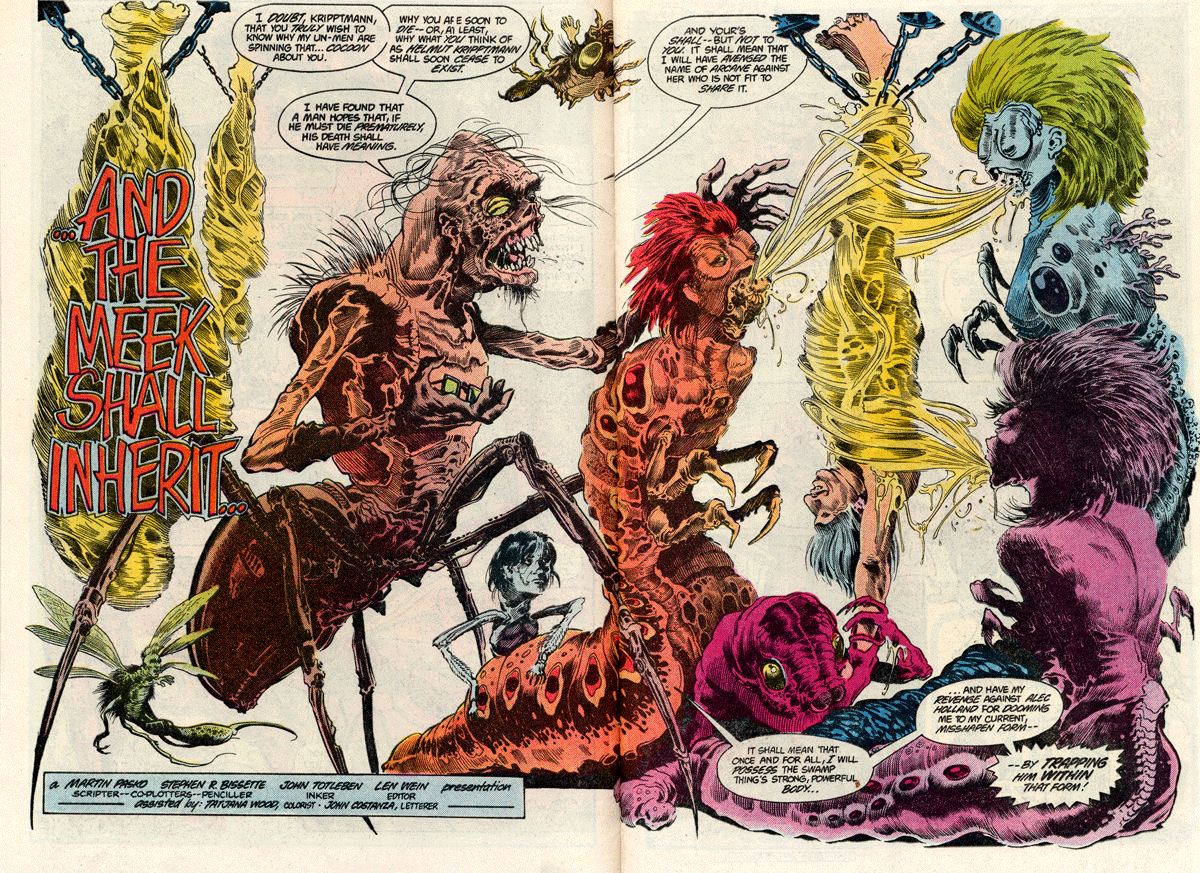
(click the image for a larger version)
Moore's sensibility seems to have been more closely in tune with the artists, though, because when they were clicking, they were unbeatable. This is my favorite page from the Moore run, the splash page of issue #42. It's positively droll:

Enjoy.
A Light Week
248. I was taking a drink when it happened, so when May Canaday walked across the screen near the beginning of Brick (2005, directed by Rian Johnson), towing her cooler full of body parts behind her, I wound up with a sinus full of cranberry grape juice. I didn't quite spray it out of my nose, but it was close. Director Johnson was the film editor on May, which explains some of the similar feel this film has in the early going. Both films are in touch with a kind of adolescent anomie, translated to the screen as a kind of existential dreamscape. I mean, the high school confidential entered this realm a long time ago now with films like River's Edge, so I'm surprised it took as long as it has to mate this sensibility with the existential dreamscape of film noir. It works surprisingly well. I mean, I occasionally laughed at the hardboiled dialogue, but I think that it was intentionally funny. Droll, but intentional. The movie is singularly fortunate to have Joseph Gordon-Levitt in the lead. He sells the dialogue with authority. Gordon-Levitt is one of the best actors currently working. I mean, he makes me want to watch a Gregg Araki movie, for Pete's sake! That's charisma.
249. I'm slowly getting around to last year's Best Picture nominees. After watching Michael Clayton (2007, directed by Tony Gilroy) this weekend, I have only Atonement left yet to see. This one isn't bad. It's a legal movie recast as a thriller, in the manner of John Grisham, and it's a chilly one, at that, but it gets by on the strength of its performances. George Clooney is excellent in the lead, but the movie belongs to Tilda Swinton, as a very nervous corporate villain. She deserved her Oscar. But then, I've been a fan of Tilda for years. Tom Wilkinson goes a bit over the top, but this is balanced out in the supporting cast by the late Sidney Pollack, who is superb.
Monday, August 18, 2008
It's the End of the World As We Know It (and I Feel Fine)
243. One of Roger Corman's last films as a director, Gas! -Or- It Became Necessary to Destroy the World in Order to Save It (1971) is a colossal mess of a movie. It's not an entirely unwatchable mess--indeed, it's never really boring--but it's a hard core weird hippie shit movie, in which the director indulges his European influences (in this case, Godard). It's beautifully shot by cinematographer Ron Dexter (the head of make-up is future great cinematographer Dean Cundey), and it's edited at a brisk pace, but it's all completely random, like it's a bunch of crap that the filmmakers made up as they went out in the desert. I know, I know, most weird hippie shit movies are a bunch of crap they made up out in the desert. I'm sure AIP's approach to these movies was to give the cast and crew some tabs of acid and a Bolex and send them out to make the movie, hoping for something to cobble together in the editing room. Of course, Corman was hardly the type, even if he IS responsible for several key weird hippie shit movies. This one posits a world where a deadly gas wipes out everyone over the age of 25, and follows a hippie couple through the absurdist wasteland afterwards. It's all hopelessly dated, but so what? The notion that the jocks at your high school are only a step or two away from becoming the fascists of tomorrow still has an eerie resonance today. But this isn't a film that should be taken seriously.
244. Alec Guinness does his then-patented meek nebbish bit in The Lavender Hill Mob (1951, directed by Charles Crichton), in which he has the perfect bank heist on his mind. He's in charge of bullion shipments, but he can't touch the stuff until he finds a way to ship it out of the country. Enter Stanley Holloway, whose character makes lead Eiffel Tower souvenirs. A bargain is struck, and the heist goes off. As is usual in heist movies, it's not the heist itself that goes afoul, it's the aftermath, but as this is one of those charmingly droll Ealing comedies, it sends its characters to relatively gentle dooms. Meanwhile, there's a fleeting glimpse of a VERY young Audrey Hepburn, and great fun is had by all.
245. When I wasn't puzzling over the great, gaping holes in the narrative, all I could think of while I was watching Mongol (2007, directed by Sergei Bodrov) was that exchange from Conan the Barbarian:
Mongol General: Hao! Dai ye! We won again! This is good, but what is best in life?
Mongol: The open steppe, fleet horse, falcons at your wrist, and the wind in your hair.
Mongol General: Wrong! Conan! What is best in life?
Conan: To crush your enemies, see them driven before you, and to hear the lamentation of the women.
Mongol General: That is good! That is good.
This movie, generally, has more or less the same plot. It also has the same appetite for spectacle. Many many people are stabbed in this movie. I mean: stabbity stab stab stab. But beyond that, it's hard to really figure this movie, because those gaps in the narrative would seem to included seriously important stuff. Temudgin--the future Genghis Khan--escapes from the Tangut Empire and then suddenly rides at the front of a huge army? How? The movie doesn't say. Oh, I enjoyed the hell out of this sucker. It keeps one's attention, after all, with brutal violence and a ton of ethnographic detail in the background, but it sheds more heat than light. Still, it's the first part of a trilogy, so perhaps the next segment will focus more on the nuts and bolts of empire.
246. I think the key to Humphrey Bogart's enduring appeal is that he was willing to take chances that other stars of his day would never have considered. It's understandable, I suppose, given that Bogart's early career was spent playing thoroughly loathsome characters, that he would have no compunctions about playing a frankly unlikeable character like Fred C. Dobbs in The Treasure of the Sierra Madre (1948, directed by John Huston). I mean, even when Cary Grant played a heel (in His Girl Friday, for example), you still couldn't help but like him. Bogart, though, he didn't care if he punctured his image, and as a result, he added to it considerably. Dobbs, paranoid with gold fever, reminds me a lot of Bogart's later portrayal of Captain Queeg in The Caine Mutiny, in so far as both of them start out as "Bogart" and gradually transform into something else. This film has great, rough-hewn characters in it. Walter Huston gets most of the glory (and the Oscar), but pretty boy Tim Holt manages to hold his own, while the parade of bit players is fascinatingly diverse. "Badges? We ain't got no badges. We don't need no badges. I don't have to show you any stinking badges."
247. It was an effort of will today not to log in and change my user name to "Vulnavia Phibes." I don't really know why that name appeals to me, but it does. I like it out of all proportion to my affection for The Abominable Doctor Phibes (1971, directed by Robert Fuest) from which it is drawn, but love's love, I guess. I mean, I like the movie, don't get me wrong, but I don't love it, really. It's an attractive film, if a bit over-lit. The art-deco designs of the film hearken back to the great horror movies of the 1930s, and they bespeak a production sensibility that's more lavish than what AIP normally paid for. But there's something lacking in it. The themed deaths are clever and occasionally ghastly, but they aren't really all that suspenseful, and no one in the movie is very likable. On this last point: I don't need someone to root for--some of my favorite movies are about bad people doing bad things--but I do need to view the characters on film as something other than mannequins. In a lot of ways, this movie reminds me a lot of an Avengers episode in which the naughty by-play of Steed and Mrs. Peel is completely absent. Alas.
(as a further aside, regarding "identification," I've always loved what writer Caitlin Kiernan had to say about readers who needed "someone to root for." "Pigs root, dear," she says. "Are you a pig?").
Monday, August 11, 2008
Scream and Shout
239. So following up my viewing of Hellraiser a couple of weeks ago, this week, I stuck Hellbound: Hellraiser II (1988, directed by Tony Randel) into the machine. My memories of the film were hazy--like its predecessor, I hadn't seen it in well over a decade. My memory of the film consisted mainly of the notion that Hellbound is closer to Clive Barker's prose, in spirit if not in letter, than the first movie. I still think that's true, though it's not necessarily a compliment. My impression at this viewing was that this is a movie with No. Damned. Plot. You have a setting in a mental institution, the elements remaining from the previous film, and writers who think that that will make the movie without any input from them. It's pretty bad. More troubling: the later part of the movie seems drawn more from the Nightmare on Elm Street series than from Hellraiser, with hell substituting for Freddy's dreamland, and with the evil doctor cum Cenobite filling the role of Freddy, suggesting that the filmmakers had exhausted their own ideas in the first two reels. This also features the pussification of the main Cenobites. What a cop out. I mentioned that I think this is closer in spirit to Barker's prose, and here's why: Barker throws narrative coherence to the wind in favor of startling verbal images. This movie attempts the same, and occasionally succeeds. Unfortunately, none of those images really connects with any experience that anyone has ever had. Some might call this "visionary," but I don't know that that's what I'd call it...
240. So having abused my brain with THAT movie, with what did I scrub the lingering residue from my tortured gray matter? That would be Cutthroat Island (1995, directed by Renny Harlin), perhaps not the wisest choice. My significant other brought it home from some bargain bin ("Honey, it was only $4.98") a few weeks ago and we hadn't filed it in the collection yet. So I stuck it in the machine.
Oy.
Let me tell you about wall to wall action--a fallacy into which this film falls. If you pitch everything at just the far side of hysteria, how do you know what's really important? Most movies that boast a thrill a minute? They're DULL. Monotonous, even. They're like being trapped on a long car trip with an ADD-afflicted ten-year old on a sugar high. And Jesus, does THIS movie fit that description. Oh, the elements are all here: pirate map, scurvy sea dogs, hissable villains (thank you, Frank Langella, but this was NOT your finest hour. I'd still sleep with you, though). What's lacking is mood. What's lacking is rhythm. What's lacking is brains. I mean, I like the idea of casting Geena Davis as a pirate captain, in theory. She's a fine actress, and I like seeing Mensa members do well. I'm sure that the movie sounded fun at the time. But performances are crafted by directors and film editors, and her then-husband Renny Harlin picks the worst possible takes and the clumsiest line readings imaginable.
So I was bored. In the big sea battle at the end of the film, full of sound and fury signifying nothing, my mind was wandering. I was wondering why it seemed like neither of the pirate ships was actually moving. Now, the movie sets up a classic stern chase, but that's not cinematic (don't tell Master and Commander, which has a stern chase that's a corker). It wants the ships to beat the hell out of each other with full broadsides. As a result, neither ship is maneuvering for advantage. They just sit there firing volley after volley, not even creating a wake. This is dumb. But by that point I just wanted it to be over so I could go to the bathroom and take some aspirin for the throbbing headache the movie gave me.
241.So God bless Brian De Palma and his 1981 thriller, Blow Out, which may be the high point of his career. It's my favorite of his movies, and when I was thinking about what to write about it, I stumbled across this review from Reverse Shot. It begins:
Like John Travolta, I remain, long after Blow Out’s closing credits roll, haunted by a scream—so piercing, palpable, so full of anguish. “Now that’s a scream!” exclaims a delighted sound technician in one of the film’s final lines of dialogue. Indeed. Not only does Nancy Allen’s climactic cry, as she reaches out to her potential savior, put to shame all of the other scream tests enacted by a succession of stalker-flick bimbos throughout the film as its central running gag—it erases the memory of all other movie screams. Anyone who denies De Palma’s humanity, or sense of the tragic, has a lot of explaining to do in the agonized face of 1981's Blow Out, which manages to be at once the director’s most melancholy, gripping, and empathically engaged work, a monumentally humane and grim film, perched ever so slightly on the edge of sadism. The scream is thus recorded, within and without the movie, played back, fraught with horrible memories; it’s the scream of all damsels in distress, the scream of every De Palma heroine, but most importantly, in the film’s world, it’s “real.”
And it ends:
The final images and sounds of Blow Out are definitive, horrible, and final, and, apologies to Antonioni’s art-house trend-setting, much more terrifying than the existential what-if miming that closes Blow-Up. De Palma wants to penetrate and shatter—with perhaps the exception of Carrie and Casualties of War, never have De Palma’s characters felt so vivid, dynamic, and therefore, cruelly snuffed out. From this point on, De Palma moved into the excess pageantry of Scarface and the truly miserable, meta-effects of Body Double, perhaps the end point in the erotic thriller, a film in which the very sight of a naked woman seems to give off the stench of rotten flesh. Blow Out is a penance for all of De Palma’s past and future cinematic crimes, as well as ours as viewers. I can think of no greater image of the force of movie watching than Travolta sitting alone in a dark room in Blow Out’s final shot, covering his ears from the horror he has witnessed, recorded, and fed back to the world. A victim and perpetrator of his own crimes, he still can’t stop watching. And listening.
...which summarizes my own thoughts on the movie so thoroughly that I can hardly improve upon the sentiment. I had forgotten, however, just how utterly bleak the ending of Blow Out is, which is not exactly how I wanted to end a weekend that was actually pretty bad for me.
So...
242. I ended the weekend with Linda Linda Linda (2005, directed by Nobuhiro Yamashita), which just makes me smile with my whole being. The band assembled for the movie apparently toured Asia for a bit (including Bae Doo-Na, the terrific Korean actress who some of you may know from The Host or Sympathy for Mr. Vengeance). This movie feeds my appetite for girl group power pop, and the title song is so infectious that it will stay in your head for days. Take a look, if you've got a mind:
Enjoy.
Monday, August 04, 2008
Last Night I Dreamed of Manderly...
237. Hitchcock's Rebecca (1940) is a haunted movie. Rebecca De Winter, the title character, is dead before the first frame of the movie, but her presence--her malign presence--is felt all through the film. It's so strong that it all but eclipses the film's lead character, the second Mrs. De Winter (Joan Fontaine), whose name the audience never even learns. Certainly, Manderly is one of the cinema's great haunted houses, and there has never, ever been a more sinister sinister servant than Judith Anderson's Mrs. Danvers.
Despite the fact that Rebecca was the director's sole Best Picture winner, it has never occupied the first rank of Hitchcock's films among critics and scholars. It tends to defy auteurist theorizing, because it just doesn't seem like a Hitchcock film. Hitch rarely went in for gothics, and this film is just about as gothic as it gets. It's a facile explanation to say that the movie is more David O. Selznick's film than Hitchcock's, but a close examination of the film and its context suggests that this might actually be an overstatement. Hitchcock was no stranger to Daphne Du Maurier, after all. Prior to Rebecca, he adapted Jamaica Inn. Later he adapted The Birds. More than that, it's widely held that Hitchcock was actively undermining Selznick's control of the film by editing the film in the camera. Selznick hated the way Hitchcock filmed. He called it a "jigsaw method" of filming. It only went together one way. Hitchcock didn't provide Selznick with "coverage," and so greatly reduced Selznick's usual role. Some of the film's other flourishes come directly from Hitchcock: the wrong man falsely accused shows up late in the film, as does the director's perennial examination of a guilty conscience. The use of deep focus cinematography is out of character, but it appears that Hitchcock was still experimenting with the possibilities of film. The most interesting thing I noticed about Rebecca with this viewing, though, is the striking similarities it shares with Vertigo, and not just in the theme of a man haunted by a dead woman. Several scenes seem oddly twinned, like Mrs. De Winter's appearance in Rebecca's costume gown and Madeline's transformation from Judy. This isn't the first time I've noticed Hitchcock working out themes and images to which he would later return. Maybe being an auteur means you never throw anything away.
238. Director Johnny To is a master at cinematic legerdemain, so if you take his 2001 duelling hitman movie, Fulltime Killer (co-directed by Wai Ka-Fai), at face value, you might think that it's ONLY an exercise in cinematic hyperbole and miss the deeper waters the film explores. It certainly wears its style on its sleeve, but beneath that, it's a sly deconstruction of the hitman subgenre. It's pretty up-front about its influences/targets: a little Seijun Suzuki here, some Jean-Pierre Melville there, a dash of John Woo. Ostensibly, it's a remake of Branded to Kill, in which the #2 assassin in the world seeks to knock off #1 and assume pre-eminence in his chosen field. The set-pieces in this movie are a lot of fun--the best involves a bunch of hand-grenades and a a prison cell--but it's the structure of the filmmaking itself that is most arresting. A polyglot of languages and styles and a fractured narrative will challenge an action fan looking for cheap thrills. But it's worth it. The closest thing to it is probably Wong Kar-Wai's The Ashes of Time.
Tuesday, July 29, 2008
The Legion of Super Jerks
I was replying to a post on another blog earlier this week and the subject of my favorite Legion of Superheroes episode came up. Specifically, I was remembering one of their try-outs where one of the characters was Plaid Lad. You can see his appearance in the middle of the following scans. What I had forgotten was both X Bomb Betty and what jerks some of the members of the Legion were. The first part of this is from Legionnaires #2 from 1993 (written by Tom and Mary Bierbaum, art by Chris Sprouse and Karl Story):
At this point, the soundtrack would be going all ominous. It's clear from the way this is going that Stephen King's Carrie is unknown in the 30th Century. But let's continue, shall we? In the next issue, Legionnaires #3, we return to poor Cera:
...and cue the revenge fantasy. Sheesh, you'd think that a thousand years of superheroics would have demonstrated that when you're a jerk to someone, that someone is going to come back as a supervillain to kick your ass. But, hey, the Legion is young. Perhaps they haven't covered the roots of supervillainy in class yet.
As a post script, we have this episode from Legionnaires #4:
At the end of this particular story, Saturn Girl makes up with Lightning Lad (they were calling him Live Wire in this particular incarnation, by the way) and all was hunky dory. Which just goes to show that some things never change. Gorgeous, smart, telepathic women will STILL be hooking up with absolute jerks a thousand years from now.
Alas.


As a postscript, here are some additional thoughts. The notion that Matter Eater Lad is judging the try-outs amuses me. I mean, come on. It must REALLY suck to get bounced by someone with as lame a power as that.
I also ran across this posting at Comic Book Resources, detailing the top five Legion rejects. Plaid Lad comes in at #5, while X-Bomb Betty gets an honorable mention. Arm-Fall-Off Boy is very disturbing, in a lame kind of way...
Cheers.
Monday, July 28, 2008
Three Revisitings
234. It's difficult to imagine an American studio of the period making a film as resolutely downbeat as Saraband for Dead Lovers (1948, directed by Basil Dearden). For that matter, it's fairly out of character for Ealing Studios, too, who were best known for their droll comedies. But downbeat this film is, telling of the tragic love affair between Princess Sophia Dorothea, the wife of the future King George I, and Swedish Count Philip Konigsmark, a mercenary in the hire of the Hanovers. There's much court intrige as the Hanovers plot to assume the English throne (they succeeded beyond their wildest dreams--the current Royals are descended from Sophia and George I). Unlike an American producer, Michael Balcon isn't tempted to append a happy ending to the actual historical record. This movie unfolds more or less as it did in "real life," in which Konigsmark is murdered by the minions of the Hanovers and the machinations of the fading Countess Clara Platten, who had an unhealthy obsession with the man. Sophia Dorothea then spent the rest of her life imprisoned in a castle. But getting to that point is all of the fun. Our doomed lovers are played by Joan Greenwood (so young it hurts to look at her, but already possessed of that fabulous voice) and Stewart Granger. The swordfight at the end is reminiscent of the swashbucklers Granger became known for (especially Scaramouche), but no swashbuckler would end the duel as this film does. The sets won an Oscar, and the costumes SHOULD have, and this is a fine example of the work of the great cinematographer, Douglas Slocombe. Supposedly, this is one of Christopher Lee's first film appearances, but I didn't spot him. One wishes that director Basil Dearden could have employed a livelier cinematic sense, but the film is overstuffed with other pleasures that its relatively mundane direction isn't really a liability. And I LOVE the title.
235. I took another look Phil Karlson's Scandal Sheet (1952) this week. I really like the hard boiled deadpan that Karlson evolved in his crime movies from this period. It's a harder version of film noir, minus some of the poetry of shadows, but adding a hard-nosed approach to storytelling. The story itself is a variant of The Big Clock (the film credits the story to a novel by Sam Fuller, but that doesn't change the dynamics), in which a reporter is investigating a murder committed by his editor, who is guiding the investigation away from himself. John Derek is more or less a non-entity as the lead here, but Broderick Crawford more than makes up for it as the movie's heavy. For that matter, Donna Reed is entirely too much for Derek, too. But he's servicable enough. There are fine character faces in support, too, including Henry Morgan as a photographer and Henry O'Neill as a drunk ex-reporter. As a plus, this doesn't waste time on extraneous detail, and clocks in at a terse 82 minutes. Talk about no-nonsense filmmaking.
236. I'm sure that when I originally saw it on its first release, the pointed critique of consumer culture and the Reagan revolution in Poltergeist (1982, directed by Tobe Hooper) was completely lost on me. I was there for the special effects, I'm sure. Watching it a quarter of a century later, I'm shocked that I missed all of that. I was also suprised at how careful the film is in building its sense of "wrongness," going from playfully unsettling manifestations of the "poltergeist" to outright horrors like the evil tree outside the children's window and that damned clown doll. The first half of the movie is a masterclass in how to construct a post-modern haunted house movie. Gone are the gothic excressences and the crumbling mansions of the past. Here we have a haunted tract house that looks just like all the other tract houses around it. We see the day to day minutiae of the lives of an average suburban family that creates a shock of recognition in the audience (the similarity to producer/ghost-director Steven Spielberg's Jaws is striking). By the middle of this latest viewing, I realized that I was watching a really good Stephen King movie. The second half of the movie is the light show, what all those teen age kids in 1982 went to see the movie for. Some of the effects haven't held up, but some of them--the house folding in on itelf at the end, for example--are as awesome today as they were back then. But perhaps the most interesting thing about this movie is that it's a horror movie in which no one dies. It's a carnival ride, sure, with bizarre mirror images thrown in to disorient the audience, but like a carnival ride, no harm is done in the end.
Monday, July 21, 2008
Objects of Chaos
231. It's common practice to group Son of Frankenstein (1939, directed by Rowland V. Lee) with the first two films in the Frankenstein series as a kind of trilogy. That's understandable, I guess, given both the presence of Karloff as The Monster and the steep drop-off in quality in subsequent films. But having watched Ghost of Frankenstein recently, I'm coming around to the notion that Son of Frankenstein is really the first film of a trilogy (Frankenstein Meets the Wolf-Man would be the third in the sequence). The last time I watched Son, I didn't have the frame of reference in mind to notices the deep similarities between the two films. Not only is the tone more or less the same as in Ghost, but it even provides Ghost with its best line: "His mother was the lighting." None of the subsequent films are as good, unfortunately, in part because they got cheaper and cheaper, but also because of the steady drain of interesting cast members. This film, on the other hand, is loaded. It looks expensive and it has terrific faces. The film arguably belongs to Bela Lugosi, but he's given a run for his money by Basil Rathbone and Lionel Atwill ("One does not easily forget, Herr Baron, an arm torn out by the roots"). It's a fun movie.
232. I don't think I've seen all of Hellraiser (1987, directed by Clive Barker) since it was in theaters. I may have seen snippets of it here and there, but the whole movie? No. In the interim, there are a number of things I had forgotten about it. One is the sheer nastiness of its violence (alleviated somewhat by unconvincing make-up effects). The other is the sheer stupidity of its ending. It's two thirds of a good movie, I think, but, Jesus, do the wheels fly off in the last act. I don't think I ever noticed the fact that the first two thirds of the movie are a deconstruction of the gothic novel with the sexual hang-ups brought to the forefront. The sexual hang-ups of the gothic novel are sadomasochistic, which gives the movie its kick and its kink. The whole thing builds quite a head of steam, but Barker has shown time and again that longer narratives are not his forte. So it is here. The images are strong, but the narrative is a muddle. Still and all, the puzzle box is one of the few movie props that I wouldn't mind owning. So that's something, I guess.
233. The Dark Knight (2008, directed by Christopher Nolan) is a crackerjack crime thriller with disturbing political subtexts. I wish I could like it more, because the performances--particularly Aaron Eckhart's--are superb and the whole is really well made. But I have grave misgivings about it. I've posted a long review of the film here: http://members.tranquility.net/~benedict/darkknight2008.html
Thursday, July 17, 2008
Do the Batusi
So my brother called me last night to ask if I wanted to go see The Dark Knight at the IMAX. I'm not opposed to it, but I'm leery as hell of it. The last go-round with Batman Begins ended badly. The flash-pans at the beginning of the movie, amplified by being on an IMAX screen, made me so motion-sick that I had to leave the theater. But what the hell.
In any event, I'm greatly amused at the seriousness of everything surrounding The Dark Knight. I mean, yeah, Batman is the genesis of the grim and gritty superhero--thank you Frank Miller--but he's also the comics character that has had far and away the widest pallet of tonal variations. Hell, much as I hated it, even Joel Schumacher's coded gay take on Batman has precedence in the comics. Frederick Wertham didn't make anything up when he concluded that Batman and Robin live "the wish dream of two homosexuals." I mean, look at this panel posted on Mike Sterling's Progressive Ruin:
Go ahead and tell me that these two outfits aren't swiped from Bettie Page's lingerie drawer. I dare you.
Somehow, Christian Bale seems too tight of ass to let go like this:
Ah, for the days of silly comicbook fun...
Monday, July 14, 2008
Functions of Genre
Only two features this week:
221. Hellboy II: The Golden Army (2008, directed by Guillermo del Toro) has a pretty standard storyline for an action fantasy, but that's genre for you. All genre movies are pretty predictable, and this one is no different. You know in pretty short order how this film is going to turn out. But that's only plot, and, as someone once said, plot is only an excuse. Lord knows, this movie understands that, because once you discard the plot, the individual scenes and individual moments are quite special, and the MEANING of what happens to the characters goes pretty far beyond what you can glean from just anticipating how everything turns out in the end. Sure, you know going in that in order to kill Prince Nuada, someone was going to have to kill Princess Nuala. Sure, you know that Hellboy is going to defeat the Golden Army by challenging Nuada's right to rule. You get that in the first ten minutes of the film (and if you don't, you just aren't paying attention). What you DON'T get is the relationships between the characters. These are unpredicable and largely independent of the plot. You don't anticipate the lovely dual motif of saving the life of the one you love even if it means the end of the world. You might anticipate the great tentacled monster that rises up over the city in this movie, but you don't anticipate what happens when it's killed. And you don't anticipate the film's many visual wonders, from the troll market to the elemental's fate to the Angel of Death. To a one, these are fabulous. But it's the smaller wonders that really make the film click. The sight of Hellboy and Abe Sapien drunkenly singing Barry Manilow's "Can't Smile Without You" might be worth the price of admission all by itself.
222. Depending on what I've seen lately, I usually name Miller's Crossing (1990) as my favorite among the Coen Brothers' movies. This alternates with Fargo, usually, but lately I've been drifting towards No Country for Old Men. Miller's Crossing is, of course, a reworking of Dashiell Hammett's Red Harvest, which itself might be my favorite of the hard boiled novels. As in Hellboy II, the plot is incidental, intricate and twisty turny though it might be. I could tell you that the movie is about Irish gangsters, but what it's really about is Gabriel Byrne chasing his hat. Early in the movie, he even comments that there's nothing stupider than a man chasing his hat. The Coens have built a formidable gallery of grotesques over the years, but none of their other movies is as packed with them as this one, whether it's Jon Polito descanting on criminal ethics or a street urching swiping the toupee off the head of a corpse. The parade of characters--none of them leading-man or leading-woman material--is endlessly fascinating. And after all these years, I still think this movie contains the Coen's best-ever sequence, in which Albert Finney defends himself against would-be assassins while "Danny Boy" plays on the soundtrack. It's contrapunctual music at its finest.
I also watched some of the third disc from the Norman McLaren Masters Edition, including:
223. Narcissus (1983)
224. Pas De Deux (1968)
225. A Chairy Tale (1957)
226. Neighbors (1952)
227. Opening Speech (1960)
228. Christmas Cracker (1962)
229. Canon (1964)
230. Ballet Adagio (1972)
These are mostly dance oriented--Narcissus is particularly lovely--and show McLaren following the lead of Maya Deren to its obvious conclusions. I should give a shout-out to Neighbors, which is a masterpiece. How this won an Oscar during the Cold War, I know not. But there it is.
Neighbors is all over YouTube. By all means, watch it:
Monday, July 07, 2008
Your Stupid Minds! Stupid! Stupid!
Last week was an anomaly for me, in so far as I didn't watch any movies whatsoever (I did sort of half-listen to Amadeus, but I can't say that counts as "watching" it). I did marginally better this week.
216. The highlight of the week was seeing Plan 9 From Outer Space (1959, directed by Edward D. Wood, Jr.) on a big screen with an audience. Man, that's a pure, dyed in the wool pleasure, let me tell you. A little background: a local theater group is putting on a musical version of Plan 9--rockabilly, which suits it, I think--and this showing was a fundraiser. Several of the songs were performed prior to the movie and they were't bad at all. If anything, they were TOO good, because anything more than marginal competence is well and truly beyond the scope of Plan 9. They had some trivia questions about the movie, too, and I won a pair of tickets to the play for knowing that the original name of the movie was "Graverobbers from Outer Space." In any event, let's dispense with the notion that Plan 9 is the worst movie ever made. No movie that repays repeat viewings with such warm pleasures can possibly hold that title. It's not even the most inept movie ever made (anyone who's ever seen a film by, say, Ron Ormond or Al Adamson knows that Ed Wood had more imagination and enthusiasm than many of his contemporaries). For that matter, it's not even Ed Wood's worst movie. Plan 9 is charming in its "let's put on a play" earnestness. And watching it a week after Pride month, I can't help but read it as a plea for tolerance towards gays, though Wood himself was "only a transvestite," as Tim Burton's biopic insisted. As an aside, it was kind of fun watching the alien ruler's eyes drift towards Eros's package in every scene they shared. Hilarious.
217. Kung Fu Panda (2008, directed by Mark Osborne and John Stevenson) is all high concept and not so much a story. The sum total of the film is found in its title. The movie itself is almost an afterthought. But as such, it's not bad. Anyone who's seen a few kung fu movies will find no surprises. This is a cross between The 36th Chamber of Shaolin and any number of Chang Cheh movies. As usual, Dreamworks' insistence on casting celebrity voices remains an unnecessary distraction. Visually, the movie is interesting for the way it tends to flatten out the 3-D computer animation, sometimes lapsing into 2-D animation outright. The best part of the movie, for me anyway, is the prologue which is animated 2-d. Along with the graphics over the closing credits, this made me wish that the whole movie had been made that way. Alas. It should be noted, however, that when it comes to computer animation, it's still Pixar first, and everyone else a distant second, a point hammered home by...
218. ...WALL-E (2008, directed by Andrew Stanton), which sets the bar impossibly high. I love Pixar's movies. I do. But that love didn't prepare me for WALL-E, which is the studio's masterpiece. This is a movie of existential loneliness, of profound emotionality, and of visionary wonders. While the largely silent opening act of the movie has been rightly praised, I think I knew I was watching a legitimately great movie when it took time out from the ruthless mechanics of its story to let WALL-E and EVE delight in a weightless pas de deux. Oh, you can see Chaplin in this, and Keaton, and Harold Lloyd, and Jacques Tati, and Stanley Kubrick; this film is every bit their spiritual stephchild. Regardless, it's resolutely an entity unto itself. As we were leaving the theater, I said to my companion: "They're still going to be watching this 50 years from now." My companion said: "I can't believe they made a cockroach endearing."
219. "Presto" (2008, directed by Doug Sweetland) is the short that accompanied WALL-E, concerning a magician and a reluctant rabbit. This is probably not the best of the Pixar shorts, but it might be the funniest. It's certainly the one that feels most like a classic Looney Tunes short. It provided a good warm-up before plunging the audience into the melancholia of WALL-E's first half-hour.
220. It had been my intention to show a Western to my guests this 4th of July, but to a one, they all bitched because they "don't like" Westerns. This kind of pissed me off, because I had planned to show The Good, The Bad, and the Ugly, which has always seemed like the Western for people who claim not to like them. But be that as it may, let it never be said that I'm not a gracious hostess. I said, "A samurai movie it is, then," which was met with enthusiasm. Of course, the joke was on them, because I chose to show Yojimbo (1962, directed by Akira Kurosawa), which, as you probably know, is A Fistful of Dollars in Japanese drag. Yojimbo is hilarious, whether it's Toshiro Mifune's nameless samurai saying "sorry, 3 coffins" to the undertaker or watching the forces of the two gang bosses line up against each other only to be too chickensh t to initiate the fight, there is comedy aplenty in this movie. I like to think of this movie as a satire of the Cold War, but you don't need any deep meanings to enjoy this. It's Kurosawa at his most cynical, as if he were channelling Billy Wilder, and making that cynicism all his own.
Monday, June 23, 2008
Superheroes and Samurai
210. The French cartoonist, Jean Giraud, who goes by the pen name of Moebius, has one of the most distinctive drawing styles in the world. It's an elaboration on the "clean line" style of Herge, and even though many of Moebius's cartoons are mindbending (he frequently collaborates with Alejandro Jodorowsky, for example), they are both narratively and visually clean. His series of Westerns about Mike Blueberry are almost classical. Unfortunately, the makers of the film version of Blueberry (2004, directed by Jan Kounen) retain none of the great cartoonist's virtues. Instead, we have a film that's so muddied up with exotic "style" that it becomes narratively incoherent. The amount of mescaline consumed in this film suggests that the filmmakers are more influenced by El Topo than by Moebius's Blueberry. This movie is pretty much an eyesore, shot through with half-assed Native American mysticism. Even a late performance by Ernest Borgnine can't save this shit. Bad.
211. Speaking of French mud. I'm one of the few people, it seems, that prefers Ang Lee's 2003 version of The Hulk to the new version currently in theaters. The Incredible Hulk (2008, directed by Louis Leterrier) isn't without virtues--most of them provided by Ed Norton--but it's a case of throwing out the baby with the bathwater. It's much uglier than its predecessor, featuring muddy production design and cinematography that occasionally loses track of its own internal geography, and it's narratively more conventional to the point of predictability; you know the drill: an action mini-climax at the end of every reel. I found this pace irritating. I much prefer Lee's classical rising action. But ultimately, the main complaint that many people have with Lee's film--that the CGI Hulk is unconvincing--seems more applicable to this film, and without an emotional weight to the story, the climax seems like a refugee from a video game. Bad.
212. and 213. I've written about both The Big Combo (1955, directed by Joseph Lewis) and The Scar (aka: Hollow Triumph, 1948, directed by Istevan Sekely) in the past. They remain great favorites. Cinematographer John Alton is the common thread between them, and these two films are among his best work, weaving nightmares out of thin air and darkness. Two of the best lines in film noir come from these films:
"First is first and second is nobody"--Mr. Brown (Richard Conte) in The Big Combo.
"It's a bitter little world full of sad surprises" --John Muller (Paul Henreid) in The Scar.
I love these movies.
214. I had forgotten just how striking the title frame from the first Lone Wolf and Cub movie is (it's Lone Wolf and Cub: Sword of Vengeance, 1972, directed by Kenji Misumi, by the way). It's been a while. Anyway, it features our hero walking a path between fire and water, heaven and hell. And it's not the end of arresting images. The signature image features a headless man's blood rising in a high geysering jet from the stump of his neck, silhouetted against the rising sun. This leads me to theorize that the Japanese have more blood in smaller bodies than Caucasians, else how does one explain the extreme blood pressures exhibited in these movies.
215. A kinder and gentler Kenji Misumi directed Sleepy Eyes of Death: Sword of Adventure (1964), the second in that series. Its star, the ill-fated Raizô Ichikawa, is a far more charismatic actor than Lone Wolf's Tomisaburo Wakayama, and the sly smile he sometimes wears should be a warning to any who cross his path. This series got darker as it went (with the fourth installment providing a template for future chambara mayhem), but this early entry is a close cousin to the early Zatoichi movies, and about as good-natured. It finds our hero protecting the kindly finance minister from the machinations of the spoiled daughter of the Shogun, whose plots are ever more elaborate. Many duels ensue, culminating in a terrific battle in the woods. I wish AnimEigo would pick up the license for these films again so I can fill in my collection.
Monday, June 16, 2008
Pussy Power
206. Teeth (2007, directed by Mitchell Lichtenstein) wants in its black little heart to be a vicious satire of teen-age sexual mores, focusing on one girl's discovery of the power of her hoohah. Because said hoohah is the mythical vagina dentata, and because all of the men in our heroine's life are colossal pricks, it doesn't take long before severed...ahem...members are littering the landscape. This all sounds more shocking than it really is, because the film is entirely too gentle for its premise, and when it does finally get nasty, it telegraphs its shocks. It doesn't go for the metaphorical jellies, unfortunately. The vague misandry that informs this film does it no favors either, though it's probably unavoidable given the premise. Jess Weixler is fine as our heroine, but the script does her no favors as it takes her from abstinence-spouting good-girl to castrating femme fatale in one unconvincing arc. That she makes something out of this is fairly surprising. Meh. Not bad. Not great.
207. Lust, Caution (2007, directed by Ang Lee) seemed a lot like Paul Verhoeven's Black Book for long stretches of its running time, so when it actually arrived at its conclusion it kind of blindsided me, because it's a conclusion that the ever-commercial Verhoeven (even in the arthouse) would never have entertained. But it's kind of perfect. The story follows a young woman who gets involved with an acting company just before the Japanese occupation of China. The company begins to play at being members of the resistance, only to have it end badly. Four years later, they are recruited by the resistance proper to kill the man they originally targeted, the collaborating Mr. Yee. The main agent in both plots is Wong Chia Chi, played by the very willing Wei Tang, who paid a professional price for her willingness to do very explicit nude scenes with Tony Leung as Mr. Yee (Leung, both male and a huge star, paid no price at all). Leung is superb, it should be said. This is one of his best performances, especially given that the movie is really about him, and conceals this until the very end. I liked this a lot.
208. I don't remember much about the Narnia books. I read them when I was a pre-teen, and that was longer ago than I care to admit having been alive. So I had no real investment in the accuracy of The Chronicles of Narnia: Prince Caspian (2008, directed by Andrew Adamson), except to note that I don't remember the book being as blatantly up-front about its deus ex machina ending. But I could be mistaken. This is a marvel of production design and special effects, but it's not very engaging as drama except when temptation comes the way of our young heroes in the form of the White Witch, as played by the wonderful Tilda Swinton. It's almost enough to get me to watch the first film. Almost.
209. Luchino Visconti is probably my favorite Italian director, mainly on the strength of three films: The Leopard, Senso, and Rocco and His Brothers. Especially the last one. Rocco, made in 1960, shows the director at the crossroads, still clinging to his neorealist roots, but falling in love with the glamour of movie stars at the same time, and pushing his own tendency towards melodrama into the realm of the operatic. You can see the evolution of the director's career summarized in the course of this movie. The result is a delerious bitches brew that culminates in one of the most dazzling cross-cut sequences in film. Although each of the five Parondi brothers gets a chapter in the movie, the film revolves around Rocco and Simone, who are polar opposites linked by bonds of blood and by their separate relationships with Nadia, a prostitute who lives in their building. Rocco is a saint. Simone is a sinner. Both character traits are shown to be equally destructive. Both brothers find their calling in the boxing ring, and this is one of the best boxing movies ever made. In the way it's constructed, you can hardly miss that this film is a progenitur of The Godfather, of Raging Bull, of Mean Streets. This film offers Alain Delon at his most approachable, a stark contrast to the cold, calculating persona he adopted later. Equally good is Anna Girardot. This is one of my favorite films.
Subscribe to:
Posts (Atom)


 Posts

