Monday, August 25, 2008

An ode to the Swamp Thing

I've been re-reading my collection of old Swamp Thing comics the last couple of weeks. I have pretty much all of Swampy's appearances up through the founding of Vertigo (a founding built as much on Alan Moore's run on the book as anything, even though Moore had long since left when it happened). Here are a couple of thoughts on the matter.

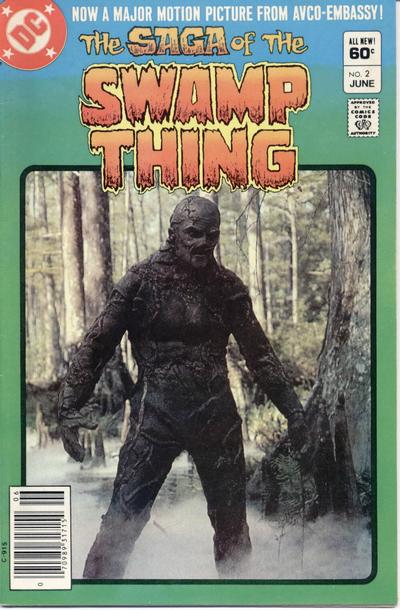
First, when the movie version of Watchmen comes out next year, I hope the filmmakers have the wit to invite Wes Craven to the premiere. Without Craven, their film probably would not exist because the Swamp Thing run by Alan Moore would not exist. The version of the book on which Moore cut his teeth at DC was originally launched to tie in to Craven's Swamp Thing movie. The second issue of this run even had letters of encouragement from Craven himself and actor Dick Durock, who played the character on screen. It used a still from the movie on the cover:


Second, I think two periods of the book's first and second runs have been unfairly overshadowed by the bookends of the Len Wein/Berni Wrightson era and the Alan Moore/Stephen Bissette/John Totleben era. There isn't anything wrong with Nestor Redondo's art on the post-Wrightson issues, except, of course, that he's not Wrightson. And the Marty Pasko issues that precede Alan Moore's run on the book are pretty good. What isn't discussed much about the Alan Moore run is that great whacks of it are built upon and reference Pasko's stories, from the corporate bad guys who have it in for the Swamp Thing to a couple of the stand-alone adventures. Moore's interpretation of the supporting cast of the original series--Matt Cable and Abigail Arcane--derives directly from their depiction by Pasko rather than the one found in the series original run. There's at least one of Marty Pasko's issues, the Twilight Zone-y 16th issue, that's easily as good as any of the Alan Moore issues. Hell, it's better than some of them.

Third, I think Alan Moore lucked into an astonishingly good situation with the art team he inherited. I had been buying the book from the outset, though by the time the book was in the mid-teens, I was wavering. I skipped an issue or two of the later Tom Yeats issues (I filled them in after the fact), but when Bissette and Totleben came on the book, I was hooked. I had been a huge fan of the work they had done in Marvel's black and white magazines, particularly "The Blood Bequest," a waaaaay over the top Dracula story, and "A Frog is a Frog," which is one of my favorite horror stories in any medium from the 1980s. Bissette had been contributing layouts for Swamp Thing during Tom Yeats's run on the book, and invariably, they were Yeats's best pages. When he and Totleben took over the book full-time, there was a noticeable jump in quality .

I should note, in passing, that I liked Tom Yeats's art. It was dark and moody and classical, in the tradition of Berni Wrightson. But it wasn't batshit insane, which Bissette and Totlebens' art categorically was.

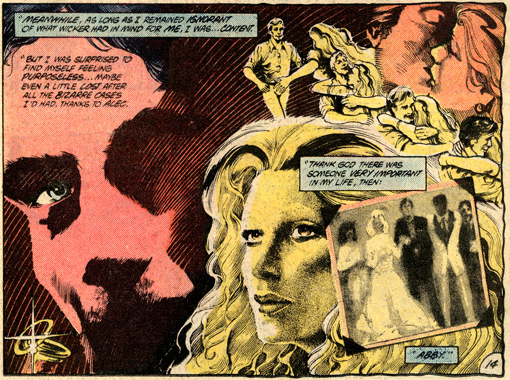
In any event, I have some serious doubts about whether or not Moore's initial success would have been as large as it was without the contributions of his artists. Tonally, his first couple of stories are very similar to Pasko's, though they are very different in terms of narrative technique. The work that Bissette and Totleben were already doing was amazing. Take for instance this panel from issue #17:


This is much more tonally dense than Yeats's work, not just in terms of image, but also in terms of technique. There are several separate and distinct methods of drawings working in this panel, and they throw in a photographic element as well.

I'm also fond of this scene, a couple of pages later:


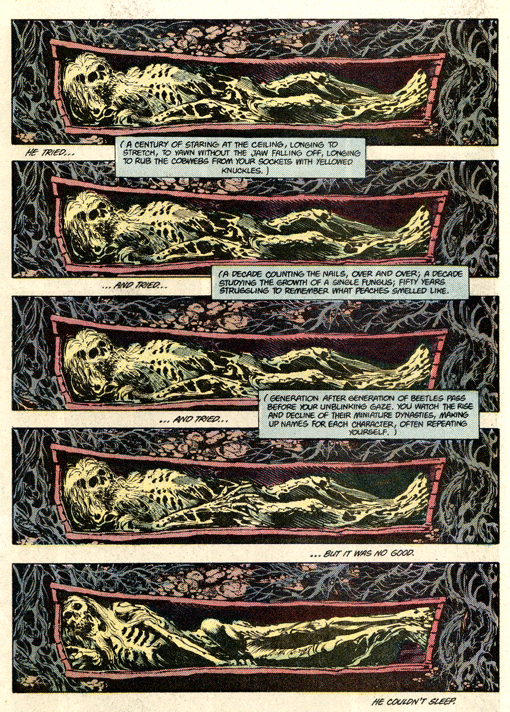
For the most part, I think Pasko as a writer gave the artists their heads. I don't know if Pasko wrote using the Marvel method (in which he provided a plot for his artists and filled in the dialogue after the fact), or if he wrote full scripts. Based on the results, I rather suspect the former, because every so often, they would cut loose with something like this, from issue #19:


(click the image for a larger version)

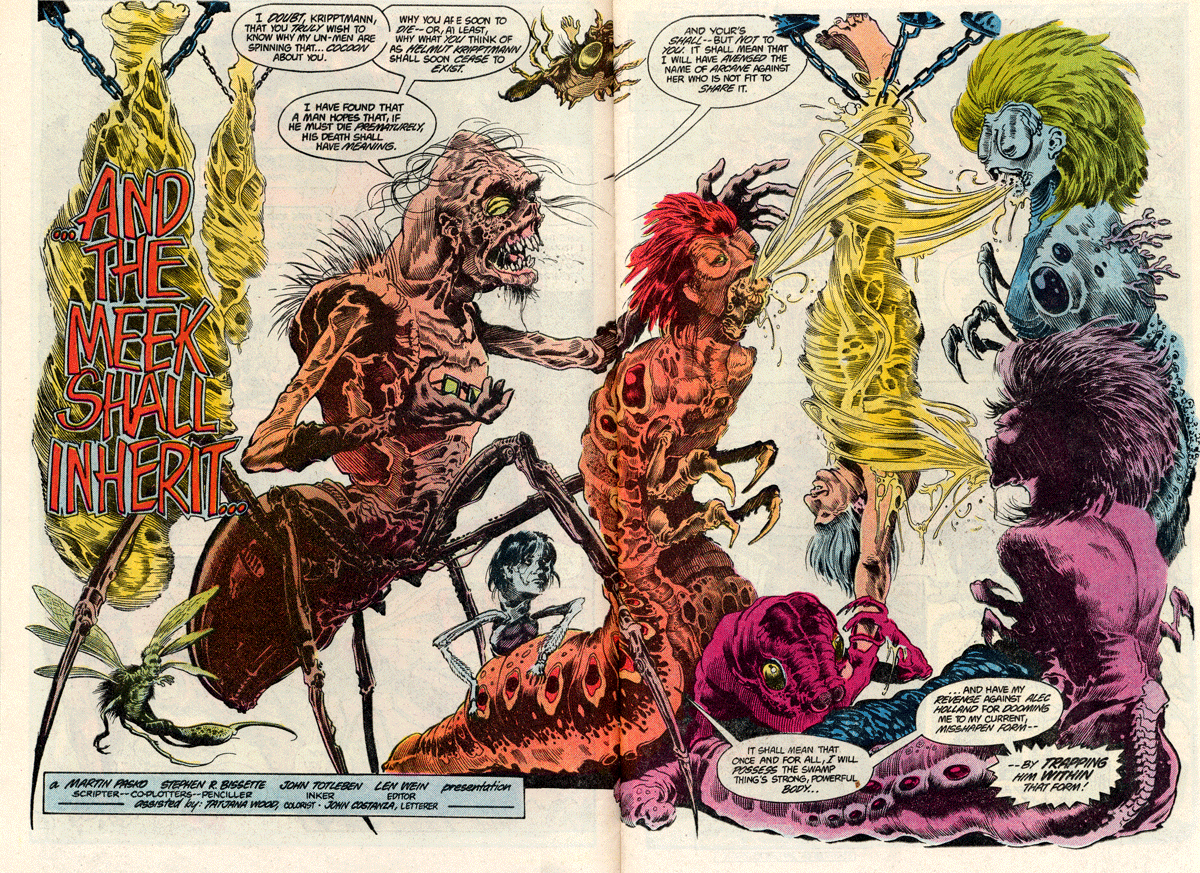
Moore's sensibility seems to have been more closely in tune with the artists, though, because when they were clicking, they were unbeatable. This is my favorite page from the Moore run, the splash page of issue #42. It's positively droll:


Enjoy.

A Light Week

248. I was taking a drink when it happened, so when May Canaday walked across the screen near the beginning of Brick (2005, directed by Rian Johnson), towing her cooler full of body parts behind her, I wound up with a sinus full of cranberry grape juice. I didn't quite spray it out of my nose, but it was close. Director Johnson was the film editor on May, which explains some of the similar feel this film has in the early going. Both films are in touch with a kind of adolescent anomie, translated to the screen as a kind of existential dreamscape. I mean, the high school confidential entered this realm a long time ago now with films like River's Edge, so I'm surprised it took as long as it has to mate this sensibility with the existential dreamscape of film noir. It works surprisingly well. I mean, I occasionally laughed at the hardboiled dialogue, but I think that it was intentionally funny. Droll, but intentional. The movie is singularly fortunate to have Joseph Gordon-Levitt in the lead. He sells the dialogue with authority. Gordon-Levitt is one of the best actors currently working. I mean, he makes me want to watch a Gregg Araki movie, for Pete's sake! That's charisma.

249. I'm slowly getting around to last year's Best Picture nominees. After watching Michael Clayton (2007, directed by Tony Gilroy) this weekend, I have only Atonement left yet to see. This one isn't bad. It's a legal movie recast as a thriller, in the manner of John Grisham, and it's a chilly one, at that, but it gets by on the strength of its performances. George Clooney is excellent in the lead, but the movie belongs to Tilda Swinton, as a very nervous corporate villain. She deserved her Oscar. But then, I've been a fan of Tilda for years. Tom Wilkinson goes a bit over the top, but this is balanced out in the supporting cast by the late Sidney Pollack, who is superb.

Monday, August 18, 2008

It's the End of the World As We Know It (and I Feel Fine)

243. One of Roger Corman's last films as a director, Gas! -Or- It Became Necessary to Destroy the World in Order to Save It (1971) is a colossal mess of a movie. It's not an entirely unwatchable mess--indeed, it's never really boring--but it's a hard core weird hippie shit movie, in which the director indulges his European influences (in this case, Godard). It's beautifully shot by cinematographer Ron Dexter (the head of make-up is future great cinematographer Dean Cundey), and it's edited at a brisk pace, but it's all completely random, like it's a bunch of crap that the filmmakers made up as they went out in the desert. I know, I know, most weird hippie shit movies are a bunch of crap they made up out in the desert. I'm sure AIP's approach to these movies was to give the cast and crew some tabs of acid and a Bolex and send them out to make the movie, hoping for something to cobble together in the editing room. Of course, Corman was hardly the type, even if he IS responsible for several key weird hippie shit movies. This one posits a world where a deadly gas wipes out everyone over the age of 25, and follows a hippie couple through the absurdist wasteland afterwards. It's all hopelessly dated, but so what? The notion that the jocks at your high school are only a step or two away from becoming the fascists of tomorrow still has an eerie resonance today. But this isn't a film that should be taken seriously.

244. Alec Guinness does his then-patented meek nebbish bit in The Lavender Hill Mob (1951, directed by Charles Crichton), in which he has the perfect bank heist on his mind. He's in charge of bullion shipments, but he can't touch the stuff until he finds a way to ship it out of the country. Enter Stanley Holloway, whose character makes lead Eiffel Tower souvenirs. A bargain is struck, and the heist goes off. As is usual in heist movies, it's not the heist itself that goes afoul, it's the aftermath, but as this is one of those charmingly droll Ealing comedies, it sends its characters to relatively gentle dooms. Meanwhile, there's a fleeting glimpse of a VERY young Audrey Hepburn, and great fun is had by all.

245. When I wasn't puzzling over the great, gaping holes in the narrative, all I could think of while I was watching Mongol (2007, directed by Sergei Bodrov) was that exchange from Conan the Barbarian:


Mongol General: Hao! Dai ye! We won again! This is good, but what is best in life?
Mongol: The open steppe, fleet horse, falcons at your wrist, and the wind in your hair.
Mongol General: Wrong! Conan! What is best in life?
Conan: To crush your enemies, see them driven before you, and to hear the lamentation of the women.
Mongol General: That is good! That is good.

This movie, generally, has more or less the same plot. It also has the same appetite for spectacle. Many many people are stabbed in this movie. I mean: stabbity stab stab stab. But beyond that, it's hard to really figure this movie, because those gaps in the narrative would seem to included seriously important stuff. Temudgin--the future Genghis Khan--escapes from the Tangut Empire and then suddenly rides at the front of a huge army? How? The movie doesn't say. Oh, I enjoyed the hell out of this sucker. It keeps one's attention, after all, with brutal violence and a ton of ethnographic detail in the background, but it sheds more heat than light. Still, it's the first part of a trilogy, so perhaps the next segment will focus more on the nuts and bolts of empire.

246. I think the key to Humphrey Bogart's enduring appeal is that he was willing to take chances that other stars of his day would never have considered. It's understandable, I suppose, given that Bogart's early career was spent playing thoroughly loathsome characters, that he would have no compunctions about playing a frankly unlikeable character like Fred C. Dobbs in The Treasure of the Sierra Madre (1948, directed by John Huston). I mean, even when Cary Grant played a heel (in His Girl Friday, for example), you still couldn't help but like him. Bogart, though, he didn't care if he punctured his image, and as a result, he added to it considerably. Dobbs, paranoid with gold fever, reminds me a lot of Bogart's later portrayal of Captain Queeg in The Caine Mutiny, in so far as both of them start out as "Bogart" and gradually transform into something else. This film has great, rough-hewn characters in it. Walter Huston gets most of the glory (and the Oscar), but pretty boy Tim Holt manages to hold his own, while the parade of bit players is fascinatingly diverse. "Badges? We ain't got no badges. We don't need no badges. I don't have to show you any stinking badges."

247. It was an effort of will today not to log in and change my user name to "Vulnavia Phibes." I don't really know why that name appeals to me, but it does. I like it out of all proportion to my affection for The Abominable Doctor Phibes (1971, directed by Robert Fuest) from which it is drawn, but love's love, I guess. I mean, I like the movie, don't get me wrong, but I don't love it, really. It's an attractive film, if a bit over-lit. The art-deco designs of the film hearken back to the great horror movies of the 1930s, and they bespeak a production sensibility that's more lavish than what AIP normally paid for. But there's something lacking in it. The themed deaths are clever and occasionally ghastly, but they aren't really all that suspenseful, and no one in the movie is very likable. On this last point: I don't need someone to root for--some of my favorite movies are about bad people doing bad things--but I do need to view the characters on film as something other than mannequins. In a lot of ways, this movie reminds me a lot of an Avengers episode in which the naughty by-play of Steed and Mrs. Peel is completely absent. Alas.

(as a further aside, regarding "identification," I've always loved what writer Caitlin Kiernan had to say about readers who needed "someone to root for." "Pigs root, dear," she says. "Are you a pig?").

Monday, August 11, 2008

Scream and Shout

239. So following up my viewing of Hellraiser a couple of weeks ago, this week, I stuck Hellbound: Hellraiser II (1988, directed by Tony Randel) into the machine. My memories of the film were hazy--like its predecessor, I hadn't seen it in well over a decade. My memory of the film consisted mainly of the notion that Hellbound is closer to Clive Barker's prose, in spirit if not in letter, than the first movie. I still think that's true, though it's not necessarily a compliment. My impression at this viewing was that this is a movie with No. Damned. Plot. You have a setting in a mental institution, the elements remaining from the previous film, and writers who think that that will make the movie without any input from them. It's pretty bad. More troubling: the later part of the movie seems drawn more from the Nightmare on Elm Street series than from Hellraiser, with hell substituting for Freddy's dreamland, and with the evil doctor cum Cenobite filling the role of Freddy, suggesting that the filmmakers had exhausted their own ideas in the first two reels. This also features the pussification of the main Cenobites. What a cop out. I mentioned that I think this is closer in spirit to Barker's prose, and here's why: Barker throws narrative coherence to the wind in favor of startling verbal images. This movie attempts the same, and occasionally succeeds. Unfortunately, none of those images really connects with any experience that anyone has ever had. Some might call this "visionary," but I don't know that that's what I'd call it...

240. So having abused my brain with THAT movie, with what did I scrub the lingering residue from my tortured gray matter? That would be Cutthroat Island (1995, directed by Renny Harlin), perhaps not the wisest choice. My significant other brought it home from some bargain bin ("Honey, it was only $4.98") a few weeks ago and we hadn't filed it in the collection yet. So I stuck it in the machine.

Oy.

Let me tell you about wall to wall action--a fallacy into which this film falls. If you pitch everything at just the far side of hysteria, how do you know what's really important? Most movies that boast a thrill a minute? They're DULL. Monotonous, even. They're like being trapped on a long car trip with an ADD-afflicted ten-year old on a sugar high. And Jesus, does THIS movie fit that description. Oh, the elements are all here: pirate map, scurvy sea dogs, hissable villains (thank you, Frank Langella, but this was NOT your finest hour. I'd still sleep with you, though). What's lacking is mood. What's lacking is rhythm. What's lacking is brains. I mean, I like the idea of casting Geena Davis as a pirate captain, in theory. She's a fine actress, and I like seeing Mensa members do well. I'm sure that the movie sounded fun at the time. But performances are crafted by directors and film editors, and her then-husband Renny Harlin picks the worst possible takes and the clumsiest line readings imaginable.

So I was bored. In the big sea battle at the end of the film, full of sound and fury signifying nothing, my mind was wandering. I was wondering why it seemed like neither of the pirate ships was actually moving. Now, the movie sets up a classic stern chase, but that's not cinematic (don't tell Master and Commander, which has a stern chase that's a corker). It wants the ships to beat the hell out of each other with full broadsides. As a result, neither ship is maneuvering for advantage. They just sit there firing volley after volley, not even creating a wake. This is dumb. But by that point I just wanted it to be over so I could go to the bathroom and take some aspirin for the throbbing headache the movie gave me.

241.So God bless Brian De Palma and his 1981 thriller, Blow Out, which may be the high point of his career. It's my favorite of his movies, and when I was thinking about what to write about it, I stumbled across this review from Reverse Shot. It begins:


Like John Travolta, I remain, long after Blow Out’s closing credits roll, haunted by a scream—so piercing, palpable, so full of anguish. “Now that’s a scream!” exclaims a delighted sound technician in one of the film’s final lines of dialogue. Indeed. Not only does Nancy Allen’s climactic cry, as she reaches out to her potential savior, put to shame all of the other scream tests enacted by a succession of stalker-flick bimbos throughout the film as its central running gag—it erases the memory of all other movie screams. Anyone who denies De Palma’s humanity, or sense of the tragic, has a lot of explaining to do in the agonized face of 1981's Blow Out, which manages to be at once the director’s most melancholy, gripping, and empathically engaged work, a monumentally humane and grim film, perched ever so slightly on the edge of sadism. The scream is thus recorded, within and without the movie, played back, fraught with horrible memories; it’s the scream of all damsels in distress, the scream of every De Palma heroine, but most importantly, in the film’s world, it’s “real.”


And it ends:


The final images and sounds of Blow Out are definitive, horrible, and final, and, apologies to Antonioni’s art-house trend-setting, much more terrifying than the existential what-if miming that closes Blow-Up. De Palma wants to penetrate and shatter—with perhaps the exception of Carrie and Casualties of War, never have De Palma’s characters felt so vivid, dynamic, and therefore, cruelly snuffed out. From this point on, De Palma moved into the excess pageantry of Scarface and the truly miserable, meta-effects of Body Double, perhaps the end point in the erotic thriller, a film in which the very sight of a naked woman seems to give off the stench of rotten flesh. Blow Out is a penance for all of De Palma’s past and future cinematic crimes, as well as ours as viewers. I can think of no greater image of the force of movie watching than Travolta sitting alone in a dark room in Blow Out’s final shot, covering his ears from the horror he has witnessed, recorded, and fed back to the world. A victim and perpetrator of his own crimes, he still can’t stop watching. And listening.


...which summarizes my own thoughts on the movie so thoroughly that I can hardly improve upon the sentiment. I had forgotten, however, just how utterly bleak the ending of Blow Out is, which is not exactly how I wanted to end a weekend that was actually pretty bad for me.

So...

242. I ended the weekend with Linda Linda Linda (2005, directed by Nobuhiro Yamashita), which just makes me smile with my whole being. The band assembled for the movie apparently toured Asia for a bit (including Bae Doo-Na, the terrific Korean actress who some of you may know from The Host or Sympathy for Mr. Vengeance). This movie feeds my appetite for girl group power pop, and the title song is so infectious that it will stay in your head for days. Take a look, if you've got a mind:


Enjoy.

Monday, August 04, 2008

Last Night I Dreamed of Manderly...

237. Hitchcock's Rebecca (1940) is a haunted movie. Rebecca De Winter, the title character, is dead before the first frame of the movie, but her presence--her malign presence--is felt all through the film. It's so strong that it all but eclipses the film's lead character, the second Mrs. De Winter (Joan Fontaine), whose name the audience never even learns. Certainly, Manderly is one of the cinema's great haunted houses, and there has never, ever been a more sinister sinister servant than Judith Anderson's Mrs. Danvers.

Despite the fact that Rebecca was the director's sole Best Picture winner, it has never occupied the first rank of Hitchcock's films among critics and scholars. It tends to defy auteurist theorizing, because it just doesn't seem like a Hitchcock film. Hitch rarely went in for gothics, and this film is just about as gothic as it gets. It's a facile explanation to say that the movie is more David O. Selznick's film than Hitchcock's, but a close examination of the film and its context suggests that this might actually be an overstatement. Hitchcock was no stranger to Daphne Du Maurier, after all. Prior to Rebecca, he adapted Jamaica Inn. Later he adapted The Birds. More than that, it's widely held that Hitchcock was actively undermining Selznick's control of the film by editing the film in the camera. Selznick hated the way Hitchcock filmed. He called it a "jigsaw method" of filming. It only went together one way. Hitchcock didn't provide Selznick with "coverage," and so greatly reduced Selznick's usual role. Some of the film's other flourishes come directly from Hitchcock: the wrong man falsely accused shows up late in the film, as does the director's perennial examination of a guilty conscience. The use of deep focus cinematography is out of character, but it appears that Hitchcock was still experimenting with the possibilities of film. The most interesting thing I noticed about Rebecca with this viewing, though, is the striking similarities it shares with Vertigo, and not just in the theme of a man haunted by a dead woman. Several scenes seem oddly twinned, like Mrs. De Winter's appearance in Rebecca's costume gown and Madeline's transformation from Judy. This isn't the first time I've noticed Hitchcock working out themes and images to which he would later return. Maybe being an auteur means you never throw anything away.

238. Director Johnny To is a master at cinematic legerdemain, so if you take his 2001 duelling hitman movie, Fulltime Killer (co-directed by Wai Ka-Fai), at face value, you might think that it's ONLY an exercise in cinematic hyperbole and miss the deeper waters the film explores. It certainly wears its style on its sleeve, but beneath that, it's a sly deconstruction of the hitman subgenre. It's pretty up-front about its influences/targets: a little Seijun Suzuki here, some Jean-Pierre Melville there, a dash of John Woo. Ostensibly, it's a remake of Branded to Kill, in which the #2 assassin in the world seeks to knock off #1 and assume pre-eminence in his chosen field. The set-pieces in this movie are a lot of fun--the best involves a bunch of hand-grenades and a a prison cell--but it's the structure of the filmmaking itself that is most arresting. A polyglot of languages and styles and a fractured narrative will challenge an action fan looking for cheap thrills. But it's worth it. The closest thing to it is probably Wong Kar-Wai's The Ashes of Time.

Tuesday, July 29, 2008

The Legion of Super Jerks

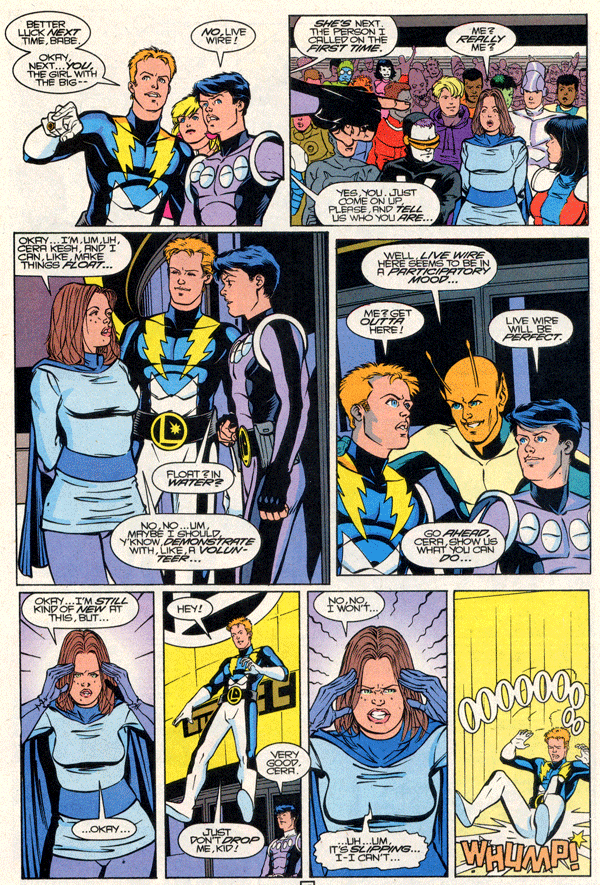
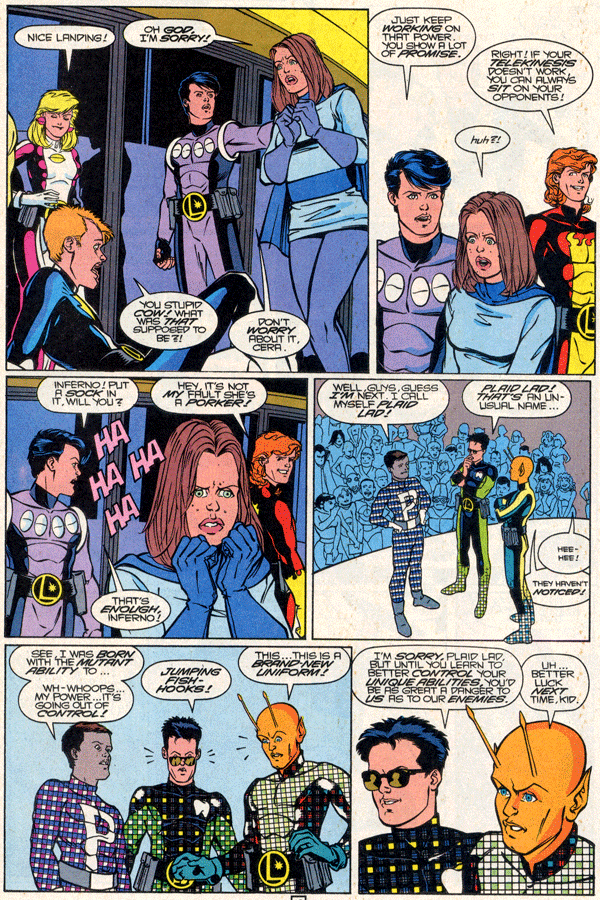
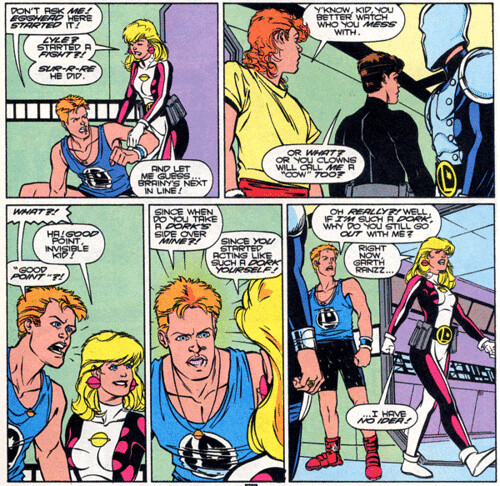
I was replying to a post on another blog earlier this week and the subject of my favorite Legion of Superheroes episode came up. Specifically, I was remembering one of their try-outs where one of the characters was Plaid Lad. You can see his appearance in the middle of the following scans. What I had forgotten was both X Bomb Betty and what jerks some of the members of the Legion were. The first part of this is from Legionnaires #2 from 1993 (written by Tom and Mary Bierbaum, art by Chris Sprouse and Karl Story):


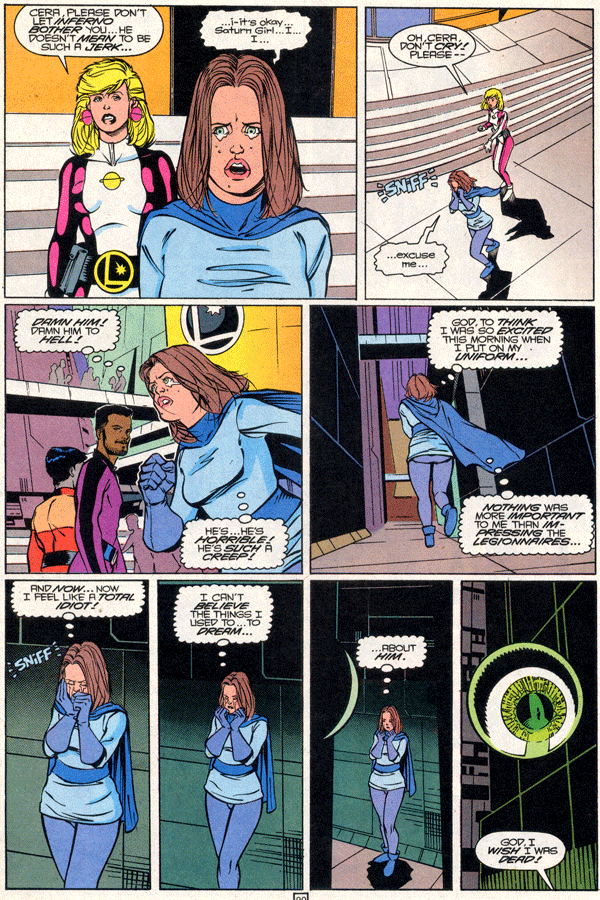
At this point, the soundtrack would be going all ominous. It's clear from the way this is going that Stephen King's Carrie is unknown in the 30th Century. But let's continue, shall we? In the next issue, Legionnaires #3, we return to poor Cera:


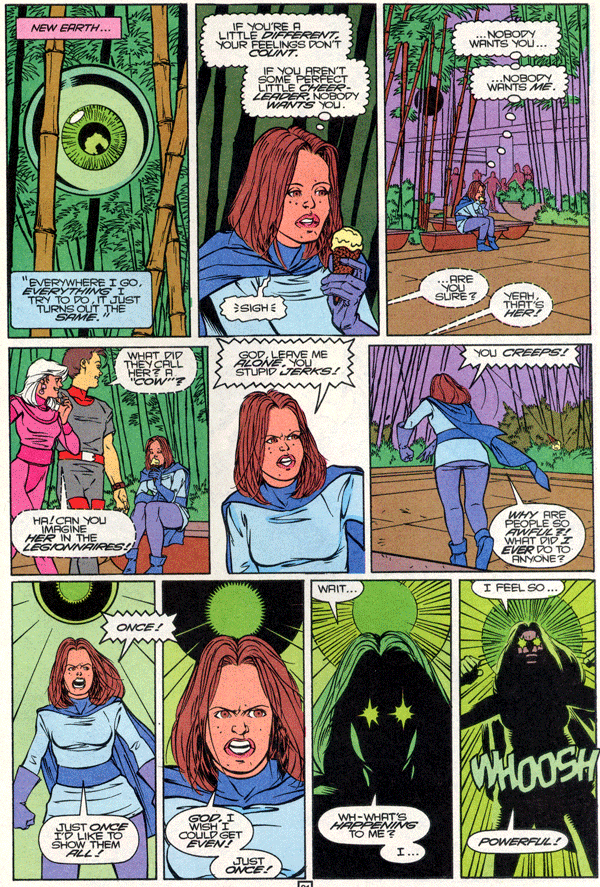
...and cue the revenge fantasy. Sheesh, you'd think that a thousand years of superheroics would have demonstrated that when you're a jerk to someone, that someone is going to come back as a supervillain to kick your ass. But, hey, the Legion is young. Perhaps they haven't covered the roots of supervillainy in class yet.

As a post script, we have this episode from Legionnaires #4:


At the end of this particular story, Saturn Girl makes up with Lightning Lad (they were calling him Live Wire in this particular incarnation, by the way) and all was hunky dory. Which just goes to show that some things never change. Gorgeous, smart, telepathic women will STILL be hooking up with absolute jerks a thousand years from now.

Alas.


As a postscript, here are some additional thoughts. The notion that Matter Eater Lad is judging the try-outs amuses me. I mean, come on. It must REALLY suck to get bounced by someone with as lame a power as that.

I also ran across this posting at Comic Book Resources, detailing the top five Legion rejects. Plaid Lad comes in at #5, while X-Bomb Betty gets an honorable mention. Arm-Fall-Off Boy is very disturbing, in a lame kind of way...

Cheers.

Monday, July 28, 2008

Three Revisitings

234. It's difficult to imagine an American studio of the period making a film as resolutely downbeat as Saraband for Dead Lovers (1948, directed by Basil Dearden). For that matter, it's fairly out of character for Ealing Studios, too, who were best known for their droll comedies. But downbeat this film is, telling of the tragic love affair between Princess Sophia Dorothea, the wife of the future King George I, and Swedish Count Philip Konigsmark, a mercenary in the hire of the Hanovers. There's much court intrige as the Hanovers plot to assume the English throne (they succeeded beyond their wildest dreams--the current Royals are descended from Sophia and George I). Unlike an American producer, Michael Balcon isn't tempted to append a happy ending to the actual historical record. This movie unfolds more or less as it did in "real life," in which Konigsmark is murdered by the minions of the Hanovers and the machinations of the fading Countess Clara Platten, who had an unhealthy obsession with the man. Sophia Dorothea then spent the rest of her life imprisoned in a castle. But getting to that point is all of the fun. Our doomed lovers are played by Joan Greenwood (so young it hurts to look at her, but already possessed of that fabulous voice) and Stewart Granger. The swordfight at the end is reminiscent of the swashbucklers Granger became known for (especially Scaramouche), but no swashbuckler would end the duel as this film does. The sets won an Oscar, and the costumes SHOULD have, and this is a fine example of the work of the great cinematographer, Douglas Slocombe. Supposedly, this is one of Christopher Lee's first film appearances, but I didn't spot him. One wishes that director Basil Dearden could have employed a livelier cinematic sense, but the film is overstuffed with other pleasures that its relatively mundane direction isn't really a liability. And I LOVE the title.

235. I took another look Phil Karlson's Scandal Sheet (1952) this week. I really like the hard boiled deadpan that Karlson evolved in his crime movies from this period. It's a harder version of film noir, minus some of the poetry of shadows, but adding a hard-nosed approach to storytelling. The story itself is a variant of The Big Clock (the film credits the story to a novel by Sam Fuller, but that doesn't change the dynamics), in which a reporter is investigating a murder committed by his editor, who is guiding the investigation away from himself. John Derek is more or less a non-entity as the lead here, but Broderick Crawford more than makes up for it as the movie's heavy. For that matter, Donna Reed is entirely too much for Derek, too. But he's servicable enough. There are fine character faces in support, too, including Henry Morgan as a photographer and Henry O'Neill as a drunk ex-reporter. As a plus, this doesn't waste time on extraneous detail, and clocks in at a terse 82 minutes. Talk about no-nonsense filmmaking.

236. I'm sure that when I originally saw it on its first release, the pointed critique of consumer culture and the Reagan revolution in Poltergeist (1982, directed by Tobe Hooper) was completely lost on me. I was there for the special effects, I'm sure. Watching it a quarter of a century later, I'm shocked that I missed all of that. I was also suprised at how careful the film is in building its sense of "wrongness," going from playfully unsettling manifestations of the "poltergeist" to outright horrors like the evil tree outside the children's window and that damned clown doll. The first half of the movie is a masterclass in how to construct a post-modern haunted house movie. Gone are the gothic excressences and the crumbling mansions of the past. Here we have a haunted tract house that looks just like all the other tract houses around it. We see the day to day minutiae of the lives of an average suburban family that creates a shock of recognition in the audience (the similarity to producer/ghost-director Steven Spielberg's Jaws is striking). By the middle of this latest viewing, I realized that I was watching a really good Stephen King movie. The second half of the movie is the light show, what all those teen age kids in 1982 went to see the movie for. Some of the effects haven't held up, but some of them--the house folding in on itelf at the end, for example--are as awesome today as they were back then. But perhaps the most interesting thing about this movie is that it's a horror movie in which no one dies. It's a carnival ride, sure, with bizarre mirror images thrown in to disorient the audience, but like a carnival ride, no harm is done in the end.

Monday, July 21, 2008

Objects of Chaos

231. It's common practice to group Son of Frankenstein (1939, directed by Rowland V. Lee) with the first two films in the Frankenstein series as a kind of trilogy. That's understandable, I guess, given both the presence of Karloff as The Monster and the steep drop-off in quality in subsequent films. But having watched Ghost of Frankenstein recently, I'm coming around to the notion that Son of Frankenstein is really the first film of a trilogy (Frankenstein Meets the Wolf-Man would be the third in the sequence). The last time I watched Son, I didn't have the frame of reference in mind to notices the deep similarities between the two films. Not only is the tone more or less the same as in Ghost, but it even provides Ghost with its best line: "His mother was the lighting." None of the subsequent films are as good, unfortunately, in part because they got cheaper and cheaper, but also because of the steady drain of interesting cast members. This film, on the other hand, is loaded. It looks expensive and it has terrific faces. The film arguably belongs to Bela Lugosi, but he's given a run for his money by Basil Rathbone and Lionel Atwill ("One does not easily forget, Herr Baron, an arm torn out by the roots"). It's a fun movie.

232. I don't think I've seen all of Hellraiser (1987, directed by Clive Barker) since it was in theaters. I may have seen snippets of it here and there, but the whole movie? No. In the interim, there are a number of things I had forgotten about it. One is the sheer nastiness of its violence (alleviated somewhat by unconvincing make-up effects). The other is the sheer stupidity of its ending. It's two thirds of a good movie, I think, but, Jesus, do the wheels fly off in the last act. I don't think I ever noticed the fact that the first two thirds of the movie are a deconstruction of the gothic novel with the sexual hang-ups brought to the forefront. The sexual hang-ups of the gothic novel are sadomasochistic, which gives the movie its kick and its kink. The whole thing builds quite a head of steam, but Barker has shown time and again that longer narratives are not his forte. So it is here. The images are strong, but the narrative is a muddle. Still and all, the puzzle box is one of the few movie props that I wouldn't mind owning. So that's something, I guess.

233. The Dark Knight (2008, directed by Christopher Nolan) is a crackerjack crime thriller with disturbing political subtexts. I wish I could like it more, because the performances--particularly Aaron Eckhart's--are superb and the whole is really well made. But I have grave misgivings about it. I've posted a long review of the film here: http://members.tranquility.net/~benedict/darkknight2008.html

Thursday, July 17, 2008

Do the Batusi

So my brother called me last night to ask if I wanted to go see The Dark Knight at the IMAX. I'm not opposed to it, but I'm leery as hell of it. The last go-round with Batman Begins ended badly. The flash-pans at the beginning of the movie, amplified by being on an IMAX screen, made me so motion-sick that I had to leave the theater. But what the hell.

In any event, I'm greatly amused at the seriousness of everything surrounding The Dark Knight. I mean, yeah, Batman is the genesis of the grim and gritty superhero--thank you Frank Miller--but he's also the comics character that has had far and away the widest pallet of tonal variations. Hell, much as I hated it, even Joel Schumacher's coded gay take on Batman has precedence in the comics. Frederick Wertham didn't make anything up when he concluded that Batman and Robin live "the wish dream of two homosexuals." I mean, look at this panel posted on Mike Sterling's Progressive Ruin:


Go ahead and tell me that these two outfits aren't swiped from Bettie Page's lingerie drawer. I dare you.

Somehow, Christian Bale seems too tight of ass to let go like this:


Ah, for the days of silly comicbook fun...

Monday, July 14, 2008

Functions of Genre

Only two features this week:

221. Hellboy II: The Golden Army (2008, directed by Guillermo del Toro) has a pretty standard storyline for an action fantasy, but that's genre for you. All genre movies are pretty predictable, and this one is no different. You know in pretty short order how this film is going to turn out. But that's only plot, and, as someone once said, plot is only an excuse. Lord knows, this movie understands that, because once you discard the plot, the individual scenes and individual moments are quite special, and the MEANING of what happens to the characters goes pretty far beyond what you can glean from just anticipating how everything turns out in the end. Sure, you know going in that in order to kill Prince Nuada, someone was going to have to kill Princess Nuala. Sure, you know that Hellboy is going to defeat the Golden Army by challenging Nuada's right to rule. You get that in the first ten minutes of the film (and if you don't, you just aren't paying attention). What you DON'T get is the relationships between the characters. These are unpredicable and largely independent of the plot. You don't anticipate the lovely dual motif of saving the life of the one you love even if it means the end of the world. You might anticipate the great tentacled monster that rises up over the city in this movie, but you don't anticipate what happens when it's killed. And you don't anticipate the film's many visual wonders, from the troll market to the elemental's fate to the Angel of Death. To a one, these are fabulous. But it's the smaller wonders that really make the film click. The sight of Hellboy and Abe Sapien drunkenly singing Barry Manilow's "Can't Smile Without You" might be worth the price of admission all by itself.

222. Depending on what I've seen lately, I usually name Miller's Crossing (1990) as my favorite among the Coen Brothers' movies. This alternates with Fargo, usually, but lately I've been drifting towards No Country for Old Men. Miller's Crossing is, of course, a reworking of Dashiell Hammett's Red Harvest, which itself might be my favorite of the hard boiled novels. As in Hellboy II, the plot is incidental, intricate and twisty turny though it might be. I could tell you that the movie is about Irish gangsters, but what it's really about is Gabriel Byrne chasing his hat. Early in the movie, he even comments that there's nothing stupider than a man chasing his hat. The Coens have built a formidable gallery of grotesques over the years, but none of their other movies is as packed with them as this one, whether it's Jon Polito descanting on criminal ethics or a street urching swiping the toupee off the head of a corpse. The parade of characters--none of them leading-man or leading-woman material--is endlessly fascinating. And after all these years, I still think this movie contains the Coen's best-ever sequence, in which Albert Finney defends himself against would-be assassins while "Danny Boy" plays on the soundtrack. It's contrapunctual music at its finest.

I also watched some of the third disc from the Norman McLaren Masters Edition, including:

223. Narcissus (1983)
224. Pas De Deux (1968)
225. A Chairy Tale (1957)
226. Neighbors (1952)
227. Opening Speech (1960)
228. Christmas Cracker (1962)
229. Canon (1964)
230. Ballet Adagio (1972)

These are mostly dance oriented--Narcissus is particularly lovely--and show McLaren following the lead of Maya Deren to its obvious conclusions. I should give a shout-out to Neighbors, which is a masterpiece. How this won an Oscar during the Cold War, I know not. But there it is.

Neighbors is all over YouTube. By all means, watch it:

Monday, July 07, 2008

Your Stupid Minds! Stupid! Stupid!

Last week was an anomaly for me, in so far as I didn't watch any movies whatsoever (I did sort of half-listen to Amadeus, but I can't say that counts as "watching" it). I did marginally better this week.

216. The highlight of the week was seeing Plan 9 From Outer Space (1959, directed by Edward D. Wood, Jr.) on a big screen with an audience. Man, that's a pure, dyed in the wool pleasure, let me tell you. A little background: a local theater group is putting on a musical version of Plan 9--rockabilly, which suits it, I think--and this showing was a fundraiser. Several of the songs were performed prior to the movie and they were't bad at all. If anything, they were TOO good, because anything more than marginal competence is well and truly beyond the scope of Plan 9. They had some trivia questions about the movie, too, and I won a pair of tickets to the play for knowing that the original name of the movie was "Graverobbers from Outer Space." In any event, let's dispense with the notion that Plan 9 is the worst movie ever made. No movie that repays repeat viewings with such warm pleasures can possibly hold that title. It's not even the most inept movie ever made (anyone who's ever seen a film by, say, Ron Ormond or Al Adamson knows that Ed Wood had more imagination and enthusiasm than many of his contemporaries). For that matter, it's not even Ed Wood's worst movie. Plan 9 is charming in its "let's put on a play" earnestness. And watching it a week after Pride month, I can't help but read it as a plea for tolerance towards gays, though Wood himself was "only a transvestite," as Tim Burton's biopic insisted. As an aside, it was kind of fun watching the alien ruler's eyes drift towards Eros's package in every scene they shared. Hilarious.

217. Kung Fu Panda (2008, directed by Mark Osborne and John Stevenson) is all high concept and not so much a story. The sum total of the film is found in its title. The movie itself is almost an afterthought. But as such, it's not bad. Anyone who's seen a few kung fu movies will find no surprises. This is a cross between The 36th Chamber of Shaolin and any number of Chang Cheh movies. As usual, Dreamworks' insistence on casting celebrity voices remains an unnecessary distraction. Visually, the movie is interesting for the way it tends to flatten out the 3-D computer animation, sometimes lapsing into 2-D animation outright. The best part of the movie, for me anyway, is the prologue which is animated 2-d. Along with the graphics over the closing credits, this made me wish that the whole movie had been made that way. Alas. It should be noted, however, that when it comes to computer animation, it's still Pixar first, and everyone else a distant second, a point hammered home by...

218. ...WALL-E (2008, directed by Andrew Stanton), which sets the bar impossibly high. I love Pixar's movies. I do. But that love didn't prepare me for WALL-E, which is the studio's masterpiece. This is a movie of existential loneliness, of profound emotionality, and of visionary wonders. While the largely silent opening act of the movie has been rightly praised, I think I knew I was watching a legitimately great movie when it took time out from the ruthless mechanics of its story to let WALL-E and EVE delight in a weightless pas de deux. Oh, you can see Chaplin in this, and Keaton, and Harold Lloyd, and Jacques Tati, and Stanley Kubrick; this film is every bit their spiritual stephchild. Regardless, it's resolutely an entity unto itself. As we were leaving the theater, I said to my companion: "They're still going to be watching this 50 years from now." My companion said: "I can't believe they made a cockroach endearing."

219. "Presto" (2008, directed by Doug Sweetland) is the short that accompanied WALL-E, concerning a magician and a reluctant rabbit. This is probably not the best of the Pixar shorts, but it might be the funniest. It's certainly the one that feels most like a classic Looney Tunes short. It provided a good warm-up before plunging the audience into the melancholia of WALL-E's first half-hour.

220. It had been my intention to show a Western to my guests this 4th of July, but to a one, they all bitched because they "don't like" Westerns. This kind of pissed me off, because I had planned to show The Good, The Bad, and the Ugly, which has always seemed like the Western for people who claim not to like them. But be that as it may, let it never be said that I'm not a gracious hostess. I said, "A samurai movie it is, then," which was met with enthusiasm. Of course, the joke was on them, because I chose to show Yojimbo (1962, directed by Akira Kurosawa), which, as you probably know, is A Fistful of Dollars in Japanese drag. Yojimbo is hilarious, whether it's Toshiro Mifune's nameless samurai saying "sorry, 3 coffins" to the undertaker or watching the forces of the two gang bosses line up against each other only to be too chickensh t to initiate the fight, there is comedy aplenty in this movie. I like to think of this movie as a satire of the Cold War, but you don't need any deep meanings to enjoy this. It's Kurosawa at his most cynical, as if he were channelling Billy Wilder, and making that cynicism all his own.

Monday, June 23, 2008

Superheroes and Samurai

210. The French cartoonist, Jean Giraud, who goes by the pen name of Moebius, has one of the most distinctive drawing styles in the world. It's an elaboration on the "clean line" style of Herge, and even though many of Moebius's cartoons are mindbending (he frequently collaborates with Alejandro Jodorowsky, for example), they are both narratively and visually clean. His series of Westerns about Mike Blueberry are almost classical. Unfortunately, the makers of the film version of Blueberry (2004, directed by Jan Kounen) retain none of the great cartoonist's virtues. Instead, we have a film that's so muddied up with exotic "style" that it becomes narratively incoherent. The amount of mescaline consumed in this film suggests that the filmmakers are more influenced by El Topo than by Moebius's Blueberry. This movie is pretty much an eyesore, shot through with half-assed Native American mysticism. Even a late performance by Ernest Borgnine can't save this shit. Bad.

211. Speaking of French mud. I'm one of the few people, it seems, that prefers Ang Lee's 2003 version of The Hulk to the new version currently in theaters. The Incredible Hulk (2008, directed by Louis Leterrier) isn't without virtues--most of them provided by Ed Norton--but it's a case of throwing out the baby with the bathwater. It's much uglier than its predecessor, featuring muddy production design and cinematography that occasionally loses track of its own internal geography, and it's narratively more conventional to the point of predictability; you know the drill: an action mini-climax at the end of every reel. I found this pace irritating. I much prefer Lee's classical rising action. But ultimately, the main complaint that many people have with Lee's film--that the CGI Hulk is unconvincing--seems more applicable to this film, and without an emotional weight to the story, the climax seems like a refugee from a video game. Bad.

212. and 213. I've written about both The Big Combo (1955, directed by Joseph Lewis) and The Scar (aka: Hollow Triumph, 1948, directed by Istevan Sekely) in the past. They remain great favorites. Cinematographer John Alton is the common thread between them, and these two films are among his best work, weaving nightmares out of thin air and darkness. Two of the best lines in film noir come from these films:

"First is first and second is nobody"--Mr. Brown (Richard Conte) in The Big Combo.

"It's a bitter little world full of sad surprises" --John Muller (Paul Henreid) in The Scar.

I love these movies.

214. I had forgotten just how striking the title frame from the first Lone Wolf and Cub movie is (it's Lone Wolf and Cub: Sword of Vengeance, 1972, directed by Kenji Misumi, by the way). It's been a while. Anyway, it features our hero walking a path between fire and water, heaven and hell. And it's not the end of arresting images. The signature image features a headless man's blood rising in a high geysering jet from the stump of his neck, silhouetted against the rising sun. This leads me to theorize that the Japanese have more blood in smaller bodies than Caucasians, else how does one explain the extreme blood pressures exhibited in these movies.

215. A kinder and gentler Kenji Misumi directed Sleepy Eyes of Death: Sword of Adventure (1964), the second in that series. Its star, the ill-fated Raizô Ichikawa, is a far more charismatic actor than Lone Wolf's Tomisaburo Wakayama, and the sly smile he sometimes wears should be a warning to any who cross his path. This series got darker as it went (with the fourth installment providing a template for future chambara mayhem), but this early entry is a close cousin to the early Zatoichi movies, and about as good-natured. It finds our hero protecting the kindly finance minister from the machinations of the spoiled daughter of the Shogun, whose plots are ever more elaborate. Many duels ensue, culminating in a terrific battle in the woods. I wish AnimEigo would pick up the license for these films again so I can fill in my collection.

Monday, June 16, 2008

Pussy Power

206. Teeth (2007, directed by Mitchell Lichtenstein) wants in its black little heart to be a vicious satire of teen-age sexual mores, focusing on one girl's discovery of the power of her hoohah. Because said hoohah is the mythical vagina dentata, and because all of the men in our heroine's life are colossal pricks, it doesn't take long before severed...ahem...members are littering the landscape. This all sounds more shocking than it really is, because the film is entirely too gentle for its premise, and when it does finally get nasty, it telegraphs its shocks. It doesn't go for the metaphorical jellies, unfortunately. The vague misandry that informs this film does it no favors either, though it's probably unavoidable given the premise. Jess Weixler is fine as our heroine, but the script does her no favors as it takes her from abstinence-spouting good-girl to castrating femme fatale in one unconvincing arc. That she makes something out of this is fairly surprising. Meh. Not bad. Not great.

207. Lust, Caution (2007, directed by Ang Lee) seemed a lot like Paul Verhoeven's Black Book for long stretches of its running time, so when it actually arrived at its conclusion it kind of blindsided me, because it's a conclusion that the ever-commercial Verhoeven (even in the arthouse) would never have entertained. But it's kind of perfect. The story follows a young woman who gets involved with an acting company just before the Japanese occupation of China. The company begins to play at being members of the resistance, only to have it end badly. Four years later, they are recruited by the resistance proper to kill the man they originally targeted, the collaborating Mr. Yee. The main agent in both plots is Wong Chia Chi, played by the very willing Wei Tang, who paid a professional price for her willingness to do very explicit nude scenes with Tony Leung as Mr. Yee (Leung, both male and a huge star, paid no price at all). Leung is superb, it should be said. This is one of his best performances, especially given that the movie is really about him, and conceals this until the very end. I liked this a lot.

208. I don't remember much about the Narnia books. I read them when I was a pre-teen, and that was longer ago than I care to admit having been alive. So I had no real investment in the accuracy of The Chronicles of Narnia: Prince Caspian (2008, directed by Andrew Adamson), except to note that I don't remember the book being as blatantly up-front about its deus ex machina ending. But I could be mistaken. This is a marvel of production design and special effects, but it's not very engaging as drama except when temptation comes the way of our young heroes in the form of the White Witch, as played by the wonderful Tilda Swinton. It's almost enough to get me to watch the first film. Almost.

209. Luchino Visconti is probably my favorite Italian director, mainly on the strength of three films: The Leopard, Senso, and Rocco and His Brothers. Especially the last one. Rocco, made in 1960, shows the director at the crossroads, still clinging to his neorealist roots, but falling in love with the glamour of movie stars at the same time, and pushing his own tendency towards melodrama into the realm of the operatic. You can see the evolution of the director's career summarized in the course of this movie. The result is a delerious bitches brew that culminates in one of the most dazzling cross-cut sequences in film. Although each of the five Parondi brothers gets a chapter in the movie, the film revolves around Rocco and Simone, who are polar opposites linked by bonds of blood and by their separate relationships with Nadia, a prostitute who lives in their building. Rocco is a saint. Simone is a sinner. Both character traits are shown to be equally destructive. Both brothers find their calling in the boxing ring, and this is one of the best boxing movies ever made. In the way it's constructed, you can hardly miss that this film is a progenitur of The Godfather, of Raging Bull, of Mean Streets. This film offers Alain Delon at his most approachable, a stark contrast to the cold, calculating persona he adopted later. Equally good is Anna Girardot. This is one of my favorite films.

Monday, June 09, 2008

Something New Under the Sun

Every so often, when I think I've seen just about everything, something comes along and knocks me on my ass. This week, it's (201.) "Muto," a short Argentinian film the likes of which I've never seen before. Seriously, it's a mind-blower. I hesitate to even describe it, so I'll just refer anyone and everyone to it:


MUTO a wall-painted animation by BLU from blu on Vimeo.

My significant other was seriously creeped out by it, so I guess it's a horror movie of sorts.

In more mundane pursuits, and in brief, this is what I saw last week:

202. There's nothing like a pale imitation to highlight the virtues of a terrific film. Hence, 20 Centimeters (2005, directed by Ramón Salazar) makes Hedwig and the Angry Inch seem better and better as its running time unfolds. Where Hedwig was powered by rage, and by a ferocious score, 20 Centimeters seems a bit limp (if you'll pardon the pun). Perhaps this is a result of having a central character who's a narcoleptic, which is in itself a kind of desperation. I mean, really, a transsexual narcoleptic with an eight inch cock whose roommate is a dwarf? Right. That's reaching guys. Still, it's not all bad. The opening musical number is pretty good, as is the closing number. This last is a version of Queen's "I Want to Break Free," which, like most Queen covers, only serves to highlight how dependent they were on the bombast of Freddie Mercury's voice. But I digress. This gets docked a bunch of points for having yet another transsexual prostitute as a central character, which is not a good way to kick off gay pride month (at least not for me). Feh.

203. I can only imagine the impact that King Hu's Come Drink With Me had when it was originally released in 1966, but it still holds up remarkably well today (compare it, for example, to Chang Cheh's movies from the same period and it looks downright sophisticated). Hu was a master at composing the film frame, something not always a strength in martial arts films (in which framing the action takes precedence over most other elements), and this film is well-composed in depth. The Shaws spent the next two decades copying the production design of this movie. There are several sequences in this movie that take some of the novelty out of the scrolling battle in Oldboy, because Hu and his collaborators were there forty years earlier. There's also a touch of Fritz Lang in the way scenes transition from one to the next--my favorite being the scene immediately after Golden Swallow roughs up the bad guys in the tavern, in which we see them all sitting around the dinner table swaddled in bandages and nursing their hurts. Perhaps most interesting is the treatment of Hu's heroine, Golden Swallow, played by the great Chang Pei Pei. She is every inch the kung-fu badass and never becomes a fainting violet, even after being poisoned. Compare this to Chang Cheh's treatment in the sequel (Golden Swallow), in which she is the title character, but barely registers as support. The Weinsteins are atoning for a lot of sins towards Asian cinema with their Dragon Dynasty label. This is a terrific disc, and something of a revelation for me after knowing this film only from nth-generation bootlegs.

204. Garson Kanin's My Favorite Wife (1940) finds Cary Grant being tormented by his most persistent comic foil. Though they only made three movies together, no one got the best of the Grant persona more decisively than Irene Dunne. In this movie, and in the very similar The Awful Truth, she puts the screws to Grant's unflappability like no other actress (Kate Hepburn included). Mind you, this is a comedy of manners--a marriage comedy--and as such, it's pretty much candy. But it's a rich, dark chocolate of a candy.

205. Dunne and Grant performed together on Radio in a version of Mr. Blandings Builds His Dream House (1949, directed by H. C. Potter), but Myrna Loy is fine in the movie version. The movie itself is sociologically interesting as a portrait of the aspirations of Americans with the war and the depression finally behind them, but at its core, it's a sitcom, and a fairly obvious one at that. Grant and Loy make the whole thing appealing, but it's hard to take the sophisticated Grant as the kind of guy who gets rooked and rooked and rooked again as he builds his dream home. For that matter, it's strange seeing Grant joining the bourgeoisie. But the Grant persona is durable, and it works even here.

Thursday, June 05, 2008

Nine that Rip

So, a couple of weeks ago, I picked up the recent Image disc for the Shaw Brothers film, The Magic Blade. Like most recent Shaw reissues from the Celestial catalog, this one was festooned with trailers. In addition to trailers for the other Shaw Brothers films in Image's Eastern Masters line, it also included a bunch of trailers for Hong Kong action films from the eighties and nineties. Most of the films in question are crap, though some of them have their highlights. What this mainly did was instill in me a jones for Hong Kong action films. I used to eat, breath, and dream HK action films when I was running a video store in the 1990s. They were part of our specialty, and our selection of movies landed us in one of the appendices of one of the earliest guides to HK action films, Sex and Zen and A Bullet In the Head by Steffan Hammond and Mike Wilkins. Sadly, the store has been defunct for years now, and this book is out of print, and the bloom is off the lily for HK action films, their style having been co-opted by other cinemas across the globe. But I still had that jones. Rather than waste it on some of the crappy films advertised on The Magic Blade--I'll get to some of those in the next few weeks--I thought I'd go straight to uncut shit and mainline it. The first part of S&Z&ABitH is a chapter called "Ten That Rip," which gives an outline of the best of the Hong Kong new wave. It's not a "best 10," which the authors freely acknowledge, but rather a jumping-off point. So what the hell, I thought. Why not go back to first principles?

The "Ten that Rip" are the following:

The Bride With White Hair (1993, directed by Ronny Yu)
A Chinese Ghost Story (1987, directed by Ching Tsui-Tung)
193. Full Contact (1993, directed by Ringo Lam)
194. Hard Boiled (1992, directed by John Woo)
It's Now Or Never (1992, directed by Kwok-Hei Chan)
195. Mr. Vampire (1985, directed by Ricky Lau)
196. Naked Killer (1992, directed by Clarence Fok)
197. Pedicab Driver (1989, directed by Sammo Hung)
198. Police Story III (1992, directed by Stanley Tong and Jackie Chan)
199. Sex and Zen (1992, directed by Michael Mak)

I own 9 of these films. The tenth, It's Now or Never, is a film I've never been able to track down. And believe me, I've tried.

Two things are immediately apparent from this listing. First: even though I say that I've fallen out with Hong Kong cinema over time, that's a lie. I've seen both The Bride With White Hair and A Chinese Ghost Story very recently. I've also been working my way through several Shaw releases. Second: 1992 and 1993 were VERY good years for Hong Kong cinema, perhaps the culmination of the Hong Kong New Wave. Certainly, pop cinema in Hong Kong has not reached such delirious heights ever since. The HK New Wave burned brightly, but it burned for a relatively short period of time.

One can quibble with some of these selections. I've never been particularly fond of Sammo Hung's Pedicab Driver, and I would happily replace it with his Eastern Condors, but that's just nitpicking.

Of the films I watched last week, I found Full Contact to be the most interesting. Maybe it's because I've been watching Shaw Brothers films recently, but the way Full Contact takes the sublimated homoerotic sadomasochism of Chang Cheh's films and makes it overt--Simon Yam's character fairly flames--makes this one jump out. And while it's as thoroughly aestheticized in its depiction of violence, this one makes it hurt a little bit more. The fight in the ice house is a good example of this, particularly when Chow Yun-Fat pins a man's hand to a block of ice with a butterfly knife. It's also possible that I noticed this one more because it has a meaty role for the ubiquitous Anthony Wong, who remains one of my favorite Chinese actors.

Hard Boiled, on the other hand, takes the aesthetic of the Hong Kong gun movie, established in John Woo's own A Better Tomorrow six year's earlier, and pushes it to its ultimate extremity. Woo films everything as if it's a set-piece, and eliminating anything that doesn't get the blood pumping. The long single shot in the running gun battle in the hospital is bravura filmmaking that even the director himself has been unable to match in the years since.

The anything goes attitude that characterizes these films reaches a kind of apotheosis in Police Story III (Supercop in America), which hangs on a couple of stunts that one-up almost all of the stunt films ever made. Watching Jackie Chan dangle in front of a train while suspended from a helicopter is crazy enough, but watching Michelle Yeoh drive a motorcycle onto the back of a moving train is beyond the pale. These people were just crazy.

Mr. Vampire is an example of a different kind of kitchen sink filmmaking, in which the film shifts moods at a whim from horror to romance to knockabout slapstick comedy. If you can get into these shifts, the movie is a lot of fun. Some viewers won't be able to make the leap. I quite like it.

Naked Killer is a remake of sorts of the Shaws' Intimate Confessions of a Chinese Courtesan. It adds a LOT of castration imagery and twists the motivations of the cop on the case. But it's all about a lesbian kung fu pas de deux in the end.

And then there's Sex and Zen, which defies easy description. It's a porno movie. It's a kung fu movie. It's a slapstick comedy. It certainly has striking production values. My own personal favorite scene shows Amy Yip practicing her caligraphy while holding her brush in her hoohah. It's that kind of movie, but it certainly makes a strong impression.

200. Away from Hong Kong, I took in Alfred Hitchcock's Shadow of a Doubt (1943), in which the director famously transposes the blank face of evil against a serene small town but less famously begins to transform from his early, Fritz Lang-inspired style into the mature "Hitchcockian" style. The early parts of this film show the director exploring the same kind of cinematic "twinning" that he would later use in Strangers on a Train, both with character names (Teresa Wright and Joseph Cotten both play characters named Charlie) and with how they are introduced (both are introduced lying on their backs on a bed, apparently afflicted with melancholia). One wonders if Hitchcock mightn't have embarked on his mature style a decade earlier had he not been reigned in by David O. Selznick, but that's useless speculation, given that he brought to Selznick more or less the same style he was using in England in the late 30s. In any event, as we were watching this, my long-suffering SO turned to me and said: "Hitch is sure making things creepy, isn't he?" To which I could only nod.

Monday, May 26, 2008

Calamari

I've put two new reviews on my main web site. They are:

Iron Man (expanding--to put it mildly--on the comments I made here a couple of weeks ago)

and

188. The Call of Cthulhu (2005, directed by Andrew Leman), which in abstract wonders about H. P. Lovecraft's relationship with calamari and lauds the D. I. Y. aesthetic that informs this particular vanity project.

During the course of last week, I also watched:

189. The Magic Blade (1976, directed by Chor Yuen), in which Ti Lung plays a wu xia swordmaster who falls in with his rival, played by the ubiquitous Lo Lieh. Both are pursued by the agents of Mr. Yu, who seeks to assert his complete dominance over the world of martial arts by laying his hands on the fabled Peacock Dart and by eliminating his main rival. Much intrigue and swordplay ensues. This is nowhere near as accomplished a film as some of Chor Yuen's other movies, and show signs of editorial tampering by the higher-ups at Shaw, but it's still entertaining as all get-out. In addition to the feature itself, the newish Image disc is festooned with 30-plus trailers for other Shaw films and other HK actioners in general. Many of these look terrible, but they still kinda sorta stoked a dormant appetite for stupid HK action films that I didn't know I still had. We'll see what comes of it.

190. Indiana Jones and the Kingdom of the Crystal Skull (2008, directed by Steven Spielberg) doesn't change the essential calculus of the Indiana Jones movies, which is to say that the series still consists of Raiders foremost, and then the other movies in various orders of preference. Personally, I liked this new film. It may actually be the best of the not-Raiders films, but I haven't seen the other two in years, so I may be talking out of my ass. Regardless of what flaws there are--and there are many--the movie is an agreeable entertainment by a director who used to be the best entertainer in the world. There are still sparks. There's an image of Indiana Jones staring up at a mushroom cloud in this film that may be the best shot in the entire series. My main complaint with this film is with Harrison Ford, actually. Not because he's too old for the movie--he's not--but rather that he doesn't seem like the same actor. The Ford of Star Wars and the first Jones movies had an edge of anger that is absent in this movie. I suppose it's reasonable that Ford has mellowed with age, so why not grant Dr. Jones the same license? Sure, but it's still jarring. My favorite part of the movie is how it suggests the adventures we didn't get to see in the intervening years since the last film. "Colonel Jones?" "Consultant at Roswell?" "Mission to Berlin?" Suggestive and tantalizing. I like that.

191. I don't have anything to add to the dialogue about The Godfather (1972, directed by Francis Ford Coppola), except to note in passing that this is the first time I've really zeroed in on the influence of Luchino Visconti on this movie.

192. It's a strange quirk of fate that placed the classic film libraries of Warner Brothers and MGM in the hands of the same corporation, because they couldn't be more politically and sociologically different. Jack Warner was a New Deal liberal, and his films reflected that. Louis B. Mayer was a conservative plutocrat, and his films reflected that. It's oil and vinegar. I don't have a point here, but it's a thought that occurred to me while watching George Cuckor's The Philadelphia Story (1940), which is firmly set amongst the rich and idle. It also occurred to me that all of my favorite Cary Grant comedies--His Girl Friday, The Awful Truth, My Favorite Wife, this--are marriage comedies. Again, I don't have a point, except perhaps that it's a Shakespearean tradition carried forward (all of the comedies end in marriage). This is fun and witty, and the stars (not limited to the film's troika of Grant, James Stewart, and Kate Hepburn) are all charmers.


Sunday, May 18, 2008

Look Ma, No Subtitles!

Staying away from the art house and the avant garde this week, I watched three fairly accomplished genre exercises.

185. And Soon the Darkness (1970, directed by Robert Fuest) is the work of several talents from The Avengers television show (Fuest, writer Brian Clemens), but you would never know it from the film itself. Absent are bizarre design excressences like Fuest occasionally used on that show, and later employed in baroque fashion on the Dr. Phibes movies. What you have here is an exercise in tightly controlled dread. And, for that matter, it seems like it was created on a bet. Given the title, you might expect the film to indulge in some kind of expressionist use of light and darkness, but no. There's not a single scene in this movie set after dark. That's not necessarily a bad thing. The filmmakers understand that some sunlit scenes can instill a feeling of existential dread just as effectively as the dark (other films that exploit this: The Hitcher, the first half of The Texas Chain Saw Massacre). In its particulars: the movie follows a pair of English girls bicycling through rural France. After a tiff, they separate, with the vivacious blond choosing to sun herself in a clearing while her more sensible friend continues on. Then the blond vanishes, and her friend must trust in increasingly suspicious strangers to help her find her. This is all performed more or less bloodlessly, but there is a pall of menace that makes the movie seem better than it actually is. Pamela Franklin is excellent in the lead.

186. Serenity (2005, directed by Joss Whedon) ties up most of the loose ends from Whedon's ill-fated television series, Firefly. I like Firefly a lot--more than Buffy and Angel, that's for sure--so this was a welcome addition. It hits a lot of stock sci-fi archetypes (the preternaturally gifted child, the warrior woman), but it also borrows the Night of the Living Dead scenario for its climax, as our band of misfits is besieged by the cannibal "Reavers." Entertaining, and it doesn't spare the carnage among the regular characters.

187. The Westerner (1940, directed by William Wyler) won Walter Brennan an Oscar for his portrayal of Judge Roy Bean, who forms a friendship with Gary Cooper's drifter after Cooper convinces the judge that he knows the judge's idol, Lily Langtree, personally. It keeps Cooper from hanging on a false horse-thieving charge. But things turn sour when Cooper finds that the judge is burning out homesteaders, including the girl Cooper is sweet on. This comes to a head at the opera house where the judge buys the house in anticipation of a performance by Ms. Langtree. This is a strange transitional western. Stagecoach blew open the doors a year earlier, and this film follows its lead, but it still has some of the cornier elements of the horse operas of the day. Plus, it hasn't even a passing acquaintance with history, not that I care much. Cooper gives one of his best performances. The new DVD from MGM is a dramatic improvement over the old one, even when one considers the lack of extras.

Friday, May 16, 2008

Begone Dull Care

Just a quick round-up of last weeks movies. I didn't watch much in the way of features, but I worked my way through the second disc of Norman McLaren shorts:

166. Begone Dull Care (1949)
167. Boogie-Doodle (1940)
168. Dots (1940)
169. Fiddle-De-Dee (1947)
170. Hen Hop (1942)
171. Hoppity Pop (1946)
172. Lines Horizontal (1962)
173. Lines Vertical (1960)
174. Loops (1940)
175. Mail Early (1941)
176. Mail Early for Christmas (1959)
177. Le Merle (1958)
178. Mosaic (1965)
179. NBC Valentine Greeting (1939)
180. New York Light Board (1961)
181. New York Light Board Record (1961)
182. Serenal (1959)
183. Short and Suite (1959)
184. Stars and Stripes (1940)

I don't have much to say about this lot except to note my admiration at the experimental nature of all of it and to note, in passing that the filmmaker tends to repeat himself, I have to give a shout out to "Beyond Dull Care" (1949), which is jaw-dropping, a first-class work of genius. The entire thing was painted and drawn directly onto frameless 35mm film stock, and yet, it still manages the not inconsiderable feat of having a cinematic pulse in spite of being completely abstract. This leaps into my own personal pantheon of animated favorites. But don't take my word for it, you can watch yourself, though the quality is pretty crummy. You can still get the gist:


On the whole, these films fall into a few categories in which McLaren is varying the theme (it's not by accident that jazz plays a big role in a lot of these films). You have the animated abstractions drawn directly on the film itself with pen and ink (e. g.: "Boogie-Doodle"), animated abstractions etched onto the film (e. g.: "Blinkity Blank"), formalist experiments with an optical printer (Lines Horizontal, Mosaic), and the pair of deranged shorts painted on frameless film (the other is Fiddle-De-Dee).

It occured to me while I was watching these that my cinemania has drifted pretty far into obsession, because this stuff is way into the realm of esoterica.

Monday, May 05, 2008

Where's Donald Duck?

Mostly short films for me this week.

More Looney Tunes from The Golden Collection, Volume 5, disc 2: Fun-Filled Fairy Tales

135. Bewitched Bunny (1954, directed by Chuck Jones). Hansel? HAN-sel?
136. Paying the Piper (1949, directed by Robert McKimson). The cats of Hamelin are a little irked at Pied Piper Porky for putting them out of work. Droll, even with all the slapstick.
137. The Bear's Tale (1940, directed by Tex Avery). Fun mash-up of Little Red Riding Hood and the Three Bears.
138. Foney Fables (1942, directed by Friz Freling). A black-out cartoon featuring vignettes from Aesop.
139. Goldimouse and the Three Cats (1960, directed by Friz Freling). Pretty good late cartoon with Sylvester and Son. Sylvester's offspring was, perhaps, his best foil.
140. Holiday for Shoestrings (1946, directed by Friz Freling). Elves. Shoemaker. The potential for scathing social satire in the hands of a less conservative director. Still not bad.
141. Little Red Rodent Hood (1952, directed by Friz Freling). Another transposition. The Warners loved Little Red Riding Hood and the Three Bears almost to the exclusion of other stories. Pretty good mid-period Freling.
142. Little Red Walking Hood (1937, directed by Tex Avery). A precursor to Avery's later dabblings in sexualized fairy tale.
143. Red Riding Hoodwinked (1955, directed by Friz Freling). Sylvester and Tweety parallel the main story of Red and Grandma. Fun.
144. The Trial of Mr. Wolf (1941, directed by Friz Freling). The familiar tale told from the point of view of the wolf to a jury of his peers. Dig Grandma's sinister profession. One of Freling's best.
145. The Turn-Tale Wolf (1952, directed by Robert McKimson). Another familiar tale from the Wolf's perspective. This time it's the Three Little Pigs, and damned if they ain't a trio of evil bastards.
146. Tom Thumb in Trouble (1940, directed by Chuck Jones). Jones was still in his "cute" phase for this one.
147. Tweety and the Beanstalk (1957, directed by Friz Freling). "Fe Fi Fo Fat, I tawt I taw a putty tat."
148. A Gander at Mother Goose (1940, directed by Tex Avery). A series of short gags. Not Avery at his best.
149. Señorella and the Glass Huarache (1964, directed by Hawley Pratt). In feel, this is a Speedy Gonzales cartoon, only without Speedy. An ethnic reworking of Cinderella. Meh.

Interesting to note the relative absence of Chuck Jones on this disc (only two shorts). Conversly, Friz Freling is all over this one (and the Pratt short at the end is Freling by proxy).

Also, I waded into the Norman McClaren Masters Edition, disc one:

150. 7 til 5 (1933)
151. A Little Phantasy on a 19th-century Painting (1946)
152. A Phantasy (1952)
153. Blinkity Blank (1955)
154. Book Bargain (1937)
155. Camera Makes Whoopee (1935)
156. C'est l'aviron (1944)
157. Là-haut sur ces montagnes (1946)
158. Love on the Wing (1939)
159. Mony a Pickle (1938)
160. News for the Navy (1937)
161. The Obedient Flame (1939)
162. La Poulette grise (1947)
163. Spheres (1969)

These films are either experimental films or short documentaries commissioned by the British Postal system. The documentaries are fascinating for their detail, occasionally enhanced by animation or slow motion photography. The experimental films, on the other hand, are all over the place in terms of style. McClaren's live action films--at least the ones on this disc--recall Dziga Vertov, while there is no single defining style to the animated films. Many of these are executed with lap-dissolving pastel drawings, occasionally placed on a multi-plane apparatus through which the camera zooms. Sometimes, the the drawing is done on the film itself, without benefit of camera. Sometimes, the intent is to illustrate the folk songs of Quebec. Sometimes the intent is a kind of moving painting. The range from representation to complete non-representation is wide in these films. McLaren's branch of filmmaking is to cinema as a whole as theoretical physics is to science. Leave it to the engineers to find practical applications. It's beautiful in and of itself in the abstract. For the record, I think my favorite among this first batch--the set has 7 discs of this stuff--is probably "Blinkety Blank," which stands out like a fireworks display on the fourth of July.

Also:

164. The Dirty Dozen (1967, directed by Robert Aldrich), because after several weeks of doing foreign films and experimental shorts, I wanted something without subtitles. In fact, I wanted something that blows shit up real good. Fortunately, this is chock full of fun characters, including Lee Marvin at his most Lee Marvin-ish, John Cassavetes earning the scratch for his own experiments, Charles Bronson as a bad-ass, and a whole bunch of other interesting faces. It sure is satisfying to see Telly Savalas get his at the end of this movie. Nasty character he plays here. It's odd to see a movie about instilling discipline remain so resolutely anti-authority, but that's Robert Aldrich for you.

165. I'll probably have more to say about Iron Man (2008, directed by Jon Favreau) when I write my review for my web site (I want to see it again before then, which is in itself a compliment). For the present, though, it should suffice to say that it's a terrific popcorn movie, and I mean that as a high compliment, because so many popcorn movies are crap even as junk food. I found myself watching with a certain amount of glee, a lot like the glee the 12 year old me derived from the movies that made me a film fan (and a comic book reader) in the first place. The casting is note perfect. I doubt the movie would work at all without Robert Downey, Jr. in the lead as Tony Stark, which bodes well for the future. The Iron Man of the comics has no Moriarty of his own, no Joker or Green Goblin. His most persistent enemy is himself and, of course, the best stories are those that explore the human heart in conflict with itself. Downey is a great fit for this kind of character arc. Oddly enough, this is the funniest movie I've seen in a while. In a lot of ways, this is a romantic comedy, though not the kind you see these days. It's more akin to the screwball comedies of the 40s than the chick flicks of today. It helps that it blows shit up real good, too, but it's entertaining even when it doesn't.

Monday, April 28, 2008

Merchants and Menace

118. The character of Shylock has come to dominate the discourse surrounding Shakespeare's The Merchant of Venice that it tends to obscure a couple of things about the play. First, the merchant of the title isn't Shylock. Second, the play is a comedy. Regardless, it's a weird, ungainly thing. Just as Romeo and Juliet is a tragedy with the structure of a comedy (with it's series of coincidences driving the action), The Merchant of Venice is a comedy with the structure of a tragedy. Were he but a little more sympathetic to Shylock--and given the attitude towards Jews in Elizabethan England, it's amazing that it's as sympathetic as it is--Shakespeare might have transformed the play into an outright tragedy, and none of the fiddling with a cast of largely odious characters. Michael Radford's movie version from 2004 reflects all of this. Al Pacino is an interesting choice for Shylock, and he acquits himself well enough in the role. Neither Jeremy Irons as Antonio (the title character) or Joseph Fiennes as Bassanio are well cast, but they serve well enough for being major characters shoved off the stage by the play's brighter lights. Lynn Collins is a sublime Portia, who acts as a bright, shiny balance to Shylock, especially in the courtroom scene (She's really a Texan? No way!). The "quality of mercy" speech is just as ineffectual as always (Shylock: "screw that, I want my pound of flesh"), but it sounds delightful here. Radford, for his part and like many an interpreter before him, tends to forget that the play is a comedy for long stretches, and punctuates this with a borrowing from The Searchers near the end of the movie. The Bard has fared much worse with far easier plays, so we'll call it good, I guess.

119. Shinya Tsukamoto's Gemini (1999) is a fairly diagrammatic movie for all its cinematic freak out. A variant on the doppelganger theme, it's constructed out of flashbacks in a fairly conventional manner. What it does indicate, however, is that the influence of Seijun Suzuki on the Japanese horror films of the last decade is deeper and stronger than I had assumed. This movie seems like a lost fourth installment of Suzuki's Taisho trilogy, though it's not nearly as elliptical.

From The Looney Tunes Golden Collection, volume 5, disc one, "Bugs and Daffy":

120. "14-Carrot Rabbit" (1952, directed by Friz Freling)
121. "Ali Baba Bunny" (1957, directed by Chuck Jones)
122. "Buccaneer Bunny" (1948, directed by Friz Freling)
123. "Bugs's Bonnets" (1956, directed by Chuck Jones)
124. "A Star is Bored (1956, directed by Friz Freling)
125. "A Pest in the House" (1947, directed by Chuck Jones)
126. "Transylvania 6-5000" (1963, directed by Chuck Jones and Maurice Noble)
127. "Oily Hare" (1952, directed by Robert McKimson)
128. "Stupor Duck" (1956, directed by Robert McKimson)
129. "The Stupor Salesman" (1948, directed by Arthur Davis)
130. "The Abominable Snow Rabbit" (1961, directed by Chuck Jones and Maurice Noble)
131. "The Super Snooper" (1952, directed by Robert McKimson)
132. "The Up-Standing Sitter" (1948, directed by Robert McKimson)
133. "Hollywood Daffy" (1946, directed by Friz Freling(???))
134. "You Were Never Duckier" (1948, directed by Chuck Jones)

I don't really have a lot to say about this lot except that this disc seems to be less heavily weighted towards Chuck Jones than previous Bugs discs. Jones gets six cartoons to four each from Freling and McKimson, plus one from Arthur Davis. There's still a slant, but it's not as pronounced as in the past. A couple of the late Jones cartoons show a transformed animation style that barely resembles the cartoons Jones et al. were making a mere ten years earlier. A couple of these are pretty quotable ("Hasan Chop!"), but none are in the first rank of Bugs or Daffy cartoons. "Hollywood Daffy" doesn't have a director listed on either the print or the IMDB, but I'm pretty sure it's a Freling.

Monday, April 21, 2008

A Whole Lotta Tunes

84. The Ruins (2008, directed by Carter Smith) is destined to be one of those minor classics that litter the horror genre. It's not ambitious. It doesn't want to overreach its modest premise, nor does it pretend to deep philosophical underpinnings, and its lack of ambition will keep it out of the bright circle of horror's best movies. But for what it DOES want to do, it excels. This is a brutal little movie that distills horror down to a simple survival narrative. It doesn't pull its punches at all, either. The story finds a group of vacationing college kids trapped on an uncharted Mayan pyramid by hostile natives. Are they sacrifices? Is there some more sinister purpose? It all clocks in at about an hour and a half, which is exactly as long as B-Movies oughta run. While there is gore aplenty for those that want it, the most disturbing things in the movie to my mind are the flowers. This movie has the scariest inflorescent landscape this side of Oz.

-------------

Regarding my year-long project, I've been wavering on how to treat short films. I just got the fourth and fifth Looney Tunes boxes and working my way through them has seriously curtailed my time for features. And I have the Norman McLaren box waiting in the wings, too. For the time being, I think I'll stick to my guns and count shorts, given the amount of time I'm sinking into them. For the curious, I watched the Bugs Bunny sides of both boxes, the fairy tales and Bob Clampett sides of Box #5, and the Cats side of Box #4. The Cats disc was an unexpected treat. The fourth box was one I've been leery of from the start, actually, because it devotes an entire disc to Speedy Gonzalez. I don't much like Speedy, so the gilding was off that lily. Silly me: the other three sides are well worth the price.

Still heavy on the Chuck Jones, but it's nice to see discs devoted to Frank Tashlin and Bob Clampett, and there are more Robert McKimson shorts in these last two boxes than in the past. That's a good thing.

From The Golden Collection, Volume 4, disc one "Bugs Bunny Favorites:"

85. Roman Legion-Hare (1955, d. Friz Freling)
86. The Grey Hounded Hare (1949, d. Robert McKimson)
87. Rabbit Hood (1949, d. Chuck Jones)

It's interesting to compare the animation styles of these three shorts. Freling was always about comic timing rather than animation; his shorts (this one included) always seem cinematically flat, if you know what I mean, though his background artists (particularly Hawley Pratt) occasionally seem like they're out UPA-ing UPA on a larger budget. Jones tends to prefer static shots, too, but he uses them like snapshots of extreme emotions, the dramatic pause if you will. Jones was still wedded to the more traditional animation style of the forties, here, but he's pretty bold in violating that with an insert from The Adventures of Robin Hood at the end of this one. An mid-period example of Jones creating a self-referencing meta-cartoon. McKimson prefered a more "animated" style, in which things were in motion. He inherits the reality stretching tendencies of Avery and Clampett (for whom he animated most of their Warners output). I've always thought that if McKimson had wedded the intellect of Jones with his own aesthetic, he might have been the greatest of the Warners. In fact, I think McKimson's cartoons are the most consistently funny of the Looney Tunes, even if they aren't consistently great. I really like McKimson, and always have, because his delineation of the major characters fixes their overall "look" in my mind more than any of the other Warner directors.

88. Operation: Rabbit (1952, d. Chuck Jones)

Probably the most quoted Looney Tune cartoon. "Wile E. Coyote. SUPER-genius." Heh.

89. Knight-Mare Hare (1955, d. Chuck Jones)

One of the more minor Jones 'toons. Bugs really needs a better foil in this one.

90. Southern Fried Rabbit (1953, d. Friz Freling)
91. Mississippi Hare (1949, d. Chuck Jones)

The opening segment of "Mississippi Hare" is sheer poetry (where Bugs has his cottontail "picked" and he winds up in a bale of cotton on a riverboat in the Old South. Southern Fried Rabbit is another face-off with Yosemite Sam, this time as an unreconstructed Confederate soldier; it has a magnificent punch line. Unfortunately, when Warners disclaims about racist stereotypes on these discs, they might as well talking about these two cartoons. They're pretty obnoxious. Still and all, they're also pretty funny.

92. Hurdy-Gurdy Hare (1950, d. Robert McKimson)

Another McKimson gem. The design and animation of the monkey and the ape in this are terrific.

93. Forward March Hare (1953, d. Chuck Jones)

Jones also specialized in putting Bugs in outlandish situations (even more so than the other directors). Here, he gets drafted by the army.

94. Barbary Coast Bunny (1956, d. Chuck Jones)
95. To Hare Is Human (1956, d. Chuck Jones)

Mid-Period Jones, the first is average. The second re-teams Bugs with Wile E. Coyote, still convinced of his genius, to good effect.

96. 8 Ball Bunny (1950, d. Chuck Jones)

Coming after the cartoons from just six years later, this one is a stark example of what Jones left behind when he began stylizing his cartoons into abstraction. Here, Bugs escorts a lost penguin home. Humphrey Bogart makes a cameo.

97. Knighty Knight Bugs (1958, d. Friz Freling)

Freling was stylizing his cartoons towards abstraction, too, but still managed to make that abstraction look like a version of reality. Jones was an expressionist. Freling was a pragmatist.

98. Rabbit Romeo (1957, d. Robert McKimson)

McKimson seems to have held onto the classic designs of the Looney Tunes characters the longest, but you begin to see the influence of UPA even in his cartoons. You get the feeling with McKimson, though, that he uses that influence by choice rather than practical necessity. June Foray does great work in this one, by the way, doing a vocal prototype for Natasha Fatale. I'm glad that the Golden Collection discs have given...ahem...voice to the other voices that contributed to the Warner cartoons besides Mel Blanc.

99. Black Tight Killers (1966, directed by Yasuhara Hasebe) shows the deepening influence of Seijun Suzuki on Japanese pop cinema, but without Suzuki's talent or lunatic abandon. Girl-gang ninjas take on the criminal element to prevent them from retrieving a fortune in ill-gotten war profits. An amiable photojournalist gets caught in the middle. I like the ninja bubble gum. I like the 45 records used as throwing stars, but, Jesus, director Hasebe hasn't gotten the memo that Japanese film is supposed to aestheticize even its trash. Eh. Enjoyable, but no more than that.

100. All About Eve (1950, directed by Joseph L. Mankiewicz) wouldn't take much tweaking to turn it into a horror movie. Give the pathologically duplicitous Eve Harrington (Anne Baxter) a homicidal streak and you have a classic horror movie set-up. Sadly, there's no body count and this is still one of the talkiest "great" movies out there. George Sanders is great, though. As always.

101. La Ceremonie (1995, directed by Claude Chabrol) is another of the director's Hitchcockian exercises. In this film, he adds a strain of class warfare as Sandrine Bonnaire and Isabelle Huppert turn on their bourgeoisie masters. The downside of this is that Chabrol seems to like his bourgeois straw family to the point where the thing turns into a bit of a muddle. I still find Chabrol to be cold fish. He takes the worldview of Hitchcock, but not the wit.

Catching up with the Looney Tunes Golden Collection. From volume four, disc four, "Kitty Korner," on which the Warners have put a bunch of cartoons involving cats. Most of them are stand-alones or feature characters who were only in a handful of cartoons. The line-up:

102. The Night Watchman (1938, directed by Chuck Jones), in which a young kitten fills in for his dad as a mouse catcher. Jones's first film as director(!) finds him emphasizing "cute." Jones would continue in this vein for several years. Historically important, I guess, but not very good compared to the contemporary films made by Clampett and Avery.

103. Conrad the Sailor (1942, directed by Chuck Jones). A dramatic difference, and recognizable as Jones's work. Seems a bit like a Goofy cartoon--certainly the voice of the title character sounds it--if Goofy had ever encountered an early iteration of Daffy Duck.

104. The Sour Puss (1940, directed by Robert Clampett), in which Porky and his cat go fishing and encounter a looney flying fish. In black and white, but closer to the Warners style of ten years later than to, say, Jones's early films. Not Clampett's finest hour; the wackiness seems a bit forced.

105. The Aristo-Cat (1943, directed by Chuck Jones). It's amazing how fast Jones became an expressionist. Though dramatically different in tone and content, this exercise in wild backgrounds is positively Caligarian. A pampered cat is left to fend for himself when his butler walks off. Two mice take advantage. Funny, but it's the visuals that make it.

106. Dough-Ray Me-Ow (1948, directed by Arthur Davis), in which conniving parrot Louie plots to do in "best pal" Heathcliff. Heathcliff takes the cake as the dimmest bulb ever to appear in a Looney Tune. "Breathe, stupid! Ya forgot to breathe!" For sheer comedy, this is one of the best.

107. Pizzicato Pussycat (1955, directed by Friz Freling) is another late cartoon to show the influence of UPA. Here we find a piano playing mouse being exploited by a cat for fame. It's interesting how abstract the backgrounds in this are, but they seem to fit the theme. They remind me of the album covers of certain jazz records from the period (think Brubeck).

108. Kiss Me Cat (1953, directed by Chuck Jones) A variant of the bulldog/cute kitten theme that Jones explored in the 1950s, in which the kitten needs to catch mice to keep his home and the bulldog tries to help. Some arresting shot compositions in this one.

109. Cat Feud (1958, directed by Chuck Jones). Another variant of the bulldog/cute kitten combo, this time on a construction site (yet another Looney Tunes descendant of Harold Lloyd). The character models in this one are drifting away from the classic Warner model sheets towards the kinds of model sheets Jones used for his television work in the 60s and 70s.

110. The Unexpected Pest (1956, directed by Robert McKimson), in which Sylvester has been too successful in catching mice, and has to find a ringer to help him keep his home. McKimson is in fine form, but the material doesn't overreach. Funny.

111. Go Fly a Kit (1957, directed by Chuck Jones). This is the one about the flying cat, who uses his tail as a propeller. Another one more in line with later Jones than with classic Warners.

112. Kiddin' the Kitten (1952, directed by Robert McKimson), in which McKimson channels W. C. Fields. Dodsworth the cat goes to absurd lengths to avoid doing actual work to keep his home free of mice. To this end, he swindles a kitten. Much to his chagrin.

113. A Peck O' Trouble (1953, directed by Robert McKimson). Dodsworth again, this time trying to get a woodpecker for breakfast without expending an effort. Fun.

114. Mouse and Garden (1960, directed by Friz Freling). Sylvester and his rival, Sam, duel over a mouse in a boathouse. Mostly flat. Freling seemed to be making dry runs for television cartooning at this time.

115. Porky's Poor Fish (1940, directed by Robert Clampett). Another reality-stretching Clampett toon. In black and white. Porky manages a fish store and the inhabitants must fend off a cat when Porky goes to lunch. Heavy on the "tune" part of Looney Tunes.

116. Swallow the Leader (1949, directed by Robert McKimson). When the swallows return to Capistrano, one cat tries to take advantage. This one seems like a lot of slapstick just for the sake of it. Characterization is at a minimum, but the gags are rapid fire. Funny and brutal. Or brutally funny.

I'll get back to Looney Tunes next week. That's not all folks...

117. Finally, I sat through Star Wars (1977, directed by George Lucas) for the first time in years. Man, that hasn't aged well. And I'm talking the original Han-shoots-first version. Only Peter Cushing seems to be in his element, but he made far more ridiculous movies than this one. The cinematography in the desert sequences is pretty good, too, come to think of it. And the "used future" production design. It's easy to see why Carrie Fisher thought she was making a turkey. The dialogue is excremental.