19. Much as I love the Marx Brothers, no one in the world can convince me that they made more than two good movies. For the most part, the "good" movies are thought to be their early movies, but on the evidence of Animal Crackers (1930, directed by Victor Heerman), I must respectfully disagree. This sucker creaks. Oh, Groucho still gets in a few good ones as the redoubtable Captain Spaulding--and even he occasionally delivers his lines in a deadpan that suggests he'd rather be at the track--but the shenanigans surrounding the theft of a painting are woefully lame, and neither Chico or Harpo manages anything inspired. Was Zeppo even in this one? I guess he was, but he doesn't make an impression. On the plus side--or maybe the plus size--Margaret Dumont is at her most Margaret Dumontish.
20. Regarding Rambo (2008, directed by Sylvester Stallone), I have this to say: Red. Meat. City.
Sly has been looking at Eye-Talian cannibal movies, it seems.
I have a certain fondness for Rocky III. It's not the serious-minded film one finds in the first Rocky by any means, but when I saw it again for the first time in decades last year, I was struck by how absolutely perfect it was. In so far as it was calculated to manipulate the audience, it hits every calculated note. Stallone tried this out again with the sequel to First Blood, and lo and behold, it was a monster hit, too. Of course, this approach can only take you so far, and the blatant manipulation absent any artistic pretense of movies like Cobra and Rocky IV becomes risible over time. Stallone's career followed suit. Was Rocky III a fluke? As I was walking out of Stallone's first Rambo movie in twenty years, I came to the conclusion that I was looking at exactly the same kind of film. It's perfect of its type. It knows exactly what fans of the Rambo movies want in a movie and it provides it. All I could do was laugh at the audacity of it.
21. I fell asleep while I was watching Fred Niblo's silent Ben-Hur over the weekend, but when I woke up, the tape was queued up for The Four Horsemen of the Apocalypse (1921, directed by Rex Ingram). This was one of the first blockbusters, a World War I epic in which a family finds itself on both sides of the conflict. This was the star-making film for Rudolph Valentino, whose nonchalant libertine in this movie was a fantasy for both men and women. The highlight of the film is a literal presentation of the four horsemen of the film's title.
22. Wild Side (2004, directed by Sébastien Lifshitz) finds a transsexual prostitute returning home to care for her ailing mother. With her come her two lovers, Mikhail, a Russian immigrant who speaks no French, and Djamel, a street hustler. This is, to say the least, awkward. But the film doesn't make excuses for these characters, each of whom is presented as damaged. They don't fit into the traditional relationship structures, so they're building structures of their own. There's a calculated existential desolation and loneliness in this movie, but I'll say this for it: if I ever make a film in which the human body is an object of the camera's gaze, I want Agnes Godard to shoot it. No one captures light on skin the way she does. I'm more than a little bit disappointed to see yet another transsexual who makes her living as a prostitute, but at least actress Stéphanie Michelini is herself a transsexual.
23. Harold and Maude (1971, directed by Hal Ashby) is one of my SO's favorite movies, but to my eye, it hasn't aged well. I think it's all the Cat Stevens. I like Bud Cort in this, but I've never really warmed up to Ruth Gordon. I just keep recasting her in my mind as Minnie Castavets from Rosemary's Baby, which is death to sympathy, methinks. Mind you, that's my problem, not the movie's.
24. Seven Seas to Calais (1962, directed by Rudolph Mate and Primo Zeglio) is a pretty lame Euro production that attempts to make a swashbuckler out of the career of Sir Francis Drake. Drake's biography would lend itself to a crackerjack swashbuckler, actually, but this film isn't it. Rod Taylor is pretty good as Drake, as is Irene Worth as Queen Elizabeth, but the story is flat, the film was edited with a chainsaw, and the comedy relief sequences among the native Americans were cringe-worthy. And can one stage the defeat of the Spanish Armada in a swimming pool? This film makes the attempt.
Monday, January 28, 2008
Movies for 1/21-1/27, 2008

Monday, January 21, 2008
Stomp.
13. Yasuzo Masumura's Black Test Car (1962) is an indictment of capitalist backstabbing among industrial spies, and if it's less outrageous a film than Masumura's earlier Giants and Toys, it's certainly as scathing a criticism. The montage of the burning wreckage of the test car of the title is a neat summary of the movie as a whole.
14. Johnnie To's Exiled (2006) is more or less a remake of the director's The Mission, but where The Mission turned its back on the gonzo filmmaking of the Hong Kong new wave, this film embraces it fully. A quartet of gangland assassins duel over their intended victim, only to abandon their hit over dinner when the victim's new wife and child intercede. Unfortunately, the boss who hired them is none too happy about it. The opening movement of the film seems like To's ode to the opening of Once Upon a Time in the West, while there are two apocalyptic gunfights later in the film that see the director interpreting the gunfights of John Woo or Ringo Lam in his own idiom. To loves to stage his mayhem in master shots where the combatants are close in on each other. A marvel of bullets and bodies in motion.
15. Big Trouble in Little China (1986, directed by John Carpenter) is one of those mid-eighties films where Hollywood tried (and failed) to catch the zeitgeist of the Hong Kong action films. My SO put this in the machine and immediately noted: "When I first saw this, I didn't know what 'wire fu' was." Kurt Russell is a picture of an incompetent hero, whose only real heroic act is to put an end to the big bad guy. It's been a while since I've watched this all the way through. This is the first time I realized that the "Masters of Death" were swiped from the second Lone Wolf and Cub film. This film was made at about the time that Carpenter's muse was beginning to leave him.
16. Cloverfield (2008, directed by Matt Reeves) doesn't have an original thought in its head, but damned if it doesn't work in spite of all of that. This film takes the classic mistake of Kaiju movies--emphasis on the human cast--and turns it into a razor sharp narrative gimmick. It's hard to believe that it's taken nearly ten years for someone to find the perfect use for The Blair Witch Project's technique of putting the camera in the hands of its characters. We still don't care all that much about the film's shallow, yuppie characters--which is good, otherwise their various deaths might overwhelm the movie--but seeing things from their ground-level point of view has a startling immediacy that I've never seen in this genre before, and that immediacy returns the giant monster movie resolutely into the realm of the horror movie. The film's best set-piece (involving a perilously leaning skyscraper) doesn't even depend on the monster. That all said, Cloverfield's most generous gift to the viewer is Michael Giacchino's faux Akira Ifukube "Overture" over the end credits.
17. Much as I like Hitchcock's original version of The Man Who Knew Too Much (1934), I understand implicitly why Hitch decided to remake it. He grasped that this original version ends at the wrong point. Instead of the vivid climax at the Royal Albert Hall, the bare outlines of which are present here, it ends with a big gunfight. It's kind of an anti-climax. Still, Peter Lorre is a superb bad guy even if Leslie Banks is a stiff as the lead.
18. I've sometimes expounded my theory about what I call "The Catherine Deneuve Problem." Essentially: if you have Catherine Deneuve in your movie, you have a problem because the actress is so inhumanly lovely that she can potentially ride roughshod over whatever your movie is about. There are, it seems to me, two solutions to this problem. The first is to submit to it and turn your picture into an adoration. This is how Jacques Demy approached it, for instance. The other solution is to defile her. This is the solution that Polanski used in Repulsion, but Luis Bunuel beat him to it in Belle de Jour, and repeated the experiment in Tristana in 1970. There was something about Deneuve that brought out the director's sadomasochism, and in this movie, he constructs a rigorous examinations of sexual power games, in which Deneuve's character submits to the older Don Lupe (Fernando Rey), only to turn the tables on him once she loses her leg to a tumor. This film is Bunuel at his most brutal, and the imagery is particularly grotesque.
Current tally: 18 movies, 9 horror movies.
Monday, January 14, 2008
Dark Pasts, Dark Futures
8. There is a certain shock of recognition found in watching Shinobi no mono (1962, directed by Satsuo Yamamoto), because many of its ninja set pieces were swiped wholesale by screenwriter Roald Dahl for You Only Live Twice. I found myself saying, "Hey, wait a minute..." quite often. The copious program notes confirm the influence (both films share the same advisor on all things ninja, too). Beyond that, this film is a labyrinthine historical piece in which two rival ninja clans are manipulated by their ruling masters against the rise of the warlord Oda Nobunaga. Caught in the middle is ninja prodigy Ishikawa Goemon, who, through his inability to keep it in his pants finds himself an outcast under the secret direction of the master of his clan. This film has tons of plot--too much plot for one movie, probably--perhaps because almost all of the principle characters are actual historical figures and perhaps because the screenwriter had all sorts of interesting extrapolations to the historical record. Goemon (historically a Robin Hood figure) is played by the excellent Raizo Ichikawa, a matinee idol who died much too young. Other familiar character actors litter the movie, including Yunosuke Ito playing yet another scowling old man and Tomisaburo Wakayama as Nobunaga. I hope Animeigo picks up the movies that follow this one in series.
9. and 10. Witchfinder General (1968, directed by Michael Reeves) is such a bitter little pill that it's no wonder that its director committed suicide shortly after it was made. The film finds Vincent Price as Matthew Hopkins, a self-styled witch hunter scouring the English countryside for witches with his not so faithful assistant, for a price. In opposition is soldier Ian Oglivy, who vows to kill Hopkins after Hopkins hangs his mentor and rapes his wife. The whole thing comes to a brutally nihilistic end. There's a strong theme of generational strife in this film--a product of its time, no doubt--and it would make an interesting double-bill with Blood on Satan's Claw (1971, directed by Piers Haggard), which is the opposite side of the same coin. That film posits its young people as truly in league with the devil, demonizes Britain's pre-Christian past, and impales Satan himself on the end of a holy avenger sword in the hands of its witch hunter. It's almost as if the makers of this film were pursuing a reactionary answer to Reeves's film. Both films make superb atmospheric use of the English countryside, keeping the eye entertained even when there's nothing important happening on screen.
11. Paul Verhoeven's RoboCop (1986) is awfully funny, but its humor is leavened with such strong graphic violence that audiences can be forgiven for not laughing at it, I guess. That was my experience when I first saw it back in the day. I was the only person in the theater laughing. Some of the people near me gave me funny looks. Part Kafka, part Philip K. Dick, and part Dirty Harry, this remains the director's most satisfying work in English. He's helped by a committed lead performance by Peter Weller, by stellar character work by Kurtwood Smith, Ronny Cox, Dan O'Herlihy, et al., by superb design work by make-up man Rob Bottin and stop-motion artist Phil Tippett, and by Basil Poledouris's riveting score.
12. I originally saw The Terminator (1984, directed by James Cameron) the night it opened. Jesus, that was 24 years ago. I saw it with some high school buddies, and none of us had high expectations. My buddies mainly wanted to see action, and I can't say that I didn't want the same, but I knew that this was made by the guy who made Piranha II: The Spawning, which I had endured a few months before on cable, so I just prayed that it wouldn't suck too much. I mean, really, a movie starring Arnold Schwarzenegger (fresh from Conan the Destroyer) as a killer robot? I think that all of us came out of the movie looking like we had been hit in the forehead by a two by four. This is a movie that laid the lumber to the audience like no other film in the marketplace at the time. It was unrelenting. I can even pinpoint the spot where I knew the movie was going to kick my ass: the scene where the terminator pops his eyeball out with an X-acto knife, revealing the electronic eye behind it.
In any event, I hadn't seen the movie in over a decade. Some perspective creeps in with time. One thing that is immediately apparent in retrospect is how much the "look" of the film is in line with other sci fi exploitation films from the same period. It looks very similar to Escape from New York or Galaxy of Terror, and, of course, there's a reason for this. This look was more or less authored by Jim Cameron when he was working as a special effects man. The other thing that I noticed about the movie was how bad the performances by its principles are. Both Michael Biehn and Linda Hamilton are servicable and both of them are blown off the screen by Schwarzenegger, in spite of the fact that Arnold has a mere 16 lines of dialogue (the film is arguably stolen by two cameos: the redoubtable Dick Miller as a gun shop owner and Bill Paxton as a punk). It's also apparent that much of the film's forward motion is the result of creative editing, rather than elaborate set-pieces, a nod to the paucity of resources available to the filmmakers.
The arc of the movie's plot has the most in common with slasher movies: we have an unstoppable killer rampaging through the cast until we are left with only the final girl to confront him. There's even a hint of the moral universe of the slasher movie when Sarah Connor's slutty roommate and her boyfriend are killed by the terminator. Thematically, however, the movie most resembles Frankenstein, which Isaac Asimov once described as the story of a robot that turns on its creator. From a purely cinematic point of view, the lumbering injured terminator at the end of the movie recalls the Monster from the old Universal Frankensteins (especially Son of Frankenstein), and the electrical effects throughout the movie should be a dead giveaway. To an extent, this is the living end of the Frankenstein story, in which our creation and our hubris brings about a heavy metal apocalypse. And this, more than any other element of the movie, is what strikes a chord.
Cheers.
Friday, January 11, 2008
A Year-long Movie Argosy
I've been lazy about writing about the movies I've seen in the past year, so I thought I'd try to jumpstart my interest in it by setting myself a goal for the new year. Thus, my current project is a variant of the October movie challenge. It is my intention to watch at least one movie for every day of the year (and it's a leap year, to boot). At least half of them--183 of them--must be horror movies. I can only count any individual movie once for the year, though I am free to watch movies multiple times if I like (subsequent viewings just won't be counted). This is my goal. We'll see if I can get there without becoming barking mad by mid-year. As a result, the number at the beginning of my reviews this year will designate where I am on this project.
To start the year:
1. The Face Of Another (1966), a weird, weird portrait of alienation and shifting identity by Japanese director Hiroshi Teshigahara. Slow, but visually arresting and creepy as all get-out.
2. MadHouse (1974, directed by Jim Clark), in which Vincent Price gives a committed performance beyond his usual hamming, in service to a screenplay that is entirely undeserving and to a director who is a clod. Still, it's nice to see Price share the screen with Peter Cushing.
3. A Bucket of Blood (1959), one of Roger Corman's three-day wonders, and better than any movie made in three days has any right being. Dick Miller is terrific as a hapless wanna-be hipster who finds his muse by encasing corpses in clay. Fun, and witty.
4. Bloody Mama (1970) isn't one of Corman's finer pictures. Shelly Winters is Ma Barker, and her brood of degenerates includes a very young Robert De Niro. Lots of sex and violence, but it suggests that Corman has looked hard at Bonnie and Clyde and seen only the exploitation potential without the rigor of the filmmaking. Corman was getting tired of directing by this point, and it shows.
5. Holiday (1938, directed by George Cukor) questions the pursuit of wealth. This film couldn't be made today--it's too openly critical of capitalism and class--but give it a couple of years. Cary Grant is superb as a young idealist marrying wealth, only to find the world of wealth to be stifling. Kate Hepburn is the free-spirited sister of his fiancee, who knows exactly what kind of gilded cage he's entering. This is sometimes billed as a comedy, but I can't for the life of me understand why. Good supporting parts from Henry Daniell and Edward Everett Horton (who always makes me think of Fractured Fairy Tales).
6. The Haunted Strangler (1958, directed by Robert Day). Interesting Karloff programmer in which Boris plays a writer obsessed with a strangler he believes to have been wrongly convicted. Unfortunately, Karloff himself--unbeknownst to his conscious mind--is the true murderer. Well mounted on a budget with relatively good performances from all involved. Karloff gets to screw up his face with aplomb when the strangler comes to the surface. Not great, but engaging at 80 minutes of length.
7. The Quiet Duel (1949, directed by Akira Kurosawa) follows a doctor who contracts syphillis while operating on a patient during WW II, and his life back home as he deals with the shame of it. In general, this is good, but not great. It plays like a first draft without the resources of, say, Red Beard. Still, there's a lot to admire. Kurosawa's regulars are fine, including an early performance from Toshiro Mifune and a fine appearance by Takashi Shimura, who I can always watch.
Current total: 7 movies. 4 horror movies.
Monday, December 03, 2007
Movies for the week of 11/26-12/2/07
I'm still mulling over my reaction to Johnnie To's Throwdown (2004), which seems to be a weird hybrid of his comedies and his crime films. It's shot in the Hong Kong noir style (as opposed to the bright, open style of, say, Yesterday Once More), but it's populated by lovable misfits and a sense of redemption that seems almost out of place in such a world. The story follows ex-Judo champ Sze-To Bo, who walked away from the sport to open a (failing) nightclub, where he seems to be drinking himself to death. Enter a young judo artist intent on challenging him, and a vagabond singer who's looking for a job. Mix well. The plot is almost entirely irrelevant. It's an excuse to watch these characters (and some others besides). My favorite character in the movie is the triad boss who is so competitive that he crushes little kids at air hockey. Louis Koo is pretty good in the lead, in a role that demands that the audience not know that he's blind until two thirds of the way into the movie.
On the other hand: To's Election 2 (2006, aka: Triad Election) is, if anything, even blacker than the style with which it is filmed. Picking up the threads from the first movie, we find Chairman Lok (Simon Yam) coming to the end of his term, and scheming to extend his rule contrary to triad custom. We also find Jimmy (Louis Koo) in the Michael Corleone role, a gangster who thought he was out, but who got dragged back in anyway. Having framed the romance of the Hong Kong crime film in the first two thirds of the first film only explode it in the end, To begins this film in a much darker mode. It's easy--poisonously easy--to see these films as a riff on The Godfather, but I think the true source is Kinji Fukasaku's Battles Without Honor and Humanity series. In the first of Fukasaku's films, the director mocks the yakuza sacrifice of fingers as penance for transgressions against their bosses by throwing one of those fingers into a chicken coop, where it is promptly devoured. To goes that one better in a scene of baroque nastiness involving a dog kennel, a cleaver, and a meat grinder. If the audience was making the mistake of sympathizing with Koo's Jimmy, this sequence obliterates it. Everyone here is a soulless lowlife. And that's where the movie becomes most interesting, because in addition to the triad machinations, there is also the specter of the government. Jimmy doesn't want to be a gangster, but the authorities on mainland China WANT him to take over the triad. To is cagey--he knows the game of pleasing the censors while saying what he wants. This is a masterclass in that kind of gamesmanship.
Milos Forman's Amadeus (1984) is witty (the title, in addition to being Mozart's middle name, is a terrific verbal bon mot). But it's not particularly good. Oh, the movie covers for the fact with lush production values and all the Mozart you could ever want, but the performances are stiff and the resolution is ridiculous. Still and all, I was surprised to learn that the god-awful laugh that Tom Hulce invented for Mozart was based on historical fact (a contemporary described the real Mozart's laugh as sounding like steel rubbing over glass). File this in the category of entertaining bad movies.
Peter Jackson's remake of King Kong (2005) is as shameless a love letter to a favorite movie as has ever been penned, but it's not an unreflected one. Especially in its extended edition, the movie echoes the original scene by scene (and occasionally frame for frame), but it manages the not inconsiderable feat of offering subtle, and occasionally scathing criticism of the original point by point. Consider, for example, the use to which Jackson puts Max Steiner's original score and the costumes worn by the natives in the original in a scene that lays bare the colonialist racism of the first film's natives. The film also difuses the weird (and racist) Freudian innuendo of the first film and places a character into the film that sympathizes with Kong as much as the audience does. But, of course, what's of real interest here is the dinosaur mayhem and the swarm of biplanes, and here, Jackson delivers in spades. Some viewers have called these scenes excessive, but when has Jackson ever delivered restraint? It's not in his nature.
Monday, November 26, 2007
Innocence and Experience
The way Lucile Hadzihalilovic's Innocence (2004) is made shows a chilly kind of French discipline, which exaggerates the fact that it doesn't explain anything to the viewer. This discipline is on display from frame one, and the first five minutes of the film are a masterclass in menacing ambiguity. Set in a girl's school surrounded by a wall with no gate and staffed with adults who seem more servants than chaperones, Innocence posits a kind of prepubescent idyll. But why does our protagonist arrive at the school in a child's coffin? I'm classifying this as a horror movie, but it doesn't really fit comfortably in a pigeonhole. There's no violence in the movie, after all, but that menace that hangs over the film is unforgettable.
Anyone who doesn't know the intended direction of George Romero's zombie movies can be forgiven for looking at Andrew Currie's Fido (2006) and wondering where the hell that came from. Romero had intended to steer his series towards a new society where zombies are controlled by enclaves of humans, used as servants, and even used to wage wars. Fido is a logical extension of that, presenting a post-zombie world in which zombies are kept as pets. This is what you might get if you crossed Lassie (Timmy's in trouble! Go get help, Fido) with Land of the Dead and salted it with a generous helping of Douglas Sirk for good measure. Include a generous helping of good actors, including Carrie Anne Moss, Billy Connoly, Dylan Baker, and Tim Blake Nelson, and you have a recipe for a cult classic, right? Well, in theory, I suppose. It's all well and good to include a Sirkian subtext of frustrated sexuality in a stifling fifties sitcom world, but it's quite another to lace the entire movie with a not so subtle undercurrent of necrophilia. It makes for a creepy viewing experience. And not creepy in a good way. Plus, it's not as funny as the premise would suggest. It's not awful, but it's a misfire none the less.
Speaking of misfires, has it really been twenty years since Paul Verhoeven came to Hollywood? Jesus, what a waste. That waste is highlighted in his first film in six years (his last was the nigh-unwatchable Hollow Man), for which the director returned to his native Holland. Black Book (2006) shows why Verhoeven mattered in the first place, all the while giving license to the excesses that led him so far astray. The good stuff: Carice Van Houten is going to be a major star. Mark my words. She's the actress Verhoeven always wanted (in Sharon Stone or Renée Soutendijk) but never had before now. There's also a certain playfullness in the way the director and screenwriter Gerard Soeteman booby-trap the cliches of the WWII thriller, culminating in a bitterly ironic twist of the tail at the end. I mean, I can hear Verhoeven chuckling at the very notion that the Nazis could be heroic and that the resistance could be villainous (and overtly anti-Semetic). That's a perilous knife's edge that the film walks, especially given that the movie starts with the massacre of a boat full of Jews who have been betrayed to the SS. But, Verhoeven being Verhoeven, he can't resist a scene in which van Houten brushes her pubic hair with peroxide to dye it blonde. Nor can he resist the excessive defilement of his heroine when she's tormented as a Nazi collaborator. That all said, I'll give him props. This movie holds one's attention from scene to scene, and the film's running time unspools in a relative blink. I see that Verhoeven is heading back to Hollywood. Ah, well...
Friday, November 16, 2007
Early Hitchcock and Favorite Horror Movie Posters
I've been sitting on public domain collections of Hitchcock for a while now. One of my brothers, who seems to forget this every year, buys them for me at Christmas. Hopefully, I've nipped this in the bud, but I still have more than enough of them. The quality of the transfers is wildly variable, as you might expect, but they're watchable for the most part (I'll get to that further on). As I was watching Young and Innocent and Blackmail this week, I kept hearing Andre De Toth's dismissal of Hitchcock in Hollywood ("He got fat and lazy"--well, he was ALWAYS fat). I began to understand just what he meant.
Young and Innocent (1937) is an early variation on Hitchcock's "man wrongly accused on the run" movies, following on The 39 Steps a couple of years earlier. It's certainly energetic. Of the early British Hitchcock movies, this is the one that seems most like his Hollywood movies. Clearly, he had become a prestige director by this time, and the higher budget is on full display in two sequences: in the mine cave-in, which seems an arbitrary disaster like the plane crash in Foreign Correspondent; and the famed overhead shot of a ballroom that comes to rest four inches from the eyes of the killer (it's almost a reversed version of the final shot of the shower scene in Psycho, the one that dollies back from Janet Leigh's staring eye). But in a lot of ways, this movie isn't like Hitchcock's Hollywood films at all. Visually, it's loaded with quaint excressences the likes of which Hitchcock would strip out of his later movies, and some sequences show the director clinging to the visual shorthand of his silent movies.
Blackmail (1929) is a true sound/silent hybrid, and shows Hitchcock at his most inventive. There's a bold dynamism in his shot compositions and editing scheme in the silent portions of the film, and a kind of remarkable frankness in the sound material that would go underground during the director's long tenure laboring under the Production code. Hitchcock provides no title cards for the silent portions, but he doesn't need them (compare this to Rich and Strange, in which the sound portions are punctuated with title cards, perhaps tongue in cheek). With this film's climax, we find the first instance of the director staging mayhem in or near a monument as a means of contrasting order and chaos, a trope rumored to have been suggested to Hitchcock by Michael Powell. Unfortunately, the disc pixilated into a storm of digital noise at the end of the movie. The problem with the public domain is that you often get what you pay for, or, more accurately, when you pay peanuts, you get monkeys.
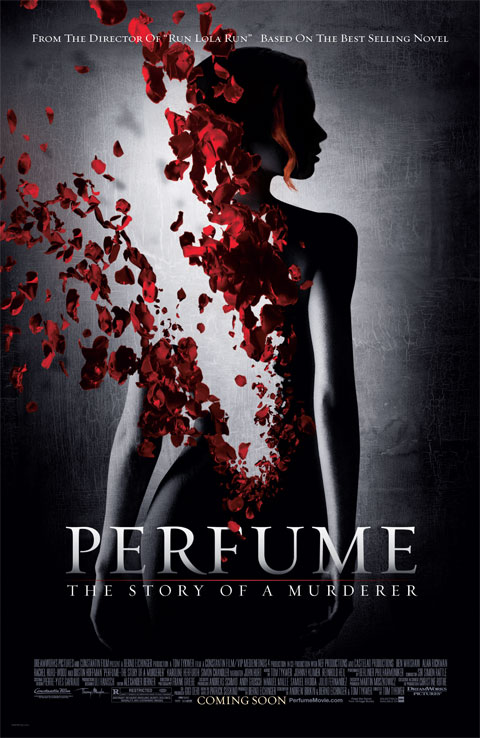
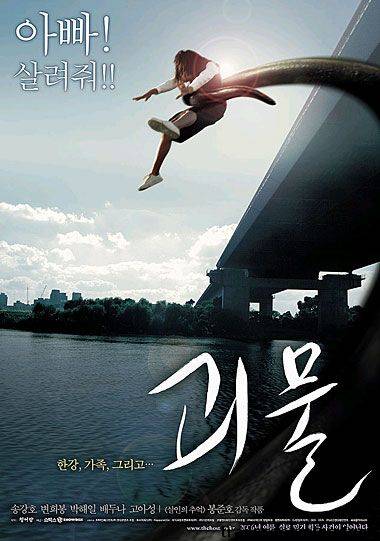
I was reading a lament that the art of the movie poster was lost. While I can certainly understand this sentiment, I think there are still movie posters being made today that stand with the best posters of yesteryear. Two of my favorites are from horror movies made last year.
I love, love, love this poster for Perfume: The Story of a Murderer:
I love, love, love this poster for The Host:
But this may be my favorite horror movie poster. It's for The Texas Chain-Saw Massacre 2:
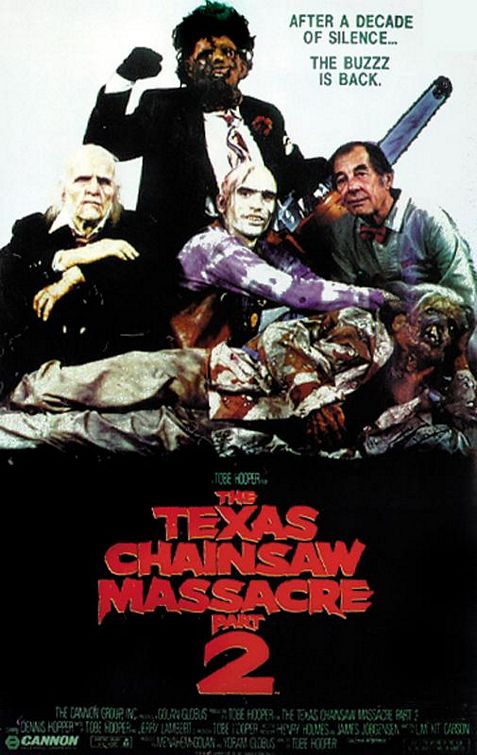
Which bears an uncanny resmblance to this poster from a beloved teen comedy from around the same time:
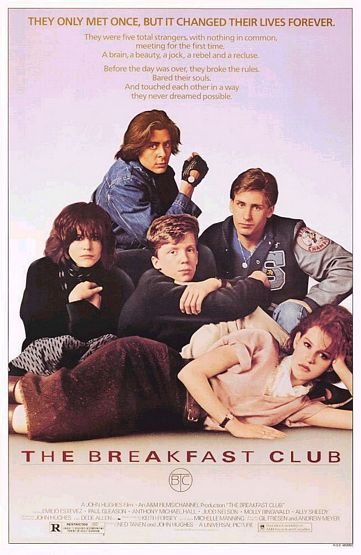
Priceless.
Monday, August 06, 2007
So I go to my local mom and pop video store to rent Bergman's Cries and Whispers and Wild Strawberries this weekend, neither of which I've seen in over a decade. I assumed, because they tend to get Criterion editions of most things, that they would have them both on DVD. Unfortunately, this turned out not to be the case. "You don't have either of them on DVD? Really?" I asked, not hiding the incredulity in my voice at all. "Apparently not," said the guy at the counter. Mind you, they DO have the long versions of Fanny and Alexander and Scenes from a Marriage, so this was a surprise. My first impulse was to run out and buy them copies of both and trade them for X-number of free rentals, but I resisted this urge. In any event, their VHS of Wild Strawberries wasn't bad at all, really, but their VHS of Cries and Whispers was attrocious. The spindles were binding, the tape was de-gaussing--exacerbating a film that is already a victim of bleeding reds in pristine editions--and it was cropped and dubbed. I made it through, but only just.
One of the reasons I've always liked Bergman is because, of the major world directors, he's the one who seems the most like he's making horror movies. His ongoing conversation about the silence of god is fraught with horror, as is his assessment of the existential state of human beings in the face of that silence. It's commonly held that The Hour of the Wolf is the closest to a "pure" horror movie that the director ever made, but reaccquainting myself with Cries and Whispers makes me question that notion. Bergman's movies generally exist outside of genre, but many of his films have generic markers. If I were to "type" Cries and Whispers, I would call it a haunted house movie. Like the best such movies, it's a narrative that confines haunted people in a metaphorical microcosm. The dominant red of the house--Bergman calls it the color of the soul--suggests to me the interior of a body, like the house itself is an organism. The persistent use of disolves, in which the faces of the characters fade to red, subsumes the characters into the environment. And a fine cast of monsters we have in this film. Liv Ullmann's Maria cuckolds her husband and fails to lift a finger when he stabs himself over it. Ingrid Tullin's Karin is an island, incapable of human contact or feeling. Neither can bear the thought of death, as incarnated by their sister, Agnes (Harriet Andersson), who they rebuke on her deathbed. Only their servant, Anna, seems fully a human being, and only she seems to have any faith in a god or in humanity. The others are bounded by Bergman's ever-present silence...or rather, the whispered voices from that silence--ghostly, or demonic, or psychological--that fill the interstices of the movie.
In comparison, Wild Strawberries seems positively antic. At one point, Bergman stages the conflict between atheisim and belief in God as a fistfight. The horror imagery is still there in the form of two dream sequences, but, like Scrooge on Christmas, our hero, old Professor Borg, finds both catharsis and human contact from his dark night of the soul. Still and all, it's interesting that he describes one of his dreams as "vivid and humiliating."
In any event, I need to visit (and re-visit) Bergman more often than I do.
Fred Zinnemann's Act of Violence (1948) was first out of the box for me upon receiving the latest of Warner's film noir boxes. I've written a long review of this for my web-site, which can be found here: http://members.tranquility.net/~benedict/actofviolence.html
I also caught up with Caged (1950, directed by John Cromwell), a film that has been eluding me for some time. When I saw that this was being released as part of the "Camp Classics" sets, I lowered my expectations. I mean, if Warner considers this as being on the same level as Trog then it must be REALLY bad, right? Well, no. It doesn't belong in that set. It's a pretty damned good film noir, a refreshingly serious women in prison movie, and a showcase for Eleanor Parker. The arc of the story, in which Parker's virtuous, wrongly convicted Marie Allen is hardened into a femme fatale by the screws and inmates of her prison, is a distaff version of Nightmare Alley, which is no small compliment. I love Agnes Moorehead in this movie, playing against type. Given the subtle lesbian coding in the film, it amuses me that Moorehead should be the socially crusading warden. Funny.
Wednesday, May 09, 2007
Movies for the week ending May 6, 2007
I played hooky from work on Friday afternoon to go see Spider-Man 3 (2007, d. Sam Raimi), which was good fun. I like it more than the first film, but I'm clearly in the minority there (the first film is spoiled for me by the Green Goblin, if you must know, who looks like a refugee from a Japanese kiddie show and has very glaring plot holes surrounding him). I like to think that the first film is the Ditko-era Spidey, ungainly and charming by turns. The second film would be the John Romita Spidey, slick, angsty, and smooth. That makes the current film the McFarland-era Spidey, which is a mannerist kind of comics. Of course, this is where the analogue breaks down, because it's pretty clear that Sam Raimi doesn't like that era, nor does he like its signature villain, Venom. He'd rather be dealing with the classic Spidey villains--like The Sandman--which is sure to piss off the fans of Venom, but I can't say I disagree with Sam on this. Characters like Venom were a big reason I stopped reading superhero books in the first place. It's also pretty clear that Sam desperately wants to direct a musical. This film is as close to a musical as a superhero movie gets. Not that there's anything wrong with that...
For anyone who complains about how "bad" Spidey 3 is, I would direct them to one of the other films I saw last week, My Super Ex-Girlfriend (2007, d. Ivan Reitman), about which I will have nothing further to say, except to note that nothing makes a good movie look better than an awful imitation.
I also finally got out to see The Host (2006, d. Bong Joon-ho), which has been described as Little Miss Sunshine meets Godzilla. While I won't dispute that characterization, it's better than that. A number of other reviews have noted that this is a movie that refutes the monster-movie playbook point by point, which is closer to the truth. For all that, I suspect that the true motivation behind the movie was a love of monsters and an impatience with how they are usually depicted. I'm sure you know the drill. A few teases early in the movie. A tail here, a footprint there, tease, tease, tease for a couple of reels before the big reveal at the beginning of the third act. Monster movies from The Beast from 20000 Fathoms to Dragonslayer use this same story structure. The Host says screw all that. In the first reel, you get more monster mayhem than many monster movies include in their entire running time, mayhem filmed in broad daylight, with the best "innocent crowd fleeing a monster" scene I've ever seen. It's a cool damned monster, too. It's not as good a film as director Bong Joon-ho's previous Memories of Murder, but it's close, which is high praise.
I also found The Professionals (1966, d. Richard Brooks) in the dump bin at Wal-mart last week for four bucks. This is one of my favorite westerns, with great performances by Lee Marvin, Burt Lancaster, and Robert Ryan and a very yummy Claudia Cardinale. It's a film that blows sh t up real good, too. A total "guy" movie, one that reeks of testosterone. I've loved this flick since I saw it with my dad as a teen. I had very odd thoughts while watching it this week, though, largely inspired by the media furor over the VT massacre. This is a movie in which there are dozens of people violently killed on screen, whether from gunshots or explosions, and I got to thinking about how out-of-kilter our value systems are when it comes to depictions of violence, especially in comparison to horror movies. In The Professionals, we root for the killers and exhult in their actions. We WANT them to kill the bad guys. But let's compare that to, say, The Texas Chain Saw Massacre, in which there are only four people killed,in which the killers are impenetrable cyphers. The filmmakers consciously skew the movie so that not only is the audience NOT invited to root for the killers, their actions are designed specifically to inspire horror. And yet, a film like The Professionals is more socially acceptable than a film like The Texas Chain Saw Massacre. TCM is occasionally thought of as a "sick" or "depraved" film, while no such criticism attaches to The Professionals. What does that say about our society? I don't know. I'm just speculating out loud.
Monday, February 19, 2007
Movies for the Week Ending 2/18/07
Leo McCarey was convinced that the Cary Grant persona was an impersonation of himself, learned by Grant on the set of The Awful Truth (1937). I doubt very much that this is wholly true, but I suspect there might be a kernel of truth to it. Grant, the chameleon, picked up bits and pieces of a lot of the people he worked with. But to my eye, the Grant persona was already in place as early as Sylvia Scarlet, two years prior to The Awful Truth. That said, it’s possible that The Awful Truth shows the Grant persona perfected. The movie itself is great fun, and Grant’s deft self-deprecation is one of the film’s main attractions. Watching him spar with co-star with Irene Dunne as they both try to wreck the other’s happy divorce is a delight. I used to love the Dunne/Grant pairings, but time hasn’t been kind to them. Dunne seems woefully out of her league, a creation of the 1930s, while Grant seems timeless. This probably works the best of them, though, and the look she gives Grant from her bed at the end of the movie is a look that I can imagine on the faces of a lot of women were Cary Grant to walk into their bedrooms.
Most of the reviews of Johnnie To’s Breaking News (2004) focus on the opening shot. It’s a great shot, so I’m not going to quibble with this, but the consensus seems to be that, outside of that shot, the rest of the movie is rote. I’m not so sure about that. There are two things in the movie that set it apart from standard Hong Kong actioners: The first is the sly, meta-cinematic reworking of Johnny Mak’s Long Arm of the Law (1984)--in both films, a gang of criminals is trapped by the police in one of Kowloon’s mammoth apartment blocks. It’s commonly thought that the satiric point of the movie is trained at the media--and it is--but it’s also trained at the history of the Hong Kong action film itself. Most viewers won’t catch this, or even care about it, but I liked it. The other thing that sets it apart is the measure of everyday life that our gang of criminals brings to their ordeal. They take a family hostage, discover that the father (To regular Lam Suet) cannot cook, and end up making a feast for the family. Both of our criminal masterminds dream of opening restaurants. It’s a totally unlooked-for flourish in a film that could be a routine programmer. We also get still more variations of the director’s obsession with cell phones, which marks this distinctively as a To film. To may be my favorite director on the Pacific rim right now.
In the interests of full disclosure, here’s how I stand with Robert Bresson: I was indifferent at best towards both The Trial of Joan of Arc and Diary of a Country Priest. I hated Au Hasard Balthazar, which may be the most disgustingly misanthropic movie I’ve ever seen. I was quite content to let sleeping dogs lie. I have plenty of other interests without forcing my way to an appreciation. In steps my significant other, who collects Arthuriana, with Bresson’s Lancelot of the Lake (1974). Now, I don’t know what I was expecting. Much as I disliked Balthazar, I’ll certainly admit that it was impeccably filmed, so I wasn’t expecting Lancelot to be as unwatchably awful as it turned out to be. For a brief moment at the beginning of the film, I wanted to pop it out of the DVD player to make sure that we were watching the right film. The opening sequence, consisting of various slaughter and mutilation of knights, seems like a first sketch for a Monty Python skit, or a poor-man’s imitation of the bloodier chambara set pieces from Japan, only with blood pumps set to “ooze” rather than “geyser.” The feeling that this was a half-baked sketch was reinforced by the constant, annoying clatter of armor. The film’s other signature sound effect is the whinny of an off-screen horse. The film repeats this sound effect--the same, unvarying sound effect--at random throughout the movie--and, again, I began to think of Monty Python (the resemblance between this and Monty Python and the Holy Grail is too close to be an accident). The film has no interest in people, except, perhaps, to delineate how awful human beings are. Bresson communicates this through his zombie actors and by a desire to look at anything but a human face except when he can’t get around it. There are a LOT of shots of the feet of knights and the feet of horses in this movie, so many that it becomes ridiculous, even at an 80 minute running time. In his desire to deny the audience the pleasure of romance or spectacle--and I’m sure that this is the intent--Bresson elides anything that might be considered a set-piece, resulting an a completely disjointed narrative as the film comes to its climax. We see aftermaths, mostly, but we don’t see context. After we finished watching this movie, my GF said “Well, that’s two hours I’ll never get back.” I didn’t have the heart to tell her that it was only an hour and twenty minutes. Such is the relativistic, time-dilating effect of really terrible movies.
I think I’m done with Bresson.
99.9 (1997) is another film by Spaniard Augusti Villaronga, whose other films ambushed me late last year. Villaronga knows how to get under the skin. He knows how to give the knife a twist or two beyond what the audience thinks it can bear. He’s on speaking terms with horror in a way few directors can manage for long. This film is no different. It follows the host of a radio show as she tries to unravel the death of a friend who died under mysterious circumstances while conducting paranormal research in a small village in Andalusia. The plot has an Asian feel to it, on the surface. Parts of the film, detailing our heroine’s friend and his work, mine the videodromic dread of The Ring and its progeny. But unlike those films, the film ultimately has a little-c catholic view of horror and evil. Evil in Villaronga’s world is part of the air. It’s everywhere. It’s wherever you find it. That all said, this isn’t nearly as alarming a film as In a Glass Cage. Its focus is far too diffuse. Villaronga follows a number of narrative dead ends as a result. The film doesn’t add up, exactly, but when it is clicking, it remains as bruisingly hurtful to the audience as the director’s other films, only with less of a point. He’s traded scalpels for an aluminum baseball bat, if you will, but both will screw you up bad in the right (or wrong) hands.
Thursday, December 07, 2006
Movies for the week of 11/7-12/3/06
The more I see it, the more I'm convinced that Only Angels Have Wings (1939) is the pivotal movie that turned Howard Hawks into an auteur in the theoretical sense and turned Cary Grant into a star for all occasions. Grant here is dramatically different than the Grant in, say, Bringing Up Baby. He's an action hero here, with no whinnying and no ridiculous situations. There's a brooding, intense edge underneath the facade of polished movie star that points the way to the darkness teased out of the Grant persona by Hawks a couple of years later in His Girl Friday. Nothing Grant had done prior to this movie gave any hint that he was anything more than a handsome light comedian. But it's Hawks who, perhaps, makes the more startling transformation. Hawks made some great films prior to this one, but here all the trends percolating through his earlier films come to the fore. This is the template for what we can now recognize as Hawks's directorial signatures. Principal among the auteurial markers is the compositions of groups in the frame and how they form communities. Not only that, but these compositions frame specific types of communities that recur in Hawks's movies time and again, communities centered around professionals doing their jobs. The Jean Arthur character in Only Angels Have Wings starts on the outside of one such community--a tight-knit group of pilots--and her ignorance of the mores of this group isolate her. Consider the following pieces of this shot:


 In this shot, Jean Arthur's character has gone to pieces after her new friend has died horribly in a plane crash. Her reaction is antithetical to the professional mores of all the pilots in the community and Hawks's screen composition slowly strips the community away from the un-professional Arthur, one character at a time. This is a stark contrast from the way her character is shot once she demonstrates her professional bona fides:

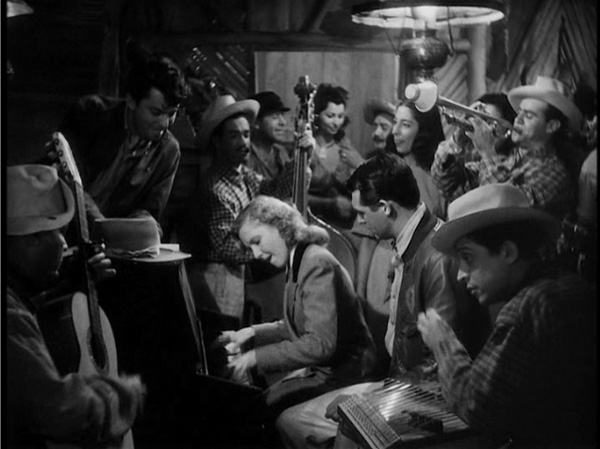 In the first of these two captures, Jean Arthur is at the center of the composition, but is not yet at the center of the community. Note the eyelines of the characters throughout the frame. They point in a number of directions, but generally don't point at Jean Arthur. Shortly after, her character demonstrates her professional specialty, and in the second capture, she's both at the center of the composition AND the attention of the community. As if to sign off on her acceptance into the community, Cary Grant's character greets her at the end of the shot with the line, "Hello, professional."
In general, the accumulation of auteurial tics transforms Only Angels Have Wings from a collection of odd plot contrivances into a superb movie. Hawks is already using pulp-fiction plot construction where the scene outranks the plot. Hawks would later formulate the theory that a good movie consists of at least three good scenes and no bad ones. This movie fulfills this requirement and then some. The movie even points the way to Hawks's signature work in the forties when Jean Arthur's character tells Cary Grant, "I'm not hard to get. All you have to do is ask," a line repeated verbatim in To Have and Have Not, a film that bears no small amount of resemblance to this one.
Hawks's examination of the professional as center of the community reaches its apotheosis in His Girl Friday (1940), but in spite of its central place in the director's work, it's more of a collaboration than one might expect. The movie simply wouldn't work without Cary Grant and his ceaseless tinkering with the Grant persona. For Hawks's part, the movie puts Rosalind Russell at the center of the community as the consummate professional who wants to chuck it all. The problem is, her job is central to who she is. Although it puts the thought into the mouth of her rat bastard editor, Walter Burns, the movie has a knowing insinuation that she'll be miserable as a housewife in Albany with milquetoast Bruce Baldwin for a husband ("He looks like that fella from the movies. Y'know, Ralph Bellamy"). Burns knows and we know that she'll be diminished if she abandons her job. In addition to all of this, Hawks also throws in one of his occasional examinations of gender roles. This is more than turning Hildy Johnson into a "Hawksian" woman (as opposed to the character one finds in The Front Page) to add romantic interest--though there is surely some of that in the relationship between Johnson and Burns--it represents a minor auteurial liet motif that runs through some of Hawks's other pictures (notably I Was a Male War Bride). One could surmise that Hawks's point of view is that gender roles are ridiculous on the surface--certainly, Hildy Johnson as a wifey in the sticks is ridiculous--and that one's professional demeanor is more central to defining one's personality and place in the community.
For Grant's part, well...there's no dancing around it. The Front Page flat out doesn't work without Grant. Walter Burns is such a colossal prick that unless he has the charisma and charm of Grant, there is no way Hildy Johnson succumbs to his ruses. None of the other actors who have played him on film have lent him the almost demonic glee that Grant plays, and none of them put the audience on the side of the profession of journalism in the way His Girl Friday does. Grant is well nigh irresistible. This is an interesting test of the Cary Grant persona, too, because it demonstrates that regardless of how evil the character is, it is sublimated by his charm. This is no small element of the persona, because it allows grant to be credible in Suspicion, Notorious, and even Charade.
In the first of these two captures, Jean Arthur is at the center of the composition, but is not yet at the center of the community. Note the eyelines of the characters throughout the frame. They point in a number of directions, but generally don't point at Jean Arthur. Shortly after, her character demonstrates her professional specialty, and in the second capture, she's both at the center of the composition AND the attention of the community. As if to sign off on her acceptance into the community, Cary Grant's character greets her at the end of the shot with the line, "Hello, professional."
In general, the accumulation of auteurial tics transforms Only Angels Have Wings from a collection of odd plot contrivances into a superb movie. Hawks is already using pulp-fiction plot construction where the scene outranks the plot. Hawks would later formulate the theory that a good movie consists of at least three good scenes and no bad ones. This movie fulfills this requirement and then some. The movie even points the way to Hawks's signature work in the forties when Jean Arthur's character tells Cary Grant, "I'm not hard to get. All you have to do is ask," a line repeated verbatim in To Have and Have Not, a film that bears no small amount of resemblance to this one.
Hawks's examination of the professional as center of the community reaches its apotheosis in His Girl Friday (1940), but in spite of its central place in the director's work, it's more of a collaboration than one might expect. The movie simply wouldn't work without Cary Grant and his ceaseless tinkering with the Grant persona. For Hawks's part, the movie puts Rosalind Russell at the center of the community as the consummate professional who wants to chuck it all. The problem is, her job is central to who she is. Although it puts the thought into the mouth of her rat bastard editor, Walter Burns, the movie has a knowing insinuation that she'll be miserable as a housewife in Albany with milquetoast Bruce Baldwin for a husband ("He looks like that fella from the movies. Y'know, Ralph Bellamy"). Burns knows and we know that she'll be diminished if she abandons her job. In addition to all of this, Hawks also throws in one of his occasional examinations of gender roles. This is more than turning Hildy Johnson into a "Hawksian" woman (as opposed to the character one finds in The Front Page) to add romantic interest--though there is surely some of that in the relationship between Johnson and Burns--it represents a minor auteurial liet motif that runs through some of Hawks's other pictures (notably I Was a Male War Bride). One could surmise that Hawks's point of view is that gender roles are ridiculous on the surface--certainly, Hildy Johnson as a wifey in the sticks is ridiculous--and that one's professional demeanor is more central to defining one's personality and place in the community.
For Grant's part, well...there's no dancing around it. The Front Page flat out doesn't work without Grant. Walter Burns is such a colossal prick that unless he has the charisma and charm of Grant, there is no way Hildy Johnson succumbs to his ruses. None of the other actors who have played him on film have lent him the almost demonic glee that Grant plays, and none of them put the audience on the side of the profession of journalism in the way His Girl Friday does. Grant is well nigh irresistible. This is an interesting test of the Cary Grant persona, too, because it demonstrates that regardless of how evil the character is, it is sublimated by his charm. This is no small element of the persona, because it allows grant to be credible in Suspicion, Notorious, and even Charade.
While I was puttering around the house this weekend, trapped by the snowstorm, I put on Leone's Fistful of Dollars as background noise. This film--indeed, most spaghetti westerns--are perfect for this purpose because of those wonderful soundtracks. We should all be thankful for Ennio Morricone.
Michael Curtiz's "remake" in name only of The Sea Hawk (1940) showcases the director's principle gift: making the un-real estate of the movies something glamorous and exotic. Oddly enough, Curtiz works this trick using the same basic raw materials as he used in the stiff Private Lives of Elizabeth and Essex, though in his and Errol Flynn's defense, it was Bette Davis who was the killjoy in that project. Here, he's not saddled with serious intent (nor is he saddled with Technicolor) and the result is a rollicking entertainment. The supporting cast is rich with interesting faces, including the ubiquitous Alan Hale, Flora Robson, Claude Raines, and Henry Daniell (Daniell, fine though he is as the bad guy, is no substitute for Basil Rathbone when it comes to dueling with Flynn). Brenda Marshall is lovely as the Spanish Ambassador's niece, though she's no Olivia Da Havilland. I don't remember ever seeing the film with the amber tint that overlays the Panama sequence, but it works better than most tinting does. Great fun, though part of me kinda wants to see a new version, faithful to Raphael Sabatini, in which our hero skips out of European society to become an Islamic reaver on the Barbary Coast. I'm not holding my breath.
Monday, November 20, 2006
The Films of Archie Leach: Movies for the week of 11/13-11/19/06
Without quite intending to, I started collecting Cary Grant movies this month. I ordered the Columbia and Warner Boxes and backordered the new Universal one. This goes with the films I already have on hand, and lo and behold, Grant has become the most prominent star in my collection's firmament...
The Columbia box is the better package, though the packaging isn't as good (I hate those damned foldy things (I'm looking at you Looney Tunes)). The Warner box has the better extrees, if you're into that sort of thing. The Universal box looks to be a complete bust for quality, given Universal's holdings, but they are films I haven't seen, so there you go.
First up from my new fiefdom: another look at Bringing Up Baby (1938, directed by Howard Hawks). About halfway through the film, it dawned on me that Cary Grant was doing Harold Lloyd. Sure enough, a check of the IMDB trivia page for the film shows that Grant did, indeed, model his character on Lloyd. The last time I saw the film, I wasn't sufficiently familiar with Lloyd to make the connection. The amazing thing isn't that Grant does a good Lloyd--he doesn't, really--so much that the Lloyd "glasses" persona overlays the Cary Grant persona, and is subsumed by it, so effortlessly. No one else but Grant could be Grant, but the Grant persona itself is surprisingly chameleonic. Grant, it seems, could be anybody. Oddly enough, I can now picture the Lloyd/Grant persona resurfacing in my memory of some of Grant's other movies (notably, Hawks's Monkey Business). The rest of the movie is nonsense, of course, but it's nonsense in the same way that Lewis Carroll is nonsense, and just as pleasurable if you're into that. This kinda sorta prefigures the film noir plot construction Hawks would later borrow from Raymond Chandler, the one commonly called "One Damned Thing After Another." I'm not a fan of Kate Hepburn in this movie--I think she's abrasive here--but she looks somehow "right" next to Grant, moreso than most of his other leading ladies. I think it's the angularity of her features and the rough edges of the version of femininity she constructs in contrast with the smooth polish of Grant's masculinity. Howard Hawks liked to undercut that masculinity, by the way. Here, he puts Grant into a maribou-trimmed dressing gown. A decade later, he would put him into full drag in I Was a Male War Bride. Neither gag works particularly well, though it's more successful in Bringing Up Baby.
Destination Tokyo (1943, directed by Delmer Daves) is a case in point when it comes to the chameleonic nature of the Cary Grant persona. There is a wide gulf between Grant's submarine commander in this film and the Lloyd/Grant comedian of Bringing Up Baby, but not only are they recognizable as aspects of the same persona, they fade completely into the imperatives of their disparate scenarios with startling ease. This kind of movie--the submarine on a mission movie--is hard to screw up, and this one hits all the notes in spite of the propaganda that underlines the film. The propaganda aspect contributes to the film's most glaring flaw: the lack of dark shadows in the characters of our sailors. They're all a loveable bunch of ordinary joes, with nary a personality defect among them. Even the atheist in the crew sees the light at the end of the movie in a scene that can't help but remind me of the end of Frances, with Jessica Lange's Frances Farmer repenting her atheism after a trans-orbital lobotomy. That said, Alan Hale IS particularly likable as the sub's cook, and John Garfield is fine as the lovable, streetwise womanizer cut-off from his natural habitat. The shots of Grant in an open shirt, all sweaty, is enough to set hearts aflutter. The man was simply gorgeous, and even in a state of dishabille, he's unflappable, the modern man perfected.
Hideo Gosha's Goyokin (1969) is the living end of the samurai movie. Filmed in a harsh, de-saturated winter landscape, Gosha's opinions of Japan's samurai (film) tradition is memorably encapsulated in the murder of crows picking over the remains of a village put to the sword by a samurai clan clinging to their power. Placed in historical context--the film is set at the end of the Tokugawa shogunate--the crow motif takes on an even broader meaning. The landscape mirrors the crows. This is not a pleasing pageant of color and action; it's a harsh, brutal deconstruction. Its portrait of samurai as state-sanctioned mass murderers points the way to Japan's entree into the modern world. It's a disturbing implication, though not entirely unprecedented in Gosha's films. It's a logical extension of the disillusion one finds in Three Outlaw Samurai and Sword of the Beast. Tatsuya Nakadai is superb in the lead as a disillusioned samurai who walks away from the bushido only to be sucked back in. Unusual for a samurai movie of this vintage, the performances by the two female leads, Yoko Tsukasa and Ruriko Asaoka, are richly nuanced.
Monday, September 18, 2006
The Pain in Spain: Movies for the Week Ending September 17, 2006
After watching two films by Spanish director Agustí Villaronga this weekend (with a third on hand), I’m not entirely sure I would want to have dinner with the man. I’m sure that, like David Cronenberg, the man himself is probably a charming gentleman with a mundane life. But you’d never know it from the films. These suckers are hurtful.
In a Glass Cage, from 1987, is cruder than El Mar (2000), but it makes up for it with sheer perversity. The story of the mutually parasitic relationship between an ex-Nazi doctor with an appetite for sadomasochistic sex with young boys and a boy with a mysterious past seems exploitative enough, until you fill in the details. The good doctor is in an iron lung--his glass cage, as it were--after a vaguely suicidal plunge from a high building, while the boy wants to be just like his friend and reads to the doctor from his papers chronicling his exploits at the concentration camp. Sometimes he even masturbates to them. I’ve never contemplated the sexual possibilities of an iron lung before, but this movie does. This is the movie that Bryan Singer’s Apt Pupil wants and fails to be. Not for the easily squigged, and definitely not for anyone with an aversion to seeing children come to harm.
That same caveat applies to El Mar, too. We see children murder children in the early goings. Like In a Glass Cage, this film is haunted by Spain’s fascist past. Set before and after the Spanish Civil War, this concerns a trio of friends who witness a firing squad run by the father of one of their classmates. They take it upon themselves to exact revenge by killing him, an act that marks them for life. One kills himself. The other two wind up in a sanitarium for tuberculosis patients after the war, where they are inexorably drawn to each other. Less perverse than In a Glass Cage this is. Less hurtful it is not. There are deep scars on display in this movie, and characters so deeply shattered that all the kings horses and all the kings men will never put them together again. For all that, though, there are moments of lyricism here, too, such as the path a body takes from death in the ominous Room 13 to the morgue. This film is what you might get if you were to cross The Devil’s Backbone with Bad Education, if that means anything to you...
By a strange quirk of shipping, I got the fourth Female Convict Scorpion movie before I got the third. The first three films in this series were directed by a guy named Shunya Ito, whose aesthetic sensibility created what you might get if you crossed Caged Heat with Noh theater. The first three films are ambitious, manufacturing legitimate art from the despised women in prison sub-genre. The fourth film, Female Prisoner #701: Grudge Song (1973), directed by exploitation genre veteran Yasuhara Hasebe, not only has no aspirations beyond exploitation thrills, it doesn't have even the slightest understanding of what made the first three films tick. In the Ito movie, our heroine--the wrongly imprisoned Matsu, or "Scorpion"--is transformed into an avenging angel. Actress Meiko Kaji cuts an imposing figure as the black-clad Matsu, speaking barely a word in each movie. Hasebe "gets" this, and contrives a number of set-pieces in which Kaji gets to glare menacingly at the camera, as she does in the other three movies. But context is everything. In the previous movies, Matsu bears the weight of a whole slate of wrongs done to her and to women in general. She's a vaguely messianic figure, whose vengeance is fully justified. Hasebe hasn't grasped this. His idea of Matsu is as a kind of distaff Man With No Name, and he blunders badly by making Matsu complicit in crimes that have no legitimate rationale as justified vengeance. Because of these crimes, Matsu is transformed from an exterminating angel into a something evil, and a banal kind of evil to boot.
It doesn't help that Hasebe's idea of style is to ape Kinji Fukasaku's yakuza movies. Only once does he try to match Shinya Ito's theatrical sensibility, in a sequence that is so nonsensical and so badly edited that even an alert viewer will be scratching his head at what he or she just saw. This is the sort of thing that can't be laid at the feet of the writers, or the cinematographers, or even the editors. This is the director's fault. And all of the lacerating glances Meiko Kaji throws at the camera can't help it.
All of which made the third film, Female Prisoner #701: Beast Stable (also 1973), all the more remarkable. Nothing makes a movie seem more like a masterpiece than watching a pale imitation of the same film in close proximity. Even more striking is the difference between this film and its two predecessors. Ito had a fraction of the budget he had for the first two films, but retained a ferocity of imagination that enabled him to substitute startling location shots for the theatrical tableaux of the previous installments. The result is no more realistic than the first two films--it is, in fact, just as abstract--but it is markedly less theatrical. The story here finds Matsu trying to survive while on the run as a hunted fugitive. The movie opens with a bang, with Matsu severing the arm of the cop who has handcuffed her in a subway and running through the city with the arm dangling from hers. Once safely away from capture, she is plunged into the world of Japan’s poor women: sweatshop workers, prostitutes, abused wives. The movie makes a point of demonstrating that even without the walls of a prison, these women are all prisoners of one kind of male exploitation or other. As in the first two movies, Matsu becomes an avatar of female rage. Unlike the others, she actually forms friendship and seems to suffer emotional hurts from her actions. My favorite shot in the movie is also one of the most mundane, in which Matsu stands on a bridge over the railroad tracks sharing a drink with Yuki, the prostitute who has befriended her. There is a deep sadness in this shot that seems a tidy summary of the intended mood of the entire film. Like the previous installments, this film is some kind of masterpiece.
The general consensus on Brian De Palma’s The Black Dahlia (2006) is that it’s a mess. That may well be true, and if you want to point a finger, point it at James Ellroy’s source novel, which is just as ridiculous as the movie. Be that as it may, I had a great time at this film, not because the movie is good--for me, the jury is out on that point--but because it represents an interesting collision of elements that should please any long-time follower of De Palma’s career. For example, I was pleased to see William Finley, the Phantom of the Paradise himself, playing yet another deformed lunatic here. I was tickled to see the movie use The Man Who Laughs as a plot point. I loved De Palma’s nod to Michael Powell in casting himself as an off-screen film director. And in a film that is only peripherally about the real Black Dahlia case, I love how the movie introduced the Dahlia as a seeming throwaway in a much longer master shot following a completely different plot point. There’s even a return of the jump at the end a la Carrie and Dressed to Kill. The screenplay, the director, and the actors all seem to be working on different films. The screenplay faithfully apes the novel, the actors look like they are playing dress-up (for the record: pretty as she is, Scarlett Johansson cannot act; the exception to all of this is Hillary Swank, who is changeable to a fault in this movie: she seems to know exactly what the various forces behind the production are up to and gives each of them what they want), and De Palma, realizing that he has no means of making a coherent whole out of the whole thing, is indulging in a summary of his career highlights. For all that, I found it compulsively watchable just the same.
Wednesday, August 02, 2006
Movies for the week ending 7/30
My review of The Set-Up (1949, directed by Robert Wise) is up at my web site. Here's the link: http://members.tranquility.net/~benedict/setup.html. A short abstract:
"The Set-up is a compact masterpiece, running some 72 minutes in real time. The real-time structure of the film is a virtuoso act that trumps similar gimmicks in High Noon or Rope by virtue of playing like a movie rather than as an experiment. Subtract the shots of clocks that remind the audience that the film is unfolding in the time it takes to watch it and the movie still works. Where the "gimmick" really comes into its own is during the boxing match. We get the whole match, rather than a match as edited for a movie a la Rocky. Sporting events--particularly fights--have their own drama to them and the movie seizes hold of that drama and milks it for all it's worth."
From the same boxed set: John Huston's The Asphalt Jungle (1950) is the talkiest damned film noir I've ever seen. Good performances, but low on cinematic style. Marilyn Monroe is sure easy on the eyes in this, though. Of the films in the first Warners film noir box, it's the one I like the least. Sterling Hayden fared better in Kubrick's similarly themed The Killing.
House of Strangers (1949, directed by Joseph L. Mankiewicz) is a film noir-ish reworking of King Lear with Edward G. Robinson as Lear and Richard Conte as Cordelia. Robinson is watchable in anything, as is Conte, and the movie is certainly attractive. This is noir as a generational family drama (a type that culminates in The Godfather). It's also a film where noir shows its roots in the Gothic traditions, mainly in its lush set design. Very entertaining.
The Spiral Staircase (1946, directed by Robert Siodmak). One of the most stylish of the old-style "old dark house" thrillers, this one shades into the modern serial killer genre, with mute Dorothy Maguire targeted by a murderer who kills women who are "imperfect." This sucker lays on the style--the shadows cast by the titular staircase puts a distinctive stamp on the proceedings--and turns the screws tight. One of my favorite movies from the 1940s.
Enjoy.
Wednesday, July 26, 2006
Movies for the week of 7/23
My week in a nutshell:
I took another stab at The Creeping Flesh (1973, directed by Freddie Francis). The last time through, I fell asleep at the halfway point--not a reflection on the movie, per se, so much as it was on the 2am hour at which I nodded off. I'm getting old, it seems. Excellent performances by Peter Cushing and Christopher Lee--every film in which they play scenes together is worth watching--but the absurdity of the thing undoes them. Freddie Francis's heart doesn't seem to be in it, either, which is nothing new (Francis was always uncomfortable as a horror director). Tigon ports over most of Hammer's mannerisms for this production, including the unfortunate equation of sexual awakening with evil. But what can you do?
Monster House (2006, directed by Gil Kenan) is the sort of kid-friendly horror movie that briefly surfaced in the 1980s (The Monster Squad, for one example). The movie concerns a trio of kids who must deal with the monstrous house across the street on Halloween, lest it devour trick or treaters like popcorn. Mostly harmless, and probably a good choice for the Goosebumps crowd, but I'd like to say a word about "performance capture" technology. There's something "off" about it. Capturing completely natural movement in animation is nothing new. Disney did it in the 1940s and backed away from it. He realized that animation needs to be slightly exaggerated to read as natural. This is something that eludes performance capture, because the technology itself is so literal-minded. The technology also gives the director license to move his camera around the scene at will, without worrying about re-blocking everything. The result is a film that is marginally lacking in actual direction and composition because no planning is necessary. I don't expect anyone to know what the hell I'm talking about.
Where the Sidewalk Ends (1950, directed by Otto Preminger) is film noir as Greek tragedy. Detective Dana Andrews has a bad temper fueled by a desire to divorce himself from his father's criminal past. This is his tragic flaw, and leads to him killing a suspect while roughing him up. Compounding things, he covers it up. Watching him manoeuver himself to his fall from grace--and a hint at redemption--is fraught with all kinds of Oedipal nuggets. The most interesting shot in the movie is the last shot, in which Andrews's catharsis is belied by the finality of a closing door. As Billy Budd learned, the law has an imperative all its own.
Pirates of the Carribean: Dead Man's Chest (2006, directed by Gore Verbinski) is exactly the same sort of film as Van Helsing. It's a relentless sequence of action scenes that are the equivalent of a ten-year-old on a sugar high racing about saying "and then this happened, and then this, and this!" Mind you, it's better than Van Helsing--basic film craft will do that--but it's also exhausting, especially at 2 and a half hours. Some sequences--I'm thinking specifically of the island cannibal sequence--could have been excised whole for a trimmer running time. In any event, the relentless pace is too much. I'm reminded of something that Clint Eastwood once said about the pace of his movies: "There's nothing wrong with MTV (style-editing)...well, actually, there is. If everything is flash images, you never have time to actually look at anything." That's certainly the case here. Johnny Depp, the main reason to see the first film, doesn't seem as daft in the second, largely because the movie never pauses to let him go nuts. There's too much plot. Alas...
In any event, Dead Man's Chest, like its predecessor, is an example of genre boundaries collapsing. It raids horror iconography wholesale for its imagery--what is Davy Jones but a piratical reimagining of the Great Cthulhu, after all?--without ever once treading on the horror genre's intention of sending a shudder down the spine. It does, however, occasionally touch on disgust, particularly if you have an allergy to shellfish.
Sunday, July 16, 2006
Movies for the week of July 10-16
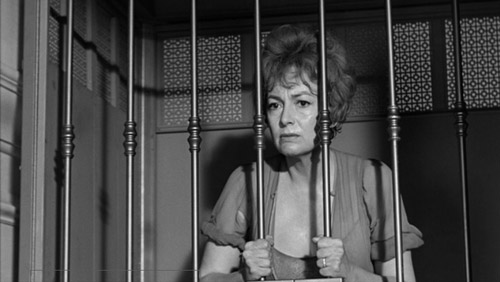 There was a certain amount of deja vu involved in watching Lady in a Cage (1964, directed by Walter Grauman) this week. On the surface, this seems like yet another rip-off of Whatever Happened to Baby Jane, in which an aging actress from Hollywood's golden age is put into an exploitation story--in this case, Olivia Da Haviland. But there, the similarity ends. The Baby Janes, for all their grand guignol gestures, are essentially old-style gothics. Lady in a Cage is something else. It is a fore-runner of the exploitation films of the 1970s, in which the sixties youth revolution collides with the middle class. It's remarkably prescient. Consider the opening credits: We see a city in a heatwave. On the soundtrack, we hear the intimations of a world spinning well and truly into chaos. The arresting freeze-frame shots of the world at large recall the end of Night of the Living Dead, but the last image we see as these shots progress to the house of our heroine is the flyblown carcass of a dead dog in the street. Even before the story itself has begun, the movie has laid before the audience the technique used a decade later by The Texas Chainsaw Massacre AND anticipated one of its first images (Tobe Hooper's film was originally to open on a shot of a dead dog by the side of the road--which can be seen in the extras of some editions of the film--but opted instead for a dead armadillo instead).
The story itself, in which the crippled upper class woman played by Miss Da Haviland is trapped in an elevator by a power-outage, recalls Wes Craven's early films, in which the bourgeoisie are stripped of their priviledge and must compete with the savages for survival. James Caan plays the film's version of Krug, the David Hess character from Last House on the Left. But this film goes Craven one better. Craven suggests that even mild-mannered "civilized" people become monsters to fight monsters. This film suggests that those "civilized" people may already have been monsters to start with (Our heroine even articulates this thought at key points of the film's running time: once near the beginning when she speculates that it might be a good time to invest in armament stocks, then later when she specifically calls herself a monster. This film is surprising for a film made in 1964 for making the class warfare between the haves and the have-nots explicit. Even more surprising is the depiction of affluence as a suffocating burden on the young.
This is all so interesting that one can't help but be disappointed that the film isn't better than it is. Apart from the opening credit sequence (perhaps the best rip-off of Saul Bass that I've ever seen), the film is largely anonymous (as one could expect from a director who is a veteran of television), a fact that argues that the dominant creative hand behind the film is screenwriter Luther Davis, who later wrote Across 110th Street, one of the bleakest of the blaxploitation films of the 1970s. More than that, the villains of the piece seem unconvincing, whether because they are poorly conceived (likely) or poorly acted (also likely). In any event, what the film lacks in style, it more than makes up for in brutality and sheer nihilism, which is a recommendation of sorts, I guess.
Future biographers of the giallo mystery might do well to look at Michaelangelo Antonioni with an eye equal to the one they cast at Mario Bava. At least two of Antonioni's 1960s films point the way to the films that follow in the 1970s. Certainly, Blow-Up is a proto-giallo. So, too, is L'Avventura (1960). We have the story of a boat party where one of the members of the party vanishes on a deserted island. The rest of the partiers search for her, but she is never seen again. It's as if she has been swallowed by the landscape (the movie films the landscapes with a glacial coldness and an epic eye that often dwarfs the figures in the frame). The disappearance, though, is only one aspect of the film's portrait of alienation. None of the characters in this film is connected in any meaningfull way to any of the other characters. The Esmeralda Ruspoli character, Patrizia, comments early in the film that she "doesn't understand islands, surrounded by all that water;" Antonioni almost immediately cuts to shots of his partiers swimming, each an island unto themselves. "If one of them dissapears," his camera seems to be saying, "what of it?" The landscape doesn't care. When the second half of the film seems to forget about the disappearance entirely, the remaining characters continue to move through meaningless lives making no connections whatsoever. It's as if interpersonal relationships are a means of passing the time until the final exit, and nothing more.
Wednesday, May 03, 2006
Eros Plus Massacre (Movies for the week of 4/24-4/30)
The bloodiest day in American history is thought to be the New York Draft Riots in July of 1863 (memorably depicted on film in Martin Scorsese's Gangs of New York). The "official" count of the dead was in the vicinity of 300 people, but that count only reflected "white Americans" as one might expect from a society in which the Know Nothings still held formidable sway. Based on conteporary accounts, the true number is nearer 7000, most of them black or Irish. What does this tell us about America? It tells us that, when it comes to the massacre, we are rank amateurs compared to the French.
Mark Twain, in comparing whether the French or the Comanche were more "civilized," notes that the massacre is the French national pastime (he decided that the Comanche were more civilized, if you must know). From the Paris Commune, to the Terror, to Vichy, the French have developed the massacre to a fine art. The piece de resistance of that art is The St. Bartholomew's Day Massacre in August of 1572, in which Catholic France set upon their Protestant dissidents, the Hugeunots, and murdered practically all of them. Some 70,000 people in two days, by most accounts. This history is recounted in Patrice Chéreau's 1994 film, Queen Margot, which should be of interest to any fan of horror films. This is a film drenched in blood. Two things triggered the massacre: first, the attempted assassination of Admiral Coligny, a Protestant advisor to the King. Second: the presence of most of the leaders of the Hugeunots at the politically motivated marriage of Queen Marguerite (Margot), daughter of Catherine De Medici, and Henri de Navarre, also a Protestant. The marriage was intended to quell the unrest between religious factions, but the assassination of Coligny was like throwing a match into a powerkeg. With all of the Hugeunot leaders conveniently in one place, it was easy to destroy them all. Cut off the head and kill the body, as they say. The massacre occurs in the first half of the film. The remainder deals with the fallout, and as the film is about the political machinations of a late medieval, early renaissance aristocracy, the fallout is also drenched in blood. Forget any romantic notions that these people resolved their differences with duels--as they do in the book by Alexandre Dumas upon which the film is nominally based--they were murderers and libertines to a one. Their weapons were sex, poison, a dagger in the back or across the throat. One of the late images tells the story of the film: Isabelle Adjani as Margot, clad in a blindingly white dress now stained with the blood of her poisoned brother, stands between the coffins of two dead men, one of them her lover. Neither man has a head. The heads are on the shelf in front of her.
I describe this film as being of interest to fans of horror movies not only for its violence, but also because it points out the essential timidity of historically themed horror films produced within the genre itself. There is nothing...nothing at all...in Hammer's recounting of the Elizabeth Bathory story in Countess Dracula (to pick one example) the equal of the violence and horror in Queen Margot. But don't approach it lightly. This is a film that can be profoundly confusing to a viewer with no prior knowledge of the story. There are dozens of characters in the film, most played by terrific actors, but there isn't anything like a scorecard. The story begins in thick of the plot, so the viewer is left to fend for himself. The sexual relationships may be as confusing as the politics, too, because everyone, it seems, is sleeping with everyone else. The filmmakers have taken the folk songs depicting Queen Margot's promiscuity and translated them literally to the screen. The resulting film is a bit of a hothouse, which would be a fault if most of it weren't true.
The title of this post is "Eros Plus Massacre," which is the title of a Japanese film from 1969. I haven't seen it, but I like the title, which fits the films I saw this week. Not just for the sex and violence, but also because some of them are Japanese.
Donald Ritchie notes in One Hundred Years of Japanese Cinema that the failing studio system in Japan attempted to prop itself up by "modularizing" their genre films. In assembling them from prefabricated elements, they kept costs down, but wound up with a cinema that began to show the uniformity of an assembly line product. This can be seen in striking fashion among Panik House's recent releases of "pinky violence" films. These films, mainly from Toei Studios, are a patchwork of revenge themes, yakuza bravado, pink film soft core, and bad girl fetishism. There turns out to be some room for a competent director to separate himself from an incompetent director, but I'll get to that in a moment.
Both Criminal Woman: Killing Melody (1973, directed by Atsushi Mihori) and Female Yakuza Tale (1973, directed by Teruo Ishii) are more or less the same movie. Both feature the formation of girl gangs that pit rival yakuza factions against each other. Both star Reiko Ike. Both feature a measure of female empowerment through revenge and crime. Virtually every trope found in these films is borrowed from another, better film. The card game that opens Shinoda's Pale Flower, for example, shows up here in a debased form, as does the pitting of both sides against each other plot of Yojimbo, and even the bold contrast of criminal women against an ash wasteland in Female Convict Scorpion: Jailhouse 41. These are all proven commercial elements that Toei has distilled into "modules" with which to build their productions. Given that the mix of elements used to construct the basic outlines of the films are identical, there is no reason for one film to be better than the other, but Criminal Woman: Killing Melody is a better film than Female Yakuza Tale, mainly because it contains fewer "modules" leeching its vitality. It's a more linear film with a tighter focus on where it wants to end up, which reflects the fact that Atsushi Mihori is a more competent director than Teruo Ishii. It is also unencumbered by a predecessor--Female Yakuza Tale is a sequel to Sex and Fury, so it doesn't carry with it an expectation of elements from a preceding film. But this is all splitting hairs. Neither film is really very good. They traffic in gratuitous sex and violence for their own sakes. The most interesting thing about these films--to me anyway--is the way Toei bites the hand that feeds it. In both films, the yakuza is depicted as bumbling, stupid, and venal, easily deceived by a woman willing to bare her breasts and completely ruled by their genitals. Toei was carried through the collapse of the studio system in part because of the yakuza film, but also because they were in bed with REAL yakuza.
The Uninvited (1944, directed by Lewis Allen) is an elegant ghost story that's something of an anomaly among Hollywood ghost stories of the period. Ghosts were rarely played straight in classic Hollywood. They tended to be the fodder for comedies or charming fantasies--they were Cary Grant and Constance Bennett in Topper or Lou Costello and Marjorie Allen in The Time of Their Lives--but this film plays it straight. Ray Milland and Ruth Hussey play a brother and sister who buy a house on the coast of England only to discover that there's something wrong about the place. The center of the house's "wrongness" seems to be Gail Russell, whose family sold the house to our heroes. Without giving too much away, this film plays out like a supernatural version of Rebecca. What is immediately evident about the film is the influence of the Val Lewton films. The film makes good use of its deep shadows and oblique approach. It hasn't fully assimilated the Lewton formula--it had the budget to show its ghost--but there's enough of it. Though the film plays the supernatural straight, there is a comedic element between hauntings that goes down pretty easy. I never think of Ray Milland as a comic actor, but between this and It Happens Every Spring, he's pretty good. This was one of my mother's favorite movies. She had good taste.
Monday, April 24, 2006
Movie Week for 4/24/06
Here's my movie week in a nutshell:
The movies from the DDD sales are starting to trickle in. I'm happiest to have replaced my "grey market" dupes of Homicidal and Mr. Sardonicus with good DVD editions. But that's not everything I watched. To wit:
Three...Extremes (2005, directed by Fruit Chan, Chan Wookpark, and Takashi Miike) poses this question: "What does it say about an anthology movie when the most sedate, austere, and tasteful entry is directed by Japanese madman Takashi Miike?" Quite a lot. This is a sequel, of sorts, to the pan-Asian Three. Like that film, it presents filmmakers from three nationalities (Japan, Korea, and Hong Kong). The results are all over the map. "Box," Miike's entry is tonally cold and elegant--to its detriment--though the "extreme" elements can be found in both the hints of incest and in the nature of the crime that drives the plot. The circus setting reminds me of Tod Browning in the twenties, which is probably not an accident. Having built up a tremendous head of steam, the story ends with an un-earned non-sequitur. "Cut," Chanwook Park's entry, seems like an offshoot of his vengeance trilogy. In purely formal visual terms, it's a dazzler. As a story, it reeks of contrivance. Still, it makes an impression. The crown jewel, though, is Fruit Chan's "Dumplings," the short version of the feature of the same name. The short is better. The feature has a different ending, and takes much longer to rachet up the dread. At short length, though, it is unforgettably nasty. As I was watching, I kept asking myself "How the hell did this get made?" It certainly couldn't be made in North America. Part Sweeney Todd, part Dorian Gray, this film trades on incendiary imagery and ideas. This may well be the sickest horror movie of the century, made poisonously appealing by Christopher Doyle's impeccably framed cinematography. But it's the sound design of the film that really turns the screws. The "crunch, crunch" of Bai Ling's dumplings as Miriam Cheung eats them puts the film well and truly over the line. Extreme, indeed.
Mr. Sardonicus (1961, directed by William Castle) was a great favorite of mine when I was younger, but revisiting it anew was a bit of a shock. Back then, I had no idea of just how thoroughly the film was plagiarized from other sources: notably from Cornell Woolrich's "Post Mortem" (in which a man is buried with his winning lottery ticket), from The Man Who Laughs, and from Les Yeux Sans Visage. The film hasn't got an original thought in its head. The film also features one of director Castle's most annoying cinematic mannerisms: do you remember the scene in Amadeus when Salieri tells Mozart that he hasn't given the audience cues for when to applaud? Castle learned that lesson early. Every time there's a "shocker," he has conveniently placed a woman in the scene who screams her head off as a cue to the audience. In any event, it's annoying. Maybe it's true: you can't go home again.
The screaming woman cue returns in Castle's Homicidal (1961), too. A shameless--and I mean SHAMELESS--rip-off of Psycho, the film further enhances Castle's reputation as a cut-rate Hitchcock. Homicidal is more violent than Psycho, and throws in an extra twist to Psycho's transgendered shenannigans, but so many scenes and elements are transparently lifted from Hitchcock that it's cold comfort. Castle wouldn't come anywhere near Hitchcock until he hired Robert Bloch to write Strait-Jacket for him, or, arguably, until he hired somebody else to direct Rosemary's Baby. Not content to rip-off just ONE source, Castle has also borrowed elements from Whatever Happened to Baby Jane, too. Still and all, there is something appealing about such brazen larceny.
Blake Edwards's Experiment in Terror (1962) is the real deal. A film noir from the very end of the cycle, this film turns the screws tight. Edwards is best known for comedies, but he demonstrates a gift for the thriller in this film. The opening conversation between Ross Martin's asthmatic psycho and Lee Remick's woman in peril is as tautly written and performed as they come, and the cat and mouse game that plays out over the rest the film never degenerates into people doing stupid things to advance the plot. Also of note is the nocturne that plays out over the film's opening credits, as a we get a nighttime tour of San Francisco to Henry Mancini's evocative and menacing jazz underscore.
Finally, there's Spike Lee's Inside Man (2005), which has been touted as a departure for the director, a rare dip into commercial filmmaking. The movie surrounds a heist that may not be a heist, and while Lee is perfectly adept at depicting this, it's a hook on which to hang a parable about multi-culturalism in New York. The song, "Chaiyya Chaiyya," announces this pretty definitively as it plays over the opening credits, but the flourishes to the plot--from the broad demographic of the hostages to the scene when the cops play a recording from the bank to see if anyone in the crowd recognizes the language--are singular instances of the director's anima. It's almost disappointing that Jodie Foster gets an ill-conceived character meant to represent "The Man." She's visibly uncomfortable in the role, which is a shame, because the rest of the cast is game. It's hard to resist a film where part of the plot turns on the size of a woman's breasts. Russ Meyer would have approved.
Cheers.
Monday, March 13, 2006
Movie Week for 3/13/06
I got a huge shipment of Asian films this week. My review of Sympathy for Lady Vengeance is up on my web site. A bunch of Johnny To movies are in the stack too, including two recent offerings.
Rumor has it that Johnnie To’s Election (2005) was cut down from a three hour running length and that it is the first installment of a trilogy. One can feel a more expansive narrative in the negative spaces of the movie and I can’t help but wonder what To might have had in mind for a longer film. The movie seems like it was made on a bet: “Can you make a triad movie without any guns?” The answer is yes, of course. Don’t be deceived by the lack of firepower, though. There’s plenty of violence in this movie. What we have here is a study in power politics among the underworld, centered around the election of a new triad chairman. The obvious comparison is The Godfather (or The Godfather Part II, given a final scene that recalls the murder of Fredo). Like those movies, Election presents a conflict between the traditional, highly ritualized (and highly self-deceiving) ways of organized crime, and the new, more impersonal, ruthless, corporate style of crime. Beyond that, though, I don’t think the analogy holds up. The Godfather movies don’t necessarily distance themselves from the gangsters they depict. They like them just a little too much. To doesn’t like ANY of his gangsters. A closer analogue would be Kinji Fukasaku’s Battles Without Honor and Humanity films, which Election also resembles. This is a generally somber movie, filmed in deeply shadowed spaces even during daylight hours, but in spite of that, To’s own playful cinematic anima comes to the fore. There is a long chase at the center of the movie, in which the baton that symbolizes the power of office is sought by both sides of the conflict. During this chase, the allegiances of the players change, then change again. It culminates in one of the director’s drollest set pieces, in which both combatants are interrupted by cell phone calls from their respective controllers. To loves cell phones, and this scene compares favorable with the cell phone scene in PTU. The ending of the film annihilates this (much like the ending of Running on Karma turns THAT movie into something much darker than its playful nature suggests). There is no “play” in the final sequence of the movie. It plays for keeps. To sets up some expectations with Simon Yam’s character, who is exactly the sort of charismatic criminal that might be an anti-hero in another movie. The ending obliterates this notion. This is To at his most black-hearted.
Like any self-respecting auteur, Johnnie To never throws anything away. There are echoes of To’s other movies in each subsequent offerring. Running on Karma, for instance, takes the absurd sight of Andy Lau in a muscle suit from the equally absurd sight of Lau in a fat suit in Love on a Diet. In Yesterday Once More (2004), we see the influence of To’s crime films on his romantic comedies. (Note: interested parties are advised to read no further). The film has Andy Lau and Sammi Cheung playing husband and wife jewel thieves. Like all international jewel thieves, they live a life of luxury, treating their careers as an elaborate game. The game becomes even more elaborate after they divorce each other over the split of a diamond robbery. A year later, when Cheung’s character threatens to remarry, Lau, in the best tradition of Cary Grant, re-enters her life to disrupt everything. Confounding everything is the ambition of Cheung’s would-be husband (the Ralph Bellamy character, if that means anything to you) and his meddling mother, who, it seems, is herself a thief. This sets up a curious echoing effect in the plot as scenes double each other, then double each other again. On the surface, this film is a frothy, caper film a la To Catch A Thief crossed with My Favorite Wife, but underneath, we have a variant on Running Out of Time. The final montage includes the unexpected lowering of a casket into a grave, a sight that turns the frothy comedy into a darker, more bittersweet movie.
Monday, February 13, 2006
My Movie Week (2/13/06)
I saw two Christian-themed movies this week. One made with the intent to blaspheme, the other with an evangelical purpose. Neither of them is going to further the reputation of Jesus Christ or his teachings...
The School of the Holy Beast (1974, directed by Norifumi Suzuki) is the more palatable of the two, in spite of the film's clear intention to ridicule and debase organized Christianity, especially Catholicism. It's a nunspoitation movie, sure, but a more artful nunsploitation movie than what usually oozes out of Catholic countries. Like many Japanese exploitation films, this one is defensible only on the grounds of its form. Director Suzuki aestheticizes his film for all it's worth. Unlike similar films from Europe, one is never discomforted with the squishier nastiness of the genre. The scene where our heroine is bound with rose briers and whipped with longstem roses is typical of the film's approach: What is happening on screen is base titilation, but it's beautiful to watch if you can divorce the content from the form. Yumi Takagawa is the perfect actress for this--gorgeous, but with a hint of steel in her demeanor, at home as a good-time girl out on the town before her confinement at the convent or as the severe avenging nun/angel at the end. That all said, the movie is an uneasy conflation of nunsploitation tropes, Hammer horror, and Japanese roman-porno that doesn't quite work, though it is artful (as opposed to "arty") enough to command some interest.
Art has no accquaintance with director Ron Ormond, or his hysterical Christian scare film, If Footmen Tire You, What Will Horses Do? (1971). Ormond is perhaps best known for his wretched Mesa of Lost Women, a constant occupant of "worst films ever made" lists. In the 1970s, Ormond turned his...um...unique talents to Christ, and in partnership with Mississippi evangelist Estus W. Pirkle (a name on which I can hardly improve) created this...thing. God is going to turn away from America, the movie tells us, unless a revival happens in the next 24 months. The "or else" part of the equation is the instantaneous Communist take-over of the United States. What's to blame for the declining morals of America? Poverty? War? Drugs? Not at all...it's Saturday morning cartoons, dancing, and "the liberal media." To what kind of life can we look forward under our coming Communist masters? 16 hour work days all year round, the taking of our Christian women to satify the lusts of Communist officers, and endless stacks of bloodstained bodies in the streets. Our children will have sharpened bamboo sticks shoved into their ears in order to prevent them from hearing the word of God. Children will be decaptitated if they honor their mother and father. Children will be encouraged to pray to Fidel Castro for candy as part of the diabolical Communist brainwashing.
No, really. I'm not making this up. For that matter, the good Reverend Pirkle claims that HE isn't making it up, either. Clearly, he's deluded. The whole production is deluded. This artifact (I can't really call it a film) fills me with a black misanthropy towards my fellow Americans. Surely evangelical Christians aren't so blindly naive. Surely they aren't so pigheadedly stupid? When I'm in a blacker mood, this film rather explains some things to me about the current politics of the United States, which tempers the pleasures so outrageously bad a film occasionally offers.
Katsuhiro Otomo's Steamboy (2004) took me by surprise. I didn't like Otomo's Akira. I don't much care for Japanese animation in general. But I liked this. As pure kinetic art, this is amazing. Every minor detail the film puts in motion is a drug to the eyes. I like the alternate history of steam technology this film posits. I like the ethical questions the film asks, and I like the fact that it doesn't come down with a heavy hand on either side of its ethical dilemma. I LOVE the fact that the film works as a coherent narrative. In my experience, this is a rare occurrence in Japanese cartoons. And despite the fact that most of the film is an excuse to stage a steampunk apocalypse, there's an appealing optimism at the end of the movie that hit the right nerve. Mostly, though, I like the fun of the movie. This is a fun movie, which is a rarity in the world these days.
Subscribe to:
Comments (Atom)







 Posts
Posts

