Monday, April 05, 2010

Harried and Harryhausened

Sinbad and the Eye of the Tiger (1977, directed by Sam Wanamaker) is very much the least of the Sinbad movies. It's woefully miscast. Patrick Wayne (son of The Duke) is WAY too white American to be a credible Sinbad, and it gives the juicier female lead to Taryn Power (daughter of Tyrone Power), rather than to Jane Seymour, who blows her off the screen. This is more or less the same movie as The Golden Voyage of Sinbad, in which an evil sorcerer has disfigured the rightful ruler and Sinbad must convey that ruler to a magical wellspring. Along the way, monsters are battled, and at the end, our heroes look on as two monsters battle each other. Unlike that movie, this movie shows our heroes to be complete morons, especially the wise man, Melantheus (played by former Doctor Who Patrick Troughton). The heroes keep just telling evil queen Zenobia their plans, which is irritating in the extreme. If they keep mum about it, the movie has no drama. This kind of special pleading is a hallmark of bad screenwriting. Ray Harryhausen's monsters remain a delight, but there's not enough of them to sustain the movie, and even these show some flagging invention on the part of the artist. The first monsters we get are these demonic insect men:

These are pretty good. But it's downhill from there. The giant walrus seems thrown in just to have an encounter during a slow part of the movie (which, unwittingly pads its length).


And the final monster is this sabertooth tiger, which is not one of Harryhausen's finest creations. It looks like a stuffed toy rather than a threatening monster.

For the most part, you can see the roots of how modern blockbusters are made in this film: you have a monster encounter at the end of every reel--approximately every ten minutes--to keep the kids' attention from wandering. Unfortunately, that doesn't work any better as drama here than it does in more recent fare. Unfortunately.


Speaking of Harryhausen, the new Clash of the Titans (2010, directed by Louis Leterrier) is surprising in at least one respect: it satisfies the Alison Bechdel rule. There are more than two women in the film with speaking parts. Two or more women speak to each other about something other than a man (in this case, Cassiopeia to her daughter, Andromeda, on the subject of defying the gods). Rah, rah, feminism. Otherwise, this sucks all kinds of ass.

This film is stitched together from bits and pieces of the original film without borrowing its overall design. Some elements seem thrown in just for the sake of echoing the old movie. Calibos, for example, seems like a throw in excuse to make giant scorpions. The contempt for the original film exhibited in this one is manifested in a throwaway bit, in which Perseus finds Bubo the owl in a bunch of scrap and tosses him aside. Mind you, the original is no great shakes and the owl was ridiculous, but why antagonize the people who grew up with it by trashing it. Feh.

Allegedly, the whole reason this exists is to update the special effects from Harryhausen's charmingly homemade stop-motion puppets to state of the art, photoreal CGI. But what, I ask, is the point of state of the art special effects if the film is edited so fast that you can't see anything? I challenge anyone to tell me what this film's harpies actually look like (apart from having wings). There were two points during this film where I said aloud "Hold. The camera. Still." If I say anything during a movie, I'm usually having a bad time, so this is telling of my experience. The way the film plays fast and loose with mythology is irritating, too, but not nearly as irritating as the way it wastes relatively good actors in the background in favor of Sam Worthington and Gemma Arterton, neither of whom exactly holds the screen. Polly walker gets four minutes of screen time? Elizabeth McGovern is even in this? Really? I almost gave this points for having some background extras at the palace in Argos dressed in the Minoan snake goddess outfit (sadly no boobs are visible), but screw it, it's anachronistic. Ralph Fiennes must have done this without preparation during some down time on the set of Harry Potter, because his performance is basically Voldermort in mythological drag. Lazy.

In a nutshell: Loud, pummeling, illogical, incomprehensible, pointless. Tremendous resources misapplied wholesale. A great steaming pile.

Saturday, April 03, 2010

Silence is Golden


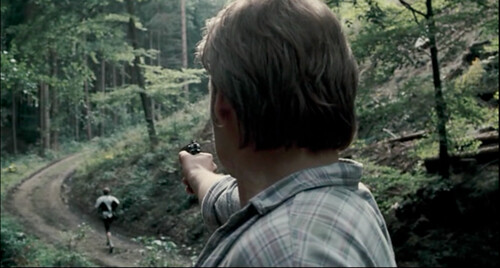
There's something wintery about the anti-Western. Altman felt it in McCabe and Mrs. Miller, Sydney Pollack felt it in Jeremiah Johnson, and you get it full-bore in Sergio Corbucci's The Great Silence (1968), a film that razes the Western to the ground and sows salt in the soil.

The movie is set in Utah somewhere during the period thought of as the Old West. I can't pinpoint it any closer than that, because the movie is strangely anachronistic. Utah is a territory in the film--Utah became a state in 1896--but our hero, Silence, carries a broomhandle Mauser rather than the stock guns of Western gunfighters. The broomhandle Mauser was first manufactured in Germany in 1896. So there's a disconnect. Further, the events of the film are based in part on the Mountain Meadow Massacre of 1857. As with most other Westerns, I prefer to think of this film as an abstraction of history, but this one seems even more anachronistic than most. Silence's gun of choice also Europeanizes the film, which may have been its intent.

In any event, our hero, Silence, played by Jean-Louis Trintignant without any dialogue, falls in with a group of "outlaws" who are being hunted by bounty killers. And by "outlaws", I mean Mormons, though the movie never uses the word. The bounty killers are led by Klaus Kinski's Loco, who'd rather bring 'em in dead than alive. It's a pretty stock set-up. What happens at the end of the movie is NOT stock. At the end, Loco draws a wounded silence out into the open by holding the captured outlaw families hostage. Silence has been sheltering with Vonetta McGee's Pauline, a widow whose husband was killed by Loco, presumably as part of the same bounty on anyone who wasn't a white Christian. She follows him to try to stop him. In the showdown, Silence, Pauline, and all of the "outlaws" are massacred. The end.

Sergio Corbucci's spaghetti westerns are all laced with with a Marxist point of view, and this one is no different, though it's more pessimistic than most. This movie is a critique of the Western's notions of heroism, when in Corbucci's worldview, the West was settled at gunpoint by genocidal murderers. This, at least, has some basis in history, and it may be why the rest of the movie is so ahistorical as a means of softening the blow. The heroic gunfighter prevailing against all odds, Corbucci seems to be saying, is bullshit.

As if to emphasize the point, the landscapes in this movie are bleak snowscapes. We first see Silence on his horse struggling through snowbanks, which eventually unhorse him. This is a kind of fimbulwinter for the West, a prelude to the twilight of the gods. It's the end of the world. The movie it most reminds me of is Hideo Gosha's Goyokin, which indulges in the same motifs of bare trees, snow, and crows. The symbolism is the same in both movies.

The silence of our main character, and his European-ness, are presumably both representative of Europe at the time the film was made. America was indulging in massacres anew in Vietnam in the name of its ideal of democracy, and Europe didn't have a voice in the matter. I could see Corbucci making the same film again in the 2000s.


For what it's worth, the studio behind The Great Silence compelled Corbucci to film a "happy" ending for the film, which is included (appropriately without a soundtrack) on the Fantomas disc. This ending just goes to show that an ending doesn't need to be happy to be satisfying, because it's just ridiculous.

Tuesday, March 30, 2010

Angelic Visitations


So, I have a friend who loves Ewan McGregor and hates Tom Hanks. I wonder if she saw Angels and Demons, the 2009 sequel to The Da Vinci Code, and if she did, I wonder what she made of it. Director Ron Howard is back, and proves once again that you can never actually tell what your going to get from him from movie to movie, even within the same franchise. Regarding McGregor, because he's playing a priest and representative of the Vatican in this movie, there was NO chance that we would get to see his endowment in this movie, which, frankly is disappointing. But then, this was made before the current scandals that are tearing the Catholic Church asunder really started to break. A missed opportunity, but you're not going to get that from a Ron Howard film or a film starring Tom Hanks anyway, so what the hell, eh?

In any event, to recap: I hated The Da Vinci Code, which I thought telegraphed its plot so thoroughly that the CSI-style flashbacks were wholly unnecessary. The sequel is quite a bit better, and not just because it dispenses with the flashbacks. It also throws in enough red herrings to make the plot at least a little bit more surprising. Plus, it takes its cues from The Abominable Dr. Phibes, though this film is Phibes on speed. Hanks is back again as symbologist Robert Langdon, who in this film is recruited by the Church (as opposed to being thwarted by it in the first movie) to help decipher the clues in the abduction of the four preferati (leading candidates for the papacy), on the eve of the conclave. The evidence points to the reappearance of the Illuminati, about which Langdon knows a bit. Meanwhile, a vial of antimatter has been stolen from the Large Hadron Collider and turned into a bomb that threatens to destroy the Vatican. So we get another treasure hunt. In most respects, it's the same movie as the first one, minus the goofy conspiracy. The conspiracy in THIS movie is only preposterous, which is one of the reasons that this is better than its predecessor by quite a lot.

Some things I liked about this film are things I liked a great deal. First: Tom Hanks has a MUCH better haircut in this movie. You may think that's a small thing, but did you SEE the haircut they gave him in the first film? Seriously. In a more sober vein, I also like the idea that Langdon is an atheist hero and admits to it when pressed by McGregor's Camerlengo: "Tells me I'm not meant to. Faith is a gift that I have yet to receive." Further, he doesn't recant at the end of the movie, which is amazing given the strong Catholic appeasement the movie indulges. I also like the depiction of the Large Hadron Colider, which, lets face it, IS one of the places in the world that could probably make that quantity of antimatter. It's also a spectacular location. The science here isn't ignorant, nor is the movie's token scientist/eye candy, Ayelet Zurer, whose role is to explain what antimatter is and to act as a foil for Langdon, someone he can spout exposition to. It's not that bad, really. There have been a LOT worse versions of this character. I also like the film's instinct for the jugular. There are several "themed" murders in this film (a la Phibes), and they are wonderfully ghastly. Finally, Rome remains one of the most photogenic cities in the world. The Eternal City, indeed.

So, all in all, a surprise. It's not a great movie at all. It's a popcorn movie that's fun while you're watching it. There are even a few things along its running time that stick in the memory. I'm glad that I didn't pay money to see this in the theater, though, because when you insert an economic element, it tends to change the amount of slack I give a movie. Take that however you like.

Monday, March 29, 2010

A Dish Best Served Cold...


Of all the varieties of genre fiction, crime fiction has always been the one that has been most attractive to filmmakers with a more artistic bent. Oh, the reasons are easy enough to see: crime fiction can be sociological or existential, it can provide horrifying moral conundrums for its characters, it can examine the roots and consequences of violence. As a result, you're more likely to find a crime drama at the art houses than you are to find a science fiction film or a western. And the art house--and the video equivalent of the art house, The Criterion Collection--is where I found Revanche (2008, directed by Götz Spielmann), a film that takes a stock crime story and telescopes it out into a meditation on revenge, forgiveness, and guilt. It transposes a story that would ordinarily be filmed in some kind of stylized fashion by a more genre-oriented director into the flat, long take aesthetic of Eastern European art cinema. Director Götz Spielmann strips the film of anything that might heighten or manipulate the audience's emotions--no score, very few close-ups, an Ozu-esque camera placement, and cold, subdued light--and it lets the characters stew for the camera. Most of the characters' emotions are internalized. It's a cold, emotionally distant way of filming, and it will alienate some audiences. It took me a while to get into it, myself.

The story follows Alex and Tamara, he a low level flunky for the owner of a brothel in Vienna, she a Ukrainian prostitute. As the film opens, the brothel's owner is trying to move Tamara into a higher level of clientele, with strings attached, of course. Tamara owes the owner a large sum of money and Alex would like to raise the money to open his own bar, so he hatches a plan to rob a bank. In one respect, Revanche shares an element in common with more conventional crime films: When someone says "Nothing can go wrong," as Alex does, you know something WILL go horribly, horribly wrong. And so it does.

This brings the film's other major players into the picture. Robert and Susanne are a cop and his wife who are growing apart due to their inability to conceive. Robert ends up killing Tamara by accident during the course of the robbery, and Alex finds himself neighbors with Robert and his wife when he hides out with his grandfather. Revenge burns in his eyes. What follows is fairly surprising, and is not a turn of events that would ordinarily play out in a more commercial film. The universe of this film is more Krzysztof Kieslowski than Sam Fuller.

The shot that opens the film is a fair summary of the arc of the story: We see a tranquil lake with the woods reflected on it until someone throws a rock into it and shatters the reflection into a cascade of ripples. Most films would follow the ripples or cut away, but this one keeps its gaze steady and waits for the ripples to abate, restoring the tranquil lake and the woods, and that, more or less, is what the film as a whole does. The film couches things in other symbolism, too, as Alex repeatedly cuts logs into shorter pieces in his grandfather's barn (impotence), then takes to mechanically chopping wood with an ax (rage). At one point, Robert and Alex meet in the woods and Alex takes the high road and Robert takes the low, which telegraphs Alex's redemption and Robert's masochistic embrace of his status as a scapegoat. For the most part, though, the film doesn't club you with this.

Oddly enough, the film has it both ways. Alex has his revenge, in a way, in a harsh table top revenge fuck with Susanne, while the film diffuses it with Alex's refusal to take revenge on Robert with violence. It's a strange crime film, this, in so far as it promises revenge in its title, but steadfastly refuses to pander to the audience's desire to see it.


Friday, March 26, 2010

We are Stardust, We are Golden


Without claiming that The Golden Voyage of Sinbad (1973, directed by Gordon Hessler) is a great movie--hell, without claiming that it's even a good one--I have to confess that the experience of seeing it is one of the most treasured memories of my childhood. We--my dad, my brothers, myself, and one of my cousins--saw it at a shithole theater in one of the suburbs of Boston on a trip to see family in 1974. On this same trip, I also saw my first pro baseball game (Cleveland beat the Red Sox 4 to 3 at Fenway). Not a bad vacation for a kid on the first vacation she can remember. Anyway, I remember being totally entranced by Sinbad, and not only for the Harryhausen effects. A pre-Doctor Who Tom Baker was a deliciously sinister bad guy and John Phillip Law remains my favorite of the three Harryhausen Sinbads for the simple expedient of being the one least like an American White Man. In any event, it's the one that captured the mystique of The 1,000 Nights best, I think.

I haven't seen it since I was a tot, though. For some reason, this is the Sinbad movie that fell through the cracks. I can't ever remember seeing it on television--hell, I can't remember ever even seeing it listed on television. The first of the Harryhausen Sinbads, The 7th Voyage of Sinbad, used to play all the time at kids matinees and then on cable, and the third one, Sinbad and the Eye of the Tiger, came out just as cable television really started to ramp up, so it was gobbled up and put into the rotation on HBO a year or two after its theatrical run. But not The Golden Voyage of Sinbad. In order to see it again, I would have had to deliberately seek it on home video. And, frankly, I didn't want to revisit it as an adult, because I was afraid it would ruin my perfectly good memories of seeing it in the theater.

Obviously, I finally decided to revisit it. You can blame the instant watch feature on Netflix for this. It made the choice poisonously easy. Imagine my surprise to discover that it actually kinda sorta holds up. Oh, it's obviously a kids movie--Caroline Munro's heaving bosom not withstanding. The characters are mostly here to fight monsters or (in the film's climax) look on as monsters fight themselves. The Sinbad movies gave Harryhausen all kinds of artistic license to include anything he felt like animating. This movie gives us a centaur (who bears a striking resemblance to both the cyclops in the first movie and the troglodyte in the third), a gryphon, an animated ship's figurehead, a nasty little homunculus, and, best of all, a statue of the goddess Kali come to life. For my money, Kali is Harryhausen's best monster, and the fight between her and Sinbad and his men easily ranks with the skeleton duel in Jason and the Argonauts as a peak of his art. Kali is possibly Harryhausen's most convincing effect, but don't take my word for it. See for yourself:

Of course, you can see the flaws in the movie writ large in that clip, too. The natives on the isle of Lemuria (where our heroes and villains find the Fountain of Destiny) are goofy as all get out, kind of like a mime troupe improvising a native ceremony without any concrete direction. And Kali herself is completely ignorant of Indian culture. Be that as it may...

In any event, chalk this up as a pleasant surprise. Sometimes, an adult sensibility doesn't obliterate the things you loved as a child, and that thought makes me happy.

Sunday, March 21, 2010

Ghost Stories

A friends of mine works as a rape crisis first-responder, and when I told her I was going to see The Ghost Writer (2010), Roman Polanski's new film, she said "Have a good time. I won't be seeing it." She views Polanski only as a rapist--with some justification, I might add--and boycotts Polanski's movies on general principles. For the most part, I can't argue with her, but I still go see Polanski movies myself. I justify this to myself by noting that more than a hundred people work on most movies, so it's not an individual enterprise like painting or music. I usually wind up having to re-think that position after I see a given movie. It's almost impossible to ignore the personal elements of Polanski's own biography in his films, and this one is no different.

The story here revolves around a ghost writer hired to doctor the memoirs of Adam Lang, a British Prime Minister whose previous ghost writer died under mysterious circumstances. During the course of writing those memoirs, Lang comes under indictment by The Hague for ordering the kidnapping, rendition, and torture of terrorist suspects on behalf of the Americans. Meanwhile, the ghost begins to piece together his predecessor's work (and the reasons for his death).

The parallels to Tony Blair are unmistakable, and I'll get to that in a minute. First, I want to point to the irony of Polanski making a film about a character who can't leave the United States for fear of arrest, which is a weird mirror image of his own situation prior to his recent arrest in Switzerland. As I said, you can't escape his biography in his movies.

The cast in this movie is uniformly excellent, and Polanski himself is in fine form. This is the kind of thriller he seemed born to make in his heyday. It reminds me of one of his "apartment" movies writ large, but it also has the merciless clockwork precision (and menace) of Chinatown. It's the kind of thriller that Hollywood itself is no longer interested in, one in which there are no action sequences as such, but in which danger is always elided. There's a shot of a woman standing in the background on a telephone in this movie, and when we hear a snippet of what she's saying, we know that only bad things are going to happen. Polanski always did paranoia well. This has a terrific cast, by the way, with Ewan McGregor as the ghost and Pierce Brosnan as Lang, and Tom Wilkinson, Kim Catrall, Olivia Williams, and even Eli Wallach in significant supporting roles. Brosnan, in particular, always surprises me in these kinds of roles. Add this to his resume along with The Tailor of Panama and The Matador as another anti-Bond performance. He's good at tired rage. If I have a quibble with the film qua film, it's that in order to set up its pessimistic ending, it requires the ghost to do something pretty stupid. But it's a small detail in a film that otherwise turns the screws tight. Plus, the final image is worth the contrivance.

I mentioned earlier that the parallels to Tony Blair are unmistakable, and I'd like to expand on that a bit. Amid all the ink spilled on movies about the Iraq war itself and their relative box office failure, one thing that seems to fly under the radar is the way that the war influences movies of all kinds, not just war movies. Examples would include movies as diverse as Dawn of the Dead and Iron Man. This movie is more overt than most, but it's still a smuggler, and a harshly critical one, at that. The war, the film tells us in the subtext, has exacerbated the sociopathic tendencies of intelligence agents and national security. It has created merry little fascists out of even the best intentioned of politicos.

In any event, what we have here is one of those caustic genre exercises that acts as a sly sociological commentary. They don't make enough of these these days. Maybe one day soon, one will be made by a director to whom I won't have to grant Orwell's benefit of clergy to enjoy.

Sunday, March 14, 2010

Blog of the Dead

Of George Romero's original trio of zombie movies, the one I have the least acquaintance with is Day of the Dead (1985). This isn't really an accident--I didn't like Day of the Dead the first time I saw it and I didn't like it any better when I saw it again in the mid-90s. There are two reasons for this: first, it's populated by repellant characters, even the heroes (a fault compounded by generally bad performances from all involved); second, it's the most nihilistic of Romero's original trio by a long mile. Younger me found this off-putting. Older me still finds it a bit off-putting, but older me is also a bit more forgiving of this sort of thing. When I originally wrote about the film for my old web site, some thirteen years ago, I noted:

"Romero is too talented to make a totally uninteresting movie when he is working in his own self-invented sub-genre, and there is actually material here that holds one's attention, but most of the film's best moments are provided by Tom Savini's thoroughly repulsive grue. Given that the principal aesthetic virtues of Night and Dawn of the Dead are not provided by their grue would indicate that Romero is using his effects as a holding action until he can make the movie he really wants to make."

Some of those more compelling elements seem a lot more important a decade further on. Alone of Romero's zombie films, Day of the Dead is not an allegory, per se. True, you could consider the underground fortress in which the movie is set--a mine shaft littered with the detritus of a ruined civilization--to be a kind of a grave, but that's not what the movie is really about. What this movie seems to be saying is that our species needs to outgrow our propensity for violence or we will all die in a global abattoir. To this end, and to make the point, the movie's heroes maintain a corral of stockpiled of zombies as they pick over the corpse of the world looking for a way forward. This is the point of the first half of the movie and its tedious barrage of recriminations between the film's two factions. It's the bickering of children (certainly, the schoolyard taunts issuing from Steel and Rickles are intended to reinforce that view). The military gets the brunt of the film's disdain, bearing the world's racism and sexism as a matter of course. The film's mad scientist, Dr. Logan, is looking to impose his will on the zombies. It gets him killed in the end. By contrast, there comes a point at which McDermott (the helicopter pilot) is obliged to throw his gun away. He lives. We need to move past violence, the movie seems to be saying, but it may be too late. The movie has an ostensibly happy ending, with Sara (Lori Cardille) waking from a nightmare only to find the other two survivors fishing on the beach. But is this a happy ending at all? The movie begins with her waking from a nightmare, after all, and we've seen what that gets her. Further, the tropical setting of this end is foreshadowed by the tropical decor of McDermott's corner of the base, complete with soundtrack cue of calypso music. That, too, proved to be a false refuge. The nightmare continues.


Some of the elements of Day of the Dead find their way into Zack Snyder's 2004 remake of Dawn of the Dead, a film that continues to surprise me. It originally surprised me by being worthy of its predecessor. These days, it surprises me by holding up to repeat viewings. This has the best cast of any zombie film that I can name. Sarah Polley and Ving Rhames invest the film with more committed performances than one would expect, and the movie is the better for it (in contrast, Romero's originals are plagued by dodgy acting). It also has terrific cues on the soundtrack, made possible by its big studio backing. This film also shows some influence from the Stephen King/Steven Spielberg school of horror when it grounds itself in suburban reality at its start. We see the world before the fall, rather than as the fall is in progress. Rather than soften the blow when everything flies apart, it intensifies it instead. But more than any of that, it has an instinct for the jugular. You see this in its razor sharp opening salvo, which is 13 minutes of pedal to the metal horror filmmaking. You see it in its willingness to follow the character arc of the film's pregnant character to its logical extreme. This jugular instinct is what it borrows from Day (rather than the original Dawn). Unlike Peter and Fran, who escape to an uncertain future in the original, our heroes escape to the universe postulated by Day in the remake. In fact, the filmmakers have it both ways in the remake, giving the audience who leaves before the final credits roll a hopeful ending, while giving die-hards a brace of nihilism on the way out to their cars. It's a neat trick.

One thing that struck me this go around (and which struck me with Day as well) is the way all of the children of Night of the Living Dead exist in the now. There is no chronology from film to film that makes any kind of sense. The zombie disaster is always a plague of the moment, and the fallout, whether it's the death of consumer culture in the 70s or the burning buildings on the horizon in the remake of Dawn (so reminiscent of 9/11 and Oklahoma City), is always the destruction of the present. This, more than anything, is what makes these films eternally popular, I think.

Friday, March 12, 2010

Crush Me With Your Thighs.

I have to say that after long periods of watching very serious movies with subtitles, I start to long for the simple things in life, specifically action movies that blow shit up real good. Right now, I'm sitting on a trio of very serious movies from Netflix, and I haven't been able to get into any of them. So I took a flier for the first part of March and went for the comfort food movies.

In the blowing things up real good department, I must express a certain amount of dissatisfaction with Hancock (2008, directed by Peter Berg), in which Will Smith plays a disaffected superhero trying to turn his life around. The movie is frontloaded with mayhem, but its big climax is surprisingly toothless. I mean, you have two superheroic characters in this movie, but at the end, in a shootout at a hospital with some common robbers, neither of them has any powers. This is a failure at a fundamental level, in so far as when you have superheroes, you need supervillains. Otherwise, you're just rehashing those Marvel Comics TV series from the 1970s where there was no budget for the heroes' heroics, to say nothing of any villain's villainy. In a Will Smith blockbuster? There's no excuse. Also, I wish the movie had forgotten about Will Smith and did something more interesting with Charlize Theron. All in all, a missed opportunity at every level. I watched this on Netflix's instant watch service, which seems an appropriate way to watch this, because I have the least amount I can invest in it other than time.

I'm trying to remember the last film by James Cameron where I didn't have to preface my enjoyment with some kind of apologia. Aliens, maybe. Certainly not True Lies (1994), a bang-up Schwarzeneggerian epic compromised by a deep and nasty streak of misogyny. This is a bit of a surprise, given that Cameron has traditionally featured strong female characters in his films, but this film, even more than The Abyss, seems informed by the director's serial marriages and divorces. It manifests itself in a "family values or else" storyline and in a casual use of the word "bitch" that starts to draw blood as the film unspools. By the time Jamie Lee Curtis's character finds her own inner strength, the film has gone to great lengths to degrade her and even then, her inner strength is defined by her husband and her strength has been fetishized. It's bad shit, and an unfortunate undercurrent for a film that, at its core, is a state of the art (in 1994) example of action filmmaking. The comedy bits mostly work--especially those involving Bill Paxton, who gives a particularly selfless performance here--and the big set-pieces are generally scaled and executed with aplomb. Pity.

The Pierce Brosnan reboot of the James Bond franchise confronts the essential sexism of the action genre Bond inspired head on. It hasn't changed Bond himself, who is just as unapologetically sexist and misogynistic as ever, but it has changed the world around him, which is why when Goldeneye (1995, directed by Martin Campbell) walks through all of the Bond tropes as if it were following a checklist, it all seems kind of fresh. This film provides Bond with a new, female boss. Judi Dench's M is prickly and harsh and doesn't have any time for Bond's charms. Samantha Bond is a radical departure as Miss Moneypenny. She seems to have a life of her own, and even if she IS still mooning for 007, she gives as good as she gets in this movie, as if there has been some leveling of the playing field. The movie-specific female characters are an interesting departure, too: Izabella Scorupco's Natalya has smarts and initiative on her own such that, when the time comes to choose between the love interest or the mission, it's her that does the choosing instead of Bond. And Famke Janssen's sadistic Xenia Onatopp goes into the Bond canon as one of the best evil henchmen. The erotic dimension to her depravity is refreshing for the way the movie puts it in the foreground. It doesn't hurt that Janssen holds the screen better than anyone else in the movie, and the expression on her face as she crushes her victims to death between her legs is an expression I wish someone would put on MY face in the throes of passion.

I wish Sean Bean was as compelling as the evil mastermind behind everything, but there's a kind of petulance in his character that puts me off--and, trust me, I would NOT kick Sean Bean out of bed for eating crackers under any other circumstances as a candidate for giving me that expression. In any event, all of the elements are put together perfectly--did I mention the credit sequence? One of my favorites from the Bond series, with Tina Turner doing the honors on the soundtrack--and even if it's not a transcendent Bond film, it's certainly an archetypal one. Director Martin Campbell saved the transcendent Bond film for Brosnan's successor in the role, some eleven years later.

Friday, February 19, 2010

A World of Hurt


According to the director herself, Kathryn Bigelow was given one day to prove herself on the set of Near Dark before the producers replaced her with another (presumably male) director. She used that day to maximum advantage, using it to orchestrate the motel shootout in which our band of white trash vampires find themselves dodging bullets and sunbeams. If you know the movie, you haven't forgotten that scene, and Bigelow kept on directing. At this writing, she's favored to become the first female winner of the Academy Award for best director for The Hurt Locker (2009), having already become the first female winner of the DGA award. I've already seen speculations that, if she should win, it's because she "makes films like a man." Bigelow's movies occupy a "male" space only if you believe demographic research that states that women don't like action movies ("'Action' is a label for video store owners," she has said in the past) or only like romantic comedies. What bullshit.

What strikes me hardest about The Hurt Locker, an account of a bomb disposal tech in the Iraqi theater who gets off on the adrenalin rush from his very dangerous occupation, is not that it has the point of view of a female director, but that it has the point of view of a director who has always explored the obsessional appeal of violence. She often eroticizes it (the movie The Hurt Locker most reminds me of is the director's own Blue Steel, in which Jamie Lee Curtis answers the question of why she became a cop with "because I get to shoot people"). And here, Bigelow's background in another genre--the horror movie--bleeds into The Hurt Locker. There are two specific sequences in the film that could not have been made by a director who wasn't in touch with the sensibilities of the horror film: first, the sequence where our squad of heroes explores a captured bomb-making facility only to discover the makings of a "human bomb." In the second, our protagonists are touring the aftermath of a nighttime suicide bombing and take off into the darkness in pursuit of the enemy. Neither of these sequences reads as "action." Both of these sequences are palpably horrific.

Another element of the movie that sticks out like a sore thumb: although Bigelow is using the "run and gun" style of shooting, presumably to give the proceedings a documentary feel, she never does so in a way that obscures the geography of the scene. You always know precisely where everything is in space. In this regard, Bigelow kicks the holy crap out of directors like Paul Greengrass at their own game.

Finally, The Hurt Locker is an interesting exercise in subtextual political critique. The film goes out of its way not to point fingers about the Iraq war, or, really, to pretend that it's about anything other than its very particular characters doing their very particular jobs. Some critics have taken this to mean that it's apolitical. I don't believe that. Its acquaintance with horror is one giveaway, which kills any kind of jingoist thrill that might transform the film into war porn. Another is the jump cut at the end of the tour that places Jeremy Renner's character in a supermarket, confronted with an oppressive consumer culture. "Is THIS why we're going to war?" is the unspoken question. This is a political film, all right, but Bigelow has used the time honored technique of "smuggling" the politics into the movie in the subtext. Sometimes, movies are stronger for the elements that the director hides. This is such a movie.


Tuesday, February 16, 2010

Gender Fixations


I don't remember who pointed me at Princesa (2001, directed by Henrique Goldman)--it was probably one of my friends on the IMDB, but I'm not sure--but I hope they aren't offended if I stop taking recommendations for transgender-themed movies from my cisgender friends. The movies themselves keep pissing me off. This is yet another dire examination of the life of a transsexual prostitute. What is it about European films about transsexuals? Do European transsexuals not pursue other professions? Surely they must. Anyway, Fernanda, the title character is from Brazil, but works the streets in Milan in order to save money for her operation. She initially lives with fellow trans prostitute Charlo (who is not transsexual, per se), and works for transsexual madame, Karin, who fancies her. For the most part, Fernanda treats the people around her pretty poorly, especially Karin, but none of these people is exactly sympathetic. One of her Johns, Gianni, is so smitten with her that he offers to leave his wife, take her in, and pay for her operation. She treats Gianni pretty poorly, too. The poor guy doesn't have any idea of why Fernanda does anything that she does. I doubt that a non-trans audience would understand why she would object to a partner who is a bottom and the movie doesn't explain it. When she's confronted by Gianni's pregnant ex-wife, she leaves him and heads back to Karin to reclaim her spot on the street.

So, given the opportunity to escape life on the street, she finds that living as a "normal" housewife is a suffocating set of gender roles and then goes back to the streets where "she feels like she belongs." What a load of happy horseshit. I mean, I "get" the point. The life of a housewife is oppressive, the film seems to opine, blah, blah, blah. It further opines that the life of a pregnant cisgender woman is more valuable than the life of a transgender woman (and has that transgender woman acquiesce to this notion). And it offers the noxious idea that trans women would choose sex work over another kind of life. Clearly, the filmmakers don't know what the fuck they're talking about. Oh, they throw Charlo at the audience, who develops AIDS and heads back home to her parents, but that's not really held as criticism. This is a film that really is slotting a life of desperate exploitation as superior for our heroine to a life of bourgeoisie comfort. Really? Give me a break.

In any event, it's all deeply offensive.


There's something chilly and clinical about the early going in XXY (2007, directed by Lucía Puenzo), the first film I think I've ever seen about an intersex person. The characters--at least initially--seem like specimens under the microscope of the filmmakers. This isn't helped by the austere backdrop of coastal Uruguay, filmed by director Lucía Puenzo in a cold, blue light. The story in this film concerns Alex, who was born with both male and female sex organs but lives as a girl, and her parents, who are at a loss as to how to help her through puberty and the awakening of her sexuality. This material has the potential to be exploitation or to be the equivalent of an after-school special (which is another kind of exploitation). The filmmakers feel the tug, I'm sure, but for the most part avoid this trap.

As far as the plot goes, Suli, Alex's mother, has brought a renowned plastic surgeon and his family to visit in the hopes that they will push Alex one way or another. Their son, Alvaro, has his own struggles with sexuality and with a father who is indifferent to him. It's a nice contrast that speaks to the notion that everyone has issues with their parents and their sexuality, not just gender variant children. Alvaro and Alex are drawn to each other, and each exacerbates the other's loneliness.

The film thaws considerably in its last third, as Alex's marine biologist father looks into options for Alex on his own. This leads him to meet another intersexed man who was assigned a female identity at birth, but disagreed and changed it, and their conversation injects an unexpected warmth into the film. There's also a cautionary tale embedded here, as Alex is assaulted by a group of boys on a beach who want to "see it." She is, after all, a freak in their eyes and they feel an entitlement to gaze upon the freak regardless of her own desires even though they will never really understand her. The end of the movie pulls a neat trick: it's the "normal" Alvaro whose relationship with his parents is destructive rather than Alex. In one of the film's last images, Alex puts her father's arm over her shoulder as they walk. I almost wish the entire movie was as warm as this image, but nothing makes a thing stand out like its opposite, I guess.

In any event, as a statement of self-determination in matters of gender identity, XXY is pretty enlightened. It's certainly light-years beyond other transgender movies that still fall into the stereotypes of gender variance as defined by a cissexual (cissexist) dominant culture.


In keeping with the theme of this post, one of the major villains of Chocolate (2008, directed by Prachya Pinkaew) is a transgender gangster who keeps among her henchmen a group of transgender thugs. Far-fetched, I know, but considerably less offensive than the crap in Princesa. Beyond that, though, this is an old fashioned martial arts movie, in so far as the plot and characters don't really matter. All that matters is jaw-dropping action, and, as in director Prachya Pinkaew's collaborations with Tony Jaa, this delivers on that count in spades. The story, such as it is, follows Zen, an autistic girl who is also a kind of savant when it comes to martial arts. When she sees martial arts--on television or in real life--she can duplicate it. A useful thing when your mother used to be a gangster's girlfriend who is owed a lot of money by mobsters, especially when said mother develops cancer and needs someone to collect those debts. This film has been described as Rain Man meets Iron Monkey, and I don't disagree with that. JeeJa Yanin, who plays our heroine, has awesome martial arts moves, and the copious ass-kicking lets her show it all off in increasingly complex fight choreographies, culminating in a 20 minute blaze of glory at the end of the film. This is one of those movies like the early 1980s Jackie Chan movies in which the viewer watches the insane stunts and thinks: "Oooh! That HAD to hurt." Like those films, there are copious outtakes at the end, showing that, yes indeed, it DID hurt. These people are crazy. In any event, this is a gas.

Monday, February 15, 2010

Hair of the Dog

I was mildly surprised to find myself enjoying the heck out of the remake of The Wolfman (2010, directed by Joe Johnston), given that everything about this film, from the change of directors midstream to the changing release dates, screamed "disaster." For all of that, it's a pretty good fusion of classic horror and the more sanguinary contemporary horror movie, one that respects its sources and doesn't feel the need to trample all over an icon in the name of becoming relevant to a contemporary audience. The basic story still works. So this film doesn't really go off after its own imp of the perverse or take any real swings at the fence, per se, but, y'know, the original item didn't do that either. It's ENORMOUSLY better than any of Universal's previous attempts to jump-start their monster franchises.

Boy, howdy! is this a good-looking movie in a gloomy/gothic sort of way. The production design is primarily done in grays and blacks and reds; it reminds me of Edward Gorey's set designs for the 1970s stage revival of Dracula. The actors are all very good, with Benicio Del Toro doing an uncanny impersonation of the Chaneys (he actually looks more like Lon senior than junior), and Anthony Hopkins doing a variation of eccentric that should be a dead giveaway as to the plot turns later in the movie. Emily Blunt is fine in the thankless role of love interest--more than fine, actually; she manages to erase any fond memories I might harbor of Evelyn Ankers. Some of that might be the work of her wardrobe, which is elegant and gothy without being stereotypical.

The set pieces are engaging and well staged. Joe Johnston is a fairly classical director who doesn't go in for the run and gun style, so the audience is clued in to what's actually happening on-screen most of the time. The filmmakers have resisted the urge to tone down the violence for the PG-13 audience, but the various dismemberments don't overwhelm things. The best scene in the movie is the asylum scene, where poor, doomed Larry Talbot is trotted out for the assembled psychiatrists to demonstrate how baseless his delusions are. I wish it had a better instinct for the jugular, but it's a fun scene. And the end of the movie is like the end of the best Paul Naschy werewolf movie ever made.

All told, a pleasant surprise.

Thursday, February 11, 2010

Embracing Pedro


I've been mulling over Pedro Almodovar's Broken Embraces (2009) for about a week now. It's a film drunk on movies. It's as constructed of other movies as any Tarantino film, and like Tarantino--hell, MORE than Tarantino--Almodovar has internalized his sources and spit them out as his own inspiration. This movie is his 8-1/2 and his Peeping Tom all rolled into one and filtered through Bad Education. It has four basic narratives, including a film within a film remake of one of his own movies, all of them centered around a director whose memories of a life in film haunt him after his blindness. More to the point, though, it provides Penelope Cruz a role that embodies everything the director loves about actresses. She's his Audrey Hepburn, Claudia Cardinale, and Marilyn Monroe all rolled into one in this movie. The opening shot during the credits tells you everything: it watches Cruz as she prepares for a take. Like the Nouvelle Vague directors, Almodovar understands that movies were invented for gazing at beautiful women.

It's in its particulars, however, that the movie sings. There are two sex scenes that give lie to the notion that there are no new ways to film sex scenes. There is a shot of Lluís Homar and Cruz together on a beach that looks like an alien landscape that says almost everything about love and the photographic image, and there is a shot in which the fictional blind director frames his last kiss with his lover between his hands as it plays on a grainy video that might be my favorite shot in all of Almodovar's films. And the climax isn't a big reveal that ties up the film's mysteries--it leaves some danging loose ends, thankfully--but is rather the restoration of a murdered movie.

All of this is filtered through a kind of formal classicism that Almodovar has been drifting towards for a little more than a decade, though, like everything else, he's internalized it and converted it into his own cinematic anima. This film is a masterpiece when viewed through that lens: beautiful, enigmatic, complex, everything anyone could want from a movie. What I mostly take away from this movie is a desire to watch more movies. In this regard, it's a gift to me at a time when my need to watch movies has been at an ebb.

Sunday, January 24, 2010

Housing Crisis

At the end of Ti West's House of the Devil (2009), I had two thoughts. First, that it was the kind of movie Lucio Fulci spent the early eighties making (including Fulci's eyeball violence!). My companion for this film corrected me by noting that Fulci never directed anything as coherent as this film. She has a point. Second, this was a far better genre reconstruction than either half of the Grindhouse double feature. Those films were far too knowing. This film is deadly serious. Its jokes are almost entirely found in the formal elements rather than in the text or the subtext. For that matter, it makes far better use of familiar genre actors like Mary Woronov and Dee Wallace by virtue of giving them actual parts rather than giving them walk-on cameos as post-modern winks at the audience.

Anyway, I'm getting ahead of myself. This movie is a loving reconstruction of the sort of horror movies that were made in the late 1970s and early 1980s. In terms of tone, pacing, story construction, and payoff, this is a film that would be comfortable on a double bill at a declining drive-in or on HBO at about 2:30 a.m., back when HBO was still desperate for content and showed all kinds of movies. It has a wintery existential look that suggests a film made in Canada as a tax break, if you know what I mean (it was, in fact, made in Connecticut).

The plot isolates a college student (Jocelin Donahue) looking to make money for a new apartment by accepting an unusual and unusually lucrative babysitting offer on the night of a full lunar eclipse. Her employers (Tom Noonan and Mary Woronov) are the kind of creepy senior citizens that befriended Rosemary Woodhouse back in 1967, which should tell you all you need to know about the plot. Tom Noonan needs to be in more movies, by the way. So does Mary Woronov.

For the most part, Jocelin Donahue does a fine job as Samantha, our heroine. It doesn't hurt that her character is wholly believable. She doesn't do anything obviously stupid, and her motivations for what might arguably be her stupidest act--when she ultimately takes the job offer--are completely justified. You can see her longing to be out on her own in the first shot to show her face (a characteristically long take comes up on her from behind as landlady Dee Wallace extols the apartment she's trying to sell her). This is set up really well. The cruel fate of Samantha's friend, Meghan (Greta Gerwig) also defies horror movie conventions, in so far as the movie doesn't seem to hold any kind of moral judgment towards her (nor should it). But then, this film has a different genealogy than that. It's not descended from the slasher movie, in spite of its "babysitter on her own" set-up.

As a formal exercise, this is a pretty tightly controlled movie. Director West, who also wrote and edited the film, shows a talent for squeezing every ounce of dread out of his long takes, and sets things up so that when the first real shock of the film happens, it's as abrupt and brutal as a bullet into your temple. More than that, though, the film has a weirdly depopulated feeling that is as isolating to the audience as it is to its central character. For the most part, the suspense the movie builds makes a promise to the audience that the payoff can't possibly keep, but it tries gamely enough with what it has. You could even argue that the end of the movie is a feminist rebuff to the normal ending of devil movies, in which the heroine takes the responsibility for her body into her own hands, though that might be stretching things a bit. In any event, if you're a long-time fan of the horror movie, the journey is pleasurable enough as it is, and, hell, those films from the eighties did the same things with their endings most of the time. And this one has a better soundtrack.

Saturday, January 23, 2010

Kinda Blue


At this point, I wonder if there's even a point to writing about Avatar (2009, directed by James Cameron). I mean, I'm late to the party anyway (even though I saw it a couple of weeks ago), and what I have to say about the film has already been said. It's a technological wonder, no doubt. It's the Birth of a Nation for the new century. The 2001, even. Yada yada yada.

My own knee jerk reaction is this: there's a disconnect between the ideas expressed in the visuals and the ideas expressed in the plot. If one approaches the film only as a sensory experience--as, apparently, a majority of film-goers do--then Avatar is a wonder, and not just as a panoply of pretty colors and awesome special effects. The visuals represent world-building SF, which is a kind of SF that really hasn't appeared on movie screens before (in part because of the technological limits that Avatar makes a point of expanding). In building his world, Cameron has obviously put a lot of thought behind the science involved. Take this film's Maguffin: Unobtainium. Cameron didn't invent this name, he merely used it for his fictional stable, naturally occurring superconductor. Cameron places the properties of this in the background. The piece that Giovanni Riblisi is using as a desk ornament floats on a magnetic field. Now, I doubt seriously that Cameron started with an explanation of his floating mountains--he surely borrowed the concept from other sources, most probably Hayao Miyazaki's Castle in the Sky--but he has worked out how such a thing might actually exist, and he's really subtle about the visual explanation. The center of the mountains is a Na'vi holy place where the tree of souls resides (more on this in a moment). Here's what it looks like:


Notice a pattern? The rocks are aligned along the lines of magnetic force. The floating mountains are obviously laced with unobtanium, and they're floating on the planet's magnetic field. Similar explanations for, say, the bioluminescence of Pandora's ecology can also be seen in the background (Pandora orbits a gas giant in a double star system, so there will be periods of long night). There are countless other details that have obviously been worked out in detail. The most important of these to the movie's plot is the "connectedness" of Pandora's ecology. This might seem like a deus ex machina or a bunch of hippy-dippy bullshit, but the movie is careful about setting things up. It's established fairly early on that the life on Pandora functions as a global neural network. It's not too far to stretch this concept to assigning the ecology an intelligence, or at the very least a self-awareness, that will almost certainly defend itself. The tree of souls seems as if it functions as a kind of brain stem or, possibly, a corpus colossum for that intelligence, or, at the very least, an interface.

On a completely meta-level, the film's conceit of placing its characters in Avatars to explore this world functions nicely as a metaphor for the method of the film's own making. The Na'vi, after all, are performance capture avatars of the actors who perform them. You can extend this to the battle mechs at the end of the movie, which are also avatars of a kind. I find this neat.

In any event, this is all characteristic of world-building SF, and it has echoes of all kinds of sources. It reminds me most of Ursula Le Guin's "The Word for World is Forest," but you can see Dune here, too. And for cinematic sources, it strikes me as a kind of conflation of Terrence Malick's last two movies, The New World (which should be obvious) and The Thin Red Line (in which the filmmaker postulates that war is an affront to nature).

Unfortunately, Avatar also shares the common flaw of world-building SF: it's not really about people. The characters in Avatar are generally types, not people. It compounds this flaw by providing them with a fairly repugnant narrative. I was complaining about the "White Savior" archetype in District 9 a few weeks ago, and here it is again. What you have here is a narrative that wants to expiate the sins of colonialism after the fact. In this regard, the narrative is kind of reprehensible, and it certainly sours the experience of watching it once the thrill of the visuals and the adrenalin rush from the action wear off, which is unfortunate.

The exception to this is Sigourney Weaver's character, who manages a certain amount of humanity due to the actress's force of will, more than anything. Her Grace Augustine (a name loaded with Significance with a capital S, methinks) is a rare thing in movies: a scientist who actually behaves like a scientist! Weaver plays her as a more stable version of Diane Fossey, and gives her a credible world-weariness, even in the face of wonders undreamed of. Weaver provides me with my favorite moment in the movie, even amid the big special effects and blood and thunder. As she's dying and being brought to the tree of souls, she looks up at it and says "I should take some samples." It's a small moment, but it says everything about who she is. No one else in the movie manages that.


A word about 3-D. Cameron deploys his 3-D in an intelligent manner--no poking things at the eye of the audience--and at times, the effect does add to the vertiginous effect the movie is going for. Cameron even blocks his actors to take advantage (he has obviously studied the way Jack Arnold blocked his actors in 3-D for The Creature from the Black Lagoon). He also gives the audience time to get used to the effect in the early going before pulling out all the stops in the last seventy minutes or so. But on the whole, I'm not sold on 3-D. The glasses are still an annoyance. I'm more impressed with the way Cameron and Weta Digital manage to create photoreal CGI characters without straying into the valley of the uncanny. Good for them.

Saturday, January 09, 2010

Decade: Gangs of New York

"Some of it I half remember. And the rest? The rest I took from dreams."


At one point, Martin Scorsese called Gangs of New York (2002) "a spaghetti western set on Mars." It's a deliriously strange movie, that shouldn't be seen as a descendant of any of Scorsese's other "gangster" pictures. This has virtually nothing in common with Mean Streets, Goodfellas, or Casino, except, of course, that the streets are mean. Of the films Scorsese made in the first decade of the 21st century, it's the one I like the best. It's the one where the experience of watching it in the theater for the first time on opening night remains indelibly etched in my brain.

I've had a lot of conversations about this movie over the years, mostly with people who don't care for it. One of my movie correspondents told me once that this was the first of a string of movies (culminating in The Departed) in which Scorsese was shamelessly playing to Academy voters. Certainly, Daniel Day Lewis's performance is so out-sized that even the meanest Academy voter can appreciate it, the argument sometimes goes. It's a pity that Leonardo Di Caprio vanishes in Lewis's shadow in this movie, leaving a hole at its center. For the most part, these conversations have convinced me, over time, that many of my movie friends don't have the barest inkling of what they are talking about with this movie. Oscar bait? Really? This movie has a character in it named Hellcat Maggie, who has filed her teeth to points, takes the ears of her enemies as trophies, and keeps them pickled in a jar at the end of a bar. If this is "Oscar bait," then give me more.


I think the key to Gangs of New York is found in that opening line of narration. This is a dream of New York, a half-remembered legend from a period and place that most people know nothing about. The mythological nature of the movie is important, just as Di Caprio's subordination to that legend is important. This is not a modern or post-modern narrative. It sprawls. It is a picaresque. Amsterdam Vallon, Di Caprio's character, is Ishmael to Lewis's Ahab, or Cormac McCarthy's nameless kid in Blood Meridian to Lewis's Judge Holden. Vallon is a viewpoint, not a character, and is intended as such. Also like those two narratives, this is about violence as a historical imperative in the formation of the American identity, and I think that this is something that the movie does brilliantly. It puts its finger on the central fissure in the American identity: the conflict between nativists and know-nothings, and the immigrants and ethnic "others," and it presses down hard. I don't agree with the critics who claim that the film is unfocused. I think it builds deliberately to a climax in which the main antagonists, nativist and immigrant, wind up indistinguishable from one another in the ruins of a New York leveled by the draft riots of the Civil War.


Apart from all of that, though, Gangs of New York is a film into which Scorsese poured every ounce of his considerable knowledge about filmmaking. This film contains what is probably my favorite single shot of the decade, in which the camera follows Irish immigrants off the boat to where they're being processed into citizenship and into the Union Army, then over to where the coffins are being loaded back onto the boats. This is all in one unbroken take. This is the cinematic equivalent to those murals that tell every part of a story in one image. It's a tour de force. And at the very end of the movie is a cut that shows Scorsese not as a Catholic filmmaker, but as a Buddhist (the director who made Kundun rather than the one who made The Last Temptation of Christ), when everything is swept away by the passage of time. That the final image of this cut is the World Trade towers is an accidental exclamation point.


Some of Scorsese's signature gifts are present in this film in singularly weird incarnations. His use of "needle drop" soundtracks, for instance, winds up mutated into a percussive mixture of fife and drum music interspersed with folk songs from the period. Present, too, is the director's obsessive attention to details, which in this film results in a riot of colorful, unfamiliar, and outre historical items, from the role of fire brigades in antebellum New York to the varieties of prostitutes and thieves to the various entertainments people used to escape their lives. This isn't a dry, period piece. At times it seems like a post-apocalyptic movie--especially at the beginning--and at others it seems like a collection of tall tales or cartoons. This last is appropriate, given that what remains in the popular imagination about this period is informed by the great cartoonist, Thomas Nast, who brought down Boss Tweed. This film provides a vivid interpretation of Tweed by Jim Broadbent. In some ways, Gangs of New York is the antithesis of Scorsese's other historical New York film, The Age of Innocence: Where that film was all tightly controlled gentility, this one is savage and sprawling; they're two sides of the same coin, one Apollonian order, the other Dionysian chaos.

In any event, the experience of watching it for the first time, as I say, is branded on my memory. It was thrilling, compulsive, and, in some ways overwhelming. There came a time near the end of the film when I realized that I was holding my breath for short periods, almost suffocated by what I was watching. It was an experience the likes of which I've never had at the movies, before or since.

Tuesday, December 29, 2009

Last Call for 2009

The year is winding down. Here are the last stragglers for the Christmas week. I don't know what I'll get to this week. Something, I hope.

I was really irritated with Harry Potter and the Half-Blood Prince (2009, directed by David Yates) the first time through. I don't know if it's the fault of the filmmakers or the DVD transfer, but the damned thing was so dark that there were long stretches where I couldn't actually tell what was going on on the screen. Annoying. The second time through, I adjusted the brightness and contrast on my tv to compensate. I don't know that it was much of an improvement, but it did save on the eyestrain. The Potter movies continue to get metaphorically darker, too, which they take from the books. This is adapted from the darkest at heart of the books, but like the last film in the sequence, it seems like it rushes from set-piece to set-piece in order to get everything in. It's all plot at the expense of character. Still, it's not all bad. Daniel Radcliffe has grown into a pretty good actor, and Emma Watson finally gives a performance that's not all twitches with eyebrows and her mouth. I'll be interested to see how they do in the final story, now that they've been stripped of mentors and allies.

I think I was sitting too close to the screen for Guy Ritchie's version of Sherlock Holmes (2009), because the visual image was really soft. Checking the technical specs of the film, I find that it was filmed with both a 35mm camera and a HDTV camera, which explains, perhaps, why the image is softer at some points than others. In any event, the film is visual mud. I liked Downey and Law as Holmes and Watson, but I think turning Holmes into a kind of super action hero was a bad idea (I should note, however, that there is some justification for it in Doyle). I liked the presence of Professor Moriarty. I hated the way the movie uses him as a franchise builder. For the most part, this is a film for which I should have waited until it came out on home video.

Don't ask me what I was doing watching Punisher: War Zone (Lexi Alexander, 2008). I mean, this is a character who hasn't exactly had the best cinematic track record. I will say that I was curious to see Ray Stevenson in the part, having really enjoyed watching him in Rome. I was also curious to see another action film directed by a woman (and to see if Lexi Alexander is a patch on Kathryn Bigelow--she's not). Actually, the action sequences aren't bad. The glue that holds them all together, on the other hand, is awful. Every time a character opens his or her mouth to speak, you have to cover your ears. Stevenson comes off the best, mainly by virtue of having so few lines. I will also admit to laughing out loud at one scene where a petty crook is handcuffed to a chair as the FBI agent on the case negotiates with him, only to have the Punisher walk in and blow his head off. I guess you had to be there. Otherwise, this pretty much sucked.

I also watched District 9 (2009, directed by Neil Blomkamp) again because my partner hadn't seen it. It doesn't hold up well to multiple viewings, in part because I really hate everyone in the movie and I hate that it uses the "white savior" archetype. Odious.

Wednesday, December 23, 2009

Decade: The Horror Movies

The "'aughts" have been a pretty good decade for horror movies. For the last several years, I've been saying that this has been one of the genre's periodic golden ages. Unlike previous golden ages, you would never know it from the marquee at your local multiplexes. Most of the real action in the genre has been pretty sub rosa. While Hollywood studios have been recycling the genre's past successes with ever-diminishing returns, seriously great horror movies have been creating waves just below the surface. Here are some of my favorites, in no particular order. Keep in mind that I have some idiosyncratic ideas about what constitutes a horror movie, so if you think one or another of my selections don't actually qualify, feel free (but I don't really want to hear about it). Anyway...links are to old reviews of these movies both here and on my old stand-alone web site.

A Tale of Two Sisters--A puzzle movie and a ghost movie and a showcase for the craft of film making (as many Korean films these days are), this takes the tropes of this decade's Asian horror movies and applies them as an elaborate ruse as we plunge into traumatic memories in a fractured narrative.

Frailty--A religious horror movie that manages the tricky feat of disturbing the viewer regardless of his or her stance on matters of faith. From my perspective, it's a harrowing portrait of the way fundamentalism distorts families, but it pulls the rug out from underneath that quite nicely. Terrific performances, particularly from director Bill Paxton.

May--A film that drinks deep the wine of loneliness. Angela Bettis is superb as a downtrodden outsider, and the ending of this film is kind of magical even while it is deeply horrifying.

Let the Right One In--My favorite queer horror film of the decade, and also a chilly examination of the horrors of childhood.

The Devil's Backbone--I think this movie really kicks into high gear when the ghost of the murdered boy, Santi, walks away from his place of haunting and pursues our young hero through the halls of his boarding school. All bets are off at this point, and when the movie lets the horrors of war intrude at the end, it goes for the throat. A piece of work, this film.

The Host--The monster movie as family farce, this throws the script for the monster movie out the window and marches to its own drummer. It contains, possibly, THE best scene of gigantic monster mayhem ever put on film, and it puts it right up front.

Perfume: The Story of a Murderer--The return of the Gothic, this is a twisted examination of obsession, shot through with fairy tale elements from the darkest of European folklore. But where it really excels is in finding a cinematic equivalent of smell. It doesn't even need to rely on smell-o-rama cards.

Inside--Probably the most relentless horror movie of the decade, this pursues its grinding horror with single-minded brutality. That it's even watchable is some kind of miracle, but it pulls this trick by mating its instinct for visceral horror with a surprisingly deft command of suspense film making. Bracing.

Pan's Labyrinth--One of the GREAT fantasy films, this is a companion piece to The Devil's Backbone. Like that film, it throws children into the horrors of war. But it also provides a dream life of children that is, in some ways, just as horrifying.

Spider Forest--The horror movie as epistemological mind fuck, or perhaps it's a cubist horror movie. Whatever it is, it's another fractured narrative from Asia that arrives in the territory of the Gothic novel and its descendants.

For the most part, though, this has been such a rich decade that ten films are just too few to really give a coherent snapshot of the state of the art. I could easily have gone in other directions. Some other suggestions:

The Others
Dagon
Drag Me to Hell
[•REC]
Dracula: Pages from a Virgin's Diary
Dawn of the Dead
The Descent
Below
Seance (Kurosawa's remake of Seance on a Wet Afternoon)
Kairo
Thirst
Sweeney Todd: The Demon Barber of Fleet Street
Slither
The Ruins
Rogue
...and any number of other films.

Those people who complain that horror is dead are morons, by the way. There has been quality filmmaking in every sector of horror filmmaking: in the mainstream, in the indie sector, on every continent, and in a broader range of sub-genres than has held sway in a very long time. It's good to be a horror fan right now.

Friday, December 18, 2009

Snowbound


So I went to see Dead Snow (2009, directed by Tommy Wirkola) last night and I think it's a movie that's going to suck on home video unless you can find a way to make it into a party.

Mind you, I had a great time at this movie, in part because I went to see it with a relatively large audience (that skewed surprisingly female) with my friend, Anna. We went to a microbrewery beforehand for dinner, so we were in a good mood. A good mood is paramount for this film, because if you're not in one, you'll get pissed off by it. The set-up is familiar, of course: vacationing young people in a remote cabin with no cell phone signal, beset on all sides by zombies (Nazi zombies, no less). It knows its cinematic roots (it explicitly name checks Peter Jackson's Braindead and The Evil Dead Movies), even if it was made in Norway, and, further, it hits the notes by rote. The role of each character is pretty much obvious from the get go, and they make their respective gore-strewn exits in more or less the order you think.


There are a lot of things to like. This film makes creative use of intestines, including one image that might elicit a spit-take if you're drinking at the time, and another in which a character witnesses their own disembowelment in a POV shot. It has an arresting visual design, too, which, much like the wood chipper scene in Fargo, uses the white landscape to spray oodles of blood in high contrast. It's a design that mirrors the colors of the Nazi uniforms worn by the zombies. But, frankly, I've seen this film before, and so have you. Lots of times. I didn't resent it, really--I don't insist on the thrill of the new--but it was disappointing.

That said, the experience of watching it made it fun. Find your best girlfriend and see it with an audience. That makes it a fun, communal experience, even if you have seen it all before. Movies can be a terrific social activity, after all. I like it a lot better than going to church or bowling, frankly.

Still and all, I can't really hate a movie that ends with the line "Oh, fuck."